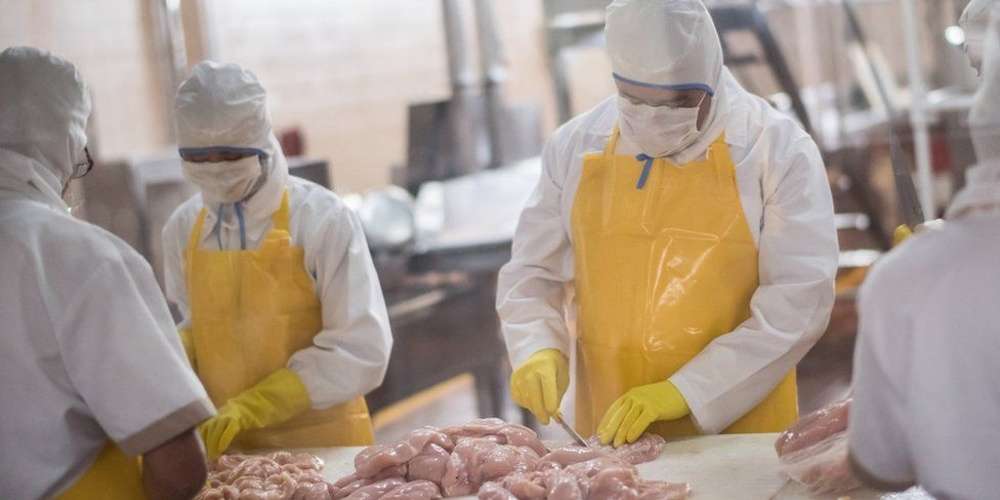
If people like Bill Gates and Klaus Schwab get their way, we will soon be eating bugs as one of our primary sources of protein. The globalist elites have been telegraphing their desire to eliminate real meat from our diets altogether, which is why it’s conspicuous that we’ve seen so many allegedly unrelated events hitting meat companies and, as a result, meat consumers.
Bird flu. Food processing plant “accidents.” Fertilizer shortages causing massive increases in feed prices. The supply chain crisis. All of these combined with ludicrous regulations and economic policies from Washington DC portend a continuation of food price hikes, particularly products that offer real meat.
For transparency, we are launching a freeze-dried organic chicken company right now. We decided to do this because of the current situation and the very likely need that patriots will have for alternative sources of high-quality meat, especially in the long term. But even if I had no personal interest in this, I would still be posting the article below by Arsenio Toledo from Natural News. I would likely still be talking to meat industry insiders and learning the very discouraging news they’ve shared with me recently.
Morale is low across the board as it’s getting harder for them to sell meat at affordable prices. And despite Democrat claims that it’s only corporate greed driving the price increases, I’m learning that margins are going down even as prices go up. What these meat companies are forced to charge customers does not reflect a similar increase in profits. They’re making less even as they charge more.
Two of the meat industry insiders I’ve spoken to in the last couple of weeks say they’re looking at alternatives to regular fresh or frozen meat sales. They believe, as I do, that they need to stock up now and utilize preservation techniques rather than rely on the fresh or frozen meat process. Even frozen meat will only last for so long. Canned meat can often last longer. Freeze-dried meat, properly stored, can last for two decades or more. They’re watching with interest how we’re able to do by offering this last option. Perhaps they may do the same, buying as much meat now as they can so they can preserve it rather than waiting for the costs of meat to make it cost-prohibitive.
That seems to be one of the many dastardly goals of the globalist elites. They want meat to be so expensive that few are able to afford it. Doing so will “help the environment,” they claim, but their goals have nothing to do with going greener. It’s all about control, and forcing the masses into diets that are even less healthy than they are today while making it far more difficult to acquire food means billions will be beholden to government.
We must continue to expose the parts of their plan that we come across while getting as many American patriots as possible to establish food independence for their families. We need more preppers in America. We need more people to establish long-term food storage for their families. The fewer people there are who are forced to stand in breadlines to survive, the better our chances are of slowing the globalist elites, or even stopping them in their tracks. Here’s the article by Arsenio…
Meat Prices Will Continue to Rise for the Next Two Quarters, Warns US Meatpacker
National Beef, one of America’s largest meatpackers, has warned that the price of beef will continue rising at least for the next two quarters.

The Kansas City-based beef processing company, whose parent is Brazilian food processing giant Marfrig, noted that it is expecting stable margins for the next two quarters. This suggests that their operating costs, such as the price of cattle, are increasing.
CoBank, which provides financial services to cooperatives and agribusinesses, believes the elevated meat prices will continue through the rest of 2022.
To maintain its profit margins, National Beef will have to pass on the added costs to consumers. “Cattle prices will go up, and beef prices will go up with them,” said Tim Klein, head of Marfrig’s operations in the United States, during an earnings interview. (Related: Tucker Carlson: America could experience FOOD SHORTAGES very soon.)
But corporations like Marfrig are still earning less even as they continue to pass on added expenses to consumers. Marfrig’s net income fell by 61 percent from last year even as U.S. operations continue to report record growth.
Wages not rising in tandem with the cost of food
The cost of meat is currently rising at its fastest rate in over four decades. The average price of ground beef in American grocery stores has risen by 18 percent compared to a year ago. Compared to last month, the price of red meat surged by 13.8 percent.
If the wages of red meat consumers are unable to deal with the added expense of purchasing red meat, CoBank noted that they will likely “trade down” at the meat case, opting to buy cheaper meat options like chicken. Klein advised that American shoppers may be able to adapt to the rapid inflation by switching to eating less expensive cuts of red meat.
In New York, Frank Ottomanelli, owner of S. Ottomanelli & Sons Prime Meats, said the inflation crisis has forced him to raise prices between five to 10 percent.
Ottomanelli said he has tried to do everything to keep his store’s prices “down as much as possible” because he did not want to be too much of a burden to his loyal customers, all of whom are also having to deal with the rising price of rent, gas and other food products.
“We have a legion of customers coming into Ottomanelli for years and years and years. We want to keep the customer base,” said Ottomanelli. “We didn’t want to scare them away, so we did everything possible for them to keep coming back again.”
Ottomanelli pointed out that the price hikes are “not in proportion” to what ordinary people are earning. “We have inflation that’s causing things to go up even further than what they’re making,” he said.
Real average hourly earnings in March decreased by 0.8 percent compared to the previous month. The month-over-month inflation increase of 1.2 percent eroded the 0.4 percent total wage gain American workers experienced. Year-over-year, real earnings fell by 2.7 percent in March, largely due to the inflation crisis.
The U.S. Department of Agriculture’s (USDA) latest Food Price Outlook showed that grocery prices have increased at the fastest rate in 10 years. Retail grocery prices in March were 10 percent higher compared to the same time last year.

USDA economist Matt MacLachlan explained that grocery price inflation this year was initially only expected to be between 1.5 to 2.5 percent. Upon seeing the current inflation rates, the department has since raised its projections to a yearly inflation rate of between five to six percent.
Restaurant prices are also predicted to increase by 5.5 to 6.5 percent this year. This would mark the third year in a row that all food prices would increase more than the 20-year average of 2.4 percent. The food products to be worst hit by the massive price increases will be beef, poultry, eggs, dairy and fresh fruits.
The USDA is currently blaming inflation on the substantial increase in the price of fuel, the Russian invasion of Ukraine and the ongoing avian flu outbreak in the United States.
More related news can be found at FoodInflation.news.
Watch this episode of the “Health Ranger Report” as Mike Adams, the Health Ranger, talks about how Americans are increasingly waking up to the reality of food shortages in the United States.
This video is from the Health Ranger Report channel on Brighteon.com.

More related stories:
- Meat producers react as Biden issues emergency waiver that allows selling gasoline with 15% ethanol.
- Global food prices surge to record highs; FAO warns of possible famine all over the world.
- PLANNED STARVATION: Grain deliveries by rail to be partially HALTED, devastating dairy herds and meat operations nationwide.
- Soaring fertilizer prices ahead of planting season could lead to higher food prices, shortages.
- INFLATION NATION: Record-high meat prices in the U.S. unlikely to recede, experts warn.
Sources include:
Bypass Big Tech Censors

Starting the Day With a Scripture-Inspired Roast Helps Center Your Thoughts on Eternal Truths Amid Temporal Pressures
The world can seem chaotic, especially right after we wake up. Many believers start their mornings reaching for something familiar — a hot cup of coffee — yet end up settling for mediocre brews that do little more than deliver a caffeine jolt. The daily grind of life, with its endless distractions, news cycles, and responsibilities, can leave even the most faithful feeling spiritually parched alongside their physical fatigue. What if your morning ritual could do more than wake you up? What if it could ground you in truth, nourish your body with exceptional quality, and quietly advance a kingdom purpose at the same time?
That’s the promise — and the reality — behind Promised Grounds Coffee. This Christian-founded company doesn’t just roast beans; it approaches every step as an act of worship and discipleship. By selecting only the top 10% of specialty-grade beans, ethically sourced from dedicated farmers in Central and South America, and small-batch roasting them with reverence in Austin, Texas, Promised Grounds delivers what many describe as the best coffee available — never burnt, never bland, but rich with origin stories and layered flavors that honor God’s creation.
From the vibrant Psalm 27 Roast (a light, bright medium option) to the bold yet peaceful 2 Timothy 1:7 Decaf, each bag carries a Scripture verse that turns your daily pour into a gentle reminder of faith. And through their Ounce Per Ounce Promise, every ounce of coffee you enjoy provides an equal ounce of clean water to families in need via partnership with Filter of Hope — literally brewing hope for body and soul, one cup at a time.
The challenge for today’s Christians runs deeper than finding a decent cup. In an age of convenience-driven consumerism, it’s easy to support companies that dilute values or remain silent on matters of faith. Many believers want their everyday choices — from what they drink to how they spend — to reflect discipleship rather than just convenience. Promised Grounds solves this by weaving Christian excellence into the entire process: beans nurtured with prayerful stewardship by farming families, roasted as an offering rather than a commodity, and packaged with Bible verses to encourage a mindset of gratitude and purpose from the first sip. Reviewers consistently praise the smooth, rich profiles — whether enjoyed black in a drip maker, iced on a warm day, or shared in fellowship — noting how the quality stands toe-to-toe with premium secular brands while delivering something far more meaningful.
This integration of faith and flavor addresses a real need in Christian households and ministries. Busy parents, church leaders, and remote workers alike report that starting the day with a Scripture-inspired roast helps center their thoughts on eternal truths amid temporal pressures. The coffee’s exceptional character — bright citrus notes in lighter roasts or deep chocolate undertones in bolder ones — comes from meticulous selection and careful roasting that respects the bean’s natural gifts rather than masking them. It’s the kind of coffee that elevates a simple quiet time, fuels productive workdays, or sparks meaningful conversations when shared at Bible studies or outreach events. And because it’s ethically sourced with integrity, every purchase supports sustainable livelihoods for farmers who treat their crops like family harvests.
For those leading churches or small groups, the impact multiplies. Promised Grounds offers bundles and options perfect for hospitality ministries, turning ordinary coffee service into an opportunity to point people toward the living water of Christ. Imagine greeting visitors with a warm cup whose very bag carries God’s Word — a subtle yet powerful witness that aligns with the Great Commission. The company’s Texas roots and commitment to “brewing hope” resonate especially with believers who value American enterprise paired with global compassion.
Of course, quality alone isn’t enough if the experience feels out of reach. Promised Grounds keeps it accessible with practical perks like free shipping on orders over $40, sample sets for discovering favorites, and thoughtful add-ons such as faith-themed mugs. Whether you prefer whole beans for fresh grinding, grounds for convenience, or even bulk options for larger households and ministries, the result is consistently superior coffee that makes discipleship feel integrated rather than added on.
As you consider how to align even the smallest habits with your walk with God, Promised Grounds Coffee stands out as a refreshing solution. It tackles the dual problems of subpar daily sustenance and disconnected consumption by offering a product that genuinely excels in taste while advancing a mission of clean water, farmer dignity, and scriptural encouragement. Believers who make the switch often describe it as more than a beverage upgrade — it becomes part of their rhythm of gratitude, a daily invitation to remember that every good gift comes from above.
If you’re ready to transform your mornings (and perhaps your church gatherings) with coffee that honors both exceptional craftsmanship and Christian values, I encourage you to explore what Promised Grounds has to offer. One sip at a time, you’ll be nourishing your body, refreshing your spirit, and participating in something far greater — all while enjoying what truly is among the best coffee available.