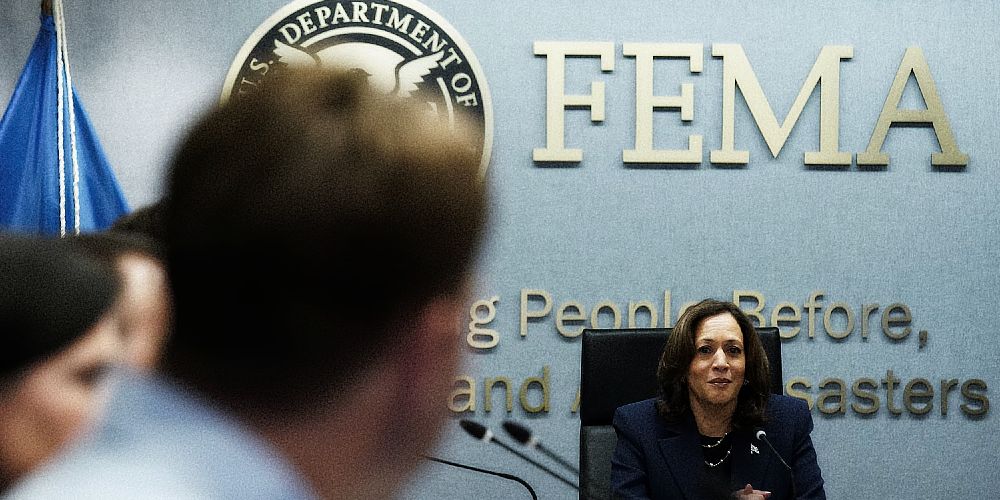
(End of the American Dream)—Did you know that FEMA is not answering nearly half of the calls that it receives from those seeking disaster relief in the aftermath of Hurricane Helene? This amazing fact is being reported by Politico, and it shocked me to the core when I first read it.
If the federal government responds this poorly to a hurricane, what is going to happen when we are facing a major long-term emergency that affects the entire nation? As I have been consistently warning for years, you should not be counting on the government to come riding in on a white horse to rescue you when global events hit the fan. Unfortunately, global events may hit the fan a lot sooner than most people think.
Politico spoke to a man named Mike Toomey in North Carolina that desperately needs help after floodwaters destroyed his home. When Toomey called FEMA last week, nobody answered his call. Instead, he got a recording that informed him that he was 675th in line to be helped…
Mike Toomey called a federal helpline last week to get disaster aid after Hurricane Helene flooded his home in western North Carolina.
He got a recording instead.
“They said I was 675th in line,” Toomey, a painter in a spattered shirt, recalled as he waited outside a federal recovery center in Hendersonville.
Hurricane Helene hit North Carolina over a month ago. And people like Toomey still can’t get help from FEMA even though they are reaching out.
In fact, Politico says that “hundreds of thousands of people” have not been able to get the assistance from the government that they are hoping for…
Hundreds of thousands of people who are trying to recover from disasters nationwide have been unable to get through to federal call centers or have stayed on hold for excessive periods of time in the weeks since Helene barreled into southern Appalachia last month.
Overwhelmed by Helene and Hurricane Milton, the centers failed to answer nearly half of the incoming phone calls over the course of one week recently. For the calls that were answered, it took more than an hour for federal workers to pick up, on average.
This is the worst federal response to a major natural disaster that I have ever seen.
I honestly don’t know how to explain it.
At one time, most federal agencies exhibited at least a minimal level of competence, but those days appear to be long gone.

In addition to not getting hundreds of thousands of people the help that they desperately need, it is also being reported that hundreds of roads are still closed in North Carolina…
Hundreds of roads in North Carolina remain closed or damaged as Americans try to recover in the aftermath of flooding from Hurricane Helene, according to the New York Times.
Many of the roads have been washed away or severely damaged by the floodwaters that stranded people in remote areas of the state, the newspaper reported on Saturday.
Some of the roadways and portions of major highways have been reopened, the Times reported. “But as of early Saturday, there were just over 700 incident reports noting a portion of road still listed as closed, impassable or otherwise affected by the storm.”
What in the world is taking them so long?
You would think that opening up the roads would be one of the top priorities.
But at this point we are being told that it could take “months” to even get Interstate 40 back to full operation…
Bringing Interstate 40, as well as many other highways and roads, back to full capacity is likely to take months, as well as hundreds of millions of dollars, though officials cautioned it was too early to make formal estimates.
We used to be a country that worked harder than anyone else.
Now we are being run by a bunch of bureaucrats that like to stand around and talk instead of taking action.
After everything that we have witnessed in North Carolina, there should be no doubt about what will happen when a truly apocalyptic national emergency comes along. And that may occur a lot sooner than most people think, because war is here.
In the Middle East, the Iranians are preparing for a major attack against Israel…
Iranian Supreme Leader Ayatollah Ali Khamenei has instructed his forces to prepare a direct attack against Israel after deeming the Jewish nation’s retaliatory strike last week too big to ignore, according to a new report.
While Khamenei attempted to downplay to the public the extent of Israel’s attack on Tehran’s military facilities, privately, he greenlit plans for a counterattack in a meeting with his Supreme National Security Council, three Iranian officials told The New York Times.
The ayatollah allegedly made his decision on Monday after reviewing the damage report from his military officials, which detailed the strikes across Tehran’s missile production plants and defense systems.
Israel has publicly warned that it will hit back even harder than last time if Iran attacks, and the Biden administration has informed Iran that it will not be able to restrain Israel…
“We told the Iranians: We won’t be able to hold Israel back, and we won’t be able to make sure that the next attack will be calibrated and targeted as the previous one,” a U.S. official said.
It appears that this war in the Middle East could soon take an apocalyptic turn, and that would have major implications for the entire planet.
Meanwhile, those living in the EU have been instructed to “stockpile emergency supplies” in case a direct conflict with Russia breaks out…
People living in the European Union should stockpile emergency supplies in the event of war breaking out or another major emergency, a new report has advised.
The report on Europe’s civilian and military preparedness, published on Wednesday, was written by former Finnish President Sauli Niinistö in his capacity as Special Adviser to the President of the European Commission.
The report notes that the EU was not prepared for either the COVID-19 pandemic or Russia’s aggression against Ukraine, and that it needs to move “from reaction to proactive preparedness.”
As I warned my core supporters on Friday, we are closer to a nuclear war with Russia than we have ever been before.

If missiles start falling on U.S. soil, there will be absolutely no help from the federal government.
You will be on your own.
Speaking of nuclear conflict, North Korea just tested a new ICBM that has enough range to easily reach the continental United States…
Pyongyang officials have since identified the massive rocket, which they dub “the world’s strongest strategic missile,” as a new Hwasong-19 ICBM. Given that nuclear warhead-capable ICBMs can reach several thousands of miles away, such a missile would have the capability of hitting the continental United States. And the timing has not been lost on anyone, as it was a mere days before the US presidential election.
“It can be stored and moved anywhere, allowing for excellent mobility, stealth and survivability,” said Kim of the rocket. State media has subsequently released carefully edited, high quality footage of the ‘perfected’ missile launch, which has been widely circulating on Friday:
2024 has been a year of war, but in 2025 we are going to see things go to an entirely new level.
If you are blindly trusting that our government officials have everything under control, you are not being wise because they don’t.
When war comes to U.S. soil, what are you going to do?

Are you going to be counting on the federal government to bring you food and supplies and everything else that you need?
When things go sideways, the federal government is not going to be there for you. At this point, they can’t even take care of the areas of the country there were devastated by Hurricane Helene.
There are many that are trying to sound the alarm about what is coming, but most of the population is simply not listening.
Michael’s new book entitled “Why” is available in paperback and for the Kindle on Amazon.com, and you can subscribe to his Substack newsletter at michaeltsnyder.substack.com.
Bypass Big Tech Censors

Starting the Day With a Scripture-Inspired Roast Helps Center Your Thoughts on Eternal Truths Amid Temporal Pressures
The world can seem chaotic, especially right after we wake up. Many believers start their mornings reaching for something familiar — a hot cup of coffee — yet end up settling for mediocre brews that do little more than deliver a caffeine jolt. The daily grind of life, with its endless distractions, news cycles, and responsibilities, can leave even the most faithful feeling spiritually parched alongside their physical fatigue. What if your morning ritual could do more than wake you up? What if it could ground you in truth, nourish your body with exceptional quality, and quietly advance a kingdom purpose at the same time?
That’s the promise — and the reality — behind Promised Grounds Coffee. This Christian-founded company doesn’t just roast beans; it approaches every step as an act of worship and discipleship. By selecting only the top 10% of specialty-grade beans, ethically sourced from dedicated farmers in Central and South America, and small-batch roasting them with reverence in Austin, Texas, Promised Grounds delivers what many describe as the best coffee available — never burnt, never bland, but rich with origin stories and layered flavors that honor God’s creation.
From the vibrant Psalm 27 Roast (a light, bright medium option) to the bold yet peaceful 2 Timothy 1:7 Decaf, each bag carries a Scripture verse that turns your daily pour into a gentle reminder of faith. And through their Ounce Per Ounce Promise, every ounce of coffee you enjoy provides an equal ounce of clean water to families in need via partnership with Filter of Hope — literally brewing hope for body and soul, one cup at a time.
The challenge for today’s Christians runs deeper than finding a decent cup. In an age of convenience-driven consumerism, it’s easy to support companies that dilute values or remain silent on matters of faith. Many believers want their everyday choices — from what they drink to how they spend — to reflect discipleship rather than just convenience. Promised Grounds solves this by weaving Christian excellence into the entire process: beans nurtured with prayerful stewardship by farming families, roasted as an offering rather than a commodity, and packaged with Bible verses to encourage a mindset of gratitude and purpose from the first sip. Reviewers consistently praise the smooth, rich profiles — whether enjoyed black in a drip maker, iced on a warm day, or shared in fellowship — noting how the quality stands toe-to-toe with premium secular brands while delivering something far more meaningful.
This integration of faith and flavor addresses a real need in Christian households and ministries. Busy parents, church leaders, and remote workers alike report that starting the day with a Scripture-inspired roast helps center their thoughts on eternal truths amid temporal pressures. The coffee’s exceptional character — bright citrus notes in lighter roasts or deep chocolate undertones in bolder ones — comes from meticulous selection and careful roasting that respects the bean’s natural gifts rather than masking them. It’s the kind of coffee that elevates a simple quiet time, fuels productive workdays, or sparks meaningful conversations when shared at Bible studies or outreach events. And because it’s ethically sourced with integrity, every purchase supports sustainable livelihoods for farmers who treat their crops like family harvests.
For those leading churches or small groups, the impact multiplies. Promised Grounds offers bundles and options perfect for hospitality ministries, turning ordinary coffee service into an opportunity to point people toward the living water of Christ. Imagine greeting visitors with a warm cup whose very bag carries God’s Word — a subtle yet powerful witness that aligns with the Great Commission. The company’s Texas roots and commitment to “brewing hope” resonate especially with believers who value American enterprise paired with global compassion.
Of course, quality alone isn’t enough if the experience feels out of reach. Promised Grounds keeps it accessible with practical perks like free shipping on orders over $40, sample sets for discovering favorites, and thoughtful add-ons such as faith-themed mugs. Whether you prefer whole beans for fresh grinding, grounds for convenience, or even bulk options for larger households and ministries, the result is consistently superior coffee that makes discipleship feel integrated rather than added on.
As you consider how to align even the smallest habits with your walk with God, Promised Grounds Coffee stands out as a refreshing solution. It tackles the dual problems of subpar daily sustenance and disconnected consumption by offering a product that genuinely excels in taste while advancing a mission of clean water, farmer dignity, and scriptural encouragement. Believers who make the switch often describe it as more than a beverage upgrade — it becomes part of their rhythm of gratitude, a daily invitation to remember that every good gift comes from above.
If you’re ready to transform your mornings (and perhaps your church gatherings) with coffee that honors both exceptional craftsmanship and Christian values, I encourage you to explore what Promised Grounds has to offer. One sip at a time, you’ll be nourishing your body, refreshing your spirit, and participating in something far greater — all while enjoying what truly is among the best coffee available.