The government doesn’t just directly charge Americans in taxes—it also imposes a hidden tax that makes everything more expensive, according to a new report.
The federal government doesn’t just pass laws in Congress. Each year, many of the 438 federal agencies—nominally under the president’s control through the executive branch—publish tens of thousands of pages in regulations, red tape that increases the costs of business, transportation, and many other factors Americans often don’t consider.
This imposes a kind of hidden tax that makes everything more expensive. It also justifies the work of the Department of Government Efficiency and other efforts to streamline the federal government, according to Clyde Wayne Crews, a fellow at the Competitive Enterprise Institute and author of the annual report, “Ten Thousand Commandments.” Crews released the 2025 version of the report on Thursday.
The report “directly and indirectly makes the case that DOGE or a successor entity—but especially Congress itself through legislation—should be more aggressive on deregulation,” Crews told The Daily Signal on Thursday.
According to the report, federal regulation costs Americans at least $2.155 trillion every year—a cost of $16,016 annually per household. This sum constitutes 16% of the average household’s pre-tax income, and 21% of household expenses. Most American families spend less than that on health care, food, transportation, entertainment, apparel, services, and savings. Only the cost of housing, an average annual household expenditure of $25,436, exceeds the costs of regulation.
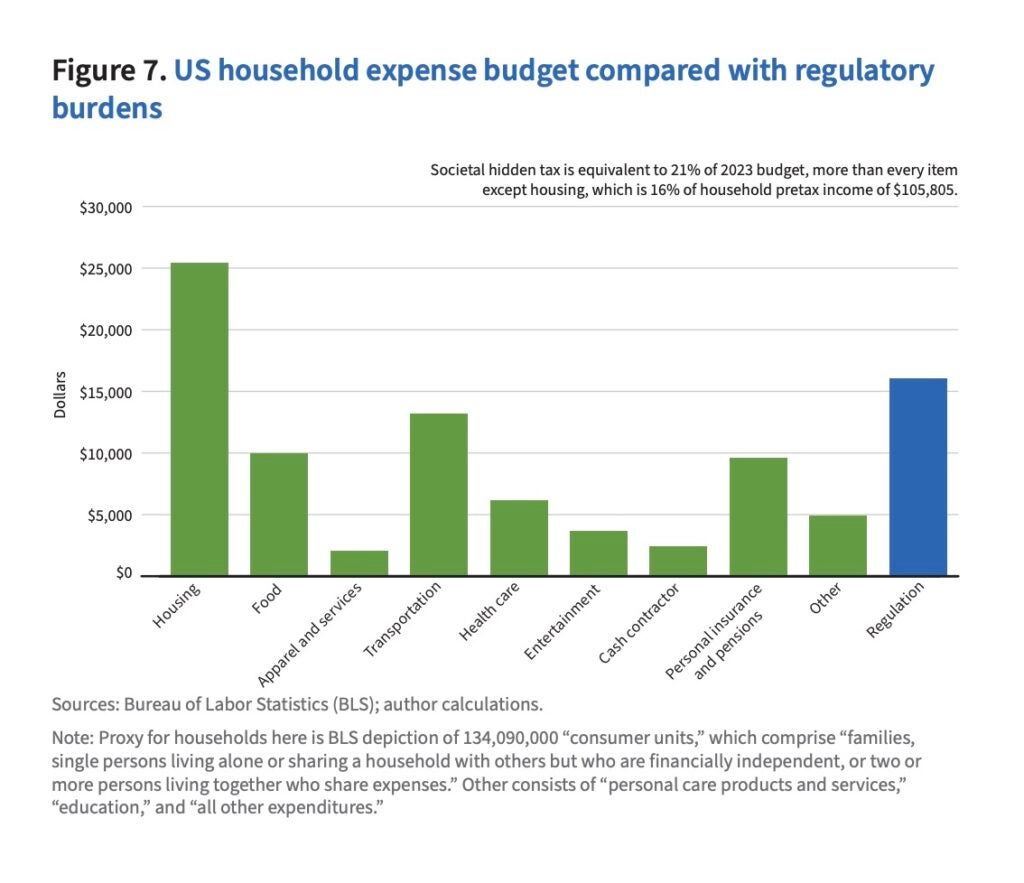
“Ordinary income and FICA taxes are itemized on pay stubs and calculated on tax returns,” the report notes. “Most regulatory costs are embedded in prices of goods and services, and never show up on a receipt or an annual statement.”
While the exact cost of these regulations that gets passed down to the consumer is impossible to gauge, the report provides a rough estimate that highlights the overall phenomenon.
The regulatory tax of $2.155 trillion comes close to the federal income tax, which collected $2.176 trillion in 2023, and stands at about four times the corporate income tax of $419 billion in 2023.

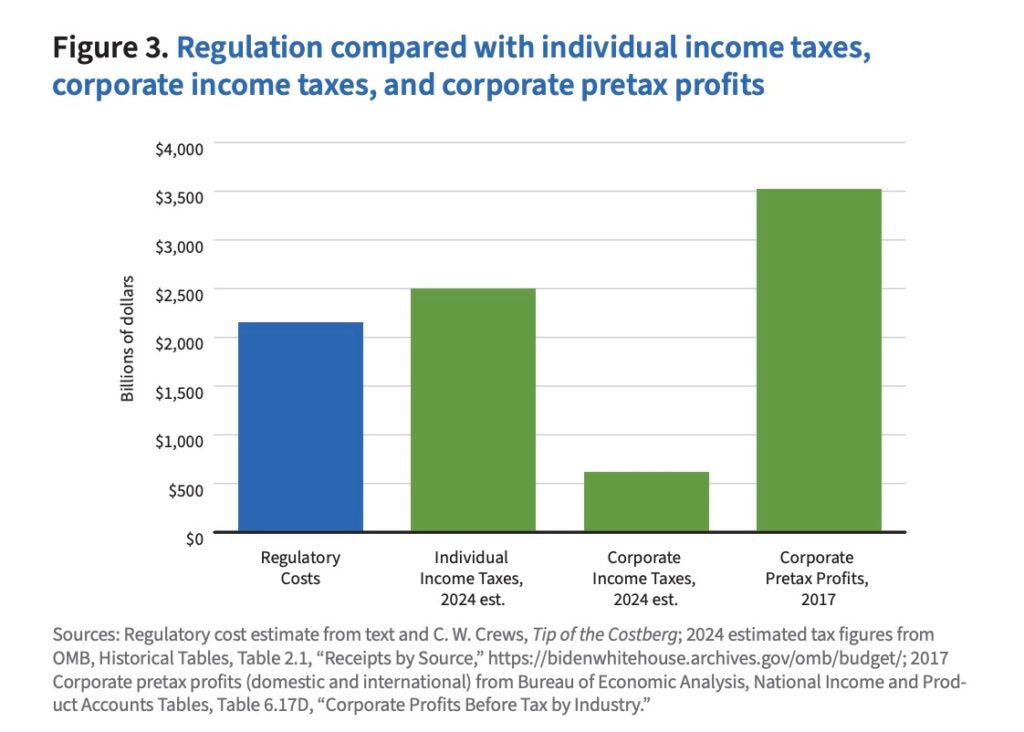
The report notes that the $2.155 trillion figure is likely an underestimate. The National Association of Manufacturers ran a similar analysis in October 2023, concluding that regulatory compliance costs the economy $3.079 trillion each year.
Crews emphasized to The Daily Signal the “fusion of federal spending and federal regulation over recent years.”
“Since COVID-19, we’ve had the CARES Act, the CHIPS and Science Act, the Inflation Reduction Act, the infrastructure law, and more, and these are all hyper-regulatory before bureaucrats even start writing rules,” Crews added.
While the Constitution places the authority to make laws in the hands of Congress, federal agencies issue far more regulations than Congress passes laws. During 2024, for example, agencies issued 3,248 final rules, compared with Congress passing 175 bills. That means for every one law passed by Congress and signed by the president, unelected bureaucrats finalized 19 regulations.
My book, “The Woketopus: The Dark Money Cabal Manipulating the Federal Government,” exposes the leftist groups that staffed and advised the Biden administration, using this bureaucracy to force their ideology on the American people.
The Federal Register, the list of all rules promulgated by the administrative state, closed at 106,109 pages in President Joe Biden’s last full year, the highest tally on record and a 19% increase over 2023. Former President Barack Obama’s final calendar year saw 95,894 pages (the highest page count for federal regulations in U.S. history), while the administrative state only managed to publish 61,067 pages in 2017, the first calendar year of the Trump administration.
The gargantuan impact of the administrative state highlights the necessity of DOGE, according to the author’s report. Yet Crews also noted that DOGE has a sunset date—July 4, 2026.
“Note that DOGE goes away in a year, so there needs to be an infrastructure built that maintains the regulatory streamlining along with the slashing of spending,” he told The Daily Signal. “To me, real regulatory reform has to start with termination of departments and agencies.”
President Donald Trump has been terminating some agencies and departments—by directing that the U.S. Agency for International Development merge back into the State Department and by directing the ultimate closure of the Department of Education.
These changes save Americans money directly—with USAID grants terminated—but as the Trump administration decreases the size and scope of the federal government, that may also save American households money in decreased regulatory burdens.
Bypass Big Tech Censors

Starting the Day With a Scripture-Inspired Roast Helps Center Your Thoughts on Eternal Truths Amid Temporal Pressures
The world can seem chaotic, especially right after we wake up. Many believers start their mornings reaching for something familiar — a hot cup of coffee — yet end up settling for mediocre brews that do little more than deliver a caffeine jolt. The daily grind of life, with its endless distractions, news cycles, and responsibilities, can leave even the most faithful feeling spiritually parched alongside their physical fatigue. What if your morning ritual could do more than wake you up? What if it could ground you in truth, nourish your body with exceptional quality, and quietly advance a kingdom purpose at the same time?
That’s the promise — and the reality — behind Promised Grounds Coffee. This Christian-founded company doesn’t just roast beans; it approaches every step as an act of worship and discipleship. By selecting only the top 10% of specialty-grade beans, ethically sourced from dedicated farmers in Central and South America, and small-batch roasting them with reverence in Austin, Texas, Promised Grounds delivers what many describe as the best coffee available — never burnt, never bland, but rich with origin stories and layered flavors that honor God’s creation.
From the vibrant Psalm 27 Roast (a light, bright medium option) to the bold yet peaceful 2 Timothy 1:7 Decaf, each bag carries a Scripture verse that turns your daily pour into a gentle reminder of faith. And through their Ounce Per Ounce Promise, every ounce of coffee you enjoy provides an equal ounce of clean water to families in need via partnership with Filter of Hope — literally brewing hope for body and soul, one cup at a time.
The challenge for today’s Christians runs deeper than finding a decent cup. In an age of convenience-driven consumerism, it’s easy to support companies that dilute values or remain silent on matters of faith. Many believers want their everyday choices — from what they drink to how they spend — to reflect discipleship rather than just convenience. Promised Grounds solves this by weaving Christian excellence into the entire process: beans nurtured with prayerful stewardship by farming families, roasted as an offering rather than a commodity, and packaged with Bible verses to encourage a mindset of gratitude and purpose from the first sip. Reviewers consistently praise the smooth, rich profiles — whether enjoyed black in a drip maker, iced on a warm day, or shared in fellowship — noting how the quality stands toe-to-toe with premium secular brands while delivering something far more meaningful.
This integration of faith and flavor addresses a real need in Christian households and ministries. Busy parents, church leaders, and remote workers alike report that starting the day with a Scripture-inspired roast helps center their thoughts on eternal truths amid temporal pressures. The coffee’s exceptional character — bright citrus notes in lighter roasts or deep chocolate undertones in bolder ones — comes from meticulous selection and careful roasting that respects the bean’s natural gifts rather than masking them. It’s the kind of coffee that elevates a simple quiet time, fuels productive workdays, or sparks meaningful conversations when shared at Bible studies or outreach events. And because it’s ethically sourced with integrity, every purchase supports sustainable livelihoods for farmers who treat their crops like family harvests.
For those leading churches or small groups, the impact multiplies. Promised Grounds offers bundles and options perfect for hospitality ministries, turning ordinary coffee service into an opportunity to point people toward the living water of Christ. Imagine greeting visitors with a warm cup whose very bag carries God’s Word — a subtle yet powerful witness that aligns with the Great Commission. The company’s Texas roots and commitment to “brewing hope” resonate especially with believers who value American enterprise paired with global compassion.
Of course, quality alone isn’t enough if the experience feels out of reach. Promised Grounds keeps it accessible with practical perks like free shipping on orders over $40, sample sets for discovering favorites, and thoughtful add-ons such as faith-themed mugs. Whether you prefer whole beans for fresh grinding, grounds for convenience, or even bulk options for larger households and ministries, the result is consistently superior coffee that makes discipleship feel integrated rather than added on.
As you consider how to align even the smallest habits with your walk with God, Promised Grounds Coffee stands out as a refreshing solution. It tackles the dual problems of subpar daily sustenance and disconnected consumption by offering a product that genuinely excels in taste while advancing a mission of clean water, farmer dignity, and scriptural encouragement. Believers who make the switch often describe it as more than a beverage upgrade — it becomes part of their rhythm of gratitude, a daily invitation to remember that every good gift comes from above.
If you’re ready to transform your mornings (and perhaps your church gatherings) with coffee that honors both exceptional craftsmanship and Christian values, I encourage you to explore what Promised Grounds has to offer. One sip at a time, you’ll be nourishing your body, refreshing your spirit, and participating in something far greater — all while enjoying what truly is among the best coffee available.