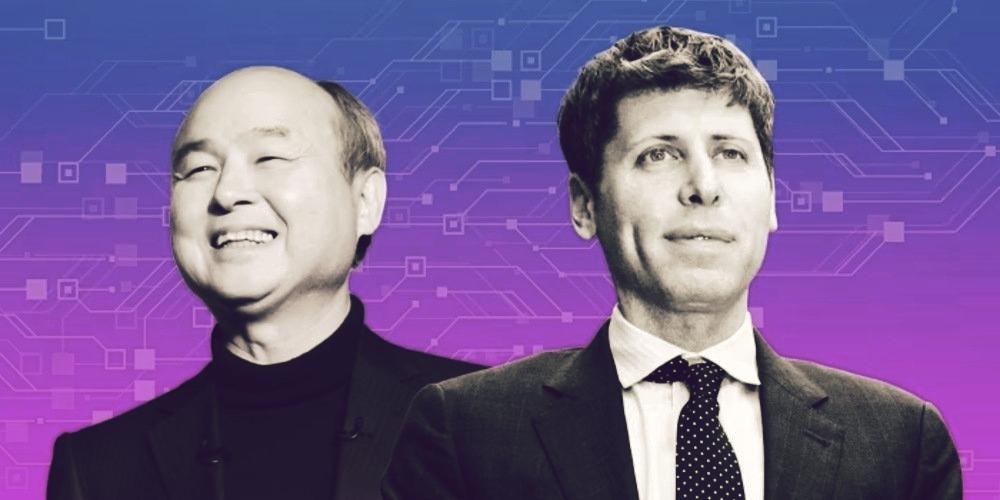
(ZeroHedge)—Back in January, when the AI trade got its latest kick higher thanks to an announcement by the newly-created “Stargate” project between OpenAI and Japan’s cartoonish momo-chasing titan Masa Son and his conglomerate SoftBank, that the initiative would spend $500 billion over 4 years to build new AI infrastructure for OpenAI in the US and would deploy $100 billion “immediately”, we said that this was one giant pipe dream as the initiative was “spending $100BN in money which does not exist to generate IRR which are not positive.” In other words, just another SoftBank special: pretending to throw crazy amounts of money which Masa Son simply does not have.
Elon Musk, whose feud with OpenAI Sam Altman is one of the defining billionaire rivalries of our time, was even more forthright, and echoed our sentiment when he said that “they don’t actually have the money.”
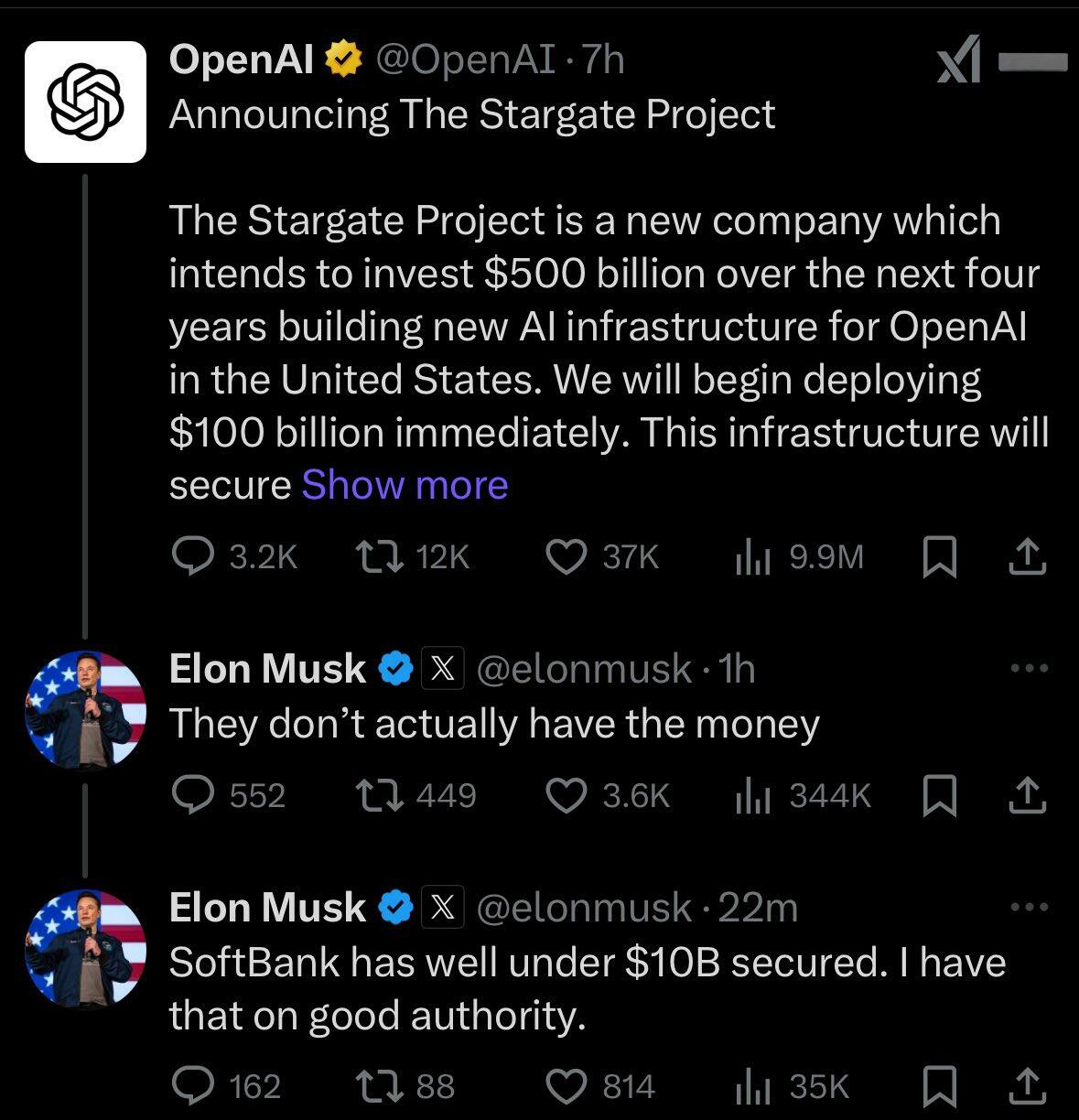
Not surprisingly we, and Elon, were right.
As the WSJ reported overnight, the $500 billion “effort” unveiled at the White House to supercharge the U.S.’s artificial-intelligence ambitions has struggled to get off the ground and has sharply scaled back its near-term plans.
Six months after Japanese billionaire Masayoshi Son stood shoulder to shoulder with Sam Altman and President Trump to announce the Stargate project, the newly formed company charged with making it happen has yet to complete a single deal for a data center.
But it’s not just the lack of any actual capital that’s a problem: it turns out that putting two narcissistic egomaniacs in the same room is not conducive to smoothly flowing consensus; instead the two have been “at odds over crucial terms of the partnership, including where to build the sites, according to people familiar with the matter.”
While the companies pledged at the January announcement to invest $100 billion “immediately,” the project is now setting the more modest goal of building a small data center by the end of this year, likely in Ohio, the people said.
Stargate’s lethargic launch is a setback to the vast ambitions of Son, who despite spending billions of dollars over the years, has been playing catch-up in the fast-evolving AI sector.
Earlier this year, SoftBank committed $30 billion to OpenAI… money, which it does not have. Which is hardly a surprise to anyone familiar with the company best known for its catastrophic investment in WeWork and countless other failures. Hoping to make everyone forget what a horrible investor it actually is, SoftBank upped the ante to ridiculous proportions making its AI bet by far the largest-ever startup investment — an enormous wager that has led SoftBank to take on new debt and sell assets. The investment was made alongside the plans for Stargate, giving SoftBank a role in the physical infrastructure needed for AI.

Meanwhile Altman, who actually does have some money, has been eager to secure the computing power to support the next generations of his company’s signature product, ChatGPT, has plowed ahead without SoftBank, signing deals for data centers with other operators.
Naturally, the leaders of both companies are lying that all is well in their joint effort. Last week they appeared on video at a SoftBank event, and Altman said they have an initial goal of building 10 gigawatts of data centers together. It is a “wonderful partnership,” he said… and the handful of people who watched couldn’t help but laugh.
In a joint statement, the two companies used even more laughable jargon, claiming they were advancing projects in multiple states and were “moving at hyperscale and speed to deliver the AI infrastructure that will power the future and serve humanity.”
Yet despite Stargate’s rocky start, it hasn’t slowed the data-center development spree that Trump has said is a national priority. AI enthusiasts say the world will require a gargantuan effort to build the warehouse-like structures filled with computer servers, and the electricity needed to supply them, on par with the construction of railroads in the 19th century.
Altman’s OpenAI recently struck a data-center deal with Oracle that calls for OpenAI to pay more than $30 billion a year to the software and cloud-computing company starting within three years. The deal, which may or may not go live in about 4-5 years, has already helped send ORCL stock to record highs, more than doubling where it was just back in April.
That deal, which doesn’t involve SoftBank, totals 4.5 gigawatts of capacity, and would consume the equivalent power of more than two Hoover Dams, enough to power about four million homes. The data centers are spread among locations around the U.S. Of course, just like Stargate, that deal too will end up being nothing but lots of hot air.

According to the WSJ, taken with a smaller deal OpenAI struck with CoreWeave, OpenAI has now completed data-center deals for nearly as much capacity as Stargate promised for this year in January. (OpenAI has said $100 billion roughly equates to 5 gigawatts of data centers.)
Meanwhile, amid the catastrophic rollout of Stargate, Son has told associates he is bullish on OpenAI and would like to invest even more in the company. Yes, invest even more money he doesn’t have.
Masa Son, who has long been viewed as something of an anti-Buffett one-hit wonder in the investing world (his only actual success was Alibaba), has long craved a prominent seat at the AI table. And yet, despite devoting the two largest startup funds ever raised – more than $140 billion – to finding the AI companies of the future, Son missed out on OpenAI and all of its competitors before the launch of ChatGPT, while being tarred by high-profile flops such as WeWork and construction startup Katerra.
In the fall of 2024, at long last he zeroed in on OpenAI. But Altman had ambitions on a scale without precedent: He has said trillions of dollars will be needed to fund the next stages of AI.
In November, Son and Altman met in Tokyo to hash out an agreement. They next brought their plans to Trump aides with the offer of announcing a giant U.S. investment. On the second day of Trump’s new administration, they stood smiling in the White House beside Trump, vowing to spend $500 billion by 2029.
“This is the beginning of our golden age,” Son said at the White House, hoping that the bulk of the funding needs would be borne by US taxpayers. He was wrong.
At the start, OpenAI and SoftBank each pledged $18 billion to the venture to get started, which they expected would develop data centers and then lease them to OpenAI. The two companies said they would jointly control the entity, with Son as its chairman. SoftBank would focus on the financial details and OpenAI on the operations, the companies added.
That’s when the chaos really started: they named Oracle and U.A.E. firm MGX as partners in the initial announcement, but their role was unclear. No agreement setting out their investment levels had been reached at the time.
“Stargate is not formed yet,” Oracle Chief Executive Safra Katz said on an investor call last month.
One recent complication between OpenAI and SoftBank has been over how extensively to build data centers on sites tied to SB Energy, a SoftBank-backed energy developer, according to people familiar with the matter.
Meanwhile, Altman has used the Stargate name, shared with a B-grade 1994 Kurt Russell film about aliens who teleport to ancient Egypt, on projects that aren’t being financed by the partnership between OpenAI and SoftBank. The trademark to Stargate is held by SoftBank, according to public filings. For instance, OpenAI refers to a data center in Abilene, Texas, and another it agreed in March to use in Denton, Texas, as part of Stargate even though they are being done without SoftBank.
Which begs the question: where will all the money come from?
To be sure, as the WSJ notes, “building data centers isn’t easy. Companies need to find sites, develop the physical structures—or pay another company to do that—buy expensive AI chips, source vast loads of electricity and find lenders to cover much of the cost, among other details. Stargate is hoping to use a new, lower-cost design for its first project in Ohio.”
Training new, better AI models requires evermore data processing and constant sources of new capital, which means companies including OpenAI are committing to larger and larger spending well before the business models of AI companies have proved profitable. Indeed, so far most analyses suggest that the IRR of AI remains solidly negative.
Which again brings up the matter of money: OpenAI’s $30-billion-a-year deal with Oracle is roughly three times as much as what Altman’s company has recently projected in annual revenue. The company, which is losing billions of dollars a year, is betting its revenue will multiply thanks to the growing ranks of paying customers and advertising, allowing it to pay for its hefty commitments.
One – rather unpleasant – answer putting this all in context, comes from Morgan Stanley, which this weekend published some shocking new math: there is simply no way to pay for all the funding needs out of equity or cash flow, and “Paying For AI Capex Will Require Over $1 Trillion In New Debt By 2028”
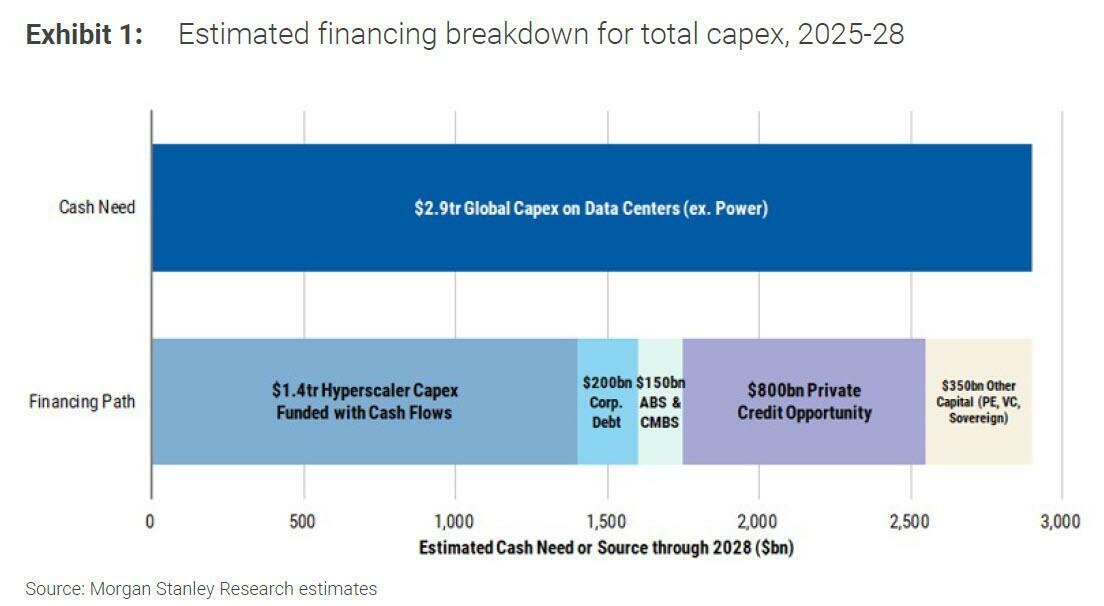
Good luck with that, and good luck with those 50x forward AI valuations once the Koolaid finally wears off.

Bypass Big Tech Censors
How to Prepare for Food Emergencies if You Don’t Have a Homestead or Bunker
In an unpredictable world, where supply chain disruptions, natural disasters, or economic instability can strike without warning, having a reliable food supply is more than just smart—it’s essential for survival. Whether you’re a “prepper” or not, we all know the golden rule: self-sufficiency is key. But what if you’re living in an apartment, working long hours, or simply don’t have the land to turn into a thriving homestead? Don’t worry; there’s a practical, effective way to build your food security without needing acres of soil or a fortified bunker.
The Ideal Prep: Building Your Own Food Empire
The ultimate dream for any serious prepper is controlling your own food production. Imagine waking up to a sprawling garden bursting with fresh vegetables, fruits, and herbs—tomatoes ripening on the vine, potatoes ready to harvest, and greens that provide nutrition year-round. Add in livestock like chickens for eggs and meat, and you’ve got a self-sustaining system that keeps your family fed no matter what chaos unfolds outside.
This approach isn’t just about calories; it’s about resilience. A well-maintained garden can yield hundreds of pounds of produce annually, while a small flock of chickens might produce dozens of eggs weekly. It’s empowering, cost-effective in the long run, and teaches invaluable skills like crop rotation, animal husbandry, and preservation techniques. If you have the space, time, and resources, starting small and scaling up is the best path to true independence.
The Reality Check: Not Everyone Can Homestead
But let’s face it—not all of us are in a position to go full homesteader. Urban dwellers might be limited to a balcony or community plot that’s far from sufficient for long-term needs. Busy professionals juggling jobs, families, and daily life often lack the hours required for daily tending. And for those in apartments, condos, or regions with harsh climates, raising livestock or maintaining a large garden simply isn’t feasible. Factors like zoning laws, soil quality, water access, or even physical limitations can make this ideal out of reach.
That’s where the frustration sets in. You want to be prepared, but without a homestead or bunker, how do you ensure your pantry doesn’t run dry during a prolonged crisis? The good news is, you don’t have to sacrifice your preparedness goals. There’s a smart, accessible alternative that bridges the gap: investing in high-quality, long-term storage food.
The Smart Alternative: Long-Term Storage Food from Heaven’s Harvest
Long-term storage food is designed for exactly these scenarios—providing nutrient-dense, shelf-stable meals that last for decades without refrigeration or special conditions. It’s the perfect solution for preppers who can’t rely on fresh production but still demand reliability and variety in their emergency stockpile.
At Heaven’s Harvest, they specialize in premium survival food kits that make preparedness effortless. Their products are crafted with the prepper mindset in mind: non-GMO, made in the USA, and packed with real ingredients that taste like home-cooked meals, not bland rations. Whether you’re stocking up for a short-term blackout or a long-haul SHTF event, our kits offer:
- Extended Shelf Life: Up to 25 years of storage, so you can buy once and forget about rotation worries.
- Nutritional Balance: High-protein entrees, fruits, vegetables, and dairy alternatives to keep your energy up and health intact.
- Ease of Preparation: Just add water, and you’ve got hearty meals like beef stroganoff, chili mac, or cheesy lasagna ready in minutes—no garden weeding required.
- Customizable Options: From individual buckets to family-sized kits, scale your supply to fit your needs and budget.
- Peace of Mind: Sealed in durable, waterproof containers that protect against pests, moisture, and light.
Unlike generic store-bought cans that spoil quickly or lack variety, Heaven’s Harvest focuses on quality and sustainability. Our food is freeze-dried or dehydrated to lock in flavor and nutrients, ensuring you’re not just surviving but thriving. And for those concerned about allergens or dietary preferences, we offer gluten-free and vegetarian options to keep everyone covered.
Why Wait? Secure Your Food Supply Today
Preparing for food emergencies doesn’t require a homestead or bunker—it requires action. By choosing long-term storage food from Heaven’s Harvest, you’re taking control in a way that fits your lifestyle. Start small with a 72-hour kit to test the waters, or go all-in with a year’s supply for ultimate security.
Visit Heaven’s Harvest today and use code “PATRIOT” for an exclusive discount on your order. Don’t let limitations hold you back; build your resilient future, one meal at a time. Your family will thank you when it matters most.