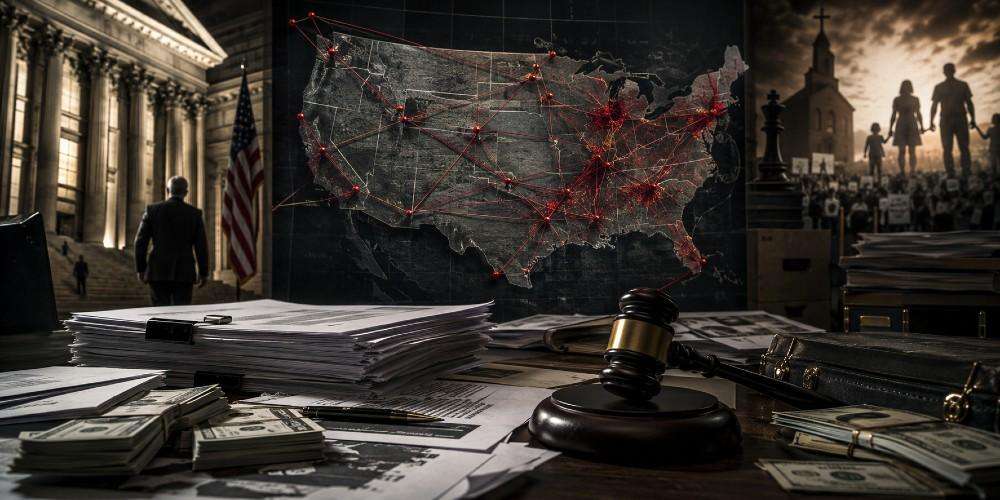
When federal authorities finally secured an indictment against the Southern Poverty Law Center, the charges centered on bank fraud, wire fraud, and money laundering. Yet anyone who has watched the SPLC’s decades-long campaign against conservative and Christian voices recognizes this as more than a financial case.
It echoes the prosecution of Al Capone, where tax evasion provided the legal hook to address a far broader criminal enterprise. The real story lies in how a once-respected civil rights outfit transformed into a reputational arsonist, labeling dissent as extremism to isolate, defund, and silence its ideological opponents.
This indictment arrives at a pivotal moment. For years, the SPLC operated with impunity, its “hate map” serving as a de facto blacklist that influenced corporations, media, law enforcement, and financial institutions. What began as opposition to genuine extremism metastasized into a lucrative machine for marginalizing mainstream conservative thought and biblical Christianity itself.
The federal case may focus on millions allegedly funneled to informants embedded in extremist circles, but the deeper scandal involves the systematic distortion of truth for power and profit.
The SPLC built its modern empire by exploiting America’s legitimate aversion to groups like the Ku Klux Klan. Once those threats receded, the organization pivoted to a broader definition of “hate” that conveniently encompassed pro-life advocates, traditional marriage supporters, and immigration skeptics. This shift was not accidental but a calculated business model. By inflating the threat of extremism, the SPLC justified endless fundraising appeals while positioning itself as the indispensable gatekeeper against supposed domestic threats.
Its Intelligence Project became the nerve center of this operation. What started as research evolved into influence peddling. Corporate boards, fearful of bad publicity, outsourced their moral discernment to an activist organization with a clear left-wing agenda. Payment processors, social media giants, and banks began treating SPLC designations as gospel, effectively creating a parallel system of private censorship that circumvented First Amendment protections.
Consider the timeline. After placing groups like the Family Research Council on its hate list in 2010, the SPLC’s rhetoric contributed to real-world violence. In 2012, a gunman entered FRC headquarters, shooting a staff member and admitting he chose the target based on the SPLC’s materials. Rather than reassess its approach, the organization doubled down. Similar patterns emerged with other targeted conservatives, raising sobering questions about the moral responsibility that accompanies such influential labeling.
The indictment highlights a particularly troubling aspect: payments to individuals within the very extremist movements the SPLC claimed to oppose. One informant allegedly helped coordinate aspects of the Charlottesville rally while on the SPLC payroll.

This raises the possibility that the organization had incentives to sustain the appearance of a vibrant far-right threat. Without visible enemies, the fundraising appeals lose their urgency. The result was a perverse ecosystem where extremism was both condemned and, in some cases, quietly sustained for narrative purposes.
Corporate America bears significant responsibility here. Following Charlottesville, companies rushed to align with the SPLC, making substantial donations and adopting its framework for “trust and safety” decisions. This was not neutral risk management but ideological compliance. Conservative organizations faced sudden account closures and payment denials while the SPLC’s own financial dealings apparently evaded scrutiny for years.
The human cost extends beyond organizations to individuals and families. Christian ministries focused on biblical sexuality, adoption, or religious liberty found themselves in the crosshairs. Parents concerned about curriculum in public schools discovered their advocacy groups smeared alongside actual radicals. This guilt-by-association tactic eroded public discourse and chilled legitimate participation in American civic life.
Critics from across the spectrum have long noted the SPLC’s internal contradictions, including past scandals involving its own workplace culture. Yet its external power remained largely unchecked until recent shifts in federal leadership. The current indictment, while narrow in its legal framing, opens the door to broader accountability for the collateral damage inflicted on American freedoms.
As Proverbs reminds us of the dangers of false witness, the SPLC’s story illustrates how institutions can stray far from their founding principles. The organization that once challenged real injustice now stands accused of manufacturing the very divisions it professed to heal. Its methods—leveraging fear, financial pressure, and institutional capture—represent a direct challenge to the pluralistic society Americans claim to value.
The indictment alone will not dismantle the SPLC’s network. With its substantial endowment and entrenched allies, the group retains significant capacity to adapt and continue its work. Real reform requires not just legal consequences but a cultural rejection of its flawed framework. Banks, tech firms, and schools must reassess their reliance on partisan scorekeepers. Policymakers should examine how government entities incorporated these designations into training and policy.
This case ultimately tests whether America still believes in the free exchange of ideas or prefers managed discourse where certain viewpoints carry professional and financial penalties. The SPLC’s approach never truly protected the vulnerable; it empowered one side of the culture war to define the boundaries of acceptable belief.
For those committed to constitutional principles and religious liberty, the path forward demands vigilance and a commitment to truth over narrative control.
In the end, confronting the SPLC’s legacy means reclaiming the right to disagree without being branded an enemy of the state or society. That principle, rooted in both American founding documents and biblical calls for justice, remains essential to a free republic.
Bypass Big Tech Censors
Two Storms, One Harvest

Every food crisis in living memory has been a one-shock event. The 2008 price spike was a commodity bubble. The 2020 shortages were a logistics failure. The 2022 grain scare was a war on one exporter’s ports. Each time, the system bent, adjusted, and recovered, and each time the experts assured us afterward that global markets are simply too big and too diversified to fail.
What nobody in Washington seems eager to discuss is that 2026 is shaping up to be something the modern food system has never actually faced. Two independent shocks, one climatic and one geopolitical, are converging on the same harvest cycle at the same time. Not sequentially. Simultaneously.
Start with the weather. The Pacific Ocean is currently building toward what forecasters now openly call a record event. NOAA’s Climate Prediction Center puts the odds of at least a strong El Niño near 88 percent, with roughly two in three odds it reaches “very strong” status, the tier reserved for perhaps three or four events in the entire satellite era. Every major global model now projects a median peak in Super El Niño territory, and most of them project it exceeding the 2015-16 event, which until now held the modern record. Sea surface anomalies were already brushing the super threshold in mid-July, months before these events normally peak. The atmosphere has already shifted into El Niño mode, and the event is forecast to crest in late fall and early winter.
This is not about “climate change.” It’s about the standard cycles of weather, and the cycle we’re currently in is one that has likely devastated societies in the past. We’re better prepared as a society today, but not all Americans are equally prepared.
Serious households have started doing the quiet math on their own. Grocery bills tell part of the story, and the forecast maps tell the rest, which is why long-term food storage has moved from fringe hobby to mainstream line item in the family budget, with established suppliers like Heaven’s Harvest seeing demand from people who five years ago would have rolled their eyes at the idea. That instinct is not paranoia. It is pattern recognition, and the pattern is worth walking through carefully.
Editor’s Note: Heaven’s Harvest IS a sponsor, but the warnings of this article are real and would be written even if we didn’t have a survival food sponsor. With that said, those who take advantage of what they offer can use promo code “Patriot” for 15% off.
The Fertilizer Clock Is Already Running
While the Pacific warms, the second shock has been unfolding in the Strait of Hormuz. The conflict with Iran turned the world’s most important energy chokepoint into a contested waterway, and the consequences reach far beyond the gas pump. Roughly a third of global fertilizer trade moves through Hormuz, and the disruption sent urea prices up 86 percent year over year by March, with a 53 percent jump in a single month.
The World Bank projects energy prices rising about 24 percent in 2026 and fertilizer about 31 percent. By its own accounting, fertilizer prices ran 35 percent higher in the first five months of this year than the same period last year.
Here is the mechanism the nightly news will not explain. Fertilizer is not a grocery item. It is a time-delayed input. The nitrogen a farmer in Iowa or Punjab could not afford to apply this spring does not show up as a problem this spring. It shows up as a thinner harvest six to twelve months later.
The World Bank’s own food security brief concedes that the effects of reduced applications earlier this season “are likely to become visible only later in harvest outcomes.” Translate that from institutional language into plain English and it means this. The damage is already done, it is already in the ground, and we are simply waiting for it to arrive on the shelf.
Now check the calendar. Six to twelve months from the spring planting season lands us squarely in late 2026 and early 2027. Which is precisely when the strongest El Niño in the instrumental record is forecast to peak, bringing its signature droughts to Southeast Asia, Australia, southern Africa, northern Brazil, and South Asia, the very regions that grow the world’s rice, sugar, and oilseeds.
The World Bank warns openly that a strong El Niño “could disrupt multiple crop belts simultaneously” on top of the conflict-driven input costs. Their baseline projection assumes the Middle East disruptions ease by autumn. What in the last two years of Middle East history suggests that assumption is safe?
The System Has No Slack Left
The comfortable answer is that global markets always adjust. But adjustment requires slack, and the slack is gone. Global cereal production is expected to decline from last year’s records even before El Niño does its work. The UN World Food Programme, hardly a den of right-wing preppers, is calling this the most significant disruption to its supply chains since Covid and the invasion of Ukraine, and its supply chain director put the stakes bluntly.
Today’s supply chain challenges are tomorrow’s hunger crisis.
There is also a political dimension that markets cannot price. When food gets scarce, governments do not behave like economists. They behave like politicians. Export bans, hoarding mandates, and panic buying at the national level turned the modest rice shortfall of 2008 into a global crisis, and analysts are already warning that import-dependent nations are the first dominoes.
The 2015-16 Super El Niño, a far weaker event than what is now forecast, threw tens of millions into food stress across Africa and Asia. This one is projected to be stronger, and it arrives with fertilizer already rationed by price and shipping lanes already contested by missiles.
What Joseph Knew
Scripture does not treat preparation for lean years as faithlessness. It treats it as wisdom delivered in advance to those willing to act on it.
Behold, there come seven years of great plenty throughout all the land of Egypt: And there shall arise after them seven years of famine; and all the plenty shall be forgotten in the land of Egypt.
Joseph did not respond to that warning with a hashtag or a committee. He stored grain during the years of abundance, and when the famine came, Egypt stood while its neighbors begged. The lesson is not that famine is certain. It is that the time to prepare is precisely when preparation still looks optional.
Nobody who filled a pantry in a year of plenty has ever regretted it, and nobody standing in an empty aisle has ever been glad he waited for certainty.
None of this calls for panic, and panic is the enemy of sound judgment anyway. It calls for the same unglamorous prudence our grandparents considered ordinary. Keep some cash margin, know your local growers, and put real food in deep storage while it is cheap and available, because the entire arc of this story is that cheap and available is a closing window.
Families looking for a straightforward place to start can visit Heaven’s Harvest and use promo code Patriot for 15 percent off long-term storable food. The forecasts may yet soften, the strait may yet reopen, and we should pray they do. But hope is a fine thing to hold and a foolish thing to eat.