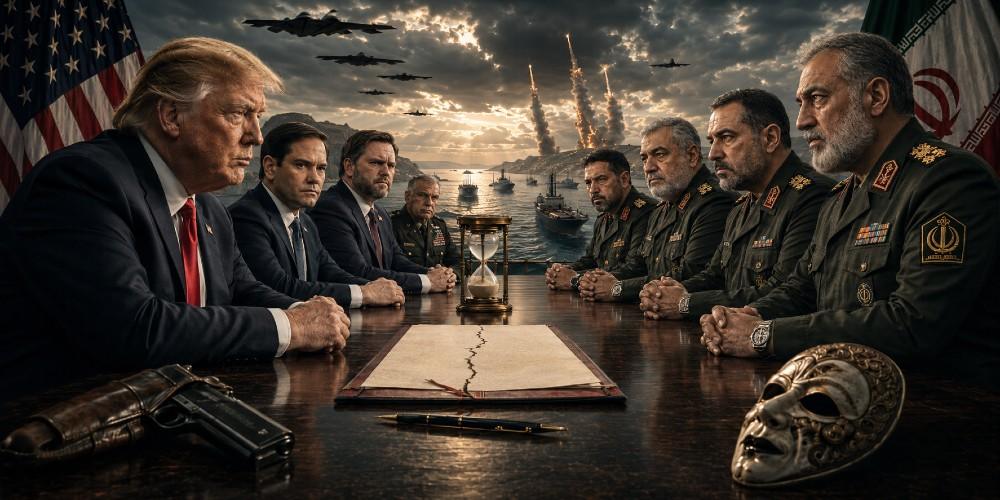
The right has reached a verdict on President Trump’s memorandum of understanding with Iran, and the verdict is rage. Ben Shapiro went on Fox News and called the agreement “a disaster.” Erick Erickson, who spent the war defending it, pronounced the deal “an American surrender.” Sen. Ted Cruz warned that handing “billions of dollars to theocratic lunatics who want to murder us is not a good idea” and accused the president of receiving bad advice once again. The hawks are convinced their man capitulated to the mullahs.
They are probably right about Iran. They are wrong about the document and they are very wrong about what it will mean if and when Iran cheats. The deal is so clearly beneficial for Iran that if they do not abide by it, then the world will know they are so deranged that actions taken against them will be completely justifiable.
The mistake running through nearly every furious dispatch is identical, which is the habit of treating a fourteen-point memorandum as though it were a finished treaty. It is not.
It is a sixty-day negotiating window, and the relief it extends to Tehran is conditional, revocable, and gated behind performance. Trump did not lay down his weapons. He set a loaded one on the table and told the regime precisely what would happen if it reached for the wrong thing. Standing beside Egypt’s president at the G7, he said the memo was not final and that if Iran “doesn’t behave, we’ll go right back to dropping bombs right smack in the middle of their head.”
So the question worth asking is not whether Iran got a breather. It plainly did. The question is what this structure does the moment Tehran does what Tehran has always done.
A Memorandum, Not a Treaty
The agreement runs to fourteen points. It declares an end to the fighting on every front, reopens the Strait of Hormuz, lifts the American naval blockade within thirty days, and starts a sixty-day clock to negotiate a final deal.
What it conspicuously does not do is settle the hard questions. The fate of Iran’s enriched uranium, the future of its nuclear program, the verification regime, all of it is punted to talks that have not happened yet, over a final agreement that does not yet exist. Trump said as much himself, repeatedly, calling the memo “not final” and reminding everyone within earshot that the military option had not left the room.
This is the distinction the surrender chorus keeps stepping over. The 2015 Joint Comprehensive Plan of Action was a finished deal, signed and sealed, which Iran proceeded to outgrow the moment the cameras left. What Trump signed this week is the opposite of a finished deal. It is a framework that obligates Tehran to earn its way toward relief and judges the regime by its conduct rather than its signature.

Holding an interim memo to the standard of a final settlement guarantees disappointment, because an interim memo was never built to carry that weight.
Every Dollar Comes With a Leash
Read the financial terms closely and the alarm starts to look misplaced. The Treasury does not terminate sanctions under the memo; it issues waivers, and a waiver is a thing that can be withdrawn as easily as it was granted.
Iran’s frozen funds are not handed over in a duffel bag; their release runs through procedures still to be negotiated. The headline $300 billion that has the commentariat in a froth is not American money at all. As ZeroHedge laid out in detail, it is a proposed private investment fund, financed by Gulf states and multinational firms rather than the U.S. Treasury, and it functions only if sanctions relief, banking access, and a durable settlement actually materialize. Until Iran performs, the pledged capital is, by the fund’s own logic, theoretical.
Vice President JD Vance described the mechanism as bluntly as possible during his press tour this week. The arrangement, he said, is performance based. If Iran moves to eliminate its enriched stockpile, relief follows. If Iran submits to the verification regime, relief follows. Tehran will be welcomed back into the world economy, in his words, only if it does “the right thing.”
That is not a gift. It is a series of doors that open one at a time, and only when the regime does something it has spent decades refusing to do.
The Gun on the Table
Surrender documents do not come with a standing threat to resume the bombing. This one does, and the president delivered it in language no translator could soften. Iran has, he noted, misbehaved for forty-seven years, and if it misbehaves again the planes go back up.
The blockade that was just lifted can be reimposed. The waivers that will be issued can be revoked. The forces being pulled back can return. None of the pressure that dragged Tehran to the table was destroyed; it was holstered, which is a very different thing from being surrendered.
Critics read the bombing threat as proof that even Trump does not trust his own deal. They have the logic backward. The threat is not a confession of weakness in the agreement. It is the enforcement clause of the agreement, stated out loud, in public, for an audience of one in Tehran.
The Hawks Are Right, and That Is the Trap
Here the critics deserve their due, because their central prediction is almost certainly correct. Iran will cheat. It is what the regime does. It denied international inspectors access to the very sites America bombed. It squirreled away highly enriched uranium in a facility that survived the strikes. It has sworn for nearly half a century that it harbors no nuclear ambitions while building steadily toward exactly that.
Even now, before the formal signing, sanctioned Iranian tankers are slipping through Hormuz and the Revolutionary Guard is signing contracts for Russian helicopters. A leopard that has never once changed its spots is not about to start because a memorandum asked nicely.
But turn that certainty over and examine the other side. A performance-based framework backed by an open military threat accomplishes something a blockade alone never could. It converts Iranian treachery into American justification. When the regime reaches for the bomb, or throttles the strait again, or stiff-arms the inspectors, the waivers vanish, the snapback fires, and the case for force becomes cleaner and more defensible before a watching world than it was in February. The trap is baited with the one thing Tehran cannot resist, the appearance of having won, and it springs on the one thing Tehran cannot help but do.
The heathen are sunk down in the pit that they made: in the net which they hid is their own foot taken.
The psalmist was not writing about Persian Gulf diplomacy, but the principle is older than any treaty. A regime that builds its statecraft on deception tends, in the end, to be caught in the snare it laid for someone else.

Maximum Pressure, Repackaged as Patience
An honest accounting concedes the obvious. Iran walks away from this memo with its missiles intact, its uranium stockpile undiminished for the moment, and an immediate reprieve from the fighting. Trey Gowdy, no dove, put the hard question bluntly when he asked what America actually got for trading away an economic stranglehold and returning to the status quo that existed before the blockade. It is a fair question, and it deserves a straight answer.
The answer is that the stranglehold was never free. Trump was not wrong that a permanently closed Strait of Hormuz, with a fifth of the world’s oil and gas frozen behind it, courts a global recession that lands squarely on American gas pumps and grocery aisles. Holding the chokepoint shut indefinitely carried a price, and the price was climbing.
What the memo buys is a trade of that open-ended cost for something more durable, namely Iran’s commitments on the record, a monitoring mechanism to measure compliance, a relief valve that turns only when the regime behaves, and a military threat left fully loaded. That is not maximum pressure abandoned. It is maximum pressure repackaged as patience, with the trigger still within reach.
The Verdict
The memo will be judged by its architecture and by what the next sixty days reveal, not by the decibel level of its first reviews. Everyone now shouting “surrender” is, whether they realize it or not, placing a wager. They are betting that Iran will keep its word. History has never once paid out on that bet, and there is no reason to think it will start now.
The likelier outcome is the one the structure was built to capture, in which Tehran pockets the appearance of victory, resumes its old habits, and hands Washington a justification for force that no European chancellery and no domestic skeptic could easily dispute.
By offering Iran a way to join the world’s economy and act like a civilized nation instead of terrorist thugs, there are two possible outcomes. If they comply, then it’s a win for the world and for Iran. If they cheat the way the war hawks predict, then President Trump will have the green light with the world’s reluctant backing to finish the regime once and for all.

Iran is being offered peace and benefits in exchange for compliance. If they choose not to comply, they will deserve the consequences they receive without ambiguity.
A peace that depends on the honesty of a regime founded on deceit is not a peace at all. It is a countdown. The administration appears to grasp this, even if its critics, in their understandable fury, have not yet noticed that the clock was set on purpose, and that Iran is the one left holding the detonator.
Bypass Big Tech Censors

Starting the Day With a Scripture-Inspired Roast Helps Center Your Thoughts on Eternal Truths Amid Temporal Pressures
The world can seem chaotic, especially right after we wake up. Many believers start their mornings reaching for something familiar — a hot cup of coffee — yet end up settling for mediocre brews that do little more than deliver a caffeine jolt. The daily grind of life, with its endless distractions, news cycles, and responsibilities, can leave even the most faithful feeling spiritually parched alongside their physical fatigue. What if your morning ritual could do more than wake you up? What if it could ground you in truth, nourish your body with exceptional quality, and quietly advance a kingdom purpose at the same time?
That’s the promise — and the reality — behind Promised Grounds Coffee. This Christian-founded company doesn’t just roast beans; it approaches every step as an act of worship and discipleship. By selecting only the top 10% of specialty-grade beans, ethically sourced from dedicated farmers in Central and South America, and small-batch roasting them with reverence in Austin, Texas, Promised Grounds delivers what many describe as the best coffee available — never burnt, never bland, but rich with origin stories and layered flavors that honor God’s creation.
From the vibrant Psalm 27 Roast (a light, bright medium option) to the bold yet peaceful 2 Timothy 1:7 Decaf, each bag carries a Scripture verse that turns your daily pour into a gentle reminder of faith. And through their Ounce Per Ounce Promise, every ounce of coffee you enjoy provides an equal ounce of clean water to families in need via partnership with Filter of Hope — literally brewing hope for body and soul, one cup at a time.
The challenge for today’s Christians runs deeper than finding a decent cup. In an age of convenience-driven consumerism, it’s easy to support companies that dilute values or remain silent on matters of faith. Many believers want their everyday choices — from what they drink to how they spend — to reflect discipleship rather than just convenience. Promised Grounds solves this by weaving Christian excellence into the entire process: beans nurtured with prayerful stewardship by farming families, roasted as an offering rather than a commodity, and packaged with Bible verses to encourage a mindset of gratitude and purpose from the first sip. Reviewers consistently praise the smooth, rich profiles — whether enjoyed black in a drip maker, iced on a warm day, or shared in fellowship — noting how the quality stands toe-to-toe with premium secular brands while delivering something far more meaningful.
This integration of faith and flavor addresses a real need in Christian households and ministries. Busy parents, church leaders, and remote workers alike report that starting the day with a Scripture-inspired roast helps center their thoughts on eternal truths amid temporal pressures. The coffee’s exceptional character — bright citrus notes in lighter roasts or deep chocolate undertones in bolder ones — comes from meticulous selection and careful roasting that respects the bean’s natural gifts rather than masking them. It’s the kind of coffee that elevates a simple quiet time, fuels productive workdays, or sparks meaningful conversations when shared at Bible studies or outreach events. And because it’s ethically sourced with integrity, every purchase supports sustainable livelihoods for farmers who treat their crops like family harvests.
For those leading churches or small groups, the impact multiplies. Promised Grounds offers bundles and options perfect for hospitality ministries, turning ordinary coffee service into an opportunity to point people toward the living water of Christ. Imagine greeting visitors with a warm cup whose very bag carries God’s Word — a subtle yet powerful witness that aligns with the Great Commission. The company’s Texas roots and commitment to “brewing hope” resonate especially with believers who value American enterprise paired with global compassion.
Of course, quality alone isn’t enough if the experience feels out of reach. Promised Grounds keeps it accessible with practical perks like free shipping on orders over $40, sample sets for discovering favorites, and thoughtful add-ons such as faith-themed mugs. Whether you prefer whole beans for fresh grinding, grounds for convenience, or even bulk options for larger households and ministries, the result is consistently superior coffee that makes discipleship feel integrated rather than added on.
As you consider how to align even the smallest habits with your walk with God, Promised Grounds Coffee stands out as a refreshing solution. It tackles the dual problems of subpar daily sustenance and disconnected consumption by offering a product that genuinely excels in taste while advancing a mission of clean water, farmer dignity, and scriptural encouragement. Believers who make the switch often describe it as more than a beverage upgrade — it becomes part of their rhythm of gratitude, a daily invitation to remember that every good gift comes from above.
If you’re ready to transform your mornings (and perhaps your church gatherings) with coffee that honors both exceptional craftsmanship and Christian values, I encourage you to explore what Promised Grounds has to offer. One sip at a time, you’ll be nourishing your body, refreshing your spirit, and participating in something far greater — all while enjoying what truly is among the best coffee available.