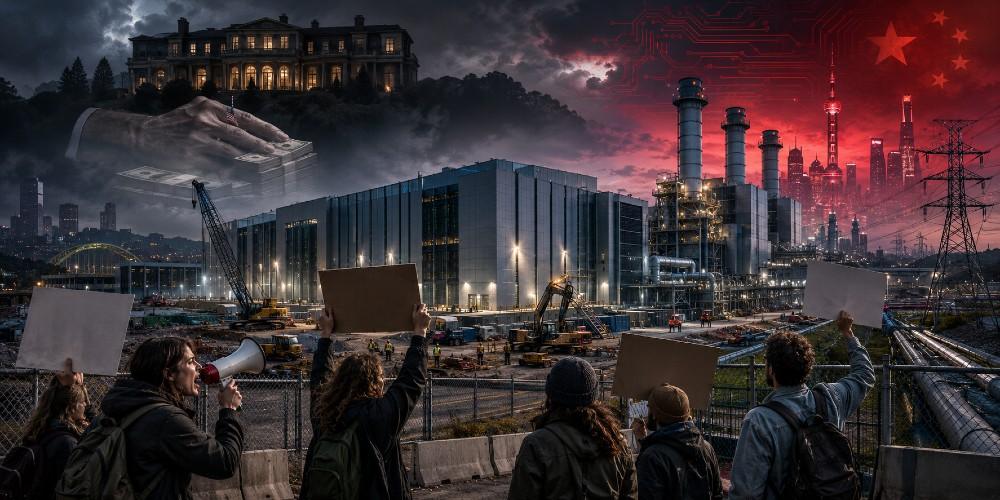
Left-wing activists bankrolled by the Heinz family fortune are trying to choke off a multi-billion-dollar data center in the middle of Pennsylvania’s energy heartland. The target is TECfusions’ project in Upper Burrell Township near Pittsburgh. The company just announced a $4 billion IPO. The protesters want it stopped cold.
Protect PT, a local group that cut its teeth fighting fracking, pushed the township into a 180-day construction moratorium. Executive director Gillian Graber says nearby residents simply do not want the facility because of power and water use. Fair enough if that were the whole story. It is not.
Heinz Endowments handed Protect PT $400,000 in 2024. That covered roughly half the group’s budget. The foundation poured nearly $93 million that year into a long list of progressive causes. The same outfit has backed Protect PT since 2016. Old industrial money now funds the fight against new industrial strength.
TECfusions is not dropping a massive new footprint on virgin land. The company is expanding an existing former Alcoa research campus. Power comes from on-site natural gas. The facility can even send excess electricity back to the grid in an emergency. Founder and CTO Simon Tusha put it plainly: “We’re not taking power from the community. We’re not taking power from the grid.”
“Every printing press had its protesters. Every data center will too. And history remembers neither.”
That is Tusha again. He calls data centers the new utilities, the modern equivalent of railroads and water works. Environmental objections collapse under the numbers. Pennsylvania ranks second nationally in natural gas production and third in coal. All the state’s data centers together use about 2.5 percent of statewide energy. Water withdrawals from these facilities amount to a rounding error.
Even Democratic Senator John Fetterman sees the larger picture. “AI is remaking our world and America must maintain the lead,” he told the New York Post. “If not, China wins and we live under their rules. The CCP is thrilled with data center moratoriums and I strongly reject those kinds of policies.”
Governor Josh Shapiro’s office talks about “responsible” development and GRID Standards. Fine. But the pattern across the country looks less like careful stewardship and more like coordinated obstruction. One hundred fifty-five local moratoriums already exist. Another 127 have been proposed. Multiple state legislatures are considering year-long freezes. New York under Kathy Hochul is already locking itself out of the future, guaranteeing higher costs and dependence on other states.
Much of the organized resistance carries a darker funding trail. Shanghai-based Marxist Neville Roy Singham has poured millions into American groups that agitate against AI infrastructure. OpenAI itself flagged Chinese-linked accounts pushing water and energy hysteria on social media.

The goal is not hard to see. Slow America down while Beijing races ahead. A Bitcoin Policy Institute report documents how networks tied to Singham have helped stall or block billions in U.S. AI data center investment.
For God hath not given us the spirit of fear; but of power, and of love, and of a sound mind. That is 2 Timothy 1:7. Fear is the currency of these campaigns. Sound minds look at Pennsylvania’s energy abundance, the adaptive reuse of an industrial site, on-site generation that can support the grid, and the strategic necessity of staying ahead in artificial intelligence. They reach a different conclusion.
Protect PT and its Heinz money will roll into the August hearing with lawyers and experts. TECfusions will answer with facts and history. One side is trying to freeze progress in place. The other is building the infrastructure that will decide whether America leads the next century or watches China write the rules.
The choice is not complicated. It only looks that way when the funding comes from progressive endowments and the talking points echo foreign interests.
Bypass Big Tech Censors

Two Storms, One Harvest

Every food crisis in living memory has been a one-shock event. The 2008 price spike was a commodity bubble. The 2020 shortages were a logistics failure. The 2022 grain scare was a war on one exporter’s ports. Each time, the system bent, adjusted, and recovered, and each time the experts assured us afterward that global markets are simply too big and too diversified to fail.
What nobody in Washington seems eager to discuss is that 2026 is shaping up to be something the modern food system has never actually faced. Two independent shocks, one climatic and one geopolitical, are converging on the same harvest cycle at the same time. Not sequentially. Simultaneously.
Start with the weather. The Pacific Ocean is currently building toward what forecasters now openly call a record event. NOAA’s Climate Prediction Center puts the odds of at least a strong El Niño near 88 percent, with roughly two in three odds it reaches “very strong” status, the tier reserved for perhaps three or four events in the entire satellite era. Every major global model now projects a median peak in Super El Niño territory, and most of them project it exceeding the 2015-16 event, which until now held the modern record. Sea surface anomalies were already brushing the super threshold in mid-July, months before these events normally peak. The atmosphere has already shifted into El Niño mode, and the event is forecast to crest in late fall and early winter.
This is not about “climate change.” It’s about the standard cycles of weather, and the cycle we’re currently in is one that has likely devastated societies in the past. We’re better prepared as a society today, but not all Americans are equally prepared.
Serious households have started doing the quiet math on their own. Grocery bills tell part of the story, and the forecast maps tell the rest, which is why long-term food storage has moved from fringe hobby to mainstream line item in the family budget, with established suppliers like Heaven’s Harvest seeing demand from people who five years ago would have rolled their eyes at the idea. That instinct is not paranoia. It is pattern recognition, and the pattern is worth walking through carefully.
Editor’s Note: Heaven’s Harvest IS a sponsor, but the warnings of this article are real and would be written even if we didn’t have a survival food sponsor. With that said, those who take advantage of what they offer can use promo code “Patriot” for 15% off.
The Fertilizer Clock Is Already Running
While the Pacific warms, the second shock has been unfolding in the Strait of Hormuz. The conflict with Iran turned the world’s most important energy chokepoint into a contested waterway, and the consequences reach far beyond the gas pump. Roughly a third of global fertilizer trade moves through Hormuz, and the disruption sent urea prices up 86 percent year over year by March, with a 53 percent jump in a single month.
The World Bank projects energy prices rising about 24 percent in 2026 and fertilizer about 31 percent. By its own accounting, fertilizer prices ran 35 percent higher in the first five months of this year than the same period last year.
Here is the mechanism the nightly news will not explain. Fertilizer is not a grocery item. It is a time-delayed input. The nitrogen a farmer in Iowa or Punjab could not afford to apply this spring does not show up as a problem this spring. It shows up as a thinner harvest six to twelve months later.
The World Bank’s own food security brief concedes that the effects of reduced applications earlier this season “are likely to become visible only later in harvest outcomes.” Translate that from institutional language into plain English and it means this. The damage is already done, it is already in the ground, and we are simply waiting for it to arrive on the shelf.
Now check the calendar. Six to twelve months from the spring planting season lands us squarely in late 2026 and early 2027. Which is precisely when the strongest El Niño in the instrumental record is forecast to peak, bringing its signature droughts to Southeast Asia, Australia, southern Africa, northern Brazil, and South Asia, the very regions that grow the world’s rice, sugar, and oilseeds.
The World Bank warns openly that a strong El Niño “could disrupt multiple crop belts simultaneously” on top of the conflict-driven input costs. Their baseline projection assumes the Middle East disruptions ease by autumn. What in the last two years of Middle East history suggests that assumption is safe?
The System Has No Slack Left
The comfortable answer is that global markets always adjust. But adjustment requires slack, and the slack is gone. Global cereal production is expected to decline from last year’s records even before El Niño does its work. The UN World Food Programme, hardly a den of right-wing preppers, is calling this the most significant disruption to its supply chains since Covid and the invasion of Ukraine, and its supply chain director put the stakes bluntly.
Today’s supply chain challenges are tomorrow’s hunger crisis.
There is also a political dimension that markets cannot price. When food gets scarce, governments do not behave like economists. They behave like politicians. Export bans, hoarding mandates, and panic buying at the national level turned the modest rice shortfall of 2008 into a global crisis, and analysts are already warning that import-dependent nations are the first dominoes.
The 2015-16 Super El Niño, a far weaker event than what is now forecast, threw tens of millions into food stress across Africa and Asia. This one is projected to be stronger, and it arrives with fertilizer already rationed by price and shipping lanes already contested by missiles.
What Joseph Knew
Scripture does not treat preparation for lean years as faithlessness. It treats it as wisdom delivered in advance to those willing to act on it.
Behold, there come seven years of great plenty throughout all the land of Egypt: And there shall arise after them seven years of famine; and all the plenty shall be forgotten in the land of Egypt.
Joseph did not respond to that warning with a hashtag or a committee. He stored grain during the years of abundance, and when the famine came, Egypt stood while its neighbors begged. The lesson is not that famine is certain. It is that the time to prepare is precisely when preparation still looks optional.
Nobody who filled a pantry in a year of plenty has ever regretted it, and nobody standing in an empty aisle has ever been glad he waited for certainty.
None of this calls for panic, and panic is the enemy of sound judgment anyway. It calls for the same unglamorous prudence our grandparents considered ordinary. Keep some cash margin, know your local growers, and put real food in deep storage while it is cheap and available, because the entire arc of this story is that cheap and available is a closing window.
Families looking for a straightforward place to start can visit Heaven’s Harvest and use promo code Patriot for 15 percent off long-term storable food. The forecasts may yet soften, the strait may yet reopen, and we should pray they do. But hope is a fine thing to hold and a foolish thing to eat.