
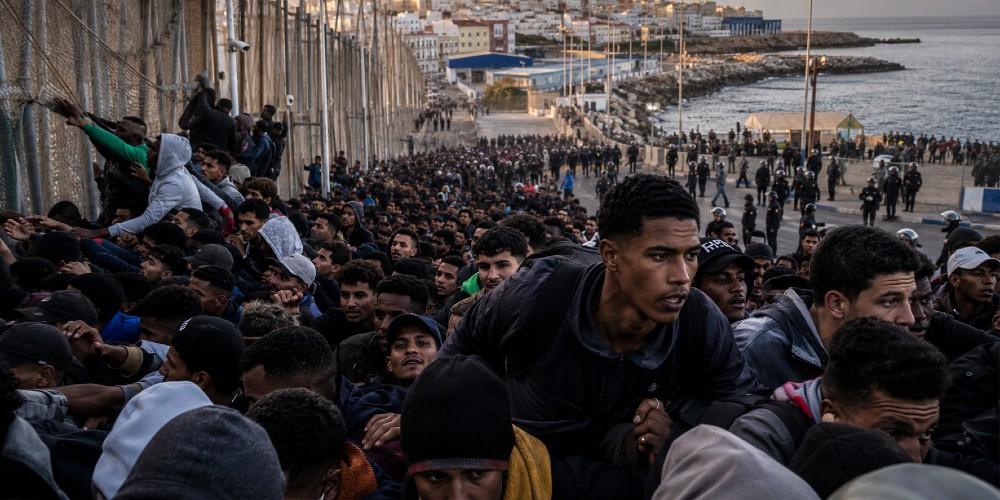
Thousands of illegal aliens stormed Spain’s North African enclave of Ceuta on Thursday. They swam around coastal barriers, scaled fences, and overwhelmed the border until it collapsed. At least nine people are dead. Bodies floated in the water while rescue teams worked. Local officials called it absolute chaos. Madrid finally sent in the military.
The Spanish government ordered the Armed Forces to support the Civil Guard after Ceuta’s leaders warned the city could no longer cope. Prime Minister Pedro Sánchez and Interior Minister Fernando Grande-Marlaska are expected to visit as the government scrambles to restore order.
State television reported between 2,000 and 3,000 crossed in a single surge. Some officials put the broader numbers far higher. Most were young men. Families with women and children were among them too.
Rachid Sbihi, who represents Civil Guard officers in Ceuta, said, “The situation is absolute chaos. It’s not possible to give precise numbers, but there are thousands of migrants crossing.”
Video showed large groups entering through the Tarajal border area, many swimming around the barriers that separate Morocco from Spanish territory. Discarded flotation devices and wet clothes littered the shore.
This is the largest wave since 2021, when more than 8,000 people entered the tiny enclave over two days and triggered a full diplomatic fight with Morocco. Ceuta, along with Melilla, forms the European Union’s only land border with Africa.
Illegal aliens from across the continent regularly try to reach it by swimming or climbing the fortified fence in hopes of stepping onto European soil. Nearly 3,000 had already entered Ceuta by land or sea this year before Thursday’s explosion. Clashes also broke out at Melilla’s border as more attempted to force their way through.
Spanish authorities say Morocco is cooperating and has intercepted many attempting the crossing. Both governments claim they are working to return those who entered illegally as quickly as possible. Yet the damage is done. Reception centers are overwhelmed. Unaccompanied minors facilities were already operating at more than 2,000 percent of capacity. Hundreds have been sleeping on the streets.

Officials in Ceuta pointed to a recent Spanish Supreme Court ruling that limits the immediate return of those who arrive by sea without full due process. The decision effectively removed the Civil Guard’s ability to turn back swimmers on the spot.
Smuggling networks and would-be crossers noticed. A Guardia Civil spokesperson described a slow trickle after the ruling that suddenly became an explosion. Whether the illegal aliens knew the legal details or simply followed the open invitation, the result is the same: a collapsed border and more bodies in the water.
Italy’s Prime Minister Giorgia Meloni reacted aggressively. She called the images from Ceuta shocking and said uncontrolled illegal immigration threatens the security of Europe’s borders. Meloni warned that Italy is prepared to take extraordinary measures, including suspending Schengen free movement with Spain, “to defend our borders and ensure the safety of our citizens.”
Her government has repeatedly criticized Sánchez’s softer approach, including prior moves to regularize hundreds of thousands of illegal aliens already inside Spain.
Europe keeps learning the same hard lesson and then forgetting it. Soft borders, court decisions that handcuff enforcement, and governments that treat sovereignty like an optional extra produce exactly this: chaos, death, and political fractures. The Spanish left has long preferred moral posturing over the hard work of controlling who enters the country. The result is not compassion. It is drowned bodies and exhausted cities.
Spain is now deploying troops because its political class refused to enforce the law when it still had the chance. Meloni sees the threat clearly. Others still pretend open borders are a virtue. The people of Ceuta are living the consequences. Nine dead is not a statistic. It is the price of pretending borders do not matter.
Bypass Big Tech Censors

Starting the Day With a Scripture-Inspired Roast Helps Center Your Thoughts on Eternal Truths Amid Temporal Pressures
The world can seem chaotic, especially right after we wake up. Many believers start their mornings reaching for something familiar — a hot cup of coffee — yet end up settling for mediocre brews that do little more than deliver a caffeine jolt. The daily grind of life, with its endless distractions, news cycles, and responsibilities, can leave even the most faithful feeling spiritually parched alongside their physical fatigue. What if your morning ritual could do more than wake you up? What if it could ground you in truth, nourish your body with exceptional quality, and quietly advance a kingdom purpose at the same time?
That’s the promise — and the reality — behind Promised Grounds Coffee. This Christian-founded company doesn’t just roast beans; it approaches every step as an act of worship and discipleship. By selecting only the top 10% of specialty-grade beans, ethically sourced from dedicated farmers in Central and South America, and small-batch roasting them with reverence in Austin, Texas, Promised Grounds delivers what many describe as the best coffee available — never burnt, never bland, but rich with origin stories and layered flavors that honor God’s creation.
From the vibrant Psalm 27 Roast (a light, bright medium option) to the bold yet peaceful 2 Timothy 1:7 Decaf, each bag carries a Scripture verse that turns your daily pour into a gentle reminder of faith. And through their Ounce Per Ounce Promise, every ounce of coffee you enjoy provides an equal ounce of clean water to families in need via partnership with Filter of Hope — literally brewing hope for body and soul, one cup at a time.
The challenge for today’s Christians runs deeper than finding a decent cup. In an age of convenience-driven consumerism, it’s easy to support companies that dilute values or remain silent on matters of faith. Many believers want their everyday choices — from what they drink to how they spend — to reflect discipleship rather than just convenience. Promised Grounds solves this by weaving Christian excellence into the entire process: beans nurtured with prayerful stewardship by farming families, roasted as an offering rather than a commodity, and packaged with Bible verses to encourage a mindset of gratitude and purpose from the first sip. Reviewers consistently praise the smooth, rich profiles — whether enjoyed black in a drip maker, iced on a warm day, or shared in fellowship — noting how the quality stands toe-to-toe with premium secular brands while delivering something far more meaningful.
This integration of faith and flavor addresses a real need in Christian households and ministries. Busy parents, church leaders, and remote workers alike report that starting the day with a Scripture-inspired roast helps center their thoughts on eternal truths amid temporal pressures. The coffee’s exceptional character — bright citrus notes in lighter roasts or deep chocolate undertones in bolder ones — comes from meticulous selection and careful roasting that respects the bean’s natural gifts rather than masking them. It’s the kind of coffee that elevates a simple quiet time, fuels productive workdays, or sparks meaningful conversations when shared at Bible studies or outreach events. And because it’s ethically sourced with integrity, every purchase supports sustainable livelihoods for farmers who treat their crops like family harvests.
For those leading churches or small groups, the impact multiplies. Promised Grounds offers bundles and options perfect for hospitality ministries, turning ordinary coffee service into an opportunity to point people toward the living water of Christ. Imagine greeting visitors with a warm cup whose very bag carries God’s Word — a subtle yet powerful witness that aligns with the Great Commission. The company’s Texas roots and commitment to “brewing hope” resonate especially with believers who value American enterprise paired with global compassion.
Of course, quality alone isn’t enough if the experience feels out of reach. Promised Grounds keeps it accessible with practical perks like free shipping on orders over $40, sample sets for discovering favorites, and thoughtful add-ons such as faith-themed mugs. Whether you prefer whole beans for fresh grinding, grounds for convenience, or even bulk options for larger households and ministries, the result is consistently superior coffee that makes discipleship feel integrated rather than added on.
As you consider how to align even the smallest habits with your walk with God, Promised Grounds Coffee stands out as a refreshing solution. It tackles the dual problems of subpar daily sustenance and disconnected consumption by offering a product that genuinely excels in taste while advancing a mission of clean water, farmer dignity, and scriptural encouragement. Believers who make the switch often describe it as more than a beverage upgrade — it becomes part of their rhythm of gratitude, a daily invitation to remember that every good gift comes from above.
If you’re ready to transform your mornings (and perhaps your church gatherings) with coffee that honors both exceptional craftsmanship and Christian values, I encourage you to explore what Promised Grounds has to offer. One sip at a time, you’ll be nourishing your body, refreshing your spirit, and participating in something far greater — all while enjoying what truly is among the best coffee available.