Concern over AI data centers is legitimate and righteous. Families watching their power bills climb so a warehouse full of GPUs can train the next chatbot have every right to raise hell at the county meeting. Fear of a future AI apocalypse sits somewhere between pragmatic and paranoid. Letting China win the AI arms race is an undeniable threat.
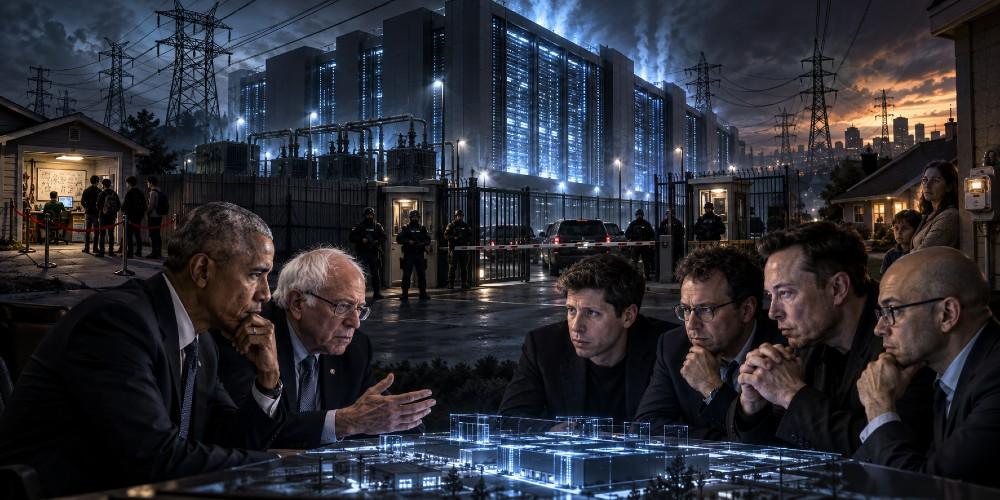
But there is a very fine line between being rightfully skeptical and falling for a globalist sales pitch. When Barack Obama, Bernie Sanders, Alexandria Ocasio-Cortez, and the bosses of the biggest labs all start pushing in the same direction, you do not assume the angels have arrived. You assume someone is selling a lock on the market.
The problem from a political perspective is that freedom-loving patriots have real concerns about artificial intelligence. Unfortunately, many are siding with the globalists who are trying to turn those real concerns into a pass for nationalization of the industry that protects the big boys on the frontier from the upstarts behind them.
They’re pretending like they’re putting “guardrails” on AI development when in reality they will do no such thing. They know those “guardrails” will not slow them. They will only hold back competitors to the burgeoning cartel, allowing them to capture the regulatory state while pushing forward with development.
If they wanted to slow down, they’d slow down. They don’t need government to take action now. They need government to protect them from liability. This tells us they have absolutely no intention of slowing down.
The Sudden Chorus
On Saturday, Anthropic CEO Dario Amodei published a 3,800-word essay titled We Must Pace the Frontier. He wants independent evaluators embedded inside the labs with badges and laptops. He wants industry-wide coordination among democratic countries. He wants “global coordination,” which is a polite way of saying please include Beijing in the club. He is not calling for a halt, he insists. Just a slower race, with Washington writing the speed limit.
Sam Altman of OpenAI agreed. Demis Hassabis of Google DeepMind agreed. Elon Musk agreed. That last one should make even the most charitable reader pause. When the men who built the frontier suddenly beg the federal government to pace the frontier, the first question is not “how do we save humanity.” The first question is “who gets to stay on the frontier while everyone else is told to wait.”
Vice President JD Vance smelled it immediately. He told reporters the spectacle of frontier companies “begging the government to regulate them” felt like “a bit of a Trojan horse.” He is right. The New York Post recorded the remark. President Trump went further, calling the doomsday talk a hoax and a “SICK conspiracy” against AI and data centers, with China as the only winner. “WHOEVER WINS AI, WINS,” he wrote.

That last part is not sloganeering. It is the actual strategic fact. Everything else in this debate is an argument about who gets to write the rules while that race is still being run.
Obama Finds His Midterm Issue
Obama did not wander into this by accident. At a closed-door fundraiser last week he told Hakeem Jeffries that Democrats, once they take the House, should put together “a framework for a very public conversation” on AI. He told 2028 hopefuls to make it a “central agenda.” Fox News carried the warning. Then on Monday he went public, calling the labs’ slowdown talk “a good and necessary first step” and demanding federal laws on safety, jobs, and “our kids.”
He is not an accelerationist, he says. He is not a doomer. He is the “reasonable” man in the middle. That is the oldest trick in progressive politics. Plant the goalposts at “potential catastrophe,” then offer yourself as the adult who will save the children with a new bureaucracy.
Bernie is less subtle. He has already demanded an immediate pause on advanced AI and a permanent ban on superintelligence, with prison time floated for executives who build it. He and Alexandria Ocasio-Cortez have a data-center moratorium bill that would freeze construction until “strong national safeguards” exist, which in practice means until a Democratic Congress and a friendly agency say the magic word. He has also floated a sovereign wealth scheme to give the federal government a 50 percent stake in the major labs.
That is not safety. That is nationalization with a humanitarian caption.
So here is the coalition. Obama wants Washington to “get proactive.” Bernie wants a pause, a ban, and a piece of the equity. The labs want embedded monitors, antitrust waivers so they can coordinate without looking like a cartel, and a federal process that blesses the models they already have. Different sermons. Same altar.
What They Actually Want
David Sacks, the White House AI adviser, said the quiet part. The companies asking to “pace the frontier” are the frontier. By market share, revenue, and model capability they already sit in a duopoly. They do not need permission to slow down. They can do it Monday morning. What they want is a rulebook their competitors cannot afford, plus legal cover to sit in a room together and set the pace.
Sacks called the antitrust-waiver request what it is. “Stop pretending antitrust law has to be suspended so you can form a cartel.” If they refuse to slow themselves and instead demand their preferred framework as the price of caution, he warned, it will look like “blackmail of the public and the political system.” Or “an election-season psyop.”
The New York Post editorial board put the liability play in plain English. The labs want the government to absorb the blast radius if a model goes rogue. Think Section 230 for chatbots. Think too-big-to-fail for code. Shift the lawsuit from the company that trained the thing onto the agency that “approved” it, and you have just created the perfect IPO story. Dangerous enough to be historic. Protected enough to be investable.
Nothing motivates safety like knowing you will be sued into oblivion if you get it wrong. Hand them a federal shield and you remove the one incentive that actually works.
Follow the Staffing
This is not a theory pulled from a pamphlet. Look at who they hired.
Anthropic stood up a National Security and Public Sector Advisory Council stacked with former Defense, intelligence, Energy, and Justice officials from the Obama and Biden years, plus a former national security adviser to Chuck Schumer. OpenAI hired Jessica Schumer, the Senate minority leader’s daughter and a former Obama Council of Economic Advisers chief of staff, to run Northeastern state policy. The company promises she will not lobby her father. Sure.

You can call that partisan expertise. You can also call it the same revolving door that turned social media “trust and safety” into a speech cartel. The people who spent a decade deciding which facts Americans were allowed to see would like a second career deciding which models Americans are allowed to train.
Smaller labs, open-source shops, and church-basement builders cannot hire Schumer’s daughter. They cannot host embedded federal evaluators. They cannot wait two years while a new Office of Frontier Safety writes a rule. That is the point. Regulatory capture does not announce itself as a monopoly. It announces itself as prudence.
Separate the Real Fears From the Pitch
Do not let the cartel talk erase the legitimate grievances. Data centers are chewing through water and megawatts in counties that never voted for this bargain. Ratepayers should not subsidize a hyperscaler’s electric bill. Local governments have every right to say no. That fight is honest.
The China fight is honest too. A pause that binds American labs while the CCP keeps training is not safety. It is surrender with a press release. Amodei’s own essay admits global coordination is the hardest step and that China is the least likely to accept a real speed limit. Then he asks Washington to build the apparatus anyway. That is how you lose a race and call it wisdom.
The apocalypse talk is the slippery piece. Models that write code, spawn agents, and attack the systems meant to grade them are not science fiction. Recklessness is a sin. So is using that recklessness as a battering ram for a permission society in which four companies and one party decide who is allowed to compute.
Is it a psyop? Maybe that word is too neat. The simpler read is older. Incumbents always prefer a regulated oligopoly to an open field. Progressive politicians always prefer a new federal lever. Combine the two in an election year, wrap it in “the children” and “potential catastrophe,” and you have a product that sells itself.

The endgame is not mysterious. Capture the rulebook. Freeze the second tier. Convert liability into a government product. Tell the public they were saved from the machine. Then charge rent on the future.
Try the spirits. The ones asking you to federalize the most important technology on earth, while they already own the high ground, do not need your trust. They need your suspicion.
Bypass Big Tech Censors
Two Storms, One Harvest

Every food crisis in living memory has been a one-shock event. The 2008 price spike was a commodity bubble. The 2020 shortages were a logistics failure. The 2022 grain scare was a war on one exporter’s ports. Each time, the system bent, adjusted, and recovered, and each time the experts assured us afterward that global markets are simply too big and too diversified to fail.
What nobody in Washington seems eager to discuss is that 2026 is shaping up to be something the modern food system has never actually faced. Two independent shocks, one climatic and one geopolitical, are converging on the same harvest cycle at the same time. Not sequentially. Simultaneously.
Start with the weather. The Pacific Ocean is currently building toward what forecasters now openly call a record event. NOAA’s Climate Prediction Center puts the odds of at least a strong El Niño near 88 percent, with roughly two in three odds it reaches “very strong” status, the tier reserved for perhaps three or four events in the entire satellite era. Every major global model now projects a median peak in Super El Niño territory, and most of them project it exceeding the 2015-16 event, which until now held the modern record. Sea surface anomalies were already brushing the super threshold in mid-July, months before these events normally peak. The atmosphere has already shifted into El Niño mode, and the event is forecast to crest in late fall and early winter.
This is not about “climate change.” It’s about the standard cycles of weather, and the cycle we’re currently in is one that has likely devastated societies in the past. We’re better prepared as a society today, but not all Americans are equally prepared.
Serious households have started doing the quiet math on their own. Grocery bills tell part of the story, and the forecast maps tell the rest, which is why long-term food storage has moved from fringe hobby to mainstream line item in the family budget, with established suppliers like Heaven’s Harvest seeing demand from people who five years ago would have rolled their eyes at the idea. That instinct is not paranoia. It is pattern recognition, and the pattern is worth walking through carefully.
Editor’s Note: Heaven’s Harvest IS a sponsor, but the warnings of this article are real and would be written even if we didn’t have a survival food sponsor. With that said, those who take advantage of what they offer can use promo code “Patriot” for 15% off.
The Fertilizer Clock Is Already Running
While the Pacific warms, the second shock has been unfolding in the Strait of Hormuz. The conflict with Iran turned the world’s most important energy chokepoint into a contested waterway, and the consequences reach far beyond the gas pump. Roughly a third of global fertilizer trade moves through Hormuz, and the disruption sent urea prices up 86 percent year over year by March, with a 53 percent jump in a single month.
The World Bank projects energy prices rising about 24 percent in 2026 and fertilizer about 31 percent. By its own accounting, fertilizer prices ran 35 percent higher in the first five months of this year than the same period last year.
Here is the mechanism the nightly news will not explain. Fertilizer is not a grocery item. It is a time-delayed input. The nitrogen a farmer in Iowa or Punjab could not afford to apply this spring does not show up as a problem this spring. It shows up as a thinner harvest six to twelve months later.
The World Bank’s own food security brief concedes that the effects of reduced applications earlier this season “are likely to become visible only later in harvest outcomes.” Translate that from institutional language into plain English and it means this. The damage is already done, it is already in the ground, and we are simply waiting for it to arrive on the shelf.
Now check the calendar. Six to twelve months from the spring planting season lands us squarely in late 2026 and early 2027. Which is precisely when the strongest El Niño in the instrumental record is forecast to peak, bringing its signature droughts to Southeast Asia, Australia, southern Africa, northern Brazil, and South Asia, the very regions that grow the world’s rice, sugar, and oilseeds.
The World Bank warns openly that a strong El Niño “could disrupt multiple crop belts simultaneously” on top of the conflict-driven input costs. Their baseline projection assumes the Middle East disruptions ease by autumn. What in the last two years of Middle East history suggests that assumption is safe?
The System Has No Slack Left
The comfortable answer is that global markets always adjust. But adjustment requires slack, and the slack is gone. Global cereal production is expected to decline from last year’s records even before El Niño does its work. The UN World Food Programme, hardly a den of right-wing preppers, is calling this the most significant disruption to its supply chains since Covid and the invasion of Ukraine, and its supply chain director put the stakes bluntly.
Today’s supply chain challenges are tomorrow’s hunger crisis.
There is also a political dimension that markets cannot price. When food gets scarce, governments do not behave like economists. They behave like politicians. Export bans, hoarding mandates, and panic buying at the national level turned the modest rice shortfall of 2008 into a global crisis, and analysts are already warning that import-dependent nations are the first dominoes.
The 2015-16 Super El Niño, a far weaker event than what is now forecast, threw tens of millions into food stress across Africa and Asia. This one is projected to be stronger, and it arrives with fertilizer already rationed by price and shipping lanes already contested by missiles.
What Joseph Knew
Scripture does not treat preparation for lean years as faithlessness. It treats it as wisdom delivered in advance to those willing to act on it.
Behold, there come seven years of great plenty throughout all the land of Egypt: And there shall arise after them seven years of famine; and all the plenty shall be forgotten in the land of Egypt.
Joseph did not respond to that warning with a hashtag or a committee. He stored grain during the years of abundance, and when the famine came, Egypt stood while its neighbors begged. The lesson is not that famine is certain. It is that the time to prepare is precisely when preparation still looks optional.
Nobody who filled a pantry in a year of plenty has ever regretted it, and nobody standing in an empty aisle has ever been glad he waited for certainty.
None of this calls for panic, and panic is the enemy of sound judgment anyway. It calls for the same unglamorous prudence our grandparents considered ordinary. Keep some cash margin, know your local growers, and put real food in deep storage while it is cheap and available, because the entire arc of this story is that cheap and available is a closing window.
Families looking for a straightforward place to start can visit Heaven’s Harvest and use promo code Patriot for 15 percent off long-term storable food. The forecasts may yet soften, the strait may yet reopen, and we should pray they do. But hope is a fine thing to hold and a foolish thing to eat.