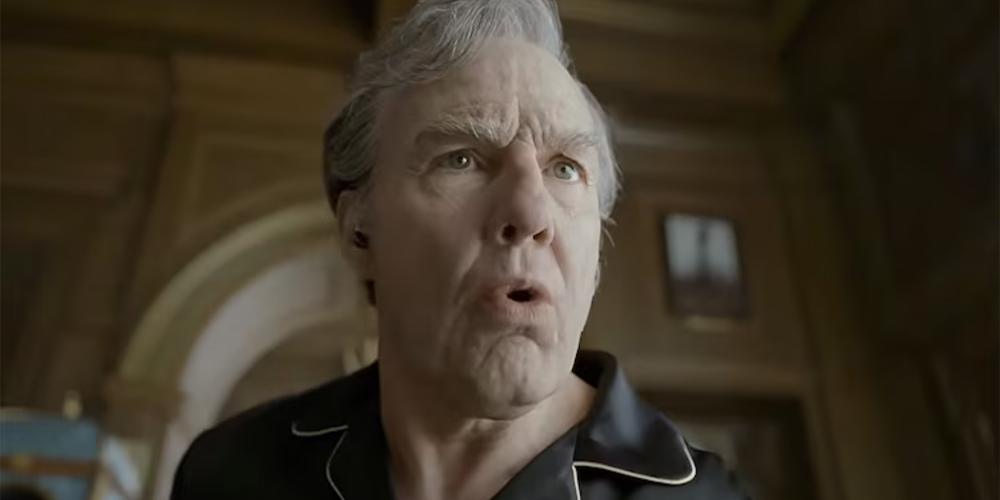
Hollywood just spent a fortune to tell you the fuel that heats your house, moves your food, and keeps the lights on is a moral crime. The audience looked at the trailer, looked at the ticket price, and stayed home. Tom Cruise’s climate sermon Digger opens Friday, and the early math says Warner Bros. is about to bury more than $100 million in a hole of its own digging.
John Nolte at Breitbart called the thing what it is. A shrill, unsubtle, 129-minute attack on the people who dare to use oil to make a better life. Director Alejandro González Iñárritu, the man behind Birdman and The Revenant, put Cruise in heavy makeup as Digger Rockwell, a Texas wildcatter who built his father’s company into a global outfit with rigs in Greenland and Alaska. Then the movie spends two hours screaming that the standard of living those rigs bought is everybody’s fault.
A Lecture Wearing a Movie Star
This is not a Mission Impossible stunt reel. It is Cruise’s first non-action lead in more than a decade, and the studio sold it as satire. The cast is stacked on purpose. Riz Ahmed, Sandra Hüller, Michael Stuhlbarg, Jesse Plemons, and John Goodman as a loudmouth president of the United States. The plot, such as it is, drops an oil baron into an ecological calamity he supposedly started and asks how much blood is on his hands.
Christian Toto, writing at Hollywood in Toto, warned readers what they were actually buying. Endless speeches on the horrors of climate change and how dern evil oil is. Cruise gets an extended close-up to rant, rave, and announce the approved moral.
We need it. We crave it. We will risk everything to burn it. So this is all our fault. Toto’s verdict was blunt. Bloated, dull, obvious, utterly lacking in self-awareness, and exhausting. Would you want to spend two hours with grown men screaming at the top of their lungs?
Even the house critics flinched. A RogerEbert.com review called Digger devoid of substance and accused Iñárritu of staging a bad, unfunny play inside his own movie, then digging a bigger hole the longer he talked. The Hollywood Reporter said the satire is so smug and bombastic it makes Adam McKay’s Don’t Look Up look almost harmless. A climate reporter at Grist, who wanted this movie to work, still walked out reaching for an Advil and called the result a mess of shrieking and spittle.
Rotten Tomatoes sits around 52 percent. Nolte’s point is the useful one. These critics grade left-wing message pictures on a curve. Evil white men, evil businessmen, oil bad, the planet dying, delivered by the biggest movie star alive. If that cocktail still comes back rotten, the picture has to be genuinely awful. The woke lab ran the experiment and the lab rats refused the pellet.
The Box Office Already Voted
Page Six reported the tracking collapse in plain numbers. Early guesses had the opening near $30 million, then $20 million, then $18 million to $20 million. By Wednesday the professional estimate had fallen to $8 million to $12 million for the weekend, good for somewhere between second and fifth, and maybe not even that. Variety and other trackers put the range a notch higher, at $12 million to $15 million. Either figure is a humiliation for a Cruise vehicle.

The budget story is worse. The film was greenlit around $125 million. Four people with knowledge of the production told the trades it climbed to $160 million to $180 million after the shoot ran long. Marketing is widely pegged near another $100 million.
Theaters keep about half of every ticket. Rival executives told Variety a movie this size needed something like a $40 million debut and roughly $350 million worldwide to break even. A Warner Bros. spokesman disputed the scarier math and put break-even closer to $300 million. Nolte’s back-of-the-envelope figure, once promotion is counted, pushes the real number toward $500 million.
Split the difference and you still land in the same ditch. An $8 million to $15 million opening does not grow into a $300 million global gross. Not for an R-rated original comedy that critics already find exhausting. If the projections hold, the loss clears $100 million, and that is before anybody prices the damage to Cruise’s run of audience trust.
Presales heading into Friday were reportedly about half of what Warner’s One Battle After Another had at the same point, and that film opened to $22 million. Amazon’s Colleen Hoover thriller Verity is tracking above $30 million in the same corridor. People will still buy a ticket. They will not buy this ticket.
They Preached to a Congregation That Already Left
Scripture has a name for this kind of swap. “Who changed the truth of God into a lie, and worshipped and served the creature more than the Creator, who is blessed for ever.”
The created world is a gift. Oil in the ground is part of that gift. Men learned to pull it out, refine it, and turn it into heat, transport, medicine, fertilizer, and the cheap calories that ended famine for a large share of the planet. Calling that theft is not science. It is a liturgy.
The doomsday calendar has been wrong so often it has become its own genre. Ice ages, resource cliffs, and drowned cities keep getting rescheduled. Meanwhile the audience that was supposed to applaud already lives with the bill. Higher fuel costs, banned appliances, and lectures from people who fly private to climate summits. Digger does not argue with those people. It scolds them, then asks them for $15 and two hours.
Warner Bros. picked a strange week to set the money on fire. This is reportedly the studio’s last release as a standalone company before Paramount Skydance, and David Ellison, close the purchase. Nolte read the release date as a flare. Please buy us before we finish the job ourselves.
The same lot has already watched The Bride! and Supergirl head toward nine-figure theatrical losses. Dune Part III in December is supposed to stop the bleeding. A Cruise climate farce was never going to be the tourniquet.
There is a cleaner lesson sitting in the wreckage. Politics is downstream from culture, and culture is downstream from what people will actually sit through. Hollywood can still hire the star, hire the Oscar director, and hire the sermon.
It cannot hire the crowd. The crowd already knows who heats the house. They are not interested in being told that miracle is a sin, and they are perfectly happy to let Warner Bros. pay for the privilege of saying it.
Bypass Big Tech Censors
Starting the Day With a Scripture-Inspired Roast Helps Center Your Thoughts on Eternal Truths Amid Temporal Pressures
The world can seem chaotic, especially right after we wake up. Many believers start their mornings reaching for something familiar — a hot cup of coffee — yet end up settling for mediocre brews that do little more than deliver a caffeine jolt. The daily grind of life, with its endless distractions, news cycles, and responsibilities, can leave even the most faithful feeling spiritually parched alongside their physical fatigue. What if your morning ritual could do more than wake you up? What if it could ground you in truth, nourish your body with exceptional quality, and quietly advance a kingdom purpose at the same time?
That’s the promise — and the reality — behind Promised Grounds Coffee. This Christian-founded company doesn’t just roast beans; it approaches every step as an act of worship and discipleship. By selecting only the top 10% of specialty-grade beans, ethically sourced from dedicated farmers in Central and South America, and small-batch roasting them with reverence in Austin, Texas, Promised Grounds delivers what many describe as the best coffee available — never burnt, never bland, but rich with origin stories and layered flavors that honor God’s creation.
From the vibrant Psalm 27 Roast (a light, bright medium option) to the bold yet peaceful 2 Timothy 1:7 Decaf, each bag carries a Scripture verse that turns your daily pour into a gentle reminder of faith. And through their Ounce Per Ounce Promise, every ounce of coffee you enjoy provides an equal ounce of clean water to families in need via partnership with Filter of Hope — literally brewing hope for body and soul, one cup at a time.
The challenge for today’s Christians runs deeper than finding a decent cup. In an age of convenience-driven consumerism, it’s easy to support companies that dilute values or remain silent on matters of faith. Many believers want their everyday choices — from what they drink to how they spend — to reflect discipleship rather than just convenience. Promised Grounds solves this by weaving Christian excellence into the entire process: beans nurtured with prayerful stewardship by farming families, roasted as an offering rather than a commodity, and packaged with Bible verses to encourage a mindset of gratitude and purpose from the first sip. Reviewers consistently praise the smooth, rich profiles — whether enjoyed black in a drip maker, iced on a warm day, or shared in fellowship — noting how the quality stands toe-to-toe with premium secular brands while delivering something far more meaningful.
This integration of faith and flavor addresses a real need in Christian households and ministries. Busy parents, church leaders, and remote workers alike report that starting the day with a Scripture-inspired roast helps center their thoughts on eternal truths amid temporal pressures. The coffee’s exceptional character — bright citrus notes in lighter roasts or deep chocolate undertones in bolder ones — comes from meticulous selection and careful roasting that respects the bean’s natural gifts rather than masking them. It’s the kind of coffee that elevates a simple quiet time, fuels productive workdays, or sparks meaningful conversations when shared at Bible studies or outreach events. And because it’s ethically sourced with integrity, every purchase supports sustainable livelihoods for farmers who treat their crops like family harvests.
For those leading churches or small groups, the impact multiplies. Promised Grounds offers bundles and options perfect for hospitality ministries, turning ordinary coffee service into an opportunity to point people toward the living water of Christ. Imagine greeting visitors with a warm cup whose very bag carries God’s Word — a subtle yet powerful witness that aligns with the Great Commission. The company’s Texas roots and commitment to “brewing hope” resonate especially with believers who value American enterprise paired with global compassion.
Of course, quality alone isn’t enough if the experience feels out of reach. Promised Grounds keeps it accessible with practical perks like free shipping on orders over $40, sample sets for discovering favorites, and thoughtful add-ons such as faith-themed mugs. Whether you prefer whole beans for fresh grinding, grounds for convenience, or even bulk options for larger households and ministries, the result is consistently superior coffee that makes discipleship feel integrated rather than added on.
As you consider how to align even the smallest habits with your walk with God, Promised Grounds Coffee stands out as a refreshing solution. It tackles the dual problems of subpar daily sustenance and disconnected consumption by offering a product that genuinely excels in taste while advancing a mission of clean water, farmer dignity, and scriptural encouragement. Believers who make the switch often describe it as more than a beverage upgrade — it becomes part of their rhythm of gratitude, a daily invitation to remember that every good gift comes from above.
If you’re ready to transform your mornings (and perhaps your church gatherings) with coffee that honors both exceptional craftsmanship and Christian values, I encourage you to explore what Promised Grounds has to offer. One sip at a time, you’ll be nourishing your body, refreshing your spirit, and participating in something far greater — all while enjoying what truly is among the best coffee available.