

(Zero Hedge)—Just two weeks into his second term, President Trump announced the first round of tariffs on Saturday, marking the resumption of his trade war. The new measures impose a 25% tariff on imported goods from Mexico and Canada—though energy imports from Canada will face a reduced rate of 10%—and a 10% tariff on imports from China. The weekend announcement surprised many world leaders and Wall Street but apparently captured Beijing’s attention.
The Wall Street Journal reports that China is preparing for trade talks with the Trump administration, aiming to restore a trade agreement with the US and reaffirm its pledge not to devalue the yuan for a competitive advantage in global trade. Based on unnamed sources, the report has not yet been officially confirmed.
Here’s more from the report:
As part of its effort to prepare for negotiations, according to the people, China’s initial proposal will center on restoring a trade agreement Beijing signed in early 2020 with the first Trump administration but didn’t implement.
The so-called Phase One deal required China to increase purchases of American goods and services by $200 billion over a two-year period. While Trump himself has described Phase One as the “greatest deal” ever made, many trade experts and business executives called it unrealistic to begin with.
Having failed to deliver on its pledge under the deal to increase US purchases, Beijing now is preparing to talk to the Trump administration about areas where China can buy more from the US, the people said.
Other parts of China’s plan, the people said, include an offer to make more investments in the US—in sectors such as batteries for electric cars, a renewed pledge by Beijing not to devalue the yuan to gain competitive advantage, and a commitment to reduce exports of fentanyl precursors.
Beijing views the 10% tariff as Trump’s way of bringing all parties to the negotiating table. Trump has threatened to impose maximum-pressure tariffs on China, potentially as high as 60%.
The initial reaction from Beijing has been muted, with the Commerce Ministry expressing strong “dissatisfaction” and vowing “corresponding countermeasures.”
Wang, UBS chief China economist, told clients earlier that Beijing would be willing to negotiate because of the negative impact the trade war could have on its economy. The 10% tariff, she said, would reduce the country’s GDP by .3 to .4 percentage points.
Goldman’s Dan Dooling (EMEA Head of FX HF Sales) provided clients with a great summary of the trade situation unfolding from Saturday:
- Weekend Trump tariff announcements a surprise vs Friday’s close
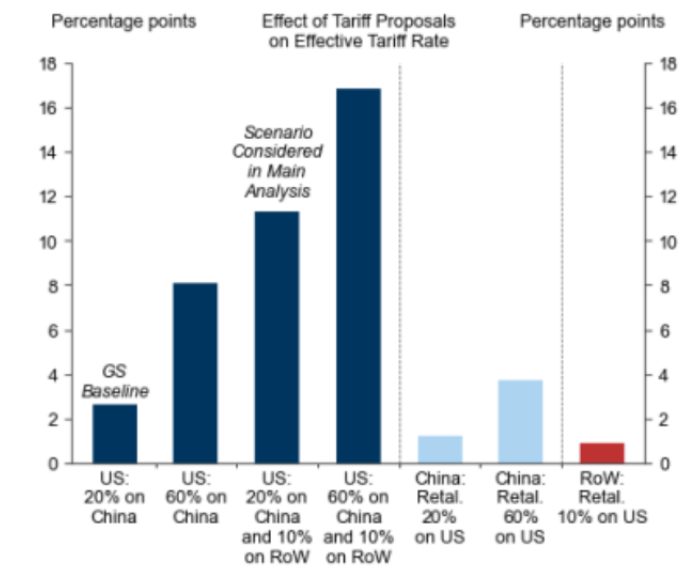
- US effective tariff rate rises +7% from from Mexico & Canada proposals with a further 1% from China proposals
- 2.5% GDP hit in Canada, 3.5% in Mexico under full 25% tariff
- The 25% Canada and Mexico tariffs imply a 0.7% increase in US core PCE prices and 0.4% hit to GDP (US econ team had 0.3% core pce boost in their baseline)
Canada, Mexico, and China account for about half of all US goods imports.

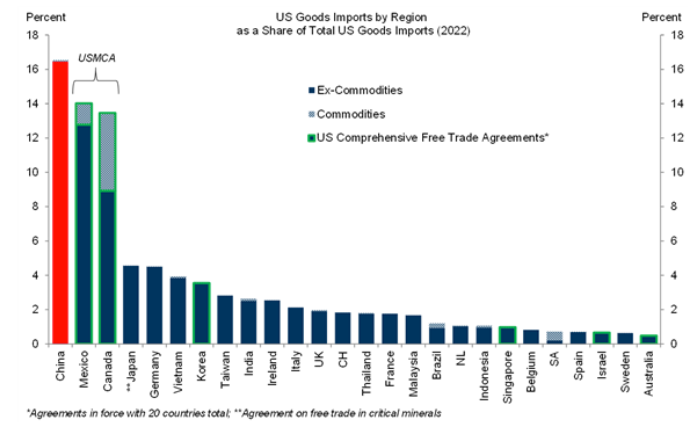
Goldman’s Jack McFerran said weekend tariff shock would raise the US effective tariff rate meaningfully: “We had modeled a 7% overall increase from 25% tariffs on Canada/Mexico (though lower tariff on Canadian oil will lower this a bit). China would add another 1%.”
More context here:
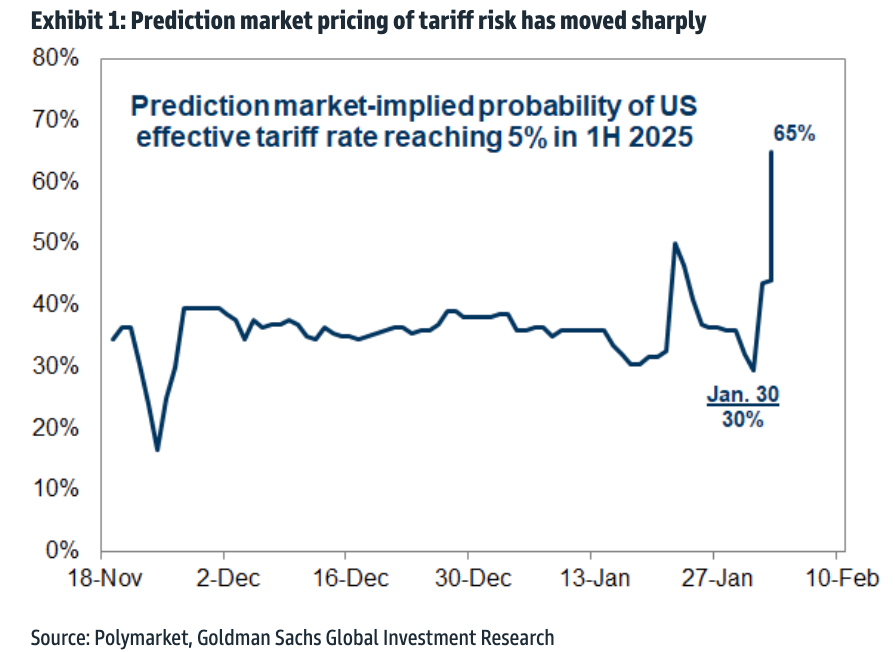
Prediction markets early had a 30% probability of a major tariff increase in the first half of this year. The market-implied probability now – via Polymarket data – has jumped to 65%.
All in all, Trump’s weekend tariff shock announcement is to get major trading partners to the table to solve not just unfair trade – but also – stop fentanyl precursor chemicals from China, flowing into Mexico and Canada, then flowing into the US and killing 100,000 Americans per year.
Bypass Big Tech Censors
Why Bullion Beats Numismatics and Collectible for Your Safe or IRA
Precious metals continue to attract Americans seeking reliable ways to protect their wealth amid inflation, geopolitical risks, and stock market swings. Whether stored in a home safe or held inside a self-directed IRA, physical gold and silver deliver tangible value that paper or digital assets often lack. Yet investors must choose carefully between bullion—pure bars and coins valued mainly for their metal content—and numismatics or collectibles, where rarity, history, and collector demand heavily influence pricing.
Advisor Bullion serves as a dependable source for straightforward, high-quality bullion. The company specializes in physical gold, silver, platinum, and palladium, emphasizing transparent pricing and products that deliver maximum metal content for every dollar spent. This approach makes it ideal for both personal holdings and retirement accounts.
Bullion consists of refined precious metals in standard forms like one-ounce coins (American Gold Eagles, Silver Eagles, Canadian Maple Leafs) or bars. Their value tracks closely to the current spot price of the metal. A typical gold bullion coin trades near the live gold spot price plus a small premium. This structure keeps costs clear and predictable.
Numismatic coins and collectibles add substantial value from factors such as age, rarity, minting errors, or historical significance. A pre-1933 U.S. gold coin or graded proof piece can carry premiums of 30%, 50%, or even 200% above melt value. While this appeals to hobbyists, it creates complexity. Pricing depends on subjective grading, collector trends, and auction results instead of daily spot prices.
For investors focused on wealth preservation and retirement security rather than building a collection, bullion often delivers better results.
Lower Costs and Better Liquidity for Home Storage
When keeping metals in a home safe or private vault, liquidity and efficiency count. Bullion offers clear benefits:
- You acquire more actual gold or silver per dollar invested. Numismatics divert a large share of your money into rarity premiums and massive sales commission, reducing your metal exposure.
- Selling bullion involves tight bid-ask spreads, so you recover nearly full spot value with minimal fees. Collectibles require finding the right buyer and may sell at a discount if demand for that specific item weakens.
- Bullion prices remain transparent and update with global spot markets. You can track gold near current levels or silver accordingly and know exactly where your holdings stand. Numismatic values are priced by the Gold IRA companies with hefty margins applied.
- Standardized coins and bars store efficiently and divide easily for partial sales. Rare coins often need protective slabs and controlled conditions, adding hassle and expense.
- Bullion enjoys worldwide acceptance. A 1-oz Gold Maple Leaf or Silver Eagle sells quickly to dealers anywhere. Niche numismatic pieces may appeal only to limited buyers, slowing liquidation when speed matters.
In times when quick access to value becomes important, bullion’s simplicity stands out.
Stronger Fit for Precious Metals IRAs
Precious metals IRAs continue gaining traction as investors diversify retirement portfolios beyond stocks and bonds. IRS rules permit certain bullion products in self-directed IRAs if they meet purity standards (.995 fine for gold, .999 for silver) and are held by an approved custodian. Eligible items include American Gold and Silver Eagles plus many generic bars and rounds from recognized mints.
Numismatic and most collectible coins generally face heavy scrutiny from custodians due to valuation disputes and elevated markups. These higher premiums mean less actual metal ends up working inside the account.
Bullion avoids these issues. Its value links directly to verifiable spot prices, which simplifies reporting and lowers the risk of regulatory challenges. More of your IRA contribution purchases real metal instead of dealer profits or speculative upside. Over time, owning additional ounces that appreciate with the metal itself can create meaningful outperformance compared with high-premium alternatives that deliver fewer ounces.
Regulatory guidance from the CFTC and state securities offices repeatedly cautions against aggressive sales of expensive numismatics or “semi-numismatic” coins for IRAs. For retirement planning, transparent bullion from established providers reduces risk and aligns better with long-term goals.
How to Get Started with Bullion
Begin by clarifying your goals. Are you protecting savings in a safe, or moving part of a retirement account into a precious metals IRA? Focus on the number of ounces you can acquire at current prices rather than chasing marked-up collectibles.
Diversify sensibly: use gold for core preservation and silver for its blend of industrial and monetary qualities. Mix coins for easier divisibility with bars for lower per-ounce costs on larger buys. Arrange secure storage—whether at home with proper insurance or through professional facilities.
As economic uncertainties linger and faith in conventional assets erodes, bullion continues proving its worth as a dependable store of value. Its direct approach avoids the hype that sometimes surrounds collectible markets and keeps the focus on the metal itself.
For investors prepared to strengthen their portfolios, Advisor Bullion supplies the expertise and selection needed to acquire high-quality bullion efficiently. Whether building personal holdings or integrating metals into an IRA, their emphasis on transparent, investment-grade products helps secure more ounces today that support greater financial security tomorrow. In a complicated financial landscape, bullion’s clarity and reliability make it the smarter foundation for protecting what matters most.


