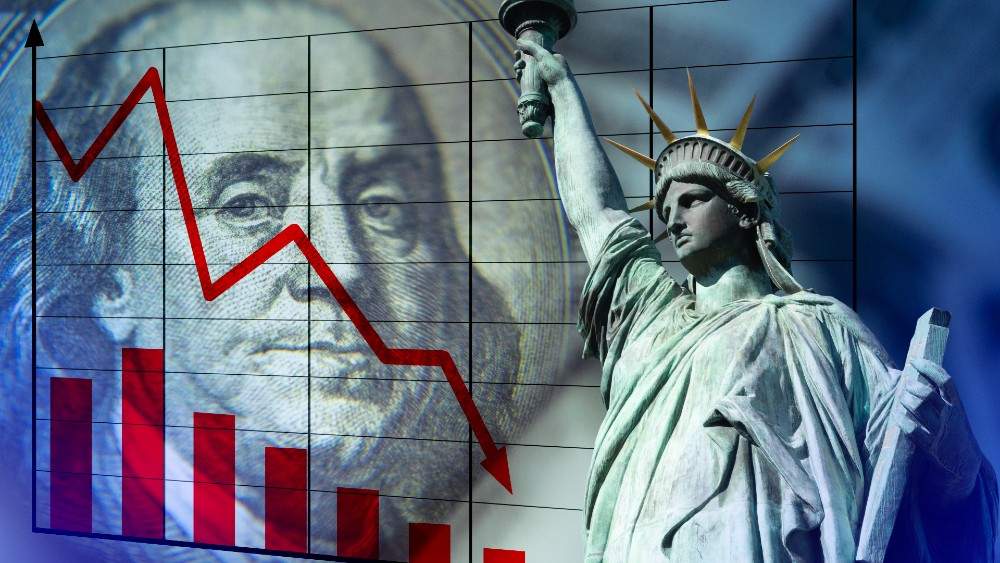
Editor’s Commentary: A reader on one of my Substacks asked a question that I haven’t really thought about answering until now: “…when to get out of the traditional market for those still clinging to the idea that the market will normalize.” I’m often guilty of assuming everyone’s seeing things that I believe are crystal clear. In this case, it’s as close to 100% as possible that there will NOT be a normalization of the markets anytime in the near future. And by near future, I believe it would take an act of God to reverse the course of western economies, including ours, before we reach a sustained and deep recession, possibly even a depression.
Possibly even a full-blown economic collapse.
The reason this is so clear to me is because I see the actions of leaders across the globe, including the Biden-Harris regime, and realize they are NOT going to do anything to prevent the collapse from happening. They WANT it to happen. Only when the system is irreversibly broken can the globalist elite cabal achieve The Great Reset.
Some point to the midterm elections as a way to reverse course. At best, a red wave will slow the bleeding. Even if they take both the House and Senate, they will not be able to pass meaningful economic legislation that doesn’t get vetoed by Joe Biden. They can prevent new legislation similar to the Inflation Reduction Act from getting through, but that’s about it. And unfortunately the feckless Republican Establishment will still be in control with Mitch McConnell and Kevin McCarthy calling the shots, so anyone looking to a post-election economic surge is missing the point.
This is why I’m so bullish about moving investments, wealth, and retirement to precious metals. Those who are familiar with my past work know that I was never big on gold and silver until about a little over a year ago. In the past, I had panned gold and silver because I believed the Trump economy would remain strong, rebounding well after Pandemic Panic Theater ended. I did not expect Biden to “win,” nor did I realize just how rapidly his regime would act to destroy the economy. I’m late to the precious metals game, but I’m trying to make up for it by recommending three America First precious metals companies.
The vast majority of companies that sell gold and silver are either donating to Democrats, working with proxies of the Chinese Communist Party, or both. This is why I only found three out of the two dozen that I vetted that I can recommend because they’re ideologically aligned. As fate would have it, they come in three sizes. Our Gold Guy is a small, family-owned precious metals shop that offers personal service. Genesis Gold Group is mid-sized and is the first one I found that focuses on Christian fellowship. Goldco is the big one.
On today’s episode of The JD Rucker Show, I dove into what to expect with the election. But the portion pertinent to the economy was the final segment, which you can see here if you don’t want to watch the whole show. I referenced the article below by Michael Snyder over at The Economic Collapse Blog…
Things haven’t looked this bad for the U.S. economy since 2008. We are in the midst of the worst inflation crisis in decades, the housing market has started to collapse, some of the largest companies in America have begun laying off workers, and economic activity is slowing down all around us. Of course Joe Biden is telling us that our economy is “strong as hell”, but that is just because he wants his party to do well in the upcoming elections. Ultimately, anyone that takes a truly objective view of things is forced to admit that the outlook for the months ahead is incredibly bleak. The following are 12 reasons why it is impossible for any rational person to be optimistic about the U.S. economy at this point…

#1 According to a recent Gallup survey, two-thirds of Americans believe that economic conditions are getting worse. When such a large proportion of the population starts behaving as though an economic downturn is coming, that actually makes an economic downturn even more likely. So many Americans are starting to hold on to their money more tightly, and that is having lots of ripple effects.
#2 The second largest auto lender in the United States just announced that it “saw charge-offs for retail auto loans quadruple in the third quarter”. We are also seeing credit card delinquencies start to rise. We certainly aren’t at 2008 levels yet, but we are moving in that direction.
#3 Cargo traffic at the Port of Los Angeles just declined to the lowest level that we have seen since the early days of the pandemic. As I noted earlier, economic activity is beginning to slow down all over the nation. One recent survey discovered that 98 percent of corporate CEOs believe that a recession is coming, and those CEOs are behaving accordingly.
#4 Major retailers such as Walmart and Target have been canceling billions of dollars in orders as they seek to cut back inventory levels. In all my years, I have never seen our largest retailers cancel so many orders just prior to the holiday season. Are they expecting the next couple of months to be a total bust?
#5 Existing home sales just fell to a 10 year low. We all knew that the housing market was going to implode once the Federal Reserve started to aggressively raise interest rates, but at this point that implosion is happening faster than most of the experts had anticipated.
#6 U.S. homebuilder sentiment has declined for 10 months in a row. That is a brand new record. I really feel sorry for you if you are a homebuilder or if you work for one. The months ahead are not going to be pleasant for you.
#7 60,000 real estate deals were called off in the month of September alone. I was stunned when I first saw that number. All over the country buyers are realizing that they agreed to pay too much and are feverishly trying to back out of deals while they still can.
#8 Mortgage demand has plunged to the lowest level in 25 years. Things never even got this bad during the downturn of 2008 and 2009. To me, this is a really troubling sign.
#9 Ian Sheperdson, the chief economist at Pantheon Macroeconomics, is projecting that home prices could fall 20 percent over the next year. Hopefully that will not happen, but there is also a possibility that they could fall even further than that. We will just have to wait and see how rapidly this new crisis plays out.
#10 U.S. diesel inventories have fallen to the lowest level since 2008. This is something that we will want to watch very carefully, because the U.S. economy runs on diesel.
#11 The core consumer price index has just surged to “the highest level since 1982”. Even though the Federal Reserve has been on an insane rate hiking spree, our inflation crisis continues to rage out of control. And as prices continue to soar, our standard of living is being absolutely eviscerated.
#12 A model created by Bloomberg economists Anna Wong and Eliza Winger indicates that there is a 100 percent chance of a recession within the next 12 months. Of course it is entirely possible that their model could be wrong. But without a doubt this is not a good sign.

Right now, even some of our society’s most relentless optimists are warning that tough economic times are ahead.
For instance, in a post on Twitter Elon Musk just suggested that we could be suffering through a recession until the spring of 2024…
If Elon Musk is any type of financial prognosticator, the market and economy could be in trouble for more than a year to come.
When prompted in a Twitter thread early on Friday morning, the Tesla CEO said that he thought the current recession would last “probably until spring of ’24”.
Because he is such an optimist, Musk believes that economic conditions will turn around eventually.
But what if they don’t?
What if the “perfect storm” that we are currently enduring ultimately results in the collapse of everything?
Are you prepared for such a scenario?

Previous generations of Americans handed us the keys to the most prosperous economy that the world has ever seen.
But instead of managing it carefully, we have piled up the biggest mountain of debt in the history of the planet, we have transformed Wall Street into the globe’s largest casino, and we have systematically destroyed the reserve currency of the world.
Thanks to a very long series of incredibly foolish decisions by our leaders, we are now facing a war with Russia, a collapse of the housing market, a global food crisis, a global inflation crisis and a worldwide financial meltdown simultaneously.
The entire system is starting to crumble all around us, but most people still believe that things will “return to normal” at some point.
Personally, I would love to see things “return to normal”, but unfortunately it appears that is not likely to happen any time soon.
***It is finally here! Michael’s new book entitled “7 Year Apocalypse” is now available in paperback and for the Kindle on Amazon.***
About the Author: My name is Michael and my brand new book entitled “7 Year Apocalypse” is now available on Amazon.com. In addition to my new book I have written five other books that are available on Amazon.com including “Lost Prophecies Of The Future Of America”, “The Beginning Of The End”, “Get Prepared Now”, and “Living A Life That Really Matters”. (#CommissionsEarned) When you purchase any of these books you help to support the work that I am doing, and one way that you can really help is by sending digital copies as gifts through Amazon to family and friends. Time is short, and I need help getting these warnings into the hands of as many people as possible.
I have published thousands of articles on The Economic Collapse Blog, End Of The American Dream and The Most Important News, and the articles that I publish on those sites are republished on dozens of other prominent websites all over the globe. I always freely and happily allow others to republish my articles on their own websites, but I also ask that they include this “About the Author” section with each article. The material contained in this article is for general information purposes only, and readers should consult licensed professionals before making any legal, business, financial or health decisions.
I encourage you to follow me on social media on Facebook and Twitter, and any way that you can share these articles with others is a great help. These are such troubled times, and people need hope. John 3:16 tells us about the hope that God has given us through Jesus Christ: “For God so loved the world, that he gave his only begotten Son, that whosoever believeth in him should not perish, but have everlasting life.” If you have not already done so, I strongly urge you to ask Jesus to be your Lord and Savior today.
Article cross-posted from The Economic Collapse Blog.
Bypass Big Tech Censors

Two Storms, One Harvest

Every food crisis in living memory has been a one-shock event. The 2008 price spike was a commodity bubble. The 2020 shortages were a logistics failure. The 2022 grain scare was a war on one exporter’s ports. Each time, the system bent, adjusted, and recovered, and each time the experts assured us afterward that global markets are simply too big and too diversified to fail.
What nobody in Washington seems eager to discuss is that 2026 is shaping up to be something the modern food system has never actually faced. Two independent shocks, one climatic and one geopolitical, are converging on the same harvest cycle at the same time. Not sequentially. Simultaneously.
Start with the weather. The Pacific Ocean is currently building toward what forecasters now openly call a record event. NOAA’s Climate Prediction Center puts the odds of at least a strong El Niño near 88 percent, with roughly two in three odds it reaches “very strong” status, the tier reserved for perhaps three or four events in the entire satellite era. Every major global model now projects a median peak in Super El Niño territory, and most of them project it exceeding the 2015-16 event, which until now held the modern record. Sea surface anomalies were already brushing the super threshold in mid-July, months before these events normally peak. The atmosphere has already shifted into El Niño mode, and the event is forecast to crest in late fall and early winter.
This is not about “climate change.” It’s about the standard cycles of weather, and the cycle we’re currently in is one that has likely devastated societies in the past. We’re better prepared as a society today, but not all Americans are equally prepared.
Serious households have started doing the quiet math on their own. Grocery bills tell part of the story, and the forecast maps tell the rest, which is why long-term food storage has moved from fringe hobby to mainstream line item in the family budget, with established suppliers like Heaven’s Harvest seeing demand from people who five years ago would have rolled their eyes at the idea. That instinct is not paranoia. It is pattern recognition, and the pattern is worth walking through carefully.
Editor’s Note: Heaven’s Harvest IS a sponsor, but the warnings of this article are real and would be written even if we didn’t have a survival food sponsor. With that said, those who take advantage of what they offer can use promo code “Patriot” for 15% off.
The Fertilizer Clock Is Already Running
While the Pacific warms, the second shock has been unfolding in the Strait of Hormuz. The conflict with Iran turned the world’s most important energy chokepoint into a contested waterway, and the consequences reach far beyond the gas pump. Roughly a third of global fertilizer trade moves through Hormuz, and the disruption sent urea prices up 86 percent year over year by March, with a 53 percent jump in a single month.
The World Bank projects energy prices rising about 24 percent in 2026 and fertilizer about 31 percent. By its own accounting, fertilizer prices ran 35 percent higher in the first five months of this year than the same period last year.
Here is the mechanism the nightly news will not explain. Fertilizer is not a grocery item. It is a time-delayed input. The nitrogen a farmer in Iowa or Punjab could not afford to apply this spring does not show up as a problem this spring. It shows up as a thinner harvest six to twelve months later.
The World Bank’s own food security brief concedes that the effects of reduced applications earlier this season “are likely to become visible only later in harvest outcomes.” Translate that from institutional language into plain English and it means this. The damage is already done, it is already in the ground, and we are simply waiting for it to arrive on the shelf.
Now check the calendar. Six to twelve months from the spring planting season lands us squarely in late 2026 and early 2027. Which is precisely when the strongest El Niño in the instrumental record is forecast to peak, bringing its signature droughts to Southeast Asia, Australia, southern Africa, northern Brazil, and South Asia, the very regions that grow the world’s rice, sugar, and oilseeds.
The World Bank warns openly that a strong El Niño “could disrupt multiple crop belts simultaneously” on top of the conflict-driven input costs. Their baseline projection assumes the Middle East disruptions ease by autumn. What in the last two years of Middle East history suggests that assumption is safe?
The System Has No Slack Left
The comfortable answer is that global markets always adjust. But adjustment requires slack, and the slack is gone. Global cereal production is expected to decline from last year’s records even before El Niño does its work. The UN World Food Programme, hardly a den of right-wing preppers, is calling this the most significant disruption to its supply chains since Covid and the invasion of Ukraine, and its supply chain director put the stakes bluntly.
Today’s supply chain challenges are tomorrow’s hunger crisis.
There is also a political dimension that markets cannot price. When food gets scarce, governments do not behave like economists. They behave like politicians. Export bans, hoarding mandates, and panic buying at the national level turned the modest rice shortfall of 2008 into a global crisis, and analysts are already warning that import-dependent nations are the first dominoes.
The 2015-16 Super El Niño, a far weaker event than what is now forecast, threw tens of millions into food stress across Africa and Asia. This one is projected to be stronger, and it arrives with fertilizer already rationed by price and shipping lanes already contested by missiles.
What Joseph Knew
Scripture does not treat preparation for lean years as faithlessness. It treats it as wisdom delivered in advance to those willing to act on it.
Behold, there come seven years of great plenty throughout all the land of Egypt: And there shall arise after them seven years of famine; and all the plenty shall be forgotten in the land of Egypt.
Joseph did not respond to that warning with a hashtag or a committee. He stored grain during the years of abundance, and when the famine came, Egypt stood while its neighbors begged. The lesson is not that famine is certain. It is that the time to prepare is precisely when preparation still looks optional.
Nobody who filled a pantry in a year of plenty has ever regretted it, and nobody standing in an empty aisle has ever been glad he waited for certainty.
None of this calls for panic, and panic is the enemy of sound judgment anyway. It calls for the same unglamorous prudence our grandparents considered ordinary. Keep some cash margin, know your local growers, and put real food in deep storage while it is cheap and available, because the entire arc of this story is that cheap and available is a closing window.
Families looking for a straightforward place to start can visit Heaven’s Harvest and use promo code Patriot for 15 percent off long-term storable food. The forecasts may yet soften, the strait may yet reopen, and we should pray they do. But hope is a fine thing to hold and a foolish thing to eat.