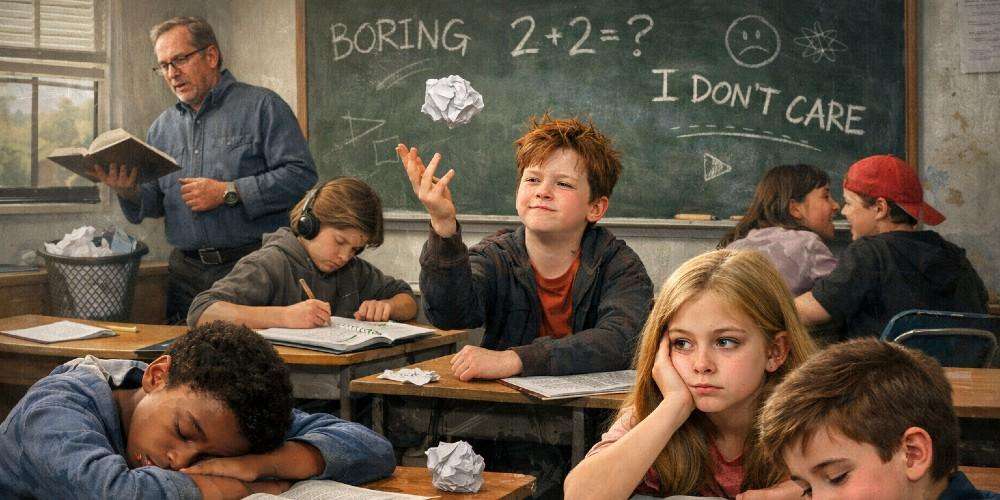
(End of the American Dream)—Virtually everyone agrees that our public schools are in a state of decline. Needless to say, it isn’t because we aren’t spending enough money. The federal government, our state governments and our local governments are collectively spending nearly a trillion dollars a year on public education. That is a colossal pile of money. Since 1960, spending per student has increased by 350 percent. That is even after adjusting for inflation.
At this stage, we spend more money per student than any other nation on the entire planet other than Luxembourg. Anyone that believes that we can solve our education crisis by spending even more money is simply being delusional.
For nearly a trillion dollars a year, we should be getting a world class education system.
But we aren’t.
In fact, students in the U.S. just keep dropping down the global rankings.
Urgent action is required if we are going to turn this around.
Gallup conducted a survey that discovered that an all-time low 35 percent of U.S. adults are satisfied with the quality of public education in the United States.
There appears to be a growing consensus that we have a major national crisis on our hands, and those that are responsible for this crisis need to be held accountable. The following are 16 facts about the shocking decline of public education in the U.S. that every American should know…

#1 Nearly one-fifth of all high school graduates in the United States cannot even read at a functional level…
National statistics indicate that close to one-fifth of high school graduates are unable to read at a functional level. This means they cannot effectively comprehend and use written information in daily life or work settings.
#2 Only 35 percent of high school seniors are proficient at reading, and only 22 percent of high school seniors are proficient at math…
The scale of the crisis is staggering. Only 35% of high school seniors read at a proficient level. One-third lack basic reading comprehension skills. In mathematics, the picture is even bleaker. Only 22% achieved proficiency. Alarmingly, 45% can’t even manage basic math. Around 2/3 are academically unprepared for college in math and reading. Even prestigious universities like Harvard must offer remedial courses for incoming freshmen lacking foundational skills.
#3 For high school seniors in the United States, math scores have fallen to the lowest level since 2005 and reading scores have fallen to the lowest level since 1992…
The latest report card on American education is in, and it’s devastating. The 2025 National Assessment of Educational Progress, released last month, revealed that the nation’s 12th-graders hit a historic performance low. Math scores cratered to levels not seen since 2005. Reading scores plummeted to their lowest level since testing began in 1992.
#4 According to the most recent NAEP assessment, only 28 percent of 8th grade students in the United States are proficient at math…
Only 28% of 8th graders scored proficient in math on the latest NAEP assessment. The effects are most severe in low-income districts, where school closures, chronic absenteeism, and staffing instability have compounded over time.
#5 In just one decade, the percentage of 13-year-olds enrolled in algebra dropped from 34 percent to 24 percent…
According to the OECD, our average student is almost a full year behind the average student from other countries. Singapore’s students are three years ahead of ours. According to the National Assessment of Education Progress (NAEP), our students are also developing slower than in previous years. In 2023, only 24% of America’s 13-year-olds were enrolled in algebra. A decade earlier, that number was 34%.
#6 It appears that the pandemic had a substantial negative impact on both the reading skills and the math skills of our fourth-grade students…
In spring 2023, just 56 percent of American fourth-graders were performing on grade level in math, down from 69 percent in 2019, according to just one example of test score data cited in the report.
Declines in reading were less stark but still concerning, and concentrated in earlier grades, with 65 percent of third-graders performing on grade level, compared with 72 percent in 2019. Recovery in reading has also been slower, with some researchers finding essentially no rebound since students returned to the classroom.
#7 At this point, only 26 percent of U.S. adults can name all three branches of government…
Only 26% of American adults can name the three branches of government. Less than one-quarter of college graduates knew that the First Amendment prohibits Congress from establishing a national religion. Most adults have no idea how many Justices serve on the Supreme Court. Tragically, Princeton University found that barely one-third (36%) of adults could pass a multiple-choice test consisting of questions taken from the U.S. Citizenship Test.
#8 Almost two-thirds of Americans between the ages of 18 and 24 are not able to identify the United Kingdom on a map of the world…
Sixty percent of students could not identify the countries the United States fought in World War II. Only 24% knew why the colonists fought against the British. Only 24% could identify Benjamin Franklin as a Founder with more students (37%) believing that he invented the light bulb. Our students fared no better in basic geography. A National Geographic study found that nearly two-thirds of Americans (ages 18-24) were unable to identify the United Kingdom (one of our most dependable foreign allies) on a world map. Closer to home, most young Americans were unable to identify the state of Ohio on a map.
#9 After climbing for 50 years, student achievement scores peaked in 1967. Sadly, they have been on a downward trend ever since…
The story of American public education’s decline does not begin in 2020 or 2016. According to research cited in Econlib’s comprehensive analysis, the trajectory changed dramatically in 1967. After rising consistently for fifty years, student achievement scores on various standardized tests dropped sharply that year and continued declining through 1980. This represented a devastating loss of educational ground. Students graduating in 1980 had learned approximately 1.25 grade-level equivalents less than their 1967 counterparts, a decline so severe that by the turn of the century, conservative estimates placed the economic growth lost due to diminished academic achievement at 3.6 percent of the 2000 gross national product.
#10 The mental health of U.S. students is deteriorating rapidly. 17 percent of them admit to having symptoms of depression and 20 percent of them have seriously committed suicide…
About 10% of children ages 3 to 17 have anxiety, while 7% have one or more diagnosed behavior disorders. Forty percent of high school students report experiencing persistent feelings of sadness and hopelessness, 17% report symptoms of depression and 20% say they have seriously considered suicide.
#11 The public school system in the U.S. has lost almost two million students since 2012, and it is being projected that another 2.9 million will be lost by 2031…
In 2012, almost 91% of all K-12 students were enrolled in public schools. One decade later, that number had fallen to 87% — a loss of nearly two million students. In its forecast for 2031, the National Center for Education Statistics expects the loss of another 2.9 million students in public schools.
#12 Students cannot learn if they are not in school. Unfortunately, chronic absenteeism jumped from 13 percent before the pandemic to 26 percent after the pandemic…

Chronic absenteeism also remains a big obstacle to learning. Twenty-six percent of students were considered chronically absent in 2022-23, up from 13 percent in 2019-2020.
#13 Our universities are only graduating about 100,000 teachers a year, and less than half of them will actually enter the profession…
The teacher shortage in the United States has reached an unprecedented level, threatening to leave millions of students without qualified educators. The Learning Policy Institute (2024) reports that over 405,000 teaching positions remain vacant nationwide, with projections indicating that this number will double within five years. The crisis is compounded by the fact that American universities will only graduate approximately 100,000 teachers this year, and less than half of them will enter the profession (National Center for Education Statistics [NCES], 2024).
#14 86 percent of U.S. school districts struggle to fill open teaching positions…
School districts throughout the United States are feeling the pain as 86% report struggles with filling open positions and 60% note they have a hard time finding substitute teachers. The shortage is especially acute for schools searching for qualified ESL, STEM, and special education teachers. About 40% of schools report that they have hired underqualified educators, 30% say they have increased class sizes, while 25% of schools have cut course offerings, especially in specialized subjects.
#15 A whopping 60 percent of U.S. teachers have experienced workplace violence, and more than 70 percent of them are dealing with “severe job-related stress”…
A shocking 60% of educators report experiencing workplace violence at least once in their careers, while over 70% struggle with severe job-related stress (American Federation of Teachers, 2024).
#16 Our teachers are not optimistic about our system of education at all. More than 80 percent of them believe that the system has gotten worse, and only 5 percent of them expect conditions to improve in the next five years…
Over 80% of public school teachers say the K-12 education system in the United States has gotten worse in the last five years. Furthermore, over half of educators don’t expect to see improvements in the next five years, with only 5% saying that things will get better.
Our children are supposed to be the future of this nation, and we are failing them.
The system spends way too much time shoving woke ideology down their throats and not nearly enough time teaching them reading, writing and arithmetic.

The truth is that our system of education needs to be rebuilt from the ground up.
That would be very painful, but if we don’t take dramatic action we will continue to fall behind the rest of the world, and that is something that we simply cannot afford to do.
Michael’s new book entitled “10 Prophetic Events That Are Coming Next” is available in paperback and for the Kindle on Amazon.com, and you can subscribe to his Substack newsletter at michaeltsnyder.substack.com.
Bypass Big Tech Censors

Two Storms, One Harvest

Every food crisis in living memory has been a one-shock event. The 2008 price spike was a commodity bubble. The 2020 shortages were a logistics failure. The 2022 grain scare was a war on one exporter’s ports. Each time, the system bent, adjusted, and recovered, and each time the experts assured us afterward that global markets are simply too big and too diversified to fail.
What nobody in Washington seems eager to discuss is that 2026 is shaping up to be something the modern food system has never actually faced. Two independent shocks, one climatic and one geopolitical, are converging on the same harvest cycle at the same time. Not sequentially. Simultaneously.
Start with the weather. The Pacific Ocean is currently building toward what forecasters now openly call a record event. NOAA’s Climate Prediction Center puts the odds of at least a strong El Niño near 88 percent, with roughly two in three odds it reaches “very strong” status, the tier reserved for perhaps three or four events in the entire satellite era. Every major global model now projects a median peak in Super El Niño territory, and most of them project it exceeding the 2015-16 event, which until now held the modern record. Sea surface anomalies were already brushing the super threshold in mid-July, months before these events normally peak. The atmosphere has already shifted into El Niño mode, and the event is forecast to crest in late fall and early winter.
This is not about “climate change.” It’s about the standard cycles of weather, and the cycle we’re currently in is one that has likely devastated societies in the past. We’re better prepared as a society today, but not all Americans are equally prepared.
Serious households have started doing the quiet math on their own. Grocery bills tell part of the story, and the forecast maps tell the rest, which is why long-term food storage has moved from fringe hobby to mainstream line item in the family budget, with established suppliers like Heaven’s Harvest seeing demand from people who five years ago would have rolled their eyes at the idea. That instinct is not paranoia. It is pattern recognition, and the pattern is worth walking through carefully.
Editor’s Note: Heaven’s Harvest IS a sponsor, but the warnings of this article are real and would be written even if we didn’t have a survival food sponsor. With that said, those who take advantage of what they offer can use promo code “Patriot” for 15% off.
The Fertilizer Clock Is Already Running
While the Pacific warms, the second shock has been unfolding in the Strait of Hormuz. The conflict with Iran turned the world’s most important energy chokepoint into a contested waterway, and the consequences reach far beyond the gas pump. Roughly a third of global fertilizer trade moves through Hormuz, and the disruption sent urea prices up 86 percent year over year by March, with a 53 percent jump in a single month.
The World Bank projects energy prices rising about 24 percent in 2026 and fertilizer about 31 percent. By its own accounting, fertilizer prices ran 35 percent higher in the first five months of this year than the same period last year.
Here is the mechanism the nightly news will not explain. Fertilizer is not a grocery item. It is a time-delayed input. The nitrogen a farmer in Iowa or Punjab could not afford to apply this spring does not show up as a problem this spring. It shows up as a thinner harvest six to twelve months later.
The World Bank’s own food security brief concedes that the effects of reduced applications earlier this season “are likely to become visible only later in harvest outcomes.” Translate that from institutional language into plain English and it means this. The damage is already done, it is already in the ground, and we are simply waiting for it to arrive on the shelf.
Now check the calendar. Six to twelve months from the spring planting season lands us squarely in late 2026 and early 2027. Which is precisely when the strongest El Niño in the instrumental record is forecast to peak, bringing its signature droughts to Southeast Asia, Australia, southern Africa, northern Brazil, and South Asia, the very regions that grow the world’s rice, sugar, and oilseeds.
The World Bank warns openly that a strong El Niño “could disrupt multiple crop belts simultaneously” on top of the conflict-driven input costs. Their baseline projection assumes the Middle East disruptions ease by autumn. What in the last two years of Middle East history suggests that assumption is safe?
The System Has No Slack Left
The comfortable answer is that global markets always adjust. But adjustment requires slack, and the slack is gone. Global cereal production is expected to decline from last year’s records even before El Niño does its work. The UN World Food Programme, hardly a den of right-wing preppers, is calling this the most significant disruption to its supply chains since Covid and the invasion of Ukraine, and its supply chain director put the stakes bluntly.
Today’s supply chain challenges are tomorrow’s hunger crisis.
There is also a political dimension that markets cannot price. When food gets scarce, governments do not behave like economists. They behave like politicians. Export bans, hoarding mandates, and panic buying at the national level turned the modest rice shortfall of 2008 into a global crisis, and analysts are already warning that import-dependent nations are the first dominoes.
The 2015-16 Super El Niño, a far weaker event than what is now forecast, threw tens of millions into food stress across Africa and Asia. This one is projected to be stronger, and it arrives with fertilizer already rationed by price and shipping lanes already contested by missiles.
What Joseph Knew
Scripture does not treat preparation for lean years as faithlessness. It treats it as wisdom delivered in advance to those willing to act on it.
Behold, there come seven years of great plenty throughout all the land of Egypt: And there shall arise after them seven years of famine; and all the plenty shall be forgotten in the land of Egypt.
Joseph did not respond to that warning with a hashtag or a committee. He stored grain during the years of abundance, and when the famine came, Egypt stood while its neighbors begged. The lesson is not that famine is certain. It is that the time to prepare is precisely when preparation still looks optional.
Nobody who filled a pantry in a year of plenty has ever regretted it, and nobody standing in an empty aisle has ever been glad he waited for certainty.
None of this calls for panic, and panic is the enemy of sound judgment anyway. It calls for the same unglamorous prudence our grandparents considered ordinary. Keep some cash margin, know your local growers, and put real food in deep storage while it is cheap and available, because the entire arc of this story is that cheap and available is a closing window.
Families looking for a straightforward place to start can visit Heaven’s Harvest and use promo code Patriot for 15 percent off long-term storable food. The forecasts may yet soften, the strait may yet reopen, and we should pray they do. But hope is a fine thing to hold and a foolish thing to eat.