(The Economic Collapse Blog)—We have come to accept that we are permanently trapped in an endless cycle of debt and money creation. But the only reason why debt and money grow at an exponential rate is because that is what our system was designed to do. The Federal Reserve and other central banks around the globe were created with a purpose. The goal was to get humanity into as much debt as possible, and those holding that debt just keep getting wealthier and wealthier. Unfortunately, we have been trained to not even question this deeply insidious arrangement.
Over the past several decades, our money supply has been growing at a pace that we have never seen before.
And once the pandemic hit, the growth of the money supply went into overdrive.
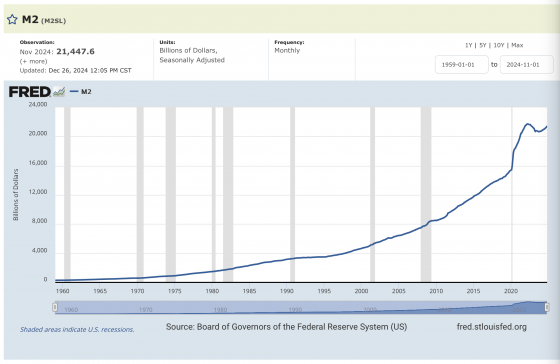
This is why the cost of living is so oppressive today.
There is simply way too much money floating around.
Over the past several decades, our national debt has also been growing at an exponential rate.

The system is designed to produce debt faster than it produces money.
That is why it will never be possible for us to pay off the national debt.
Sadly, most Americans don’t even understand what the Federal Reserve is.
One thing that the Federal Reserve is NOT is a government agency. In fact, it is about as “federal” as Federal Express. It is a private central bank designed to make money for the people who created it. In fact, the Federal Reserve was the culmination of an effort by the international banking elite to force a permanent private central bank on the American people that began all the way back during the days of our Founding Fathers.
But don’t just take my word for it. The following are 21 quotes about central banking from past presidents, congressmen and other notable historical figures…
- John Adams, the second president of the United States: “All the perplexities, confusion and distress in America arise, not from defects in their Constitution or Confederation, not from want of honor or virtue, so much as from the downright ignorance of the nature of coin, credit and circulation.”
- James Madison: “History records that the money changers have used every form of abuse, intrigue, deceit, and violent means possible to maintain their control over governments by controlling money and it’s issuance.”
- Thomas Jefferson: “I believe that banking institutions are more dangerous to our liberties than standing armies. Already they have raised up a monied aristocracy that has set the government at defiance. The issuing power (of money) should be taken away from the banks and restored to the people to whom it properly belongs.”
- Abraham Lincoln: “The money powers prey upon the nation in times of peace and conspire against it in times of adversity. It is more despotic than a monarchy, more insolent than autocracy, and more selfish than bureaucracy. It denounces as public enemies all who question its methods or throw light upon its crimes. I have two great enemies, the Southern Army in front of me and the bankers in the rear. Of the two, the one at my rear is my greatest foe.”
- James A. Garfield: “Whoever controls the volume of money in any country is absolute master of all industry and commerce.”
- Woodrow Wilson: “A great industrial nation is controlled by it’s system of credit. Our system of credit is concentrated in the hands of a few men. We have come to be one of the worst ruled, one of the most completely controlled and dominated governments in the world–no longer a government of free opinion, no longer a government by conviction and vote of the majority, but a government by the opinion and duress of small groups of dominant men.”
- Mayer Amschel Bauer Rothschild: “Give me control of a nation’s money and I care not who makes it’s laws”
- Horace Greeley: “While boasting of our noble deeds were careful to conceal the ugly fact that by an iniquitous money system we have nationalized a system of oppression which, though more refined, is not less cruel than the old system of chattel slavery.”
- Sir Josiah Stamp, the former President of the Bank of England: “Bankers own the earth. Take it away from them, but leave them the power to create money and control credit, and with a flick of a pen they will create enough to buy it back.”
- Rothschild Brothers of London, 1863: “The few who understand the system, will either be so interested from it’s profits or so dependent on its favors, that there will be no opposition from that class.”
- Charles A. Lindbergh Sr. in 1913: “This [Federal Reserve Act] establishes the most gigantic trust on earth. When the President [Wilson} signs this bill, the invisible government of the monetary power will be legalized….the worst legislative crime of the ages is perpetrated by this banking and currency bill.”
- Charles A. Lindbergh Sr. in 1923: “The financial system has been turned over to the Federal Reserve Board. That Board administers the finance system by authority of a purely profiteering group. The system is Private, conducted for the sole purpose of obtaining the greatest possible profits from the use of other people’s money”
- Congressman Louis T. McFadden: “The Federal Reserve banks are one of the most corrupt institutions the world has ever seen. There is not a man within the sound of my voice who does not know that this nation is run by the International bankers.”
- Congressman Louis T. McFadden in 1932 just before FDR began his first term: “We have, in this country, one of the most corrupt institutions the world has ever known. I refer to the Federal Reserve Board. This evil institution has impoverished the people of the United States and has practically bankrupted our government. It has done this through the corrupt practices of the moneyed vultures who control it.”
- Franklin Delano Roosevelt: “The real truth of the matter is, as you and I know, that a financial element in the large centers has owned the government of the U.S. since the days of Andrew Jackson.”
- Eustace Mullins: “As soon as Mr. Roosevelt took office, the Federal Reserve began to buy government securities at the rate of ten million dollars a week for 10 weeks, and created one hundred million dollars in new [checkbook] currency, which alleviated the critical famine of money and credit, and the factories started hiring people again.”
- Congressman Wright Patman, Congressional Record, Sept 30, 1941: “The Federal Reserve bank buys government bonds without one penny…”
- Senator Barry Goldwater: “Most Americans have no real understanding of the operation of the international money lenders. The accounts of the Federal Reserve System have never been audited. It operates outside the control of Congress and manipulates the credit of the United States.”
- Henry Ford: It is well that the people of the nation do not understand our banking and monetary system, for if they did, I believe there would be a revolution before tomorrow morning.”
- Lewis vs. United States, 680 F. 2d 1239 9th Circuit 1982: “The regional Federal Reserve banks are not government agencies. …but are independent, privately owned and locally controlled corporations.”
- Boston Federal Reserve Bank: “When you or I write a check there must be sufficient funds in our account to cover the check, but when the Federal Reserve writes a check there is no bank deposit on which that check is drawn. When the Federal Reserve writes a check, it is creating money.”
Why isn’t this one of the biggest political issues in the country today?
The Federal Reserve is at the center of a controversy over central banking that has been around since the very beginning of the United States. Unfortunately, the Federal Reserve system is so incredibly complex and the American people have been so “dumbed down” that the vast majority of the population literally has no idea how our system really works.
If we do nothing, things will continue to get even worse for ordinary Americans.
In 2001, 17 million people were on food stamps.
Today, more than 42 million people are on food stamps…
Food stamp enrollment has increased significantly in recent decades.
In fiscal year 2023, 42.1 million Americans received food stamps. This is 2.4 times the 17.3 million who were enrolled in FY 2001.
As the number of people receiving food stamp benefits has increased, the percentage of the U.S. population enrolled has also increased.
In fiscal year 2023, 12.6 percent of the total U.S. population received food stamp benefits. This is more than double the 6.1 percent in FY 2001.
One out of every four children in America now gets assistance from food stamps each month. In fact, it is projected that half of all U.S. kids will be on food stamps at some point in their lives.
Our entire system is designed to funnel wealth to those at the very top of the pyramid at the expense of everyone else.
I have been writing about the evils of the Federal Reserve system for more than a decade, but sometimes it feels like I am banging my head into a wall.
What will it take for the American people to finally wake up?

Michael’s new book entitled “Why” is available in paperback and for the Kindle on Amazon.com, and you can subscribe to his Substack newsletter at michaeltsnyder.substack.com.
Bypass Big Tech Censors

Two Storms, One Harvest

Every food crisis in living memory has been a one-shock event. The 2008 price spike was a commodity bubble. The 2020 shortages were a logistics failure. The 2022 grain scare was a war on one exporter’s ports. Each time, the system bent, adjusted, and recovered, and each time the experts assured us afterward that global markets are simply too big and too diversified to fail.
What nobody in Washington seems eager to discuss is that 2026 is shaping up to be something the modern food system has never actually faced. Two independent shocks, one climatic and one geopolitical, are converging on the same harvest cycle at the same time. Not sequentially. Simultaneously.
Start with the weather. The Pacific Ocean is currently building toward what forecasters now openly call a record event. NOAA’s Climate Prediction Center puts the odds of at least a strong El Niño near 88 percent, with roughly two in three odds it reaches “very strong” status, the tier reserved for perhaps three or four events in the entire satellite era. Every major global model now projects a median peak in Super El Niño territory, and most of them project it exceeding the 2015-16 event, which until now held the modern record. Sea surface anomalies were already brushing the super threshold in mid-July, months before these events normally peak. The atmosphere has already shifted into El Niño mode, and the event is forecast to crest in late fall and early winter.
This is not about “climate change.” It’s about the standard cycles of weather, and the cycle we’re currently in is one that has likely devastated societies in the past. We’re better prepared as a society today, but not all Americans are equally prepared.
Serious households have started doing the quiet math on their own. Grocery bills tell part of the story, and the forecast maps tell the rest, which is why long-term food storage has moved from fringe hobby to mainstream line item in the family budget, with established suppliers like Heaven’s Harvest seeing demand from people who five years ago would have rolled their eyes at the idea. That instinct is not paranoia. It is pattern recognition, and the pattern is worth walking through carefully.
Editor’s Note: Heaven’s Harvest IS a sponsor, but the warnings of this article are real and would be written even if we didn’t have a survival food sponsor. With that said, those who take advantage of what they offer can use promo code “Patriot” for 15% off.
The Fertilizer Clock Is Already Running
While the Pacific warms, the second shock has been unfolding in the Strait of Hormuz. The conflict with Iran turned the world’s most important energy chokepoint into a contested waterway, and the consequences reach far beyond the gas pump. Roughly a third of global fertilizer trade moves through Hormuz, and the disruption sent urea prices up 86 percent year over year by March, with a 53 percent jump in a single month.
The World Bank projects energy prices rising about 24 percent in 2026 and fertilizer about 31 percent. By its own accounting, fertilizer prices ran 35 percent higher in the first five months of this year than the same period last year.
Here is the mechanism the nightly news will not explain. Fertilizer is not a grocery item. It is a time-delayed input. The nitrogen a farmer in Iowa or Punjab could not afford to apply this spring does not show up as a problem this spring. It shows up as a thinner harvest six to twelve months later.
The World Bank’s own food security brief concedes that the effects of reduced applications earlier this season “are likely to become visible only later in harvest outcomes.” Translate that from institutional language into plain English and it means this. The damage is already done, it is already in the ground, and we are simply waiting for it to arrive on the shelf.
Now check the calendar. Six to twelve months from the spring planting season lands us squarely in late 2026 and early 2027. Which is precisely when the strongest El Niño in the instrumental record is forecast to peak, bringing its signature droughts to Southeast Asia, Australia, southern Africa, northern Brazil, and South Asia, the very regions that grow the world’s rice, sugar, and oilseeds.
The World Bank warns openly that a strong El Niño “could disrupt multiple crop belts simultaneously” on top of the conflict-driven input costs. Their baseline projection assumes the Middle East disruptions ease by autumn. What in the last two years of Middle East history suggests that assumption is safe?
The System Has No Slack Left
The comfortable answer is that global markets always adjust. But adjustment requires slack, and the slack is gone. Global cereal production is expected to decline from last year’s records even before El Niño does its work. The UN World Food Programme, hardly a den of right-wing preppers, is calling this the most significant disruption to its supply chains since Covid and the invasion of Ukraine, and its supply chain director put the stakes bluntly.
Today’s supply chain challenges are tomorrow’s hunger crisis.
There is also a political dimension that markets cannot price. When food gets scarce, governments do not behave like economists. They behave like politicians. Export bans, hoarding mandates, and panic buying at the national level turned the modest rice shortfall of 2008 into a global crisis, and analysts are already warning that import-dependent nations are the first dominoes.
The 2015-16 Super El Niño, a far weaker event than what is now forecast, threw tens of millions into food stress across Africa and Asia. This one is projected to be stronger, and it arrives with fertilizer already rationed by price and shipping lanes already contested by missiles.
What Joseph Knew
Scripture does not treat preparation for lean years as faithlessness. It treats it as wisdom delivered in advance to those willing to act on it.
Behold, there come seven years of great plenty throughout all the land of Egypt: And there shall arise after them seven years of famine; and all the plenty shall be forgotten in the land of Egypt.
Joseph did not respond to that warning with a hashtag or a committee. He stored grain during the years of abundance, and when the famine came, Egypt stood while its neighbors begged. The lesson is not that famine is certain. It is that the time to prepare is precisely when preparation still looks optional.
Nobody who filled a pantry in a year of plenty has ever regretted it, and nobody standing in an empty aisle has ever been glad he waited for certainty.
None of this calls for panic, and panic is the enemy of sound judgment anyway. It calls for the same unglamorous prudence our grandparents considered ordinary. Keep some cash margin, know your local growers, and put real food in deep storage while it is cheap and available, because the entire arc of this story is that cheap and available is a closing window.
Families looking for a straightforward place to start can visit Heaven’s Harvest and use promo code Patriot for 15 percent off long-term storable food. The forecasts may yet soften, the strait may yet reopen, and we should pray they do. But hope is a fine thing to hold and a foolish thing to eat.