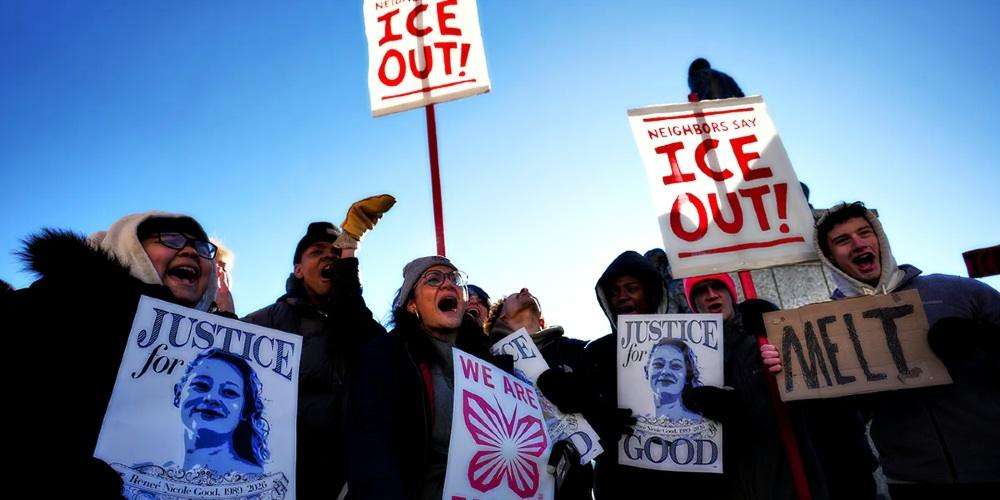
(End of the American Dream)—The stage is being set for one of the most dramatic years of civil unrest that any of us have ever seen. In major cities all over the United States, vast numbers of far left activists are being recruited for “rapid response teams” that seek to disrupt ICE operations as much as possible. Of course when members of these “rapid response teams” confront ICE officers, violence often erupts. We have already seen so many examples of this, but there is no way that the left is going to back down now. Instead, they plan to take things to an entirely new level in the months ahead.
Of course it is against the law to try to prevent federal law enforcement officers from carrying out their duties, but these far left radicals don’t seem to care.
In New York City, an “army” of over 4,000 anti-ICE activists is currently being created…
New York City socialists are mustering an army of more than 4,000 anti-ICE activists to form “rapid response” battalions and obstruct the feds in an expected imminent crackdown on illegal migrants in the Big Apple.
Mayor Mamdani’s comrades with the DSA outlined the mission Thursday at a monthly meeting of their Immigrant Justice Working Group in the swanky Midtown digs of the Chinese Communist Party-linked People’s Forum, where photos of communist idols Fidel Castro and Che Guevara decorate the walls.
In Chicago, more than a dozen “rapid response teams” have already been formed…
- Aurora Rapid Response Team
- Berwyn-Cicero Rapid Response Network
- Chicago Far South Side Rapid Response
- Chinatown/Bridgeport ICE Watch, led by the Coalition for a Better Chinese American Community
- DeKalb Area Rapid Response Team
- Immigrant Solidarity DuPage
- Kenwood-Hyde Park-Woodlawn Rapid Response Team
- La Villita Se Defiende
- Northside Lakefront Rapid Response Team (Uptown, Edgewater, Lakeview and Lincoln Park)
- Northwest Side Rapid Response Team
- PASO, or the West Suburban Action Project, conducts Know Your Rights workshops, rapid response, and trainings for rapid responders looking to support Chicago-area suburbs like Cicero, Berwyn, Melrose Park and more.
- Protect Rogers Park
- Southeast Side Rapid Response Team
- Southland Rapid Response Team (Blue Island, Crestwood, Alsip)
- Southwest Rapid Response
In Minnesota, a “centralized rapid response network” was developed long before the current violence erupted…
During the months preceding the surge of ICE agents to the Twin Cities, local people and organizations created a relatively centralized rapid response network, in which observers would submit sightings with varying levels of substantiation to an admin on a mass text system. As soon as admins could intake, reformat, and verify the reports, they would blast it out on the system and people nearby would converge. This seemed to work for turning people out to major operations, like a raid on an apartment complex, but began to falter as ICE experimented with faster, more lightweight operations.
Many of these anti-ICE activists are hardcore radicals that are not afraid to use force.
On Saturday, Senate candidate Jake Lang was viciously assaulted by a “large leftist mob”…
Social media is being flooded with multiple instances of conservative commentators, protesters and also unaffiliated bystanders being assaulted and some nearly killed. This includes former J6 prisoner and “controversial” Florida Senate candidate Jake Lang, who was rushed by a large leftist mob, cornered, beaten and reportedly stabbed.
Lang was attacked following a speech he gave a the Minneapolis City Hall for his “March Against Fraud”. There were no Minneapolis police to be found during the incident. Lang was struck over the head several times with various weapons, and had to be hospitalized for severe lacerations and cranial bleeding. Keep in mind, this attack was for Lang simply giving a speech.
Whether or not one agrees with Lang’s views on immigration and race, he has the right to voice them without being nearly murdered.
Lang should be very thankful that he was not killed.

It could have happened so easily, because these radicals are not messing around.
On Sunday, anti-ICE protesters in Minnesota stormed a Baptist church…
One of the members of the church posted after the incident, “ICE protestors invaded my church this morning. They stormed in right as the sermon started, surrounded the congregation, and started shouting obscenities and their disgusting slogans. As the children started crying, this seemed to enrage one man even more and he started screaming about how we are ‘privileged pigs.’”
“It’s hard to know what to say or do in a situation like this but the congregation began to pray, read Scripture, and sing. Eventually we were told to move to another part of the church and the protestors were cleared out,” the person added. “I don’t know what kind of person can do something this disordered and evil but I keep thinking Father forgive them for they know not what they do. Pray for Minnesota.”
How would you respond if this happened in your church?
With the way that things are going in this country, that could really happen.
Shockingly, Don Lemon was actually “embedded with the protesters” as they came storming into the church…
Former CNN host Don Lemon had been embedded with the protestors as they stormed the church, claiming that he was “not part of the activists, but we’re here just reporting on them.” As the activists shouted and interrupted the service, Lemon said, “so this is what the First Amendment is about, about the freedom to protest.” The Department of Justice’s Civil Rights Division is investigating potential violations of the FACE Act in response to the incident, which prohibits obstructing, injuring, or intimidating people who are exercising their First Amendment right of religious freedom at a place of worship.
Don Lemon seems to think that he will be able to avoid prosecution by claiming that he was simply “reporting” on the protest.
We’ll see how that works out.
Another one of the individuals that stormed the church is a member of a school board in St. Paul, and she claims that she would do it again if given another opportunity…
Chauntyll Allen, leader of Black Lives Matter Twin Cities, who was among the group, tells TMZ … the jarring protest inside the church was necessary to make clear to the parishioners that having a pastor who is also an ICE official is unacceptable.
Chauntyll, who’s also a St. Paul School Board member, argues the community is being ripped apart by ICE … so the group disrupting a church service — and upsetting some parishioners — in comparison is pretty small potatoes.
The protesters have been dragged by people on the Right for going inside the church … but Chauntyll tells us she doesn’t think a line was crossed … and she would do it again if given the opportunity.
This is how crazy things have become.
The streets of the Twin Cities have been turned into a war zone, and the police are just standing aside and watching.
On Monday, a crowd of anti-ICE women stormed a Target in St. Paul and demanded that ICE agents be prevented from using the store’s bathrooms…

An incident like that is pretty funny, but what isn’t funny is that some anti-ICE radicals are now starting to break out their guns.

In fact, one anti-ICE protester in St. Paul was just filmed carrying around a rifle…
Disturbing footage out of St. Paul, Minnesota, shows a rotund man standing guard in a neighborhood armed with a rifle, a wild escalation in leftists’ protest tactics against ICE.
The footage, seen over 7.6 million times as of writing, features a man armed with a rifle and a suppressor, as he tells reporters he’s protecting his community.
“Do you live in the neighborhood?” a reporter asks him.
“Yep, this is my block. This is my area. I don’t go into other people’s neighborhoods and try to intimidate them, right? I protect my people.”
Meanwhile, 1,500 U.S. troops have been ordered to get ready for a potential deployment to the Twin Cities…
The Pentagon has ordered about 1,500 troops to prepare for a possible deployment to Minnesota, as the state reels from intensifying anti-ICE protests after the fatal shooting of Renee Nicole Good.
President Donald Trump has threatened to invoke the Insurrection Act in response to the unrest, and two battalions of the 11th Airborne Division were placed on prepare-to-deploy orders in case he does so, two defense officials told NBC News.
So what happens if anti-ICE radicals start taking shots at U.S. soldiers that have been deployed to Minnesota and those soldiers start firing back?
Once Americans begin killing Americans in the streets, things could spiral out of control very rapidly.
Of course the truth is that people are already getting hit by bullets.
Just last night, two police officers in Portland were shot as an anti-ICE mob rioted at an ICE facility in Portland…

On Monday, January 19, 2026 at 8:21 p.m., Portland Police Officers assigned to North Precinct responded to the area of Northeast 21st Avenue and Northeast Clackamas Street to a report of a threat with weapon call. Officers arrived and located the suspect on Northeast Clackamas Street between Northeast 16th Avenue and Northeast 17th Avenue.
The suspect fired shots at the officers, striking two of them. The officers were transported to the hospital by ambulance, treated, and their conditions are stable.
The suspect ran off and numerous officers set up a perimeter around the area in an effort to contain the suspect.
This is just the start of the chaos.
The radical left’s “rapid response teams” aren’t going to back down.
Neither will the Trump administration.
Widespread civil unrest is in our immediate future, and it isn’t going to be pretty.
***People in more than 100 different nations are exposed to the truth through Michael Snyder’s Substack each week. When you choose to become a paid subscriber you make yourself part of that effort. It is when times are the darkest that the most light is needed, and those of you that are paid subscribers make this operation possible.***
Comments About This Story Through X:
We are switching to using X as our comment “system.” Our hope is that by using that public forum, more of our readers will be willing to share their thoughts.
Bypass Big Tech Censors
Two Storms, One Harvest

Every food crisis in living memory has been a one-shock event. The 2008 price spike was a commodity bubble. The 2020 shortages were a logistics failure. The 2022 grain scare was a war on one exporter’s ports. Each time, the system bent, adjusted, and recovered, and each time the experts assured us afterward that global markets are simply too big and too diversified to fail.
What nobody in Washington seems eager to discuss is that 2026 is shaping up to be something the modern food system has never actually faced. Two independent shocks, one climatic and one geopolitical, are converging on the same harvest cycle at the same time. Not sequentially. Simultaneously.
Start with the weather. The Pacific Ocean is currently building toward what forecasters now openly call a record event. NOAA’s Climate Prediction Center puts the odds of at least a strong El Niño near 88 percent, with roughly two in three odds it reaches “very strong” status, the tier reserved for perhaps three or four events in the entire satellite era. Every major global model now projects a median peak in Super El Niño territory, and most of them project it exceeding the 2015-16 event, which until now held the modern record. Sea surface anomalies were already brushing the super threshold in mid-July, months before these events normally peak. The atmosphere has already shifted into El Niño mode, and the event is forecast to crest in late fall and early winter.
This is not about “climate change.” It’s about the standard cycles of weather, and the cycle we’re currently in is one that has likely devastated societies in the past. We’re better prepared as a society today, but not all Americans are equally prepared.
Serious households have started doing the quiet math on their own. Grocery bills tell part of the story, and the forecast maps tell the rest, which is why long-term food storage has moved from fringe hobby to mainstream line item in the family budget, with established suppliers like Heaven’s Harvest seeing demand from people who five years ago would have rolled their eyes at the idea. That instinct is not paranoia. It is pattern recognition, and the pattern is worth walking through carefully.
Editor’s Note: Heaven’s Harvest IS a sponsor, but the warnings of this article are real and would be written even if we didn’t have a survival food sponsor. With that said, those who take advantage of what they offer can use promo code “Patriot” for 15% off.
The Fertilizer Clock Is Already Running
While the Pacific warms, the second shock has been unfolding in the Strait of Hormuz. The conflict with Iran turned the world’s most important energy chokepoint into a contested waterway, and the consequences reach far beyond the gas pump. Roughly a third of global fertilizer trade moves through Hormuz, and the disruption sent urea prices up 86 percent year over year by March, with a 53 percent jump in a single month.
The World Bank projects energy prices rising about 24 percent in 2026 and fertilizer about 31 percent. By its own accounting, fertilizer prices ran 35 percent higher in the first five months of this year than the same period last year.
Here is the mechanism the nightly news will not explain. Fertilizer is not a grocery item. It is a time-delayed input. The nitrogen a farmer in Iowa or Punjab could not afford to apply this spring does not show up as a problem this spring. It shows up as a thinner harvest six to twelve months later.
The World Bank’s own food security brief concedes that the effects of reduced applications earlier this season “are likely to become visible only later in harvest outcomes.” Translate that from institutional language into plain English and it means this. The damage is already done, it is already in the ground, and we are simply waiting for it to arrive on the shelf.
Now check the calendar. Six to twelve months from the spring planting season lands us squarely in late 2026 and early 2027. Which is precisely when the strongest El Niño in the instrumental record is forecast to peak, bringing its signature droughts to Southeast Asia, Australia, southern Africa, northern Brazil, and South Asia, the very regions that grow the world’s rice, sugar, and oilseeds.
The World Bank warns openly that a strong El Niño “could disrupt multiple crop belts simultaneously” on top of the conflict-driven input costs. Their baseline projection assumes the Middle East disruptions ease by autumn. What in the last two years of Middle East history suggests that assumption is safe?
The System Has No Slack Left
The comfortable answer is that global markets always adjust. But adjustment requires slack, and the slack is gone. Global cereal production is expected to decline from last year’s records even before El Niño does its work. The UN World Food Programme, hardly a den of right-wing preppers, is calling this the most significant disruption to its supply chains since Covid and the invasion of Ukraine, and its supply chain director put the stakes bluntly.
Today’s supply chain challenges are tomorrow’s hunger crisis.
There is also a political dimension that markets cannot price. When food gets scarce, governments do not behave like economists. They behave like politicians. Export bans, hoarding mandates, and panic buying at the national level turned the modest rice shortfall of 2008 into a global crisis, and analysts are already warning that import-dependent nations are the first dominoes.
The 2015-16 Super El Niño, a far weaker event than what is now forecast, threw tens of millions into food stress across Africa and Asia. This one is projected to be stronger, and it arrives with fertilizer already rationed by price and shipping lanes already contested by missiles.
What Joseph Knew
Scripture does not treat preparation for lean years as faithlessness. It treats it as wisdom delivered in advance to those willing to act on it.
Behold, there come seven years of great plenty throughout all the land of Egypt: And there shall arise after them seven years of famine; and all the plenty shall be forgotten in the land of Egypt.
Joseph did not respond to that warning with a hashtag or a committee. He stored grain during the years of abundance, and when the famine came, Egypt stood while its neighbors begged. The lesson is not that famine is certain. It is that the time to prepare is precisely when preparation still looks optional.
Nobody who filled a pantry in a year of plenty has ever regretted it, and nobody standing in an empty aisle has ever been glad he waited for certainty.
None of this calls for panic, and panic is the enemy of sound judgment anyway. It calls for the same unglamorous prudence our grandparents considered ordinary. Keep some cash margin, know your local growers, and put real food in deep storage while it is cheap and available, because the entire arc of this story is that cheap and available is a closing window.
Families looking for a straightforward place to start can visit Heaven’s Harvest and use promo code Patriot for 15 percent off long-term storable food. The forecasts may yet soften, the strait may yet reopen, and we should pray they do. But hope is a fine thing to hold and a foolish thing to eat.