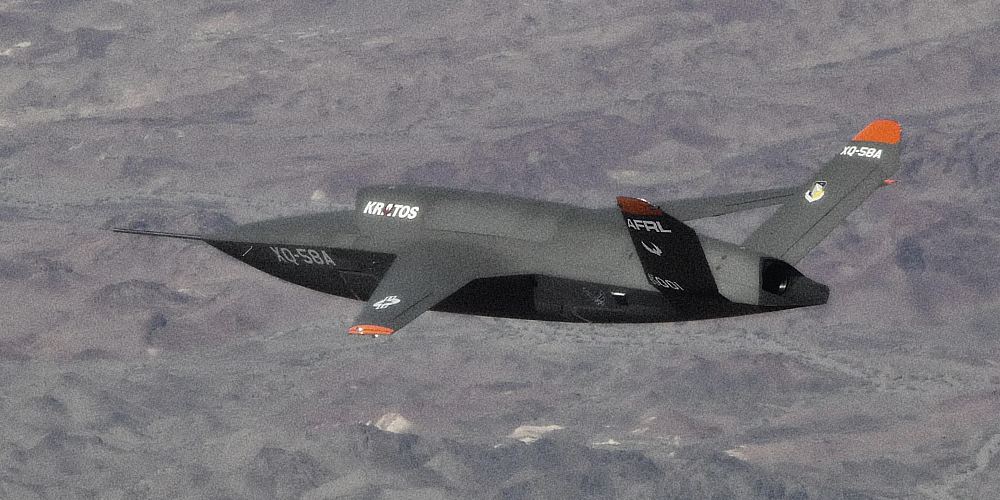
- Kratos Defense and Security has confirmed that it successfully completed the first flight of its Thanatos stealth UCAV.
- The company’s next tests will focus on the Thanatos’ integrated systems and their ability to meet mission requirements as stipulated by the Department of Defense.
- While not being confirmed, it is strongly suggested that the Thanatos is being built to serve with the U.S. Air Force.
- Kratos is also developing other combat drones for the U.S. Armed Forces, particularly the XQ-58 Valkyrie stealth UCAV, which could serve with the Air Force and Marine Corps in the next few years.
(Natural News)—Kratos Defense and Security has confirmed the successful first flight of its stealthy unmanned combat aerial vehicle (UCAV), the Thanatos.
The exact date of the flight was not disclosed due to the sensitive nature of the project. The flight was conducted to validate the aircraft’s basic aerodynamic design, marking a significant milestone in the development of the highly classified stealth drone program.
Steve Fendley, president of Kratos’ Unmanned Systems Division, stated that the drone’s flight abilities have been effectively proven. The company is now shifting its focus to testing Thanatos’ integrated systems to ensure it meets mission requirements.
“We’re not trying to figure out ‘Does the airplane fly?’ We’re now trying to figure out ‘Does the integrated system tick the mission box?'” Fendley said. (Related: Mysterious drones swarmed a U.S. military airbase for 17 days; officials say they don’t know who operated them.)
The Thanatos UCAV was first unveiled in November 2023 through a 3D artist’s rendering included in Kratos’ financial report. The design features a single-engine, tailless configuration with a diamond-shaped wing, blended air inlets and a recessed engine exhaust, all of which contribute to its low-observability characteristics. The aircraft’s design also lacks traditional vertical and horizontal stabilizers, reflecting Kratos’ emphasis on stealth technology.
Kratos likely to sell Thanatos to the Air Force
While the identity of the customer for the Thanatos remains undisclosed, the aircraft’s design includes both the markings for Kratos and the United States Air Force, strongly suggesting that the drone’s first operator will be the Air Force.
The company has expressed strong interest in the upcoming Increment 2 of the Air Force’s Collaborative Combat Aircraft (CCA) program, which aims to integrate unmanned assets with Next Generation Air Dominance (NGAD) platforms.
The CCA program, also referred to as the “Loyal Wingman” concept, envisions unmanned aircraft operating alongside crewed fighters to enhance mission effectiveness. Fendley highlighted the potential of CCAs to augment fifth-generation fighter aircraft and offboard systems from fourth-generation aircraft, particularly in electronic warfare to improve survivability.

Kratos has prior experience developing UCAVs under the CCA program, specifically with its experimental XQ-58 Valkyrie stealth UCAV, which is currently in testing with the Air Force and the Marine Corps.
The Valkyrie, which is runway-independent and capable of launching via rockets or a trolley, has demonstrated its operational relevance during exercises like Emerald Flag in October 2024. During this mission, the Valkyrie successfully passed targeting data to Marine Corps F-35Bs, marking a significant step in closing the kill chain.
Fendley noted that the Department of Defense has increasingly prioritized runway independence, a feature that Kratos has incorporated into its UCAV designs. While it is unclear whether the Thanatos will share this capability, the company is exploring conventional takeoff and landing systems with retractable gear.
In terms of manufacturing, Kratos has designed its UCAVs with scalability in mind. A study on the feasibility of a 1,000-unit production run for the Valkyrie revealed that propulsion systems would be the primary constraint. Kratos is collaborating with GE Aerospace to develop scalable engines for future systems, including CCAs.
Watch this Dec. 17 episode of “Brighteon Broadcast News” as Mike Adams, the Health Ranger, discusses the possible use of drones with radar invisibility technology in the United States.
This video is from the Health Ranger Report channel on Brighteon.com.
More related stories:
- Mach 7 drone illustrates China’s latest leap in hypersonic technology.
- Ukraine claims to be developing “unstoppable” AI-controlled drones that can attack targets on the battlefield.
- Iran has developed a new, high-tech combat drone for Russia to use in Ukraine.
- Fully autonomous KILLER DRONES now closer to reality as rapid development of AI continues.
- Advanced swarming drones operated by U.K. defense ministry ready for deployment within months.
Sources include:
Bypass Big Tech Censors

Starting the Day With a Scripture-Inspired Roast Helps Center Your Thoughts on Eternal Truths Amid Temporal Pressures
The world can seem chaotic, especially right after we wake up. Many believers start their mornings reaching for something familiar — a hot cup of coffee — yet end up settling for mediocre brews that do little more than deliver a caffeine jolt. The daily grind of life, with its endless distractions, news cycles, and responsibilities, can leave even the most faithful feeling spiritually parched alongside their physical fatigue. What if your morning ritual could do more than wake you up? What if it could ground you in truth, nourish your body with exceptional quality, and quietly advance a kingdom purpose at the same time?
That’s the promise — and the reality — behind Promised Grounds Coffee. This Christian-founded company doesn’t just roast beans; it approaches every step as an act of worship and discipleship. By selecting only the top 10% of specialty-grade beans, ethically sourced from dedicated farmers in Central and South America, and small-batch roasting them with reverence in Austin, Texas, Promised Grounds delivers what many describe as the best coffee available — never burnt, never bland, but rich with origin stories and layered flavors that honor God’s creation.
From the vibrant Psalm 27 Roast (a light, bright medium option) to the bold yet peaceful 2 Timothy 1:7 Decaf, each bag carries a Scripture verse that turns your daily pour into a gentle reminder of faith. And through their Ounce Per Ounce Promise, every ounce of coffee you enjoy provides an equal ounce of clean water to families in need via partnership with Filter of Hope — literally brewing hope for body and soul, one cup at a time.
The challenge for today’s Christians runs deeper than finding a decent cup. In an age of convenience-driven consumerism, it’s easy to support companies that dilute values or remain silent on matters of faith. Many believers want their everyday choices — from what they drink to how they spend — to reflect discipleship rather than just convenience. Promised Grounds solves this by weaving Christian excellence into the entire process: beans nurtured with prayerful stewardship by farming families, roasted as an offering rather than a commodity, and packaged with Bible verses to encourage a mindset of gratitude and purpose from the first sip. Reviewers consistently praise the smooth, rich profiles — whether enjoyed black in a drip maker, iced on a warm day, or shared in fellowship — noting how the quality stands toe-to-toe with premium secular brands while delivering something far more meaningful.
This integration of faith and flavor addresses a real need in Christian households and ministries. Busy parents, church leaders, and remote workers alike report that starting the day with a Scripture-inspired roast helps center their thoughts on eternal truths amid temporal pressures. The coffee’s exceptional character — bright citrus notes in lighter roasts or deep chocolate undertones in bolder ones — comes from meticulous selection and careful roasting that respects the bean’s natural gifts rather than masking them. It’s the kind of coffee that elevates a simple quiet time, fuels productive workdays, or sparks meaningful conversations when shared at Bible studies or outreach events. And because it’s ethically sourced with integrity, every purchase supports sustainable livelihoods for farmers who treat their crops like family harvests.
For those leading churches or small groups, the impact multiplies. Promised Grounds offers bundles and options perfect for hospitality ministries, turning ordinary coffee service into an opportunity to point people toward the living water of Christ. Imagine greeting visitors with a warm cup whose very bag carries God’s Word — a subtle yet powerful witness that aligns with the Great Commission. The company’s Texas roots and commitment to “brewing hope” resonate especially with believers who value American enterprise paired with global compassion.
Of course, quality alone isn’t enough if the experience feels out of reach. Promised Grounds keeps it accessible with practical perks like free shipping on orders over $40, sample sets for discovering favorites, and thoughtful add-ons such as faith-themed mugs. Whether you prefer whole beans for fresh grinding, grounds for convenience, or even bulk options for larger households and ministries, the result is consistently superior coffee that makes discipleship feel integrated rather than added on.
As you consider how to align even the smallest habits with your walk with God, Promised Grounds Coffee stands out as a refreshing solution. It tackles the dual problems of subpar daily sustenance and disconnected consumption by offering a product that genuinely excels in taste while advancing a mission of clean water, farmer dignity, and scriptural encouragement. Believers who make the switch often describe it as more than a beverage upgrade — it becomes part of their rhythm of gratitude, a daily invitation to remember that every good gift comes from above.
If you’re ready to transform your mornings (and perhaps your church gatherings) with coffee that honors both exceptional craftsmanship and Christian values, I encourage you to explore what Promised Grounds has to offer. One sip at a time, you’ll be nourishing your body, refreshing your spirit, and participating in something far greater — all while enjoying what truly is among the best coffee available.