(End of the American Dream)—Everyone knew that there would be violence once Donald Trump returned to the White House. He has been the most demonized man in America for the past eight years, and there are a lot of people out there that have deeply internalized the propaganda that has been relentlessly pounded into their heads.
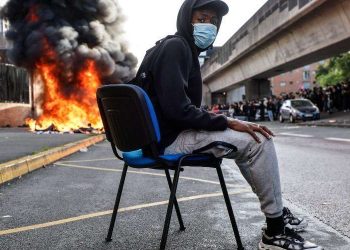
At this point, there is no president in the entire history of our country that the left hates more than Donald Trump. Just the mere thought of him can provoke uncontrollable rage in many leftists. So it was inevitable that there would be violence, and I am entirely convinced that what we have experienced so far is just the beginning of a tsunami of civil disorder.
During the past couple of months, Tesla vehicles and Tesla dealerships have become favorite targets for those that absolutely hate the changes that Donald Trump and Elon Musk have been making to the federal government. The following summary of attacks was put together by Connor O’Keeffe…
In recent weeks, there has been a sharp increase in violent attacks aimed at destroying cars and other property carrying the logo of Elon Musk’s electric car company, Tesla.
In Colorado, a woman was charged with using Molotov cocktails to set multiple cars at a Tesla dealership on fire before painting the word Nazi on a store sign. In Oregon, one man fired a rifle into one Tesla dealership while someone else fired shots and threw explosives into another. In Washington, four Tesla Cybertrucks were set on fire, a Tesla sedan was covered in gasoline and set ablaze on a city street, and various other Cybertrucks had swastikas painted on them.
Seven Tesla charging stations were burned in Massachusetts, two Teslas were set on fire in Texas, several Teslas were shot and lit on fire in Nevada, and much more. As recently as Monday, multiple firebombs were discovered in a Tesla dealership in Austin, Texas. It’s clear that these are, at the very least, copycat acts aimed at Elon Musk and anyone who owns or is interested in buying a car from his company.
We have seen attacks happen over and over again, and a number of the perpetrators have been arrested.
Needless to say, it isn’t moderate Democrats that are committing these acts of violence.
In almost every case, the ideology of those that have been arrested is on the far left of the political spectrum.
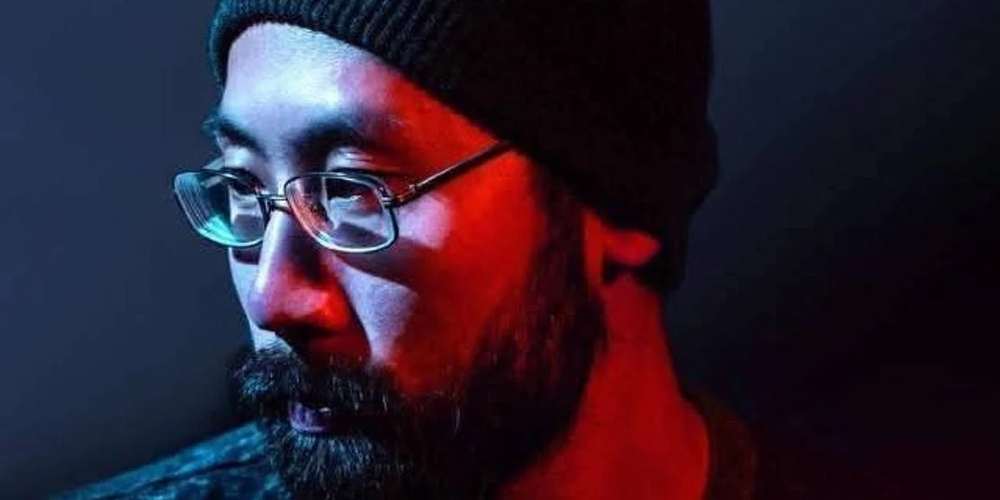
In fact, a 36-year-old man that has been charged with a series of attacks in Las Vegas is being described as a “potential communist”…
An alleged ‘Communist’ has been arrested in Las Vegas for setting several Tesla cars on fire using Molotov cocktails before firing rounds into the burning vehicles on March 18.
Paul Hyon Kim, 36, was charged on Wednesday with 15 offenses, including arson and destroying or injuring personal property valued at $5,000 or more, police told a press conference the following day.
Las Vegas Metro Police also said Kim’s social media indicated that he was a ‘potential Communist’ with ‘pro Palestine affiliations’, according to Fox News reporter Bill Melugin.
Even before the election, many on the far left were openly talking about the need for a “revolution” if Trump won.

Now that Trump is back in the Oval Office, the chatter about a “revolution” on social media has only intensified. Most conservatives have no idea how serious there people are about their plans.
Of course many on the far left don’t use the term “communist” anymore. Instead they will refer to themselves as “socialists”, “anarchists”, “revolutionaries” or “progressives”.
But at the end of the day, their ideology is pretty much indistinguishable from the ideology of other communist movements all over the globe. Many conservatives are downplaying the threat of far left violence, and I believe that is a huge mistake.
Yes, there have been some incidents that have been quite funny. For example, one radical leftist that attempted to ram his four-wheeler into the side of a Cybertruck should have known that it wouldn’t do any damage at all. The following comes from a humorous piece that was posted on Zero Hedge…
We present readers with what may be one of the dumbest, most brainwashed, unhealthiest, lowest IQ, and unhinged Democrat yet—a morbidly obsessed activist who slammed his ATV into the driver’s side of a Tesla Cybertruck, an incident likely linked to radical far-left political grievances captured by the vehicle’s Sentry Mode security cameras.
Tesla investor Sawyer Merritt wrote on X, “This guy was arrested today after ramming his mini four-wheeler into a Cybertruck,” adding, “Little did he know that the Cybertruck has 1.8mm bulletproof stainless-steel doors capable of taking some heavy hits. He was charged with one count of felony criminal mischief & failure to identify.”
Apparently this particular individual vandalized a number of Tesla vehicles, and Texarkana police reported on Facebook that they now have him in custody…
We arrested 33 year old Demarqeyun Cox this afternoon after he allegedly damaged multiple Tesla vehicles in separate incidents across the city today.
The first report came from the Golden Palace restaurant on Summerhill Road, where surveillance footage from the car itself captured a guy on a mini four-wheeler intentionally ramming a parked Tesla at full speed. While officers were searching for the suspect, another call came in reporting damage to a Tesla in the Lowe’s parking lot.
Shortly after that, Officer Blake Lummus spotted Cox riding a mini four-wheeler near Summerhill and New Boston Roads and recognized him as the suspect in the earlier video. After being stopped, Cox initially gave a false name but was quickly identified and taken into custody.
That is great news.
But there are thousands of others just like him.
And in this environment, Elon Musk is not the only billionaire that is being targeted.
A “Robin Hood mentality” is starting to take hold in America, and there are apparently many leftists that are convinced that it is okay to shoplift from Whole Foods because it is owned by Jeff Bezos…
Take Jesse, a 30-something tech worker who until recently would steal entire bags of groceries from Whole Foods with his roommates. A friend at Instacart tipped them off to the opportunity — with so many personal shoppers roaming around the aisles, workers weren’t going to notice another person loading bags or whether they were paying for what was in them. Once, they got expensive steaks from the butcher and left without paying for them, later grilling them out on a friend’s roof.
“I never felt bad for the corporation as a whole, because it was Amazon and, you know, it was Jeff Bezos,” Jesse said. “He just profits so much taking advantage of the little people, so if we as little people can bite back a little bit, and that’s me taking $100 maybe out of revenue for him, that’s a little bit of a middle finger.”
Separately, there’s Carson, another Whole Foods bandit whose friends joke they’re actually “liberating” items from the store, not stealing. As Carson, a 30-something who works in the nonprofit sector, told me for a story last year, he likes slipping salmon lox into his laptop sleeve and estimates he saves about $1,000 in groceries a year by shoplifting, largely from Whole Foods.
Stealing something that does not belong to you is always wrong.
It doesn’t matter if it is owned by a billionaire or by a homeless person.
Unfortunately, so many leftists in our society now believe that morality is relative.

They have created an entirely alternate reality for themselves where it is okay to lie, cheat, steal and firebomb Tesla dealerships.
And in this alternate reality, Donald Trump is literally the devil.
Since Trump is literally the personification of evil in their minds, they desperately want Democrats in Washington “to be much more aggressive” with Trump…
Mike Arnold, a 74-year-old Air Force veteran from Cathedral City, California, said he attended a Khanna event in Norco this past weekend, because he “got tired of screaming at the TV.”
Like Siegel, he said he isn’t sure the country will make it to Democratic elections in 2026. Trump, he said, is advancing an authoritarian agenda — bullying white-shoe law firms and universities and calling for the impeachment of judges who rule against him.
“The courts might not hold, and if the courts don’t hold, the only next thing is the military itself,” said Arnold. Democratic leaders, Arnold said, “have to be much more aggressive than they have been.”
During the weeks and months ahead, I certainly expect the left to get “much more aggressive”, and that will not be good for any of us.
In a civilized society, there is no room for political violence.
Unfortunately, we are not a civilized society any longer.
An internal revolution has already begun, and it will grow every time Donald Trump makes another major move that the left does not like.
Sadly, most people on the left and the right have no idea where all of this civil disorder will eventually take us.
Michael’s new book entitled “Why” is available in paperback and for the Kindle on Amazon.com, and you can subscribe to his Substack newsletter at michaeltsnyder.substack.com.
Bypass Big Tech Censors
Starting the Day With a Scripture-Inspired Roast Helps Center Your Thoughts on Eternal Truths Amid Temporal Pressures
The world can seem chaotic, especially right after we wake up. Many believers start their mornings reaching for something familiar — a hot cup of coffee — yet end up settling for mediocre brews that do little more than deliver a caffeine jolt. The daily grind of life, with its endless distractions, news cycles, and responsibilities, can leave even the most faithful feeling spiritually parched alongside their physical fatigue. What if your morning ritual could do more than wake you up? What if it could ground you in truth, nourish your body with exceptional quality, and quietly advance a kingdom purpose at the same time?
That’s the promise — and the reality — behind Promised Grounds Coffee. This Christian-founded company doesn’t just roast beans; it approaches every step as an act of worship and discipleship. By selecting only the top 10% of specialty-grade beans, ethically sourced from dedicated farmers in Central and South America, and small-batch roasting them with reverence in Austin, Texas, Promised Grounds delivers what many describe as the best coffee available — never burnt, never bland, but rich with origin stories and layered flavors that honor God’s creation.
From the vibrant Psalm 27 Roast (a light, bright medium option) to the bold yet peaceful 2 Timothy 1:7 Decaf, each bag carries a Scripture verse that turns your daily pour into a gentle reminder of faith. And through their Ounce Per Ounce Promise, every ounce of coffee you enjoy provides an equal ounce of clean water to families in need via partnership with Filter of Hope — literally brewing hope for body and soul, one cup at a time.
The challenge for today’s Christians runs deeper than finding a decent cup. In an age of convenience-driven consumerism, it’s easy to support companies that dilute values or remain silent on matters of faith. Many believers want their everyday choices — from what they drink to how they spend — to reflect discipleship rather than just convenience. Promised Grounds solves this by weaving Christian excellence into the entire process: beans nurtured with prayerful stewardship by farming families, roasted as an offering rather than a commodity, and packaged with Bible verses to encourage a mindset of gratitude and purpose from the first sip. Reviewers consistently praise the smooth, rich profiles — whether enjoyed black in a drip maker, iced on a warm day, or shared in fellowship — noting how the quality stands toe-to-toe with premium secular brands while delivering something far more meaningful.
This integration of faith and flavor addresses a real need in Christian households and ministries. Busy parents, church leaders, and remote workers alike report that starting the day with a Scripture-inspired roast helps center their thoughts on eternal truths amid temporal pressures. The coffee’s exceptional character — bright citrus notes in lighter roasts or deep chocolate undertones in bolder ones — comes from meticulous selection and careful roasting that respects the bean’s natural gifts rather than masking them. It’s the kind of coffee that elevates a simple quiet time, fuels productive workdays, or sparks meaningful conversations when shared at Bible studies or outreach events. And because it’s ethically sourced with integrity, every purchase supports sustainable livelihoods for farmers who treat their crops like family harvests.
For those leading churches or small groups, the impact multiplies. Promised Grounds offers bundles and options perfect for hospitality ministries, turning ordinary coffee service into an opportunity to point people toward the living water of Christ. Imagine greeting visitors with a warm cup whose very bag carries God’s Word — a subtle yet powerful witness that aligns with the Great Commission. The company’s Texas roots and commitment to “brewing hope” resonate especially with believers who value American enterprise paired with global compassion.
Of course, quality alone isn’t enough if the experience feels out of reach. Promised Grounds keeps it accessible with practical perks like free shipping on orders over $40, sample sets for discovering favorites, and thoughtful add-ons such as faith-themed mugs. Whether you prefer whole beans for fresh grinding, grounds for convenience, or even bulk options for larger households and ministries, the result is consistently superior coffee that makes discipleship feel integrated rather than added on.
As you consider how to align even the smallest habits with your walk with God, Promised Grounds Coffee stands out as a refreshing solution. It tackles the dual problems of subpar daily sustenance and disconnected consumption by offering a product that genuinely excels in taste while advancing a mission of clean water, farmer dignity, and scriptural encouragement. Believers who make the switch often describe it as more than a beverage upgrade — it becomes part of their rhythm of gratitude, a daily invitation to remember that every good gift comes from above.
If you’re ready to transform your mornings (and perhaps your church gatherings) with coffee that honors both exceptional craftsmanship and Christian values, I encourage you to explore what Promised Grounds has to offer. One sip at a time, you’ll be nourishing your body, refreshing your spirit, and participating in something far greater — all while enjoying what truly is among the best coffee available.