
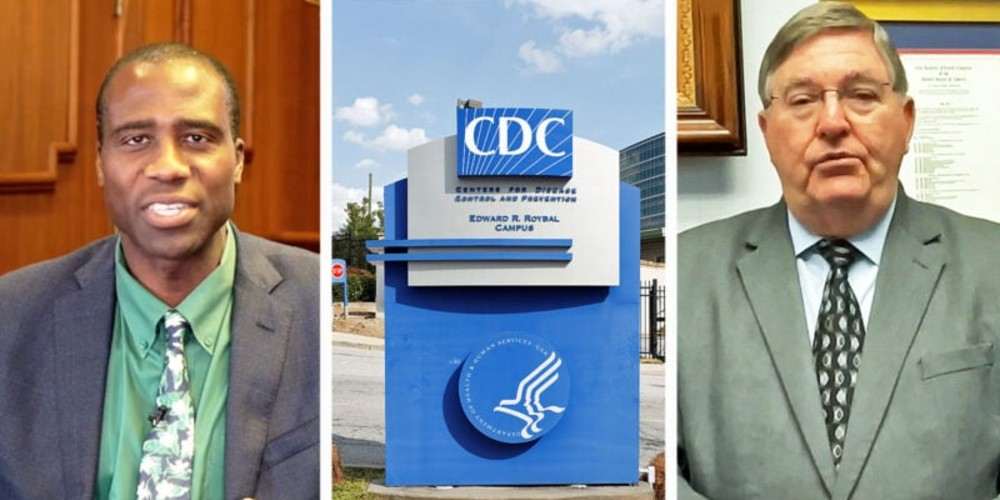
Florida Surgeon General Joseph Ladapo and former Texas Republican Congressman Michael Burgess have emerged as potential nominees to lead the Centers for Disease Control and Prevention (CDC), CBS News reported.
The White House last week withdrew President Donald Trump’s previous nominee, Dr. Dave Weldon, shortly before his U.S. Senate confirmation meeting.
CBS News cited unnamed administration officials, who said they are trying to “get it right” with their next nominee. The news outlet said the Trump administration is “seeking to address concerns about a prolonged vacancy at the agency or the prospect of another embarrassing about-face.”
Ladapo and Burgess have support from “some of President Trump’s allies.”
Other potential nominees have declined offers, CBS News reported.
Drug safety advocate Kim Witczak, a member of the U.S. Food and Drug Administration’s (FDA) Psychopharmacologic Drugs Advisory Committee, said both potential nominees “represent bold departures from the status quo, but for very different reasons.”
Witczak said:
“Ladapo has been outspoken in challenging prevailing public health narratives, especially around COVID-19, and would likely bring a disruptive, but much-needed shake-up to an institution in desperate need of reform. He also knows how to navigate political landmines.
“Burgess, a physician and former Congressman, brings extensive policy experience, but his long tenure in Washington may not signal the kind of transformational change many are hoping for.”
The eventual nominee will likely face questions from Senators about the rise in measles cases, the bird flu outbreak and their stance on vaccines.
This will be the first time a nominee to lead the CDC will undergo a Senate confirmation process — the result of a 2022 Congressional amendment.

Meanwhile, Susan Monarez, Ph.D., previously deputy director of the Advanced Research Projects Agency for Health, is serving as acting director of the agency.
Burgess shifted away from past support for COVID vaccines
Reuters, citing an unnamed source “familiar with the matter,” reported that Burgess is the “likely nominee” for the nomination to lead the CDC, adding that a final decision has not yet been made.
Reuters also reported that the CDC rescheduled for April 15-16 a meeting of its vaccine advisory panel. The agency postponed the meeting last month.
Burgess is a former obstetrician and gynecologist who in January retired from Congress after 22 years. He led the U.S. House of Representatives doctors’ caucus for several years until his retirement.
Reuters reported that Burgess initially supported COVID-19 vaccines, telling Congress during the pandemic that the vaccines are “safe and effective tools that have been proven to protect Americans from preventable, life-threatening diseases.” He also spoke about the need to confront “vaccine hesitancy.”
Burgess later shifted his position. In a March 2022 tweet, he expressed support for a Congressional resolution to end the CDC’s mask mandate for public transportation, saying that “Americans are tired of nonsense policies.”
In a January 2023 tweet, Burgess criticized the COVID-19 vaccine mandate for healthcare workers, calling it an “egregious overstep.” He has also expressed support for the U.S. withdrawal from the World Health Organization.
At a 2023 Congressional hearing, Burgess said, “We all share the goal of rebuilding the faith and trust in the CDC, because I think most of us recognize we need a well-functioning and respected CDC in order to protect the American people.”
Ladapo called for end to mRNA COVID shots, water fluoridation
Ladapo, Florida’s surgeon general since 2021, “has drawn controversy on a number of issues,” including his stance on COVID-19 vaccines, CBS News reported.
In 2022, Ladapo recommended against the administration of COVID-19 vaccines for healthy children, making Florida the first state to break with official CDC guidance.
The next year, he called on federal public health officials to “publicly” explain 12 key issues related to the COVID-19 vaccine rollout.
Last year, Ladapo called for a halt in the administration of mRNA COVID-19 vaccines, stating that the FDA and CDC did not adequately respond to his letter with questions about the issue.

Earlier this month, he supported Florida Gov. Ron DeSantis’ call for the CDC to stop recommending the COVID-19 vaccine for children.
Ladapo has also questioned establishment guidance on water fluoridation. In November 2024, he advised local governmental authorities across Florida to stop fluoridating their water supply, citing the neuropsychiatric risks associated with the practice. Ladapo repeated these calls earlier this month.
According to CBS News, Ladapo’s positions mean his confirmation prospects “could be steep.” But his positions have also earned him “some prominent supporters” — including DeSantis.
In a statement to CBS News, Weldon expressed his support for Ladapo:
“I thoroughly support Dr. Ladapo for CDC director. He should be at the top of President Trump’s list. He has done a great job for us here in Florida and his education and experience make him the perfect choice.
“Whoever they pick, to get past [Republican Sen. Bill] Cassidy, it’s best if they have never said anything remotely critical of the childhood vaccine program. Though 90% of parents are refusing COVID shots for their kids, 50% are refusing the flu shot, and 10% are refusing the measles.”
Cassidy previously wavered in his support for Robert F. Kennedy Jr. to lead the U.S. Department of Health and Human Services (HHS) — which oversees federal public health agencies, including the CDC and FDA.
Cassidy ultimately supported Kennedy’s nomination after he said Kennedy committed to meet or speak with him multiple times monthly, and to include Cassidy in the HHS hiring process.
Weldon suggested that Cassidy’s opposition contributed to the White House withdrawing his nomination, CBS News reported. But one former congressman has suggested that a pathway still exists for Weldon to be named CDC director.
In a statement released Thursday, Hon. Dan Burton, former chairman of the House Committee on Oversight and Government Reform, called for the recess appointment of Weldon to lead the CDC. Burton cited Weldon’s willingness to hear a “balanced perspective” on vaccines, as a key reason why Weldon should be appointed.
The U.S. Constitution allows the president to unilaterally appoint a candidate to a federal position while Congress is in recess. The appointee can remain in the position until the end of the following Senate session.
‘The days of ‘trust us, we’re the experts’ are over’
An HHS spokesperson on Thursday confirmed for Reuters that the CDC’s vaccine advisory committee’s previously postponed meeting has been rescheduled for April 15-16.
The Advisory Committee on Immunization Practices, or ACIP, helps set the vaccination schedule for children and adults and issues recommendations to the CDC regarding vaccine approval.
According to HHS, the meeting was postponed to accommodate public comment. The rescheduled meeting will include an update on the measles outbreak.

According to Endpoints News, the draft agenda of the postponed meeting included a review of new COVID-19, flu, RSV and meningitis vaccines and the hospitalization of five people who received Valneva’s chikungunya vaccine.
Endpoints reported that it remains unclear if the agenda for the meeting will change, although unnamed sources said the meeting might be shortened and some agenda items might be cut.
Witczak called for transparency regarding the topics ACIP will discuss next month. She said:
“When public confidence in health institutions is at an all-time low, reducing transparency and limiting dialogue can send the wrong message. What’s being cut, and why? The public deserves to know. It raises red flags about what’s being deprioritized and a shortened meeting could undermine meaningful deliberation.”
Witczak called ACIP’s “lack of independence” its “most glaring deficiency.”
“Time and again, ACIP has served as a backdoor endorsement panel for vaccine products, rather than a critical oversight body. Conflicts of interest, fast-tracked approvals, groupthink and the absence of long-term safety data have severely undermined its credibility.”
She added:
“For too long, regulatory and advisory bodies have been captured by the very industries they are supposed to oversee. Leadership at the CDC and by extension, ACIP, must reflect a renewed commitment to public trust, transparency and safety. The days of ‘trust us, we’re the experts’ are over.”
Bypass Big Tech Censors
Two Storms, One Harvest

Every food crisis in living memory has been a one-shock event. The 2008 price spike was a commodity bubble. The 2020 shortages were a logistics failure. The 2022 grain scare was a war on one exporter’s ports. Each time, the system bent, adjusted, and recovered, and each time the experts assured us afterward that global markets are simply too big and too diversified to fail.
What nobody in Washington seems eager to discuss is that 2026 is shaping up to be something the modern food system has never actually faced. Two independent shocks, one climatic and one geopolitical, are converging on the same harvest cycle at the same time. Not sequentially. Simultaneously.
Start with the weather. The Pacific Ocean is currently building toward what forecasters now openly call a record event. NOAA’s Climate Prediction Center puts the odds of at least a strong El Niño near 88 percent, with roughly two in three odds it reaches “very strong” status, the tier reserved for perhaps three or four events in the entire satellite era. Every major global model now projects a median peak in Super El Niño territory, and most of them project it exceeding the 2015-16 event, which until now held the modern record. Sea surface anomalies were already brushing the super threshold in mid-July, months before these events normally peak. The atmosphere has already shifted into El Niño mode, and the event is forecast to crest in late fall and early winter.
This is not about “climate change.” It’s about the standard cycles of weather, and the cycle we’re currently in is one that has likely devastated societies in the past. We’re better prepared as a society today, but not all Americans are equally prepared.
Serious households have started doing the quiet math on their own. Grocery bills tell part of the story, and the forecast maps tell the rest, which is why long-term food storage has moved from fringe hobby to mainstream line item in the family budget, with established suppliers like Heaven’s Harvest seeing demand from people who five years ago would have rolled their eyes at the idea. That instinct is not paranoia. It is pattern recognition, and the pattern is worth walking through carefully.
Editor’s Note: Heaven’s Harvest IS a sponsor, but the warnings of this article are real and would be written even if we didn’t have a survival food sponsor. With that said, those who take advantage of what they offer can use promo code “Patriot” for 15% off.
The Fertilizer Clock Is Already Running
While the Pacific warms, the second shock has been unfolding in the Strait of Hormuz. The conflict with Iran turned the world’s most important energy chokepoint into a contested waterway, and the consequences reach far beyond the gas pump. Roughly a third of global fertilizer trade moves through Hormuz, and the disruption sent urea prices up 86 percent year over year by March, with a 53 percent jump in a single month.
The World Bank projects energy prices rising about 24 percent in 2026 and fertilizer about 31 percent. By its own accounting, fertilizer prices ran 35 percent higher in the first five months of this year than the same period last year.
Here is the mechanism the nightly news will not explain. Fertilizer is not a grocery item. It is a time-delayed input. The nitrogen a farmer in Iowa or Punjab could not afford to apply this spring does not show up as a problem this spring. It shows up as a thinner harvest six to twelve months later.
The World Bank’s own food security brief concedes that the effects of reduced applications earlier this season “are likely to become visible only later in harvest outcomes.” Translate that from institutional language into plain English and it means this. The damage is already done, it is already in the ground, and we are simply waiting for it to arrive on the shelf.
Now check the calendar. Six to twelve months from the spring planting season lands us squarely in late 2026 and early 2027. Which is precisely when the strongest El Niño in the instrumental record is forecast to peak, bringing its signature droughts to Southeast Asia, Australia, southern Africa, northern Brazil, and South Asia, the very regions that grow the world’s rice, sugar, and oilseeds.
The World Bank warns openly that a strong El Niño “could disrupt multiple crop belts simultaneously” on top of the conflict-driven input costs. Their baseline projection assumes the Middle East disruptions ease by autumn. What in the last two years of Middle East history suggests that assumption is safe?
The System Has No Slack Left
The comfortable answer is that global markets always adjust. But adjustment requires slack, and the slack is gone. Global cereal production is expected to decline from last year’s records even before El Niño does its work. The UN World Food Programme, hardly a den of right-wing preppers, is calling this the most significant disruption to its supply chains since Covid and the invasion of Ukraine, and its supply chain director put the stakes bluntly.
Today’s supply chain challenges are tomorrow’s hunger crisis.
There is also a political dimension that markets cannot price. When food gets scarce, governments do not behave like economists. They behave like politicians. Export bans, hoarding mandates, and panic buying at the national level turned the modest rice shortfall of 2008 into a global crisis, and analysts are already warning that import-dependent nations are the first dominoes.
The 2015-16 Super El Niño, a far weaker event than what is now forecast, threw tens of millions into food stress across Africa and Asia. This one is projected to be stronger, and it arrives with fertilizer already rationed by price and shipping lanes already contested by missiles.
What Joseph Knew
Scripture does not treat preparation for lean years as faithlessness. It treats it as wisdom delivered in advance to those willing to act on it.
Behold, there come seven years of great plenty throughout all the land of Egypt: And there shall arise after them seven years of famine; and all the plenty shall be forgotten in the land of Egypt.
Joseph did not respond to that warning with a hashtag or a committee. He stored grain during the years of abundance, and when the famine came, Egypt stood while its neighbors begged. The lesson is not that famine is certain. It is that the time to prepare is precisely when preparation still looks optional.
Nobody who filled a pantry in a year of plenty has ever regretted it, and nobody standing in an empty aisle has ever been glad he waited for certainty.
None of this calls for panic, and panic is the enemy of sound judgment anyway. It calls for the same unglamorous prudence our grandparents considered ordinary. Keep some cash margin, know your local growers, and put real food in deep storage while it is cheap and available, because the entire arc of this story is that cheap and available is a closing window.
Families looking for a straightforward place to start can visit Heaven’s Harvest and use promo code Patriot for 15 percent off long-term storable food. The forecasts may yet soften, the strait may yet reopen, and we should pray they do. But hope is a fine thing to hold and a foolish thing to eat.


