
(Zero Hedge)—The key question facing equity markets now is whether the April 8 low marked a floor — or merely a trap door for bulls.
Veteran emerging-markets investor Mark Mobius joined Bloomberg TV earlier, warning, “Cash is king” as he waits for the trade war storm and mounting macroeconomic headwinds to blow over.
“At this stage, cash is king. So 95% of my money in the funds are in cash,” Mobius said in an interview, adding, “Right now, we’ve got to keep the cash and be ready to move when the time is right.”
Mobius continued: “If the market comes down further, of course we will put more money in.”
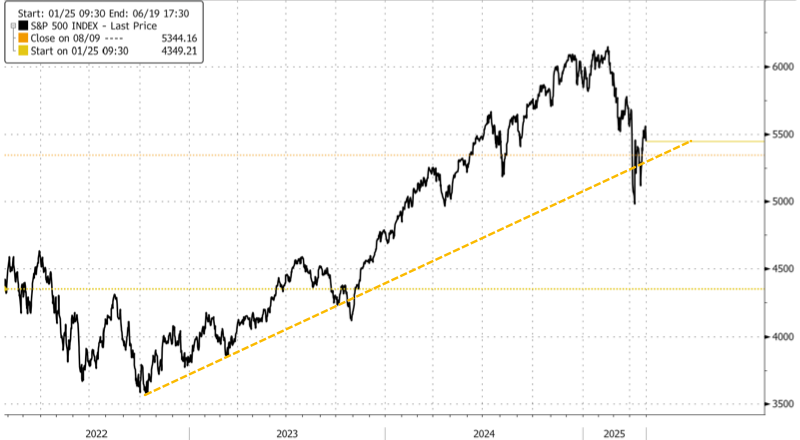
He said he owns “a little bit with S&P 500 funds” to track the market and expects higher prices by the end of the year.
“Trump doesn’t want to see a big market crash, so he will be making adjustments and announcements, which will give a little bit more confidence for people in the market,” the legendary investor said.
He pointed out that he has “become very bullish on China” and sees possibilities for Beijing to boost trade and domestic consumption amid the ongoing trade war.
“Right now, we’ve got to keep the cash and be ready to move when the time is right”
Veteran emerging-markets investor Mark Mobius is keeping the bulk of his funds’ holdings in cash as he waits out the trade-related uncertainty https://t.co/X3z6gg4pvE pic.twitter.com/bHNvjszfUM
— Bloomberg (@business) April 30, 2025
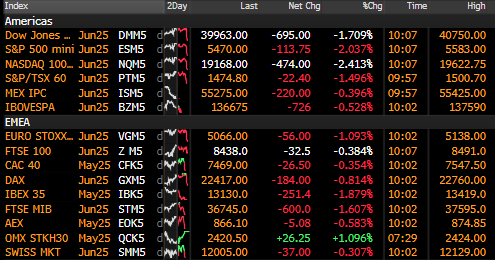
By late Tuesday morning in the US, main equity futures tumbled following a series of negative prints that cast dark shadows over the US economy:

- Rate-Cut Odds Jump After ADP Reports Weakest Job Growth Since July 2024
- US Q1 GDP Contracts On Record Imports, Shrinking Govt, As Consumption Comes In Stronger Than Expected
Main equity futures were dumped following the bad macro prints.
However, there is good news:
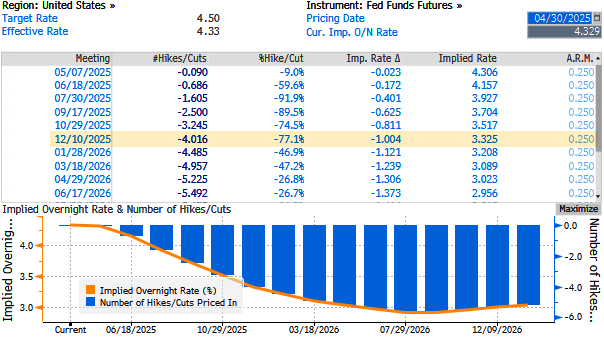
*TRADERS FULLY PRICE FOUR QUARTER-POINT FED CUTS BY END-2025
Powell dragged in, kicking and screaming
— zerohedge (@zerohedge) April 30, 2025
Implied four cuts by year’s end.
Separately from Mobius’ interview, Goldman analyst Vickie Chang offered clients a market snapshot on Tuesday, assessing whether the April 8 low marked a concrete bottom for stocks — or if another leg lower is still ahead:
- The most immediate question for markets is whether there is fresh downside to come. We said that a shift in trade policy was the most obvious route for recovery in risk assets, and there has been a modest version of that dynamic since April 9. Even though the economic impact is yet to be felt, it is possible that we are past the peak of new tariff “shocks” and policy uncertainty.
- In past equity corrections, markets tended to bottom near the trough in economic activity. But if there was a clear cause of the weakness, it was enough for the market to see the peak in pressure from that source to conclude that activity would bottom soon, and for equities to trough ahead of that. In episodes where the source was less easy to track, the market did not trough until economic growth itself started to bottom.
- What matters now is whether the current episode is more like past “shock”-driven corrections where the tariff shock having seemingly peaked could be enough to mark the market bottom, or whether this will ultimately be a scenario where the economic data needs to stabilize first. It is possible that simply being through the worst of the shock has allowed the market to set some limits on the process, even if the damage is yet to be felt and if the underlying economic situation remains bad for some time.
- Despite that possibility, we still think there is significant vulnerability in a recession scenario, even if the worst of the underlying “shock” has passed, for three reasons: 1) It has generally been true that in shock-driven corrections, there has been a meaningful reversal and not just a peak in the source of the pressure. So the tariff reversal may need to be more dramatic to be equivalent to those past peaks. 2) The unemployment rate matters a lot for the pricing of risk, and it has been some time since the economy has undergone a period of job and portfolio losses happening together. 3) The 19% drawdown so far would be relatively mild relative to past recessionary drawdowns and would have entirely taken place before economic damage is seen, which would be historically unusual.
- It is worth keeping an open mind given the unprecedented nature of the current shock, but continued market recovery from here means putting an increasing weight on the belief that recessionary dynamics will not take hold, and requires confidence in the market’s ability to look through what is likely to be a further weakening in the data. We think the balance of risks still argues for expecting renewed declines in equity prices from current levels and for adding downside protection, especially if further relaxation makes that protection cheaper.
Just days ago, Bank of America’s Michael Hartnett told clients to “sell rips” and stay long “BIG” (his favorite trade idea for 2025, namely Bonds, International Stocks, and Gold).
Bypass Big Tech Censors

Starting the Day With a Scripture-Inspired Roast Helps Center Your Thoughts on Eternal Truths Amid Temporal Pressures
The world can seem chaotic, especially right after we wake up. Many believers start their mornings reaching for something familiar — a hot cup of coffee — yet end up settling for mediocre brews that do little more than deliver a caffeine jolt. The daily grind of life, with its endless distractions, news cycles, and responsibilities, can leave even the most faithful feeling spiritually parched alongside their physical fatigue. What if your morning ritual could do more than wake you up? What if it could ground you in truth, nourish your body with exceptional quality, and quietly advance a kingdom purpose at the same time?
That’s the promise — and the reality — behind Promised Grounds Coffee. This Christian-founded company doesn’t just roast beans; it approaches every step as an act of worship and discipleship. By selecting only the top 10% of specialty-grade beans, ethically sourced from dedicated farmers in Central and South America, and small-batch roasting them with reverence in Austin, Texas, Promised Grounds delivers what many describe as the best coffee available — never burnt, never bland, but rich with origin stories and layered flavors that honor God’s creation.
From the vibrant Psalm 27 Roast (a light, bright medium option) to the bold yet peaceful 2 Timothy 1:7 Decaf, each bag carries a Scripture verse that turns your daily pour into a gentle reminder of faith. And through their Ounce Per Ounce Promise, every ounce of coffee you enjoy provides an equal ounce of clean water to families in need via partnership with Filter of Hope — literally brewing hope for body and soul, one cup at a time.
The challenge for today’s Christians runs deeper than finding a decent cup. In an age of convenience-driven consumerism, it’s easy to support companies that dilute values or remain silent on matters of faith. Many believers want their everyday choices — from what they drink to how they spend — to reflect discipleship rather than just convenience. Promised Grounds solves this by weaving Christian excellence into the entire process: beans nurtured with prayerful stewardship by farming families, roasted as an offering rather than a commodity, and packaged with Bible verses to encourage a mindset of gratitude and purpose from the first sip. Reviewers consistently praise the smooth, rich profiles — whether enjoyed black in a drip maker, iced on a warm day, or shared in fellowship — noting how the quality stands toe-to-toe with premium secular brands while delivering something far more meaningful.
This integration of faith and flavor addresses a real need in Christian households and ministries. Busy parents, church leaders, and remote workers alike report that starting the day with a Scripture-inspired roast helps center their thoughts on eternal truths amid temporal pressures. The coffee’s exceptional character — bright citrus notes in lighter roasts or deep chocolate undertones in bolder ones — comes from meticulous selection and careful roasting that respects the bean’s natural gifts rather than masking them. It’s the kind of coffee that elevates a simple quiet time, fuels productive workdays, or sparks meaningful conversations when shared at Bible studies or outreach events. And because it’s ethically sourced with integrity, every purchase supports sustainable livelihoods for farmers who treat their crops like family harvests.
For those leading churches or small groups, the impact multiplies. Promised Grounds offers bundles and options perfect for hospitality ministries, turning ordinary coffee service into an opportunity to point people toward the living water of Christ. Imagine greeting visitors with a warm cup whose very bag carries God’s Word — a subtle yet powerful witness that aligns with the Great Commission. The company’s Texas roots and commitment to “brewing hope” resonate especially with believers who value American enterprise paired with global compassion.
Of course, quality alone isn’t enough if the experience feels out of reach. Promised Grounds keeps it accessible with practical perks like free shipping on orders over $40, sample sets for discovering favorites, and thoughtful add-ons such as faith-themed mugs. Whether you prefer whole beans for fresh grinding, grounds for convenience, or even bulk options for larger households and ministries, the result is consistently superior coffee that makes discipleship feel integrated rather than added on.
As you consider how to align even the smallest habits with your walk with God, Promised Grounds Coffee stands out as a refreshing solution. It tackles the dual problems of subpar daily sustenance and disconnected consumption by offering a product that genuinely excels in taste while advancing a mission of clean water, farmer dignity, and scriptural encouragement. Believers who make the switch often describe it as more than a beverage upgrade — it becomes part of their rhythm of gratitude, a daily invitation to remember that every good gift comes from above.
If you’re ready to transform your mornings (and perhaps your church gatherings) with coffee that honors both exceptional craftsmanship and Christian values, I encourage you to explore what Promised Grounds has to offer. One sip at a time, you’ll be nourishing your body, refreshing your spirit, and participating in something far greater — all while enjoying what truly is among the best coffee available.