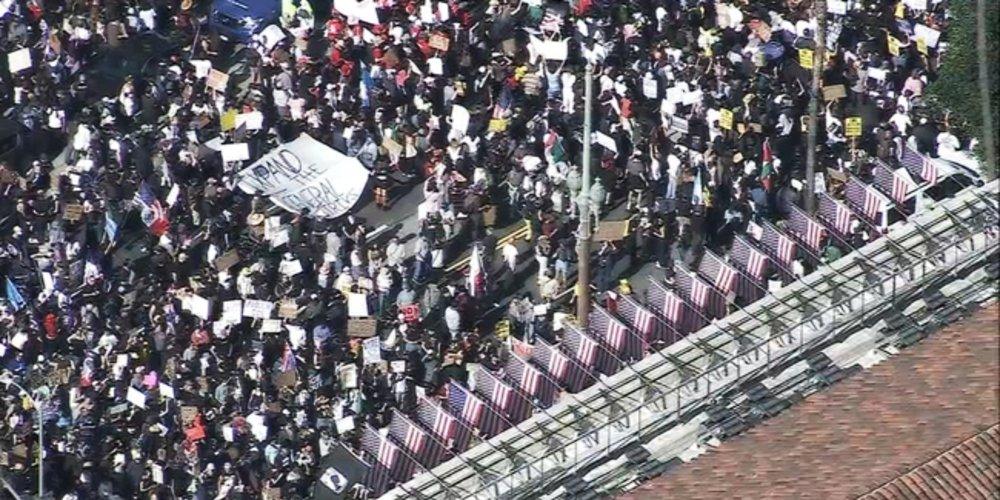
Thousands gathered in downtown Los Angeles on Friday, starting what appeared to be a routine demonstration against federal immigration enforcement. The crowd assembled at City Hall before marching toward the Metropolitan Detention Center, chanting demands to dismantle ICE operations.
What began as organized chants quickly devolved into confrontations, with a group of agitators pushing a large construction dumpster to block the facility’s loading dock entrance. Bottles, rocks, and other debris soon flew toward officers and federal agents guarding the site.
LAPD responded swiftly, issuing a dispersal order around 5:45 p.m. local time for the area along Alameda Street between Union Station and First Street. When some refused to leave, the department declared a citywide tactical alert, citing ongoing violence between Temple and Aliso streets.
Video footage released by LAPD captured the scene, showing protesters hurling objects at law enforcement. Officers deployed pepper balls and tear gas to regain control, and less-lethal munitions were authorized after reports of direct assaults on personnel.
At least five arrests followed for failure to disperse, as announced by Los Angeles Mayor Karen Bass during a press conference that evening. One additional individual faced charges for allegedly using a slingshot to launch hard metal objects at officers.
LAPD stated on social media, “Protestors are actively fighting with Officers after multiple dispersal orders were issued. Metropolitan Division is now on scene. Less than lethal has been authorized due to the violence against officers.”
The department had expressed hopes for peaceful demonstrations but pointed to the actions of “violent agitators” as the catalyst for intervention.
These clashes formed part of a broader “ICE Out Everywhere” campaign rippling across the nation, fueled by recent fatalities in Minneapolis involving federal agents being used as excuses for anti-American puppet masters activating their insurgents.

On January 7, ICE officer Jonathan Ross shot and killed Renee Nicole Good after she struck him with her vehicle. Just weeks later, on January 24, U.S. Customs and Border Protection agents fatally shot Alex Jeffrey Pretti as they attempted to disarm him after he interfered with an enforcement action in an active crime scene.
These incidents have amplified accusations that the Trump administration’s mass deportation efforts, dubbed “Operation Metro Surge,” are somehow making Americans less safe despite leading to over 3,000 apprehensions in Minnesota alone since December.
Adding to the tension, former CNN host Don Lemon was arrested on Friday in connection with a January 18 protest at Cities Church in St. Paul, Minnesota. Lemon, along with eight others, faces federal charges of conspiracy to deprive rights and violating the Freedom of Access to Clinic Entrances (FACE) Act for disrupting a worship service to protest ICE.
Released without bond, Lemon is set to appear in court on February 9. Mayor Bass referenced his case in her remarks, calling it “an egregious misuse of our justice system” and tying it to broader erosion of democratic norms in the nation’s 250th year.
Rep. Maxine Waters joined the Los Angeles crowd, leading chants of “ICE out of L.A.” in front of riot-geared officers. She described the scene at the detention center as people “exercising their constitutional rights,” even as tear gas filled the air, insisting, “people are not moving.”
Bass echoed calls for peace but warned, “Violent protests are exactly what I believe this administration wants to see happen. Don’t be surprised if the military reenters our city.”
Such statements raise questions about whether local leaders are fanning flames rather than calming them, especially as peaceful assembly gives way to property damage and assaults on those tasked with upholding the law.
In a city already strained by immigration debates, these events expose deeper divides. Federal agents face scrutiny for their methods, yet the chaos in streets like Alameda underscores the risks when protests cross into aggression. As nationwide demonstrations continue, with more planned through the weekend, the pushback against enforcement reveals a coordinated effort to thwart policies aimed at protecting American communities from the burdens of porous borders. Law enforcement’s measured response in Los Angeles prevented worse outcomes, but the pattern of escalation suggests underlying forces may be at play, intent on sowing discord to derail necessary reforms.
When violence supplants dialogue, it undermines the very freedoms the Constitution and natural law uphold. As investigations unfold and charges proceed, the nation watches whether accountability will prevail or if division deepens further.
Comments About This Story Through X:
We are switching to using X as our comment “system.” Our hope is that by using that public forum, more of our readers will be willing to share their thoughts. Be sure to like and repost to spread the news.
Bypass Big Tech Censors

Starting the Day With a Scripture-Inspired Roast Helps Center Your Thoughts on Eternal Truths Amid Temporal Pressures
The world can seem chaotic, especially right after we wake up. Many believers start their mornings reaching for something familiar — a hot cup of coffee — yet end up settling for mediocre brews that do little more than deliver a caffeine jolt. The daily grind of life, with its endless distractions, news cycles, and responsibilities, can leave even the most faithful feeling spiritually parched alongside their physical fatigue. What if your morning ritual could do more than wake you up? What if it could ground you in truth, nourish your body with exceptional quality, and quietly advance a kingdom purpose at the same time?
That’s the promise — and the reality — behind Promised Grounds Coffee. This Christian-founded company doesn’t just roast beans; it approaches every step as an act of worship and discipleship. By selecting only the top 10% of specialty-grade beans, ethically sourced from dedicated farmers in Central and South America, and small-batch roasting them with reverence in Austin, Texas, Promised Grounds delivers what many describe as the best coffee available — never burnt, never bland, but rich with origin stories and layered flavors that honor God’s creation.
From the vibrant Psalm 27 Roast (a light, bright medium option) to the bold yet peaceful 2 Timothy 1:7 Decaf, each bag carries a Scripture verse that turns your daily pour into a gentle reminder of faith. And through their Ounce Per Ounce Promise, every ounce of coffee you enjoy provides an equal ounce of clean water to families in need via partnership with Filter of Hope — literally brewing hope for body and soul, one cup at a time.
The challenge for today’s Christians runs deeper than finding a decent cup. In an age of convenience-driven consumerism, it’s easy to support companies that dilute values or remain silent on matters of faith. Many believers want their everyday choices — from what they drink to how they spend — to reflect discipleship rather than just convenience. Promised Grounds solves this by weaving Christian excellence into the entire process: beans nurtured with prayerful stewardship by farming families, roasted as an offering rather than a commodity, and packaged with Bible verses to encourage a mindset of gratitude and purpose from the first sip. Reviewers consistently praise the smooth, rich profiles — whether enjoyed black in a drip maker, iced on a warm day, or shared in fellowship — noting how the quality stands toe-to-toe with premium secular brands while delivering something far more meaningful.
This integration of faith and flavor addresses a real need in Christian households and ministries. Busy parents, church leaders, and remote workers alike report that starting the day with a Scripture-inspired roast helps center their thoughts on eternal truths amid temporal pressures. The coffee’s exceptional character — bright citrus notes in lighter roasts or deep chocolate undertones in bolder ones — comes from meticulous selection and careful roasting that respects the bean’s natural gifts rather than masking them. It’s the kind of coffee that elevates a simple quiet time, fuels productive workdays, or sparks meaningful conversations when shared at Bible studies or outreach events. And because it’s ethically sourced with integrity, every purchase supports sustainable livelihoods for farmers who treat their crops like family harvests.
For those leading churches or small groups, the impact multiplies. Promised Grounds offers bundles and options perfect for hospitality ministries, turning ordinary coffee service into an opportunity to point people toward the living water of Christ. Imagine greeting visitors with a warm cup whose very bag carries God’s Word — a subtle yet powerful witness that aligns with the Great Commission. The company’s Texas roots and commitment to “brewing hope” resonate especially with believers who value American enterprise paired with global compassion.
Of course, quality alone isn’t enough if the experience feels out of reach. Promised Grounds keeps it accessible with practical perks like free shipping on orders over $40, sample sets for discovering favorites, and thoughtful add-ons such as faith-themed mugs. Whether you prefer whole beans for fresh grinding, grounds for convenience, or even bulk options for larger households and ministries, the result is consistently superior coffee that makes discipleship feel integrated rather than added on.
As you consider how to align even the smallest habits with your walk with God, Promised Grounds Coffee stands out as a refreshing solution. It tackles the dual problems of subpar daily sustenance and disconnected consumption by offering a product that genuinely excels in taste while advancing a mission of clean water, farmer dignity, and scriptural encouragement. Believers who make the switch often describe it as more than a beverage upgrade — it becomes part of their rhythm of gratitude, a daily invitation to remember that every good gift comes from above.
If you’re ready to transform your mornings (and perhaps your church gatherings) with coffee that honors both exceptional craftsmanship and Christian values, I encourage you to explore what Promised Grounds has to offer. One sip at a time, you’ll be nourishing your body, refreshing your spirit, and participating in something far greater — all while enjoying what truly is among the best coffee available.