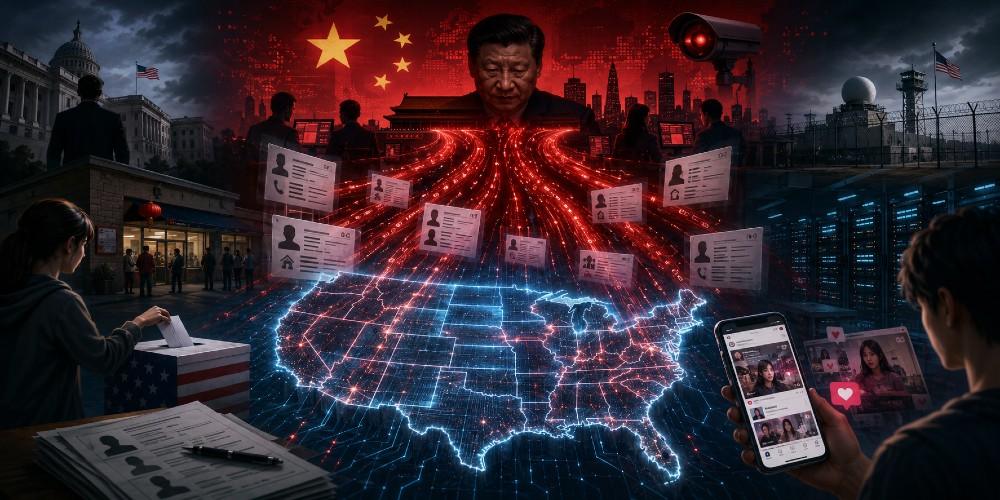
China just handed itself the personal files of 220 million American voters. Names. Addresses. Phone numbers. Party affiliation. Everything needed to profile you, target you, and mess with elections from the other side of the Pacific.
President Trump dropped that bombshell last week, and the usual suspects yawned. They should be screaming. This is not some random data breach. This is the Chinese Communist Party building a permanent dossier on nearly every registered voter in the country. They already know more about us than we know about ourselves.
And voter files are only the beginning.
Beijing has been vacuuming up American lives for years. The 2015 Office of Personnel Management hack handed them the security clearance forms of 22 million federal workers and contractors. Phone records. Health data. The theft never stopped. Now they own the raw material for blackmail, identity fraud, and psychological operations on a scale no foreign power has ever achieved on U.S. soil.
Our children are next. Tens of millions of American kids live on TikTok, a platform that functions as both data vacuum and propaganda machine. China good. America bad. That is the daily diet. Wonder why so many teenagers suddenly sound like they swallowed a Beijing talking point about Iran or the military? They did not invent those opinions. They absorbed them.
The infiltration runs deeper still. Chinese agents have wormed their way into the highest levels of state government. Linda Sun, once a top aide to New York Governor Kathy Hochul, now stands accused of serving as a paid asset for the CCP. Lavish perks. Secret meetings. The whole package. One governor’s office. How many more are still operating in the dark?
Then there are the secret police stations. Not in Shanghai. In New York. In other American cities. Disguised as “community centers” and “cultural associations,” these outposts monitor, intimidate, and harass Chinese-Americans who dare criticize the regime. Pastor Bob Fu of Midland, Texas, learned this the hard way. After he spoke against the persecution of Christians inside China, mobs surrounded his home shouting death threats until the FBI finally stepped in. That is not foreign policy. That is foreign occupation.
The Chinese Communist Party’s United Front Work Department runs the entire enterprise. It invites American politicians and influencers on carefully staged junkets to the People’s Republic, shows them gleaming skyscrapers and high-speed trains, then sends them home singing the praises of “Socialism with Chinese Characteristics.” Minnesota Governor Tim Walz is only the most recent example. Corporations that do business in China and universities that cash Beijing’s checks face the same pressure: promote the Party line or lose access. Richard Gere’s career never recovered from supporting Tibet. Stanford University severed ties with one critic of the one-child policy after Beijing demanded he be “severely punished.”

Meanwhile, Chinese-linked networks flood American social media with division. Spamouflage Dragon and similar operations impersonate U.S. citizens to stoke racial tension, anti-police rage, and political chaos. Chinese-controlled newspapers and radio stations inside our own borders pump out a steady stream of anti-American content. During the 2020 Antifa riots, the Chinese consulate in Houston was caught recruiting agitators. The State Department shut it down. The rest of the network simply went quieter.
They are not finished. China-linked agents have been buying land next to critical U.S. military bases. They are actively campaigning against American data centers in a transparent effort to cripple our artificial intelligence edge while their own models, trained on stolen U.S. data and tied to the People’s Liberation Army, grow stronger by the day. Allow Chinese electric vehicles onto American roads and you hand Beijing rolling surveillance platforms that can be shut down or hijacked remotely.
This is not competition. This is conquest by a thousand cuts. The goal is not influence. The goal is submission. Capture the institutions. Silence the critics. Rewrite the narrative. Prepare the battlefield. Defeat the only nation still standing in the way of permanent communist power.
As the Apostle Paul wrote in Ephesians 6:12, “For we wrestle not against flesh and blood, but against principalities, against powers, against the rulers of the darkness of this world, against spiritual wickedness in high places.” The Chinese Communist Party is an atheist regime that murders Christians, harvests organs, and treats human beings as disposable tools of the state. It does not hide its ambitions. It simply counts on American elites to stay distracted, profitable, and soft.
Enough. Every facet of American life is under attack. Our elections. Our children. Our churches. Our universities. Our technology. Our soil. The Biggest Brother is not in Washington. He is in Beijing. And he is already inside the house.
Bypass Big Tech Censors
Starting the Day With a Scripture-Inspired Roast Helps Center Your Thoughts on Eternal Truths Amid Temporal Pressures
The world can seem chaotic, especially right after we wake up. Many believers start their mornings reaching for something familiar — a hot cup of coffee — yet end up settling for mediocre brews that do little more than deliver a caffeine jolt. The daily grind of life, with its endless distractions, news cycles, and responsibilities, can leave even the most faithful feeling spiritually parched alongside their physical fatigue. What if your morning ritual could do more than wake you up? What if it could ground you in truth, nourish your body with exceptional quality, and quietly advance a kingdom purpose at the same time?
That’s the promise — and the reality — behind Promised Grounds Coffee. This Christian-founded company doesn’t just roast beans; it approaches every step as an act of worship and discipleship. By selecting only the top 10% of specialty-grade beans, ethically sourced from dedicated farmers in Central and South America, and small-batch roasting them with reverence in Austin, Texas, Promised Grounds delivers what many describe as the best coffee available — never burnt, never bland, but rich with origin stories and layered flavors that honor God’s creation.
From the vibrant Psalm 27 Roast (a light, bright medium option) to the bold yet peaceful 2 Timothy 1:7 Decaf, each bag carries a Scripture verse that turns your daily pour into a gentle reminder of faith. And through their Ounce Per Ounce Promise, every ounce of coffee you enjoy provides an equal ounce of clean water to families in need via partnership with Filter of Hope — literally brewing hope for body and soul, one cup at a time.
The challenge for today’s Christians runs deeper than finding a decent cup. In an age of convenience-driven consumerism, it’s easy to support companies that dilute values or remain silent on matters of faith. Many believers want their everyday choices — from what they drink to how they spend — to reflect discipleship rather than just convenience. Promised Grounds solves this by weaving Christian excellence into the entire process: beans nurtured with prayerful stewardship by farming families, roasted as an offering rather than a commodity, and packaged with Bible verses to encourage a mindset of gratitude and purpose from the first sip. Reviewers consistently praise the smooth, rich profiles — whether enjoyed black in a drip maker, iced on a warm day, or shared in fellowship — noting how the quality stands toe-to-toe with premium secular brands while delivering something far more meaningful.
This integration of faith and flavor addresses a real need in Christian households and ministries. Busy parents, church leaders, and remote workers alike report that starting the day with a Scripture-inspired roast helps center their thoughts on eternal truths amid temporal pressures. The coffee’s exceptional character — bright citrus notes in lighter roasts or deep chocolate undertones in bolder ones — comes from meticulous selection and careful roasting that respects the bean’s natural gifts rather than masking them. It’s the kind of coffee that elevates a simple quiet time, fuels productive workdays, or sparks meaningful conversations when shared at Bible studies or outreach events. And because it’s ethically sourced with integrity, every purchase supports sustainable livelihoods for farmers who treat their crops like family harvests.
For those leading churches or small groups, the impact multiplies. Promised Grounds offers bundles and options perfect for hospitality ministries, turning ordinary coffee service into an opportunity to point people toward the living water of Christ. Imagine greeting visitors with a warm cup whose very bag carries God’s Word — a subtle yet powerful witness that aligns with the Great Commission. The company’s Texas roots and commitment to “brewing hope” resonate especially with believers who value American enterprise paired with global compassion.
Of course, quality alone isn’t enough if the experience feels out of reach. Promised Grounds keeps it accessible with practical perks like free shipping on orders over $40, sample sets for discovering favorites, and thoughtful add-ons such as faith-themed mugs. Whether you prefer whole beans for fresh grinding, grounds for convenience, or even bulk options for larger households and ministries, the result is consistently superior coffee that makes discipleship feel integrated rather than added on.
As you consider how to align even the smallest habits with your walk with God, Promised Grounds Coffee stands out as a refreshing solution. It tackles the dual problems of subpar daily sustenance and disconnected consumption by offering a product that genuinely excels in taste while advancing a mission of clean water, farmer dignity, and scriptural encouragement. Believers who make the switch often describe it as more than a beverage upgrade — it becomes part of their rhythm of gratitude, a daily invitation to remember that every good gift comes from above.
If you’re ready to transform your mornings (and perhaps your church gatherings) with coffee that honors both exceptional craftsmanship and Christian values, I encourage you to explore what Promised Grounds has to offer. One sip at a time, you’ll be nourishing your body, refreshing your spirit, and participating in something far greater — all while enjoying what truly is among the best coffee available.