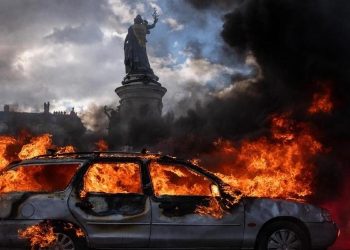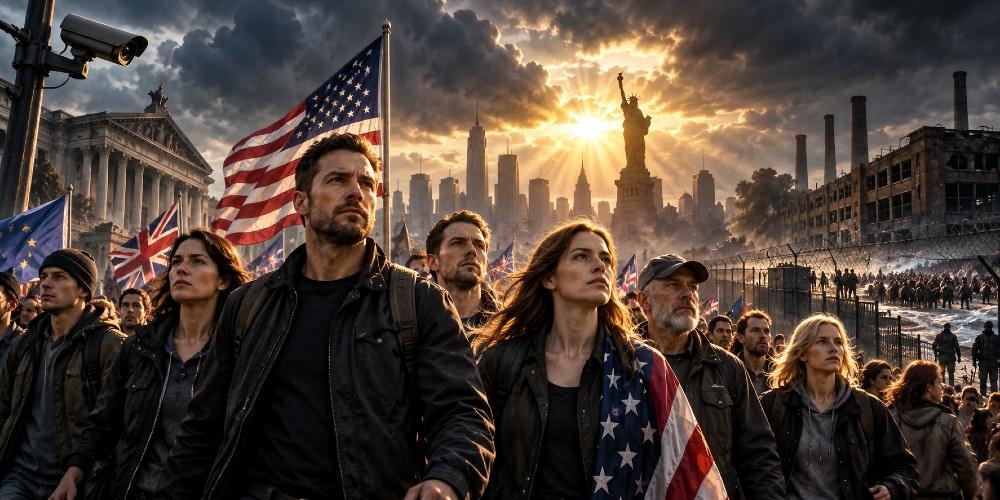
When pundits say that the United States — or the West, more generally — is “in decline,” what do they mean?
Are they talking about Western nations’ rising and unsustainable sovereign debts, including a U.S. national debt of over forty trillion dollars? Are they acknowledging that forty-plus years of “free trade deals” have hollowed out once-bustling manufacturing and industrial towns and left tens of millions of blue-collar workers unemployed and dependent upon government welfare? Are they admitting that a century-long public policy campaign designed to arrest population growth by discouraging marriage and families and encouraging promiscuity and abortions has created a highly sexualized, self-indulgent, and lonely world? Are they recognizing that open borders and Western governments’ traitorous betrayals of their own citizens have transformed relatively peaceful countries united by common cultures into battlegrounds where warring tribes from around the world attack Western nations’ histories, churches, traditions, tranquility, security, identities, and beliefs?
These are all symptoms of decline. There are many more. But none of these sizable problems is a death sentence for Western civilization.
After all, we live in a world where fifty million people live as slaves today. Nearly twenty million of those slaves toil in India and China. However, when political pundits describe the U.S. and the West as “in decline,” they usually describe the future as belonging to the planet’s two largest slaveholding nations. From the point of view of Christians and other enslaved minorities, India and China are Hell, while the West is the Promised Land.
Similarly, communist China runs the most sophisticated domestic surveillance system of any nation in the world. News flows are strictly regulated. Social media accounts are monitored. Purchases are tracked. Citizens’ “social credit scores” are adjusted to reward “correct” behavior and punish “incorrect” thoughts. While Western governments are shamelessly copying these forms of soft oppression and constructing their own surveillance states, the degree of totalitarianism that already defines life in communist China is not yet prevalent in the West.
Even more importantly, Western citizens have not yet yielded to totalitarianism as an inevitability. The United Kingdom uses as many surveillance cameras to spy on its citizens as communist China, but rebellious Brits vandalize these cameras much more frequently than their Chinese counterparts. Likewise, Americans have begun to target and destroy Flock Safety cameras that record license plates and track citizens’ movements. As Western governments scheme to construct surveillance infrastructure that is repressive in nature, Western citizens in growing numbers are fighting back against totalitarianism and in defense of personal freedom.
The governments of Canada, the United Kingdom, the European Union, Australia, and New Zealand censor online communication and criminalize public dissent; there is no question that free speech is under attack throughout the West. But Western citizens are constantly finding workarounds to communicate with each other and to spread their messages far and wide.
While the European Commission and the British and Canadian governments are working to build digital “Iron Curtains” to keep “unwanted” thoughts and expressions from reaching their citizens’ minds, freedom-lovers are waging quiet wars against State propaganda and other systems of public control. Western governments are finding it difficult to erect modern “Berlin Walls” that separate free-speaking Westerners from thought-policed Westerners because Westerners on both sides of these social media walls are exchanging government-labeled “disinformation” in defiance of their regimes’ authoritarian mandates.

Furthermore, the fastest growing political parties across most of the West are so-called “populist” movements demanding an end to mass immigration and a return to secure borders. There is a belated recognition that Western civilization has been under attack for quite some time and that Western governments have been the primary villains doing the attacking.
There is increasing public awareness that Western governments have been replacing Western citizens with foreigners as part of a long-term, malevolent effort to repudiate Western values and traditions and to instigate sufficient domestic strife to distract citizens from the economy-killing effects of “green energy” delusions that have no effect on the weather but do transfer wealth from the poorest to the richest members of society.
For too many years, government-sponsored paramilitary forces such as Antifa have been the only shock troops causing mayhem on the streets and terrorizing Western citizens. Now Western citizens are mobilizing huge public movements of their own in an effort to demonstrate to Western governments that they will no longer be silenced. For days, large numbers of citizens have been fanning out across Great Britain and Spain to protest their governments’ open borders policies that have flooded both countries with dangerous foreign nationals. They fight for free speech, secure borders, and the preservation of their way of life.
Western governments continue to demonstrate how afraid they are of their own citizens by expanding online speech controls, criminalizing public opinion as “hate speech,” undermining the electoral will of voters, outright canceling elections, and designating popular political parties as “domestic terror” groups.
These protests, opposition movements, and forms of civil disobedience may appear chaotic or even scare people, but they are hardly signs of “decline.” On the contrary, they are unmistakable indications of life coming from Western societies that have appeared comatose for entirely too long. Energizing long-inert electorates takes time, but once the event horizon for political change is crossed, there is no going back.
A mere decade before the American War for Independence, colonials were overwhelmingly loyal to the British Crown. The threshold separating status quo from revolution is often thin.
That is why the German political Establishment is losing its collective mind right now after the “Alternative for Deutschland” party won a historic victory in Germany’s Saxony-Anhalt state elections on Sunday. Despite the German Deep State’s attempts to criminalize AfD as a domestic terror group because of its opposition to open borders and the European Union and support for German culture and cheap energy, German citizens (including young voters) rallied behind the rebellious party. There hasn’t been this much raw energy and excitement in Germany since the wall came down.
This political effervescence popping up in different parts of the West is intoxicating. There is electricity in the air. It’s as if volatile elements are being shaken together, and Western citizens are waiting for the explosive chemical reaction. These are not signs of “decline.” These are the winds of change.
If decline is not inevitable, then, why have so many political prognosticators already written obituaries for the United States and the West? Perhaps pessimistic political pundits are a big part of the problem. They view Western “decline” as predetermined because they lack the sense of civilizational pride necessary to accomplish audacious things.
Our American ancestors embraced the spirit of “Manifest Destiny,” the belief that settlers would tame the frontier and expand the American way of life across the continent. They were not deterred by the lack of roads or the multitudinous dangers. They did not expect government agents to “save” them; they knew that they were on their own. Yet they did the hard things anyway. They crossed rivers and mountains. They carved new trails through the wilderness.
With callused hands, they plowed the fields and farmed the land. They built the country one settlement at a time until America’s destiny lay manifest from coast to coast.
Our problems — no matter how gargantuan they seem — are not evidence of American or Western decline. Decline comes when people refuse to confront what threatens them. It spreads like poison gas slowly suffocating a nation.

It disorients entire countries, one lost soul at a time. But decline is a choice. Every day, you either give in or fight. In America and across the West, we have so much worth defending. Our enemies wish for us to submit and die. We shall rebel and live.
Bypass Big Tech Censors

Two Storms, One Harvest

Every food crisis in living memory has been a one-shock event. The 2008 price spike was a commodity bubble. The 2020 shortages were a logistics failure. The 2022 grain scare was a war on one exporter’s ports. Each time, the system bent, adjusted, and recovered, and each time the experts assured us afterward that global markets are simply too big and too diversified to fail.
What nobody in Washington seems eager to discuss is that 2026 is shaping up to be something the modern food system has never actually faced. Two independent shocks, one climatic and one geopolitical, are converging on the same harvest cycle at the same time. Not sequentially. Simultaneously.
Start with the weather. The Pacific Ocean is currently building toward what forecasters now openly call a record event. NOAA’s Climate Prediction Center puts the odds of at least a strong El Niño near 88 percent, with roughly two in three odds it reaches “very strong” status, the tier reserved for perhaps three or four events in the entire satellite era. Every major global model now projects a median peak in Super El Niño territory, and most of them project it exceeding the 2015-16 event, which until now held the modern record. Sea surface anomalies were already brushing the super threshold in mid-July, months before these events normally peak. The atmosphere has already shifted into El Niño mode, and the event is forecast to crest in late fall and early winter.
This is not about “climate change.” It’s about the standard cycles of weather, and the cycle we’re currently in is one that has likely devastated societies in the past. We’re better prepared as a society today, but not all Americans are equally prepared.
Serious households have started doing the quiet math on their own. Grocery bills tell part of the story, and the forecast maps tell the rest, which is why long-term food storage has moved from fringe hobby to mainstream line item in the family budget, with established suppliers like Heaven’s Harvest seeing demand from people who five years ago would have rolled their eyes at the idea. That instinct is not paranoia. It is pattern recognition, and the pattern is worth walking through carefully.
Editor’s Note: Heaven’s Harvest IS a sponsor, but the warnings of this article are real and would be written even if we didn’t have a survival food sponsor. With that said, those who take advantage of what they offer can use promo code “Patriot” for 15% off.
The Fertilizer Clock Is Already Running
While the Pacific warms, the second shock has been unfolding in the Strait of Hormuz. The conflict with Iran turned the world’s most important energy chokepoint into a contested waterway, and the consequences reach far beyond the gas pump. Roughly a third of global fertilizer trade moves through Hormuz, and the disruption sent urea prices up 86 percent year over year by March, with a 53 percent jump in a single month.
The World Bank projects energy prices rising about 24 percent in 2026 and fertilizer about 31 percent. By its own accounting, fertilizer prices ran 35 percent higher in the first five months of this year than the same period last year.
Here is the mechanism the nightly news will not explain. Fertilizer is not a grocery item. It is a time-delayed input. The nitrogen a farmer in Iowa or Punjab could not afford to apply this spring does not show up as a problem this spring. It shows up as a thinner harvest six to twelve months later.
The World Bank’s own food security brief concedes that the effects of reduced applications earlier this season “are likely to become visible only later in harvest outcomes.” Translate that from institutional language into plain English and it means this. The damage is already done, it is already in the ground, and we are simply waiting for it to arrive on the shelf.
Now check the calendar. Six to twelve months from the spring planting season lands us squarely in late 2026 and early 2027. Which is precisely when the strongest El Niño in the instrumental record is forecast to peak, bringing its signature droughts to Southeast Asia, Australia, southern Africa, northern Brazil, and South Asia, the very regions that grow the world’s rice, sugar, and oilseeds.
The World Bank warns openly that a strong El Niño “could disrupt multiple crop belts simultaneously” on top of the conflict-driven input costs. Their baseline projection assumes the Middle East disruptions ease by autumn. What in the last two years of Middle East history suggests that assumption is safe?
The System Has No Slack Left
The comfortable answer is that global markets always adjust. But adjustment requires slack, and the slack is gone. Global cereal production is expected to decline from last year’s records even before El Niño does its work. The UN World Food Programme, hardly a den of right-wing preppers, is calling this the most significant disruption to its supply chains since Covid and the invasion of Ukraine, and its supply chain director put the stakes bluntly.
Today’s supply chain challenges are tomorrow’s hunger crisis.
There is also a political dimension that markets cannot price. When food gets scarce, governments do not behave like economists. They behave like politicians. Export bans, hoarding mandates, and panic buying at the national level turned the modest rice shortfall of 2008 into a global crisis, and analysts are already warning that import-dependent nations are the first dominoes.
The 2015-16 Super El Niño, a far weaker event than what is now forecast, threw tens of millions into food stress across Africa and Asia. This one is projected to be stronger, and it arrives with fertilizer already rationed by price and shipping lanes already contested by missiles.
What Joseph Knew
Scripture does not treat preparation for lean years as faithlessness. It treats it as wisdom delivered in advance to those willing to act on it.
Behold, there come seven years of great plenty throughout all the land of Egypt: And there shall arise after them seven years of famine; and all the plenty shall be forgotten in the land of Egypt.
Joseph did not respond to that warning with a hashtag or a committee. He stored grain during the years of abundance, and when the famine came, Egypt stood while its neighbors begged. The lesson is not that famine is certain. It is that the time to prepare is precisely when preparation still looks optional.
Nobody who filled a pantry in a year of plenty has ever regretted it, and nobody standing in an empty aisle has ever been glad he waited for certainty.
None of this calls for panic, and panic is the enemy of sound judgment anyway. It calls for the same unglamorous prudence our grandparents considered ordinary. Keep some cash margin, know your local growers, and put real food in deep storage while it is cheap and available, because the entire arc of this story is that cheap and available is a closing window.
Families looking for a straightforward place to start can visit Heaven’s Harvest and use promo code Patriot for 15 percent off long-term storable food. The forecasts may yet soften, the strait may yet reopen, and we should pray they do. But hope is a fine thing to hold and a foolish thing to eat.