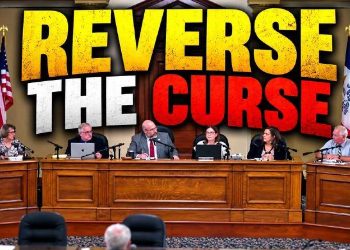
In the wake of President Donald Trump’s second term and the aggressive policy shifts spearheaded by his administration and allies like Elon Musk, Democrats have faced a challenging political landscape. With Republicans controlling the White House and Congress, the Democratic Party has struggled to find its footing, prompting a shift toward unconventional strategies to regain momentum.
Critics argue that rather than relying on genuine grassroots support, Democrats are increasingly turning to astroturfing—coordinated, inorganic efforts disguised as spontaneous public sentiment—to push their agenda. They are doing this in three ways:
- Infiltrating Republican town halls
- Amplifying presence at rallies like Bernie Sanders’ recent Denver event
- Orchestrating attacks against Tesla
Infiltrating Republican Town Halls with Operatives
Republican town halls, once routine forums for constituent engagement, have become battlegrounds in the current political climate. Following Trump’s reelection in November 2024, the National Republican Congressional Committee (NRCC) advised House Republicans to avoid in-person town halls due to disruptive protests, a move Democrats quickly seized upon.
The Democratic National Committee (DNC), alongside the Democratic Congressional Campaign Committee (DCCC) and state parties, launched a coordinated effort dubbed “People’s Town Halls” across all 50 states, targeting Republican-held districts. These events, often framed as responses to GOP lawmakers’ refusal to face constituents, have drawn scrutiny for their orchestrated nature.
Embattled Senator Chuck Schumer recently let the cat out of the bag. Republican Senator Josh Hawley lambasted him for it.
Chuck Schumer said the quiet part out loud: Democrats are sending astroturf protestors to disrupt Republican town halls. It’s not organic. It’s acting.
Democrats aren’t a political party. They’re a theater troupe funded by George Soros pic.twitter.com/N2q4czyuzb
— Josh Hawley (@HawleyMO) March 21, 2025
Critics point to a pattern resembling past astroturfing efforts, where progressive groups like MoveOn.org and Indivisible—funded through platforms like ActBlue—mobilize activists to flood Republican events with pre-planned disruptions. Posts on X have suggested that these protests are not organic expressions of local discontent but rather “manufactured productions” designed to create the illusion of widespread opposition to Trump and Musk’s policies, such as the Department of Government Efficiency (DOGE) cuts.
While concrete evidence of direct payments to protesters remains elusive, the synchronized messaging and rapid deployment of these groups suggest a level of coordination that belies a spontaneous grassroots movement. The result? Media outlets like CNN and MSNBC amplify these scenes, framing them as evidence of a broad public backlash, even as Republicans dismiss them as staged.
Amplifying Presence at Rallies Like Bernie Sanders’ Denver Event
The “Fighting Oligarchy” tour, led by Senator Bernie Sanders and Representative Alexandria Ocasio-Cortez, has drawn massive crowds, with the Denver rally on March 21, 2025, attracting over 34,000 attendees—the largest in Sanders’ career. Billed as a resistance to Trump’s agenda and Musk’s influence, the event was a spectacle of progressive defiance, with Sanders declaring, “The American people will not allow Trump to move us into oligarchy.” Yet, questions linger about the authenticity of this turnout.

Posts on X have claimed that GPS data analysis revealed 84% of Denver rally attendees had participated in nine or more prior protests, with ties to groups funded by ActBlue and even USAID.
GPS—Here we go again, there were 20,189 devices. Still a large crowd but not even close to the 30,000 quoted in Denver newspapers nor the 34,000 quoted by Bernie Sanders and AOC.
84% of the devices present had attended 9 or more Kamala Harris rallies, antifa/blm, pro-Hamas,… https://t.co/zQuvc0ATx5
— Tony Seruga (@TonySeruga) March 23, 2025
While this data lacks independent verification, it fuels speculation that the crowd was bolstered by seasoned activists rather than a spontaneous gathering of disillusioned citizens. Sanders’ team reported that half of the RSVPs came from individuals not on his usual supporter list, suggesting an influx of participants mobilized through external networks. Critics argue this reflects a deliberate effort by Democratic operatives to inflate the perception of support, turning a rally into a staged show of force. The Sanders-AOC tour, while undeniably popular among progressives, may thus serve as a vehicle for astroturfing, projecting an image of unity and momentum that masks the party’s broader struggles to connect with voters organically.
Coordinating Attacks Against Tesla
Elon Musk’s high-profile role in Trump’s administration, particularly through DOGE, has made him—and by extension, Tesla—a lightning rod for Democratic criticism. Since early 2025, Tesla has faced a wave of protests and vandalism, from boycotts urged by groups like Tesla Takedown to incidents like the targeting of a Cybertruck in Lakewood, Colorado. Governor Tim Walz’s public jabs at Musk, including a quip about Tesla’s stock plummeting 41.4% year-to-date as of March, have coincided with these actions, raising suspicions of a coordinated campaign.
Posts on X and conservative commentators allege that these efforts are not grassroots but orchestrated by Democratic-aligned entities. MoveOn.org, which has received significant funding from George Soros’ Open Society Policy Center, announced a “Congress Works for Us, Not Musk” initiative aimed at countering the Trump-Musk agenda, including protests at Tesla facilities.
The decentralized nature of groups like Tesla Takedown, which has amplified demonstrations nationwide, suggests a networked effort rather than isolated acts of dissent. While no direct evidence proves Democratic leadership is paying protesters, the alignment of rhetoric—from Walz’s town halls in GOP districts to Sanders’ rally speeches—hints at a broader strategy to undermine Musk’s credibility and, by extension, Trump’s administration. Tesla’s defenders, including Trump himself on Truth Social, have decried these actions as “collusive” attempts to harm Musk’s enterprises, further polarizing the narrative.
A Strategy of Perception Over Substance
Astroturfing, by definition, seeks to mimic grassroots enthusiasm while concealing its top-down origins. In flooding Republican town halls, packing rallies like Denver, and targeting Tesla, Democrats appear to be crafting a narrative of resistance that prioritizes optics over organic support. This approach may yield short-term gains—media coverage, viral moments, and pressure on GOP lawmakers—but it risks alienating voters who see through the veneer of coordination. As the 2026 midterms loom, the question remains: can a party struggling with a 29% favorability rating, as reported by CNN in March 2025, rebuild trust through manufactured dissent, or will these tactics only deepen the divide? For now, the astroturfing allegations remain a contentious flashpoint in an already fractious political arena.
Bypass Big Tech Censors

Starting the Day With a Scripture-Inspired Roast Helps Center Your Thoughts on Eternal Truths Amid Temporal Pressures
The world can seem chaotic, especially right after we wake up. Many believers start their mornings reaching for something familiar — a hot cup of coffee — yet end up settling for mediocre brews that do little more than deliver a caffeine jolt. The daily grind of life, with its endless distractions, news cycles, and responsibilities, can leave even the most faithful feeling spiritually parched alongside their physical fatigue. What if your morning ritual could do more than wake you up? What if it could ground you in truth, nourish your body with exceptional quality, and quietly advance a kingdom purpose at the same time?
That’s the promise — and the reality — behind Promised Grounds Coffee. This Christian-founded company doesn’t just roast beans; it approaches every step as an act of worship and discipleship. By selecting only the top 10% of specialty-grade beans, ethically sourced from dedicated farmers in Central and South America, and small-batch roasting them with reverence in Austin, Texas, Promised Grounds delivers what many describe as the best coffee available — never burnt, never bland, but rich with origin stories and layered flavors that honor God’s creation.
From the vibrant Psalm 27 Roast (a light, bright medium option) to the bold yet peaceful 2 Timothy 1:7 Decaf, each bag carries a Scripture verse that turns your daily pour into a gentle reminder of faith. And through their Ounce Per Ounce Promise, every ounce of coffee you enjoy provides an equal ounce of clean water to families in need via partnership with Filter of Hope — literally brewing hope for body and soul, one cup at a time.
The challenge for today’s Christians runs deeper than finding a decent cup. In an age of convenience-driven consumerism, it’s easy to support companies that dilute values or remain silent on matters of faith. Many believers want their everyday choices — from what they drink to how they spend — to reflect discipleship rather than just convenience. Promised Grounds solves this by weaving Christian excellence into the entire process: beans nurtured with prayerful stewardship by farming families, roasted as an offering rather than a commodity, and packaged with Bible verses to encourage a mindset of gratitude and purpose from the first sip. Reviewers consistently praise the smooth, rich profiles — whether enjoyed black in a drip maker, iced on a warm day, or shared in fellowship — noting how the quality stands toe-to-toe with premium secular brands while delivering something far more meaningful.
This integration of faith and flavor addresses a real need in Christian households and ministries. Busy parents, church leaders, and remote workers alike report that starting the day with a Scripture-inspired roast helps center their thoughts on eternal truths amid temporal pressures. The coffee’s exceptional character — bright citrus notes in lighter roasts or deep chocolate undertones in bolder ones — comes from meticulous selection and careful roasting that respects the bean’s natural gifts rather than masking them. It’s the kind of coffee that elevates a simple quiet time, fuels productive workdays, or sparks meaningful conversations when shared at Bible studies or outreach events. And because it’s ethically sourced with integrity, every purchase supports sustainable livelihoods for farmers who treat their crops like family harvests.
For those leading churches or small groups, the impact multiplies. Promised Grounds offers bundles and options perfect for hospitality ministries, turning ordinary coffee service into an opportunity to point people toward the living water of Christ. Imagine greeting visitors with a warm cup whose very bag carries God’s Word — a subtle yet powerful witness that aligns with the Great Commission. The company’s Texas roots and commitment to “brewing hope” resonate especially with believers who value American enterprise paired with global compassion.
Of course, quality alone isn’t enough if the experience feels out of reach. Promised Grounds keeps it accessible with practical perks like free shipping on orders over $40, sample sets for discovering favorites, and thoughtful add-ons such as faith-themed mugs. Whether you prefer whole beans for fresh grinding, grounds for convenience, or even bulk options for larger households and ministries, the result is consistently superior coffee that makes discipleship feel integrated rather than added on.
As you consider how to align even the smallest habits with your walk with God, Promised Grounds Coffee stands out as a refreshing solution. It tackles the dual problems of subpar daily sustenance and disconnected consumption by offering a product that genuinely excels in taste while advancing a mission of clean water, farmer dignity, and scriptural encouragement. Believers who make the switch often describe it as more than a beverage upgrade — it becomes part of their rhythm of gratitude, a daily invitation to remember that every good gift comes from above.
If you’re ready to transform your mornings (and perhaps your church gatherings) with coffee that honors both exceptional craftsmanship and Christian values, I encourage you to explore what Promised Grounds has to offer. One sip at a time, you’ll be nourishing your body, refreshing your spirit, and participating in something far greater — all while enjoying what truly is among the best coffee available.