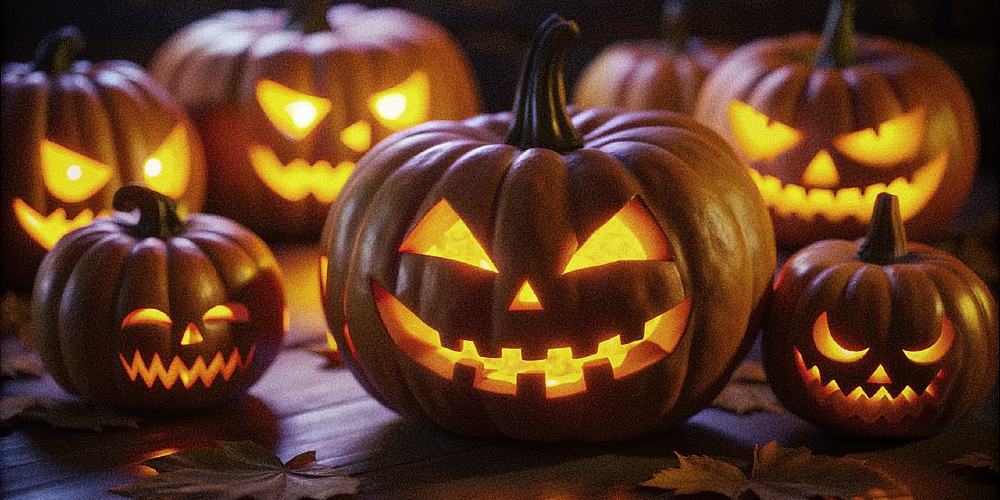
(End of the American Dream)—Most people gleefully celebrate Halloween without ever thinking about how it originated or what our Halloween traditions really mean. They just assume that it must be okay since almost everyone else is doing it. Today, Halloween is celebrated all over the world, but that hasn’t always been the case. In fact, there was a time when most Americans did not celebrate it.
It was only during the 20th century that it actually became a nationwide holiday that was celebrated on a widespread basis, and only within the past few decades has it really taken off as a truly global holiday.
To find the original roots of Halloween, one must go back approximately 2,000 years to the ancient Celtic festival of Samhain…
Halloween’s original roots trace back to Samhain (pronounced “sow-in”—because of course the Celts couldn’t make it easy), an ancient Celtic festival that marked the end of the harvest season in Ireland. The Celts believed that on October 31st, the boundary between the living and the dead became, shall we say, a little thin. To keep any wandering spirits at bay, they’d light massive bonfires and don costumes—probably doubling as a solid excuse for some much-needed group bonding (what else was there to do in ancient Ireland, really?).
This is where the tradition of “Halloween costumes” began.
Some revelers apparently wore costumes to ward off spirits, but others apparently wore them “to allow for communication with the spirit world”…
Besides the reasons given above, Halloween masks and costumes were used to hide one’s attendance at pagan festivals or—as in traditional shamanism (mediated by a witch doctor or pagan priest) and other forms of animism—to change the personality of the wearer to allow for communication with the spirit world. Here, costumes could be worn to ward off evil spirits. On the other hand, the costume wearer might use a mask to try to attract and absorb the power of the animal represented by the mask and costume worn. According to this scenario, Halloween costumes may have originated with the Celtic Druid ceremonial participants, who wore animal heads and skins to acquire the strength of a particular animal.
Today, some of the most popular Halloween costumes are of ghosts, witches, vampires and fallen angels.
But most people are entirely convinced that there is absolutely no danger in dressing up as such entities.
According to the History Channel, during Samhain the Celts would also “burn crops and animals as sacrifices to the Celtic deities”…

In addition to causing trouble and damaging crops, Celts thought that the presence of the otherworldly spirits made it easier for the Druids, or Celtic priests, to make predictions about the future. For a people entirely dependent on the volatile natural world, these prophecies were an important source of comfort during the long, dark winter.
To commemorate the event, Druids built huge sacred bonfires, where people gathered to burn crops and animals as sacrifices to the Celtic deities. During the celebration, the Celts wore costumes, typically consisting of animal heads and skins, and attempted to tell each other’s fortunes.
That is quite alarming. And there are also some ancient documents that indicate that humans were often sacrificed in massive Samhain fires as well…
According to old documents, in its most primitive guise, Samhain would have featured many sacrifices to the Celtic gods of death, with both animals and humans thrown in to huge firepits as offerings.
People claimed the ancient Druids ate their first born children on Samhain, or collected the blood of their sacrificial humans in cauldrons and drank it.
But nobody does such things anymore, right?
Well, Pastor John Ramirez says that when he was a practicing Satanist he actually participated in the sacrifice of animals on Halloween…
Ramirez, now a pastor, knows all about the dark reality of Halloween. He once sacrificed animals as part of satanic rituals and his friends even knew him as “Lucifer’s son.”
Now as a born again believer, he strongly warns Christians against celebrating Halloween and participating in harvest festivals.
“The only harvest we should celebrate is the harvest of souls,” he adds.
Those that are obsessed with spiritual darkness take these things very seriously.
Many of them even still call this holiday “Samhain” even though most of us call it Halloween.
So how did it come to be called Halloween?
Well, it all started when the Celts were invaded by the Roman Empire…
However, when the Roman Empire took over the majority of the Celtic region, two ancient Roman festivals merged with the festival of Samhain over the 400 years the Romans occupied the territory. These festivals were Feralia, a day honoring the dead, and a day celebrating Pomona, the Roman goddess of fruit and trees who is primarily symbolized with an apple.
It was not until roughly the 9th through 11th centuries when early Christianity was spreading throughout the Celtic territory that we finally obtained the name we all know and love. The Christian (specifically Catholic) holiday of All Saints’ Day was very similar to the festival of Samhain with bonfires and costumes, though it was celebrated in early November. It was also called All-Hallows and the festival of Samhain—celebrated the night before—became known as All-Hallows Eve and eventually Halloween.
From that time forward, “Halloween” was primarily a Catholic celebration.
That is why the Puritans that settled in early America were steadfastly against it. The following comes from Wikipedia…
Lesley Bannatyne and Cindy Ott write that Anglican colonists in the southern United States and Catholic colonists in Maryland “recognized All Hallow’s Eve in their church calendars”,[141][142] although the Puritans of New England strongly opposed the holiday, along with other traditional celebrations of the established Church, including Christmas.[143] Almanacs of the late 18th and early 19th century give no indication that Halloween was widely celebrated in North America.[26]
It was not until after mass Irish and Scottish immigration in the 19th century that Halloween became a major holiday in America.[26] Most American Halloween traditions were inherited from the Irish and Scots,[27][144] though “In Cajun areas, a nocturnal Mass was said in cemeteries on Halloween night. Candles that had been blessed were placed on graves, and families sometimes spent the entire night at the graveside”.[145] Originally confined to these immigrant communities, it was gradually assimilated into mainstream society and was celebrated coast to coast by people of all social, racial, and religious backgrounds by the early 20th century.[146] Then, through American influence, these Halloween traditions spread to many other countries by the late 20th and early 21st century, including to mainland Europe and some parts of the Far East.[28][16][147]
Today, Halloween has become one of our biggest holidays.
In fact, it is being projected that Americans will spend more than 11 billion dollars on Halloween this year alone…
Americans are projected to spend $11.6 billion on Halloween decorations, costumes, candy and other festive purchases this October, according to an annual survey from the National Retail Federation.
When broken down, that $11.6 billion translated to $3.8 billion spent on costumes, $3.8 billion dedicated to decorations, $3.5 billion allocated to purchasing candy and $0.5 billion spent on greeting cards, per the survey.
If you can believe it, Americans even spend approximately 700 million dollars on costumes for their pets each year.

Can you believe that?
One survey found that 93 percent of Americans celebrate Halloween in some way.
Needless to say, this makes certain people very happy. The founder of the Church of Satan, Anton LaVey, once made the following statement: “I am glad that Christian parents let their children worship the devil at least one night out of the year. Welcome to Halloween.”
Like I noted earlier, most people celebrate Halloween without ever even thinking about it.
In fact, many people don’t know why they believe what they believe about most things.
If we are going to do something, we need to understand why we are doing it.

As for where Halloween originally came from, now you know the truth.
Michael’s new book entitled “Why” is available in paperback and for the Kindle on Amazon.com, and you can subscribe to his Substack newsletter at michaeltsnyder.substack.com.
Bypass Big Tech Censors

Two Storms, One Harvest

Every food crisis in living memory has been a one-shock event. The 2008 price spike was a commodity bubble. The 2020 shortages were a logistics failure. The 2022 grain scare was a war on one exporter’s ports. Each time, the system bent, adjusted, and recovered, and each time the experts assured us afterward that global markets are simply too big and too diversified to fail.
What nobody in Washington seems eager to discuss is that 2026 is shaping up to be something the modern food system has never actually faced. Two independent shocks, one climatic and one geopolitical, are converging on the same harvest cycle at the same time. Not sequentially. Simultaneously.
Start with the weather. The Pacific Ocean is currently building toward what forecasters now openly call a record event. NOAA’s Climate Prediction Center puts the odds of at least a strong El Niño near 88 percent, with roughly two in three odds it reaches “very strong” status, the tier reserved for perhaps three or four events in the entire satellite era. Every major global model now projects a median peak in Super El Niño territory, and most of them project it exceeding the 2015-16 event, which until now held the modern record. Sea surface anomalies were already brushing the super threshold in mid-July, months before these events normally peak. The atmosphere has already shifted into El Niño mode, and the event is forecast to crest in late fall and early winter.
This is not about “climate change.” It’s about the standard cycles of weather, and the cycle we’re currently in is one that has likely devastated societies in the past. We’re better prepared as a society today, but not all Americans are equally prepared.
Serious households have started doing the quiet math on their own. Grocery bills tell part of the story, and the forecast maps tell the rest, which is why long-term food storage has moved from fringe hobby to mainstream line item in the family budget, with established suppliers like Heaven’s Harvest seeing demand from people who five years ago would have rolled their eyes at the idea. That instinct is not paranoia. It is pattern recognition, and the pattern is worth walking through carefully.
Editor’s Note: Heaven’s Harvest IS a sponsor, but the warnings of this article are real and would be written even if we didn’t have a survival food sponsor. With that said, those who take advantage of what they offer can use promo code “Patriot” for 15% off.
The Fertilizer Clock Is Already Running
While the Pacific warms, the second shock has been unfolding in the Strait of Hormuz. The conflict with Iran turned the world’s most important energy chokepoint into a contested waterway, and the consequences reach far beyond the gas pump. Roughly a third of global fertilizer trade moves through Hormuz, and the disruption sent urea prices up 86 percent year over year by March, with a 53 percent jump in a single month.
The World Bank projects energy prices rising about 24 percent in 2026 and fertilizer about 31 percent. By its own accounting, fertilizer prices ran 35 percent higher in the first five months of this year than the same period last year.
Here is the mechanism the nightly news will not explain. Fertilizer is not a grocery item. It is a time-delayed input. The nitrogen a farmer in Iowa or Punjab could not afford to apply this spring does not show up as a problem this spring. It shows up as a thinner harvest six to twelve months later.
The World Bank’s own food security brief concedes that the effects of reduced applications earlier this season “are likely to become visible only later in harvest outcomes.” Translate that from institutional language into plain English and it means this. The damage is already done, it is already in the ground, and we are simply waiting for it to arrive on the shelf.
Now check the calendar. Six to twelve months from the spring planting season lands us squarely in late 2026 and early 2027. Which is precisely when the strongest El Niño in the instrumental record is forecast to peak, bringing its signature droughts to Southeast Asia, Australia, southern Africa, northern Brazil, and South Asia, the very regions that grow the world’s rice, sugar, and oilseeds.
The World Bank warns openly that a strong El Niño “could disrupt multiple crop belts simultaneously” on top of the conflict-driven input costs. Their baseline projection assumes the Middle East disruptions ease by autumn. What in the last two years of Middle East history suggests that assumption is safe?
The System Has No Slack Left
The comfortable answer is that global markets always adjust. But adjustment requires slack, and the slack is gone. Global cereal production is expected to decline from last year’s records even before El Niño does its work. The UN World Food Programme, hardly a den of right-wing preppers, is calling this the most significant disruption to its supply chains since Covid and the invasion of Ukraine, and its supply chain director put the stakes bluntly.
Today’s supply chain challenges are tomorrow’s hunger crisis.
There is also a political dimension that markets cannot price. When food gets scarce, governments do not behave like economists. They behave like politicians. Export bans, hoarding mandates, and panic buying at the national level turned the modest rice shortfall of 2008 into a global crisis, and analysts are already warning that import-dependent nations are the first dominoes.
The 2015-16 Super El Niño, a far weaker event than what is now forecast, threw tens of millions into food stress across Africa and Asia. This one is projected to be stronger, and it arrives with fertilizer already rationed by price and shipping lanes already contested by missiles.
What Joseph Knew
Scripture does not treat preparation for lean years as faithlessness. It treats it as wisdom delivered in advance to those willing to act on it.
Behold, there come seven years of great plenty throughout all the land of Egypt: And there shall arise after them seven years of famine; and all the plenty shall be forgotten in the land of Egypt.
Joseph did not respond to that warning with a hashtag or a committee. He stored grain during the years of abundance, and when the famine came, Egypt stood while its neighbors begged. The lesson is not that famine is certain. It is that the time to prepare is precisely when preparation still looks optional.
Nobody who filled a pantry in a year of plenty has ever regretted it, and nobody standing in an empty aisle has ever been glad he waited for certainty.
None of this calls for panic, and panic is the enemy of sound judgment anyway. It calls for the same unglamorous prudence our grandparents considered ordinary. Keep some cash margin, know your local growers, and put real food in deep storage while it is cheap and available, because the entire arc of this story is that cheap and available is a closing window.
Families looking for a straightforward place to start can visit Heaven’s Harvest and use promo code Patriot for 15 percent off long-term storable food. The forecasts may yet soften, the strait may yet reopen, and we should pray they do. But hope is a fine thing to hold and a foolish thing to eat.