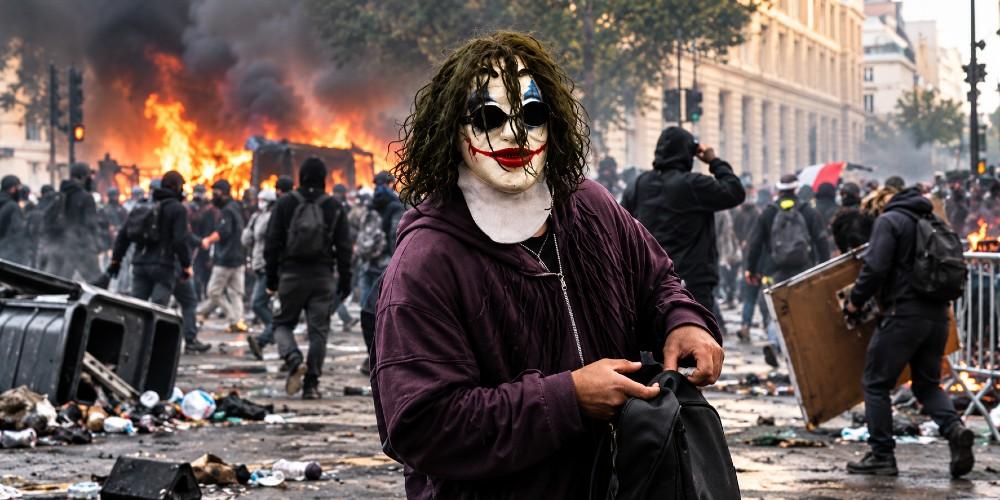
France is on fire again, and the usual suspects are pouring gasoline while calling it student solidarity. On Saturday the student protests over “school conditions” merged with a nationwide revolt that put more than half a million people in the streets. Rioters attacked public buildings, looted stores, and set fires from Paris to Lyon. More than 800 people were arrested.
And that was just one day.
A communist academic named Vijay Prashad celebrated the whole mess with a single post that tied Paris to New Delhi and Buenos Aires and borrowed a line from The Clash: “Let fury have the hour, anger can be power.”
Prashad is not some random cheerleader. He is executive director of Tricontinental Ltd., the nonprofit funded by American-born Marxist tech tycoon Neville Roy Singham, who lives in Shanghai. That one detail tells you everything about the franchise.
Fox News Digital’s investigation by Asra Nomani has now identified 54 organizations and movements inside France’s October protest ecosystem and its wider network of amplifiers. Only 16 of them—roughly one in three—are actual student or youth groups. The other 38 are adult-led communist parties, revolutionary socialist outfits, labor unions, political parties, advocacy groups, Islamists, and international propaganda outlets.
The Adult Operators Behind the “Student” Revolt
The list includes the Gilets jaunes, the radical far-left Yellow Vests, and La France Insoumise, the far-left socialist party known as France Unbowed. From the beginning, these groups treated broken classrooms and school conditions as the useful pretext for a broader war against capitalism, austerity, policing, and military spending.
Photos from the streets show the hammer and sickle flying next to the Palestinian keffiyeh. That is the red-green alliance in real time: communists and Islamists finding common cause against the West they both despise.
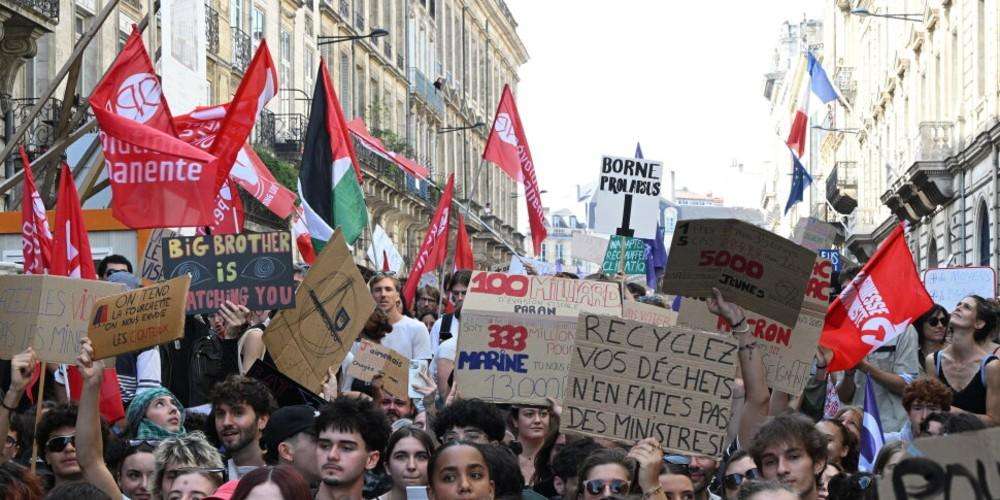
Nomani’s earlier reporting already showed how the same pattern works. Of an earlier count of 50 groups, only about a third were youth organizations. The rest were unions such as the CGT and Force Ouvrière, the French Communist Party, civil-rights front groups, and Palestinian-solidarity activists.
BreakThrough News, the New York outlet inside the Singham network, pushed the violence to a global audience with dramatic anti-police clips. The same network that has spent years amplifying unrest in American cities is now treating French streets as the latest franchise location.

“Paris-New Delhi-Buenos Aires. Let fury have the hour, anger can be power.”
That is not organic student rage. That is coordination.
The November 20 Escalation Already on the Calendar
The same people are not waiting for the next spontaneous spark. An international coalition of 28 communist and socialist youth organizations is already organizing a coordinated strike across 12 European countries on November 20 under the slogan “Fight for Our Future, Not Their Wars!”
They want walkouts, demonstrations, assemblies, blockades, and occupations. Groups in the United Kingdom such as Counterfire, the International Socialist Alternative, the Socialist Party, Socialist Students, and the Stop the War Coalition are promoting it and linking opposition to military spending with the usual anti-capitalist demands.
The manifesto complains that governments are spending on rearmament while cutting education, healthcare, and housing. It treats NATO, conscription talk, and any defense against actual threats as the real enemy. French school blockades, Spanish eviction protests, and German student walkouts against conscription are being folded into one narrative so the next round of chaos can be sold as a continental youth uprising rather than what it is: an organized political project.
The Franchise Model
Singham’s network supplies the international amplifier. Tricontinental, CodePink, and BreakThrough News have already demonstrated the playbook: seize a local grievance, frame it as systemic oppression, flood the zone with sympathetic media, and treat every arrest or police response as proof that the system must be dismantled.
The French Communist Party’s national secretary poses with protesters. Far-left politicians from La France Insoumise smile for the cameras with students. Meanwhile the adult operators stay in the background, ready to expand the demand set from better classrooms to the abolition of the existing order.
This is not new. The same red-green alliance has appeared in American campus encampments, in European anti-Israel marches, and in the long campaign against Western institutions. The difference is that Fox has now named the operators and counted the groups. Only a minority are the students whose faces appear in the photos. The majority are the permanent staff of Chaos Inc.
Scripture has a clearer description of the pattern. “For such are false apostles, deceitful workers, transforming themselves into the apostles of Christ. And no marvel; for Satan himself is transformed into an angel of light.”
The people burning streets and calling it solidarity for the future are not confused youth. They are the latest local franchise of a transnational project that has always known exactly what it wants: the weakening of every ordered society that stands in its way. France is simply the current storefront.
Here are the groups involved, compiled by Nomani at Fox News…
COMMUNIST AND SOCIALIST STUDENT AND YOUTH GROUPS
- Communist Youth of Greece — COMMUNIST: A Greek communist youth organization that has publicly supported French students, connecting their education demands to opposition to military spending and government austerity. It has also supported communist protesters in Madrid, Spain, and Greece.
- La Jeunesse Communists — COMMUNIST: A group coordinating communist youth activism visible in the French demonstrations, including hammer-and-sickle flags and banners calling for “Class War!”
- Le Poing Levé — The Raised Fist — REVOLUTIONARY COMMUNIST: A revolutionary student and youth organization associated with Révolution Permanente that works to connect high-school and university protests.
- Union de la Jeunesse Communiste (UJC) — Communist Youth Union — COMMUNIST: A French communist youth organization that called on supporters to join and amplify the student struggle.
STUDENT AND YOUTH GROUPS
- AFGES – Les étudiant·e·s d’Alsace — The Students of Alsace: A Strasbourg-based student federation affiliated with FAGE that posted about the early October mobilization while describing itself as politically independent. It coordinated protests in Strasbourg on Oct. 17 with an Instagram post that said, “MOBILISER,” which means “MOBILIZE.” Another post invited activists onto the streets with the message, “LE COMBAT CONTINUE,” or “THE FIGHT CONTINUES.”
- Étudiants Musulmans de France (EMF) — Muslim Students of France: A Muslim student association involved in student representation and campus solidarity whose social-media activity appears in the protest research; its exact Oct. 17 role remains unconfirmed.
- Fédération des associations générales étudiantes (FAGE) — Federation of General Student Associations: A national student federation that joined calls for student mobilization against the “extremely violent repression” of youth. It shared footage of its members marching on Oct. 17, with the hashtags #manifestation #genz #17octobre.
- Fédération Syndicale Étudiante (FSE) — Student Trade Union Federation: A left-wing student organization whose activists appeared in demonstrations and announced “Democratic and Antifascist Vigilance Committees,” linking high-school grievances to the treatment of anti-Israel activists and union members. On Saturday, it posted videos with its trademark solid red flags. One message read: “In Bordeaux, protesters invade the house of the mayor! On October 17, the whole country is on a standstill. Everyone is mobilizing for better living conditions, and against cutting the budget for public service! In Bordeaux, we hear echoing in the protest: Only one solution, the Revolution! The mobilization of the 17 continues: let’s block everywhere in France!”
- Interfac Île-de-France — Regional Student Coordination: A student coordination organization among Oct. 17 organizers involved in discussions over demonstration routes in Paris.
- Les Lycéens! — The High School Students!: A high-school student organization active in the early school blockades.
- Renouveau lycéen — High School Renewal: A high-school student organization identified in coverage of the October school mobilization.
- Rassemblement pour l’égalité et la démocratie Jeunes — Youth for Equality and Democracy: A youth civic and political organization associated with organizing support for students in Seine-Saint-Denis; its specific Oct. 17 role has not been independently established.
- Solidaires Étudiant·e·s — Solidaires Students: A left-wing student union that supported the high-school movement and helped connect university students with the October demonstrations.
- Union Étudiante — Student Union: A national university student union that helped mobilize students for the Oct. 6 demonstrations and encouraged participation in the broader movement.
- Union nationale des étudiants de France (UNEF) — National Union of Students of France: One of France’s established student unions, it was among the organizers of the Oct. 6 nationwide demonstrations.
- Union syndicale lycéenne (USL) — High School Students’ Union: A French high-school student union that helped organize the initial school blockades and October demonstrations before publicly supporting students joining the Oct. 17 Yellow Vest mobilization.
COMMUNIST, MARXIST, TROTSKYIST AND REVOLUTIONARY-SOCIALIST ORGANIZATIONS
- International Communist League — TROTSKYIST: An international communist organization whose French publication Le Bolchévik called on labor unions to mobilize in support of the school protests.
- Jeunesse du Monde — COMMUNIST PUBLICATION: A communist publication associated with the Organisation Communiste de France; separate organizational participation in the October 17 protests has not been established.
- La France insoumise (LFI) — France Unbowed — LEFT-POPULIST / SOCIALIST: A political movement whose elected officials supported student blockades, including lawmaker Louis Boyard, who waved a Palestinian flag alongside students at Paris-Est-Créteil University.
- Nouveau Parti anticapitaliste – L’Anticapitaliste (NPA) — New Anticapitalist Party — REVOLUTIONARY SOCIALIST: A revolutionary anti-capitalist party that urged continued mobilization after the Oct. 6 protests.
- Organisation communiste révolutionnaire — REVOLUTIONARY COMMUNIST: A communist organization identified in the wider research whose precise legal identity and direct October protest activities require additional verification.
- Parti communiste français (PCF) — French Communist Party — COMMUNIST: Party leader Fabien Roussel publicly supported student demonstrators in Paris alongside communist elected officials and activists as demonstrators carried party flags.
- Parti des Indigènes de la République (PIR) — Party of the Indigenous of the Republic — DECOLONIAL POLITICAL MOVEMENT: A political organization that defended the student revolt and circulated imagery of protesters outside Lycée Paul Éluard holding a Palestinian flag.
- Parti de l’égalité socialiste — Socialist Equality Party — TROTSKYIST: A French socialist organization that called for workers’ action committees and broader mobilization in support of the student movement.
- Revolutionary Communist Group — COMMUNIST: A British revolutionary communist organization that published an article connecting the French student revolt to opposition to capitalism, imperialism and support for Palestine.
- Révolution Permanente — Permanent Revolution — TROTSKYIST: A revolutionary socialist organization and publication that reported on university blockades and encouraged solidarity between high-school and university students.
- World Socialist Web Site — TROTSKYIST MEDIA: An international socialist publication that covered the French school blockades and placed them within a broader argument about austerity, militarization and capitalism.
MUSLIM STUDENT AND PRO-PALESTINE ORGANIZATIONS
- Union juive française pour la paix (UJFP) — French Jewish Union for Peace: A Jewish peace and Palestine-solidarity organization that publicized “support for high school students” who joined protests in early October.
- Urgence Palestine — Palestine Emergency: A French Palestine-solidarity organization whose protest-related social-media activity appears in the research, although direct organization of the October 17 demonstrations is not established.
LABOR UNIONS, TEACHERS’ FEDERATIONS AND FARMERS
- CGT Éduc’action — CGT Education: The education-sector organization of the General Confederation of Labour that joined union mobilization calls.
- CFDT Éducation Formation Recherche Publiques — CFDT Public Education, Training and Research: A public education and research union that joined education-sector statements supporting the school movement.
- Confédération générale du travail (CGT) — General Confederation of Labour: One of France’s major national labor confederations that supported the October school mobilizations and joined the Oct. 17 cost-of-living protests.
- Confédération nationale du travail (CNT) — National Confederation of Labour — ANARCHO-SYNDICALIST TRADITION: A revolutionary-syndicalist labor organization that endorsed the student movement, declaring that students were right to revolt.
- Confédération paysanne — Peasant Confederation: A farmers’ union that called on agricultural workers to join Oct. 17 protests, linking rural economic grievances with the national mobilization.
- Fédération syndicale unitaire (FSU) — Unitary Trade Union Federation: A major education and public-sector union federation that supported the school mobilization.
- FNEC FP-FO — National Federation of Education, Culture and Vocational Training–Workers’ Force: Force Ouvrière’s education federation, which joined calls supporting high-school demonstrations.
- Force Ouvrière (FO) — Workers’ Force: A national labor confederation whose education affiliates joined calls supporting high-school students.
- SUD éducation — SUD Education: A left-wing education union that joined mobilization calls involving students and education workers.
- Syndicat national des enseignements de second degré (SNES-FSU) — National Union of Secondary Education: A major secondary-school personnel union that supported strikes and demonstrations in solidarity with students.
- Union syndicale Solidaires — Solidaires Trade Union: A left-wing labor federation whose regional branches promoted Oct. 17 demonstrations and strikes after earlier student solidarity mobilizations.
- Union nationale des syndicats autonomes (UNSA) — National Union of Autonomous Trade Unions: A national trade-union federation whose education organizations supported the school movement.
HUMAN-RIGHTS, PARENTS’, ENVIRONMENTAL AND ECONOMIC-JUSTICE ORGANIZATIONS
- Amnesty International France: The French section of Amnesty International that reported on police treatment of minors during the school protests.
- ATTAC France — Association for the Taxation of Financial Transactions and Citizen Action: An economic-justice organization that linked protest grievances with opposition to austerity and restrictions on civil liberties.
- Coordination nationale du mouvement du 26 septembre — September 26 Movement Coordination: A climate-mobilization network that encouraged participation in Oct. 17 protests and connected environmental concerns with household economic pressures.
- Extinction Rebellion: An international environmental activist movement whose imagery appeared in photographic coverage of the French demonstrations.
- Fédération des conseils de parents d’élèves (FCPE) — Federation of Parents’ Councils: A national parents’ federation that called on members to demonstrate and announced participation by its national board in Paris.
- Gilets jaunes — Yellow Vests: A radical far-left French protest group revived around fuel prices and the cost of living whose Oct. 17 demonstrations converged with the student mobilization.
- Intersyndicale nationale VTC — National Private-Hire Drivers’ Union Coalition: A professional drivers’ coalition that promoted participation in the Oct. 17 mobilization, including a gathering at Place de la Bastille.
- Les Soulèvements de la Terre — Earth Uprisings: A radical environmental movement that celebrated the student revolt and called for an antifascist uprising.
- Ligue des droits de l’Homme (LDH) — Human Rights League: A French civil-liberties organization that publicized support for students and criticism of police repression.
- Mouvement contre le racisme et pour l’amitié entre les peuples (MRAP) — Movement Against Racism and for Friendship Between Peoples: An antiracism organization identified in earlier coalition activity around the student demonstrations.
- SOS Racisme — SOS Racism: A French antiracism organization included in coalition activity supporting the school movement.
INTERNATIONAL AMPLIFIERS AND ADDITIONAL OCT. 17 ORGANIZERS
- BreakThrough News — COMMUNIST SINGHAM NETWORK: A New York-based outlet that reported on French student demonstrations and previewed their participation in the October 17 cost-of-living mobilization.
- Indian Alliance Paris — COMMUNIST SINGHAM NETWORK: A France-based Indian diaspora organization that connected French and Indian youth protests through its social-media messaging. It has partnered with the SIngham network’s People’s Forum for an event.
THE NEXT MOBILIZATION: NOV. 20 EUROPEAN YOUTH STRIKE
- Counterfire — United Kingdom — REVOLUTIONARY SOCIALIST / ANTI-WAR: A British socialist organization that advertised the Nov. 20 strike and connected opposition to war with campaigns involving universities and Palestine.
- International Socialist Alternative — REVOLUTIONARY SOCIALIST: An international socialist organization that endorsed the Nov. 20 action and connected opposition to militarization with criticism of capitalism.
- International Youth Strike coalition: The international organizing coalition announced plans in August for coordinated Nov. 20 student walkouts and demonstrations across Europe under the slogan “Fight for Our Future, Not Their Wars!”
- Socialist Party — United Kingdom — TROTSKYIST: A British socialist party whose October commentary linked France’s student revolt with wider European mobilization and the forthcoming strike.
- Socialist Students — United Kingdom — SOCIALIST: A British socialist student organization that promoted the Nov. 20 strike and sought to connect student opposition to military spending with wider socialist campaigns.
- Stop the War Coalition — United Kingdom — ANTI-WAR: A British anti-war organization that promoted the youth strike and encouraged demonstrations opposing military spending.
Bypass Big Tech Censors
Two Storms, One Harvest

Every food crisis in living memory has been a one-shock event. The 2008 price spike was a commodity bubble. The 2020 shortages were a logistics failure. The 2022 grain scare was a war on one exporter’s ports. Each time, the system bent, adjusted, and recovered, and each time the experts assured us afterward that global markets are simply too big and too diversified to fail.
What nobody in Washington seems eager to discuss is that 2026 is shaping up to be something the modern food system has never actually faced. Two independent shocks, one climatic and one geopolitical, are converging on the same harvest cycle at the same time. Not sequentially. Simultaneously.
Start with the weather. The Pacific Ocean is currently building toward what forecasters now openly call a record event. NOAA’s Climate Prediction Center puts the odds of at least a strong El Niño near 88 percent, with roughly two in three odds it reaches “very strong” status, the tier reserved for perhaps three or four events in the entire satellite era. Every major global model now projects a median peak in Super El Niño territory, and most of them project it exceeding the 2015-16 event, which until now held the modern record. Sea surface anomalies were already brushing the super threshold in mid-July, months before these events normally peak. The atmosphere has already shifted into El Niño mode, and the event is forecast to crest in late fall and early winter.
This is not about “climate change.” It’s about the standard cycles of weather, and the cycle we’re currently in is one that has likely devastated societies in the past. We’re better prepared as a society today, but not all Americans are equally prepared.
Serious households have started doing the quiet math on their own. Grocery bills tell part of the story, and the forecast maps tell the rest, which is why long-term food storage has moved from fringe hobby to mainstream line item in the family budget, with established suppliers like Heaven’s Harvest seeing demand from people who five years ago would have rolled their eyes at the idea. That instinct is not paranoia. It is pattern recognition, and the pattern is worth walking through carefully.
Editor’s Note: Heaven’s Harvest IS a sponsor, but the warnings of this article are real and would be written even if we didn’t have a survival food sponsor. With that said, those who take advantage of what they offer can use promo code “Patriot” for 15% off.
The Fertilizer Clock Is Already Running
While the Pacific warms, the second shock has been unfolding in the Strait of Hormuz. The conflict with Iran turned the world’s most important energy chokepoint into a contested waterway, and the consequences reach far beyond the gas pump. Roughly a third of global fertilizer trade moves through Hormuz, and the disruption sent urea prices up 86 percent year over year by March, with a 53 percent jump in a single month.
The World Bank projects energy prices rising about 24 percent in 2026 and fertilizer about 31 percent. By its own accounting, fertilizer prices ran 35 percent higher in the first five months of this year than the same period last year.
Here is the mechanism the nightly news will not explain. Fertilizer is not a grocery item. It is a time-delayed input. The nitrogen a farmer in Iowa or Punjab could not afford to apply this spring does not show up as a problem this spring. It shows up as a thinner harvest six to twelve months later.
The World Bank’s own food security brief concedes that the effects of reduced applications earlier this season “are likely to become visible only later in harvest outcomes.” Translate that from institutional language into plain English and it means this. The damage is already done, it is already in the ground, and we are simply waiting for it to arrive on the shelf.
Now check the calendar. Six to twelve months from the spring planting season lands us squarely in late 2026 and early 2027. Which is precisely when the strongest El Niño in the instrumental record is forecast to peak, bringing its signature droughts to Southeast Asia, Australia, southern Africa, northern Brazil, and South Asia, the very regions that grow the world’s rice, sugar, and oilseeds.
The World Bank warns openly that a strong El Niño “could disrupt multiple crop belts simultaneously” on top of the conflict-driven input costs. Their baseline projection assumes the Middle East disruptions ease by autumn. What in the last two years of Middle East history suggests that assumption is safe?
The System Has No Slack Left
The comfortable answer is that global markets always adjust. But adjustment requires slack, and the slack is gone. Global cereal production is expected to decline from last year’s records even before El Niño does its work. The UN World Food Programme, hardly a den of right-wing preppers, is calling this the most significant disruption to its supply chains since Covid and the invasion of Ukraine, and its supply chain director put the stakes bluntly.
Today’s supply chain challenges are tomorrow’s hunger crisis.
There is also a political dimension that markets cannot price. When food gets scarce, governments do not behave like economists. They behave like politicians. Export bans, hoarding mandates, and panic buying at the national level turned the modest rice shortfall of 2008 into a global crisis, and analysts are already warning that import-dependent nations are the first dominoes.
The 2015-16 Super El Niño, a far weaker event than what is now forecast, threw tens of millions into food stress across Africa and Asia. This one is projected to be stronger, and it arrives with fertilizer already rationed by price and shipping lanes already contested by missiles.
What Joseph Knew
Scripture does not treat preparation for lean years as faithlessness. It treats it as wisdom delivered in advance to those willing to act on it.
Behold, there come seven years of great plenty throughout all the land of Egypt: And there shall arise after them seven years of famine; and all the plenty shall be forgotten in the land of Egypt.
Joseph did not respond to that warning with a hashtag or a committee. He stored grain during the years of abundance, and when the famine came, Egypt stood while its neighbors begged. The lesson is not that famine is certain. It is that the time to prepare is precisely when preparation still looks optional.
Nobody who filled a pantry in a year of plenty has ever regretted it, and nobody standing in an empty aisle has ever been glad he waited for certainty.
None of this calls for panic, and panic is the enemy of sound judgment anyway. It calls for the same unglamorous prudence our grandparents considered ordinary. Keep some cash margin, know your local growers, and put real food in deep storage while it is cheap and available, because the entire arc of this story is that cheap and available is a closing window.
Families looking for a straightforward place to start can visit Heaven’s Harvest and use promo code Patriot for 15 percent off long-term storable food. The forecasts may yet soften, the strait may yet reopen, and we should pray they do. But hope is a fine thing to hold and a foolish thing to eat.