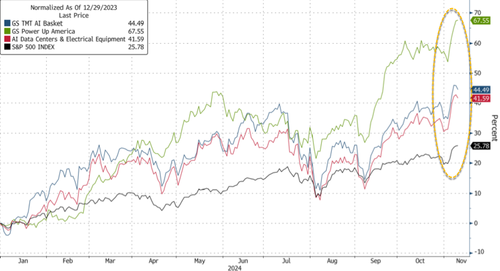
As we’ve been writing for the better part of the past year, the focus of the next AI trade remains all about energy and ‘powering up America’ through an upgraded grid to ensure AI infrastructure can support power-hungry chatbots.
However, the conversation appears to be shifting as Goldman President of Global Affairs and Co-Head of the Global Institute Jared Cohen published a new article discussing the geopolitics of AI infrastructure and a data center diplomacy strategy.
Cohen penned an article in Foreign Policy titled “The Next AI Debate Is About Geopolitics,” in which he explores the geopolitical importance of AI infrastructure, particularly the global race to establish data centers.
On Monday, Cohen provided clients with an executive summary of the note that explained data might be the “new oil,” but nations – not nature – will determine where data enters are built.
Here’s more:
The United States is home to the plurality of the world’s data centers, yet America’s aging energy grid is under enormous strain. Energy demand in the U.S. has been flat for two decades, data center vacancy rates are near record lows, and the shortage of powered land with the connectivity required to support large-scale data centers, combined with supply chain challenges and lengthy permitting timelines for new infrastructure present challenges to realizing both the public and private sectors’ AI ambitions. Goldman Sachs Research estimates that data centers used three percent of U.S. power in 2022, a number that could reach eight percent by 2030 – estimates by regulatory and industry groups, as well as the International Energy Agency, all point in the same direction.
AI could solve some of these problems, and innovation could improve the U.S.’s domestic outlook. AI could improve grid planning, grid resilience, and materials discovery for clean energy technologies. Increased efficiency of chips, with denser circuits and new architectures are already reducing semiconductor energy needs at remarkable scale. The U.S. produces more oil than any nation in history, and natural gas production has boomed since the shale gas revolution of the early 2000s. A more robust power grid that embraces diverse energy resources—including nuclear power, small modular reactors, and reactivated nuclear plants—could change the market calculations in America’s favor.
But to win, the United States will need to enlist its asymmetric advantage of global alliances and partnerships, both in the public and private sectors. This would be a commercial and public sector strategy for data center diplomacy—proactively identifying able, willing, and trusted international partners; pooling public and private capital; identifying and addressing security and privacy risks; and incentivizing innovation across the technology stack. This task is growing more urgent, and more promising. Leaders need to develop a list of locations that satisfy all or even most of these criteria for data centers.
Key players include:
- Canada: The United States’ top trading partner with vast amounts of powered, networked land close to abundant natural resources and energy. Leading hyperscalers and data center developers have recently announced major projects in Canada totaling tens of billions of dollars, including investments in the energy-rich province of Alberta. A U.S. ally through NATO, the Five Eyes intelligence alliance, and potential future AUKUS technology partnerships.
- The Nordic countries: Leaders in green energy and now all members of NATO. They have exceptional technology companies of their own, including telecommunications giants. Their connectivity, energy sustainability, and access to power have long made them data center hubs for hyperscalers. Their cool climates also help prevent overheating in data centers, potentially allowing better performance levels and lower costs over the long term.
- Japan and South Korea: Home to world-leading technology ecosystems. Tokyo is investing 0.71 percent of its gross domestic product on semiconductors through 2025—a much higher figure than most industrial economies, including the United States.
- The Arab Gulf countries of the Middle East: These countries aim not just to export oil, but also AI. Saudi Arabia and the United Arab Emirates have some of the highest internet penetration rates worldwide. Qatar’s AI market has grown substantially, and Doha has the capacity for significant infrastructure buildouts, as demonstrated by its investments around energy and transportation. The subsea fiber optic cables that are the backbone of the modern internet have critical nodes in the Red Sea and the Persian Gulf, where 90 percent of Europe-Asia data traffic is carried. The region connects Europe to the global south. They are all moving their petrodollars toward investments in the energy transition and domestic industries, from life sciences to telecommunications to manufacturing, and AI will accelerate that trend. The U.S. has a chance to pull these countries closer to its technology ecosystem rather than China’s, but will have to make prudent risk assessments as it does so.
For those who missed it, in our note “The Next AI Trade” from April of this year, we outlined various investment opportunities for powering up America, most of which have dramatically outperformed the market.
Bypass Big Tech Censors

Starting the Day With a Scripture-Inspired Roast Helps Center Your Thoughts on Eternal Truths Amid Temporal Pressures
The world can seem chaotic, especially right after we wake up. Many believers start their mornings reaching for something familiar — a hot cup of coffee — yet end up settling for mediocre brews that do little more than deliver a caffeine jolt. The daily grind of life, with its endless distractions, news cycles, and responsibilities, can leave even the most faithful feeling spiritually parched alongside their physical fatigue. What if your morning ritual could do more than wake you up? What if it could ground you in truth, nourish your body with exceptional quality, and quietly advance a kingdom purpose at the same time?
That’s the promise — and the reality — behind Promised Grounds Coffee. This Christian-founded company doesn’t just roast beans; it approaches every step as an act of worship and discipleship. By selecting only the top 10% of specialty-grade beans, ethically sourced from dedicated farmers in Central and South America, and small-batch roasting them with reverence in Austin, Texas, Promised Grounds delivers what many describe as the best coffee available — never burnt, never bland, but rich with origin stories and layered flavors that honor God’s creation.
From the vibrant Psalm 27 Roast (a light, bright medium option) to the bold yet peaceful 2 Timothy 1:7 Decaf, each bag carries a Scripture verse that turns your daily pour into a gentle reminder of faith. And through their Ounce Per Ounce Promise, every ounce of coffee you enjoy provides an equal ounce of clean water to families in need via partnership with Filter of Hope — literally brewing hope for body and soul, one cup at a time.
The challenge for today’s Christians runs deeper than finding a decent cup. In an age of convenience-driven consumerism, it’s easy to support companies that dilute values or remain silent on matters of faith. Many believers want their everyday choices — from what they drink to how they spend — to reflect discipleship rather than just convenience. Promised Grounds solves this by weaving Christian excellence into the entire process: beans nurtured with prayerful stewardship by farming families, roasted as an offering rather than a commodity, and packaged with Bible verses to encourage a mindset of gratitude and purpose from the first sip. Reviewers consistently praise the smooth, rich profiles — whether enjoyed black in a drip maker, iced on a warm day, or shared in fellowship — noting how the quality stands toe-to-toe with premium secular brands while delivering something far more meaningful.
This integration of faith and flavor addresses a real need in Christian households and ministries. Busy parents, church leaders, and remote workers alike report that starting the day with a Scripture-inspired roast helps center their thoughts on eternal truths amid temporal pressures. The coffee’s exceptional character — bright citrus notes in lighter roasts or deep chocolate undertones in bolder ones — comes from meticulous selection and careful roasting that respects the bean’s natural gifts rather than masking them. It’s the kind of coffee that elevates a simple quiet time, fuels productive workdays, or sparks meaningful conversations when shared at Bible studies or outreach events. And because it’s ethically sourced with integrity, every purchase supports sustainable livelihoods for farmers who treat their crops like family harvests.
For those leading churches or small groups, the impact multiplies. Promised Grounds offers bundles and options perfect for hospitality ministries, turning ordinary coffee service into an opportunity to point people toward the living water of Christ. Imagine greeting visitors with a warm cup whose very bag carries God’s Word — a subtle yet powerful witness that aligns with the Great Commission. The company’s Texas roots and commitment to “brewing hope” resonate especially with believers who value American enterprise paired with global compassion.
Of course, quality alone isn’t enough if the experience feels out of reach. Promised Grounds keeps it accessible with practical perks like free shipping on orders over $40, sample sets for discovering favorites, and thoughtful add-ons such as faith-themed mugs. Whether you prefer whole beans for fresh grinding, grounds for convenience, or even bulk options for larger households and ministries, the result is consistently superior coffee that makes discipleship feel integrated rather than added on.
As you consider how to align even the smallest habits with your walk with God, Promised Grounds Coffee stands out as a refreshing solution. It tackles the dual problems of subpar daily sustenance and disconnected consumption by offering a product that genuinely excels in taste while advancing a mission of clean water, farmer dignity, and scriptural encouragement. Believers who make the switch often describe it as more than a beverage upgrade — it becomes part of their rhythm of gratitude, a daily invitation to remember that every good gift comes from above.
If you’re ready to transform your mornings (and perhaps your church gatherings) with coffee that honors both exceptional craftsmanship and Christian values, I encourage you to explore what Promised Grounds has to offer. One sip at a time, you’ll be nourishing your body, refreshing your spirit, and participating in something far greater — all while enjoying what truly is among the best coffee available.