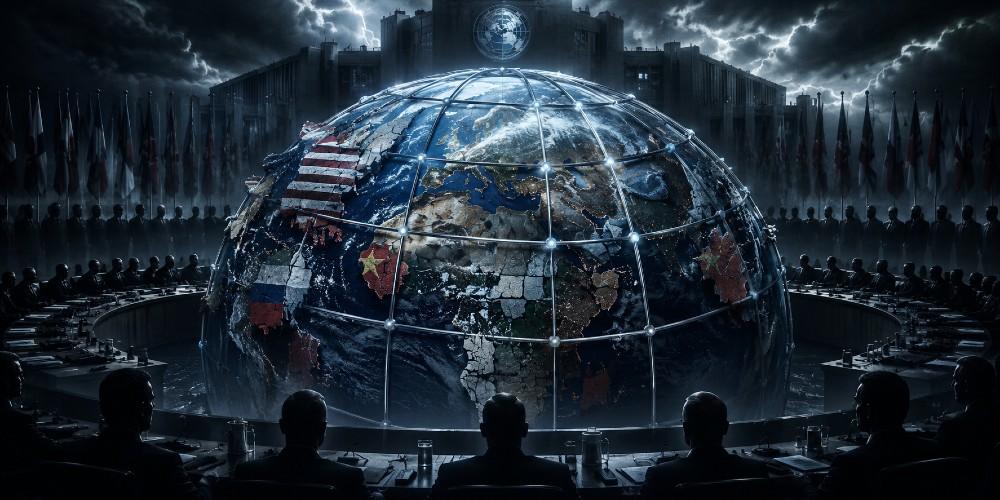
People are beginning to understand that those who rule in their name have long been working to eliminate the nation-state.
The United Nations is not neutral ground for national governments to discuss their differences; it is a governmental construct meant to replace national governments. The World Health Organization is not an international body meant to coordinate complex responses to global health emergencies; it is an institution vested with vast power and authority to track and regulate every human on the planet. The Bank for International Settlements, the World Bank Group, and the International Monetary Fund don’t exist to expand free trade, open markets, and assist developing nations; they exist to centralize control over all economic transactions in the world.
The onslaught of “green new deal” laws in Canada, the United States, the United Kingdom, the European Union, Australia, and New Zealand have nothing to do with preserving the environment or “saving the planet”; they are part of a broader U.N. initiative to track every person’s so-called “carbon footprint” in order to monitor, tax, and regulate all human activity. The U.N.’s “climate reparations” policy has nothing to do with “justice” or “science”; it exists to justify the redistribution of wealth from Western nations to non-Western nations under the guise of “international law.”
The message we have heard all our lives is loud and clear: Nations do bad things. International organizations do good things.
The rhetorical war on “nationalism” didn’t begin because people who are proud of their nations magically became Nazis; people who are proud of their nations are called “Nazis” so that those who rule over us can demonize the nation-state. If you go back through newspapers and scholarly essays before WWII, “nationalism” and “patriotism” are used interchangeably.
After WWII, there is an obvious linguistic break. “Patriotism,” for the most part, survives as an acceptable civic virtue (How else can governments send men into battle if there are no patriots?). “Nationalism,” however, becomes increasingly used through the decades as a derogatory term linked to fascism — as if the very organizing concept of a nation-state is inherently authoritarian and anti-democratic.
Thinking about this anti-nationalism campaign for more than a second reveals its silliness. Why would a constitutional republic with representative democracy be “fascist” at the national level but “democratic” when organized internationally? Why would the Executive leader of a nation such as Germany, France, or the United States be more “authoritarian” than the secretary-general of the U.N. or the president of the European Commission? Why would an international governing body be considered more “democratic” than a town, region, or nation of people governing themselves? Why should the president of the European Commission, Ursula von der Leyen, be considered Europe’s “representative leader” when the European people never voted for her to “represent” them?
The U.N. has 193 member state ambassadors representing roughly 8.3 billion people. Why should such a minuscule parliamentary assembly be considered “democratic” or “representative” at all? At best, it uses the veneer of “democracy” to justify imposing its authoritarian will upon all of humanity. Whether one dictator or 193 dictators working in concert — when humanity is forced to obey the edicts of rulers, it doesn’t matter if those edicts come from a national or international body.

Natural rights and freedoms do not become more natural because 193 people in New York City say so. God-given liberties exist despite the existence of government, not because of government. The more people over whom a government claims jurisdiction, the less likely that any one person’s natural rights will be respected and protected. When a citizen cannot look his “representative” in the face, his “representative” is much less concerned about infringing that citizen’s natural liberties.
International governments are no less likely to become totalitarian than national governments. Just as Hitler’s national socialism and Mussolini’s fascism did last century, international tyranny prefers to disguise itself as something peaceful, benevolent, and for the common good.
Had Hitler successfully conquered Europe, perhaps the German Empire would have been called the European Union. Had Hitler conquered the world, perhaps the U.N.’s headquarters would be in Berlin. National totalitarianism becomes international totalitarianism just as easily as national mask and vaccine mandates transform into “vaccine passports” and World Health Organization mandates.
The same people who hyperventilate about President Trump’s supposed “authoritarianism” roundly applaud the authoritarianism of global institutions such as the World Health Organization. In fact, when the president withdrew the United States from WHO on his first day back in office last year due to the international body’s mishandling of the COVID pandemic and efforts to cover up the pandemic’s origin in Wuhan, China, critics in the press accused Trump of being “scientifically reckless” and called “global cooperation” a “biological necessity.”
That’s another part of internationalism’s linguistic magic trick: The same global corporate news machine that has spent the last eighty-plus years conditioning people to understand the word “nationalism” as something evil, militant, and barbaric has simultaneously conditioned the world to see anything “international” as inherently good, peaceful, and progressive.
The “national / international” dichotomy didn’t happen by accident; it’s been shoved down our throats all our lives. But once again, if a rational person takes a moment to consider the semantic manipulation, it is quite absurd.
If the International Monetary Fund, headquartered in Washington, D.C., were more accurately renamed the “American Monetary Fund,” would the financial institution become more suspect? If so, then how should we view the word “international” as anything other than a verbal ruse meant to project a false message that the IMF acts on behalf of all people on the planet? American taxpayers have principally funded the World Health Organization since its formation in 1948.
If it had been called the American Health Organization, would the press have been as upset when “authoritarian” Trump decided to stop funding it? If not, does this not suggest that words such as “world” and “global” distort the identity and purpose of these intrusive organizations?
“Internationalism” is a Trojan Horse or at least the camel’s nose under the tent for Big Government authoritarians who wish to impose their will on the whole planet.
When “international” agents or soldiers come knocking, their mission sounds downright “humanitarian,” doesn’t it? The United Nations has a whole Department of Peace Operations. That department sends out military and law enforcement personnel known as “peacekeepers.” And for decades the “peacekeepers” from the Department of Peace Operations have raped women and girls all over the world.
The “internationals” have been abusing the “nationals,” and the international United Nations and the multinational corporate news organizations have spent decades covering up all of the “internationals’” prolific raping. International organizations dedicated to “peace” can’t be seen doing things that only “fascist” nationals do.
Big lies expose internationalism’s true intent: Internationalists are building a global empire. This empire is authoritarian (because it demands global compliance at the expense of personal freedom) and totalitarian (because it requires complete subservience to a centralized and dictatorial global government). There is nothing “democratic” or “representative” about this international system of governance.

It has no interest in protecting an individual’s rights and freedoms. It has no interest in respecting a nation’s sovereignty. It will permit both individuals and nations to be raped in the name of “global peace.”
Therefore, it makes perfect sense why the United Nations encourages mass illegal immigration into the United States and Europe. When you are in the business of destroying nations, you do not care if murderers and rapists destroy local families. You do not care if Islamic terrorists burn down Christian churches. You do not care if the “newcomers” to Europe and America have pledged to conquer the West.
For globalism to win, it must first kill the nation-state.
Bypass Big Tech Censors
Starting the Day With a Scripture-Inspired Roast Helps Center Your Thoughts on Eternal Truths Amid Temporal Pressures
The world can seem chaotic, especially right after we wake up. Many believers start their mornings reaching for something familiar — a hot cup of coffee — yet end up settling for mediocre brews that do little more than deliver a caffeine jolt. The daily grind of life, with its endless distractions, news cycles, and responsibilities, can leave even the most faithful feeling spiritually parched alongside their physical fatigue. What if your morning ritual could do more than wake you up? What if it could ground you in truth, nourish your body with exceptional quality, and quietly advance a kingdom purpose at the same time?
That’s the promise — and the reality — behind Promised Grounds Coffee. This Christian-founded company doesn’t just roast beans; it approaches every step as an act of worship and discipleship. By selecting only the top 10% of specialty-grade beans, ethically sourced from dedicated farmers in Central and South America, and small-batch roasting them with reverence in Austin, Texas, Promised Grounds delivers what many describe as the best coffee available — never burnt, never bland, but rich with origin stories and layered flavors that honor God’s creation.
From the vibrant Psalm 27 Roast (a light, bright medium option) to the bold yet peaceful 2 Timothy 1:7 Decaf, each bag carries a Scripture verse that turns your daily pour into a gentle reminder of faith. And through their Ounce Per Ounce Promise, every ounce of coffee you enjoy provides an equal ounce of clean water to families in need via partnership with Filter of Hope — literally brewing hope for body and soul, one cup at a time.
The challenge for today’s Christians runs deeper than finding a decent cup. In an age of convenience-driven consumerism, it’s easy to support companies that dilute values or remain silent on matters of faith. Many believers want their everyday choices — from what they drink to how they spend — to reflect discipleship rather than just convenience. Promised Grounds solves this by weaving Christian excellence into the entire process: beans nurtured with prayerful stewardship by farming families, roasted as an offering rather than a commodity, and packaged with Bible verses to encourage a mindset of gratitude and purpose from the first sip. Reviewers consistently praise the smooth, rich profiles — whether enjoyed black in a drip maker, iced on a warm day, or shared in fellowship — noting how the quality stands toe-to-toe with premium secular brands while delivering something far more meaningful.
This integration of faith and flavor addresses a real need in Christian households and ministries. Busy parents, church leaders, and remote workers alike report that starting the day with a Scripture-inspired roast helps center their thoughts on eternal truths amid temporal pressures. The coffee’s exceptional character — bright citrus notes in lighter roasts or deep chocolate undertones in bolder ones — comes from meticulous selection and careful roasting that respects the bean’s natural gifts rather than masking them. It’s the kind of coffee that elevates a simple quiet time, fuels productive workdays, or sparks meaningful conversations when shared at Bible studies or outreach events. And because it’s ethically sourced with integrity, every purchase supports sustainable livelihoods for farmers who treat their crops like family harvests.
For those leading churches or small groups, the impact multiplies. Promised Grounds offers bundles and options perfect for hospitality ministries, turning ordinary coffee service into an opportunity to point people toward the living water of Christ. Imagine greeting visitors with a warm cup whose very bag carries God’s Word — a subtle yet powerful witness that aligns with the Great Commission. The company’s Texas roots and commitment to “brewing hope” resonate especially with believers who value American enterprise paired with global compassion.
Of course, quality alone isn’t enough if the experience feels out of reach. Promised Grounds keeps it accessible with practical perks like free shipping on orders over $40, sample sets for discovering favorites, and thoughtful add-ons such as faith-themed mugs. Whether you prefer whole beans for fresh grinding, grounds for convenience, or even bulk options for larger households and ministries, the result is consistently superior coffee that makes discipleship feel integrated rather than added on.
As you consider how to align even the smallest habits with your walk with God, Promised Grounds Coffee stands out as a refreshing solution. It tackles the dual problems of subpar daily sustenance and disconnected consumption by offering a product that genuinely excels in taste while advancing a mission of clean water, farmer dignity, and scriptural encouragement. Believers who make the switch often describe it as more than a beverage upgrade — it becomes part of their rhythm of gratitude, a daily invitation to remember that every good gift comes from above.
If you’re ready to transform your mornings (and perhaps your church gatherings) with coffee that honors both exceptional craftsmanship and Christian values, I encourage you to explore what Promised Grounds has to offer. One sip at a time, you’ll be nourishing your body, refreshing your spirit, and participating in something far greater — all while enjoying what truly is among the best coffee available.