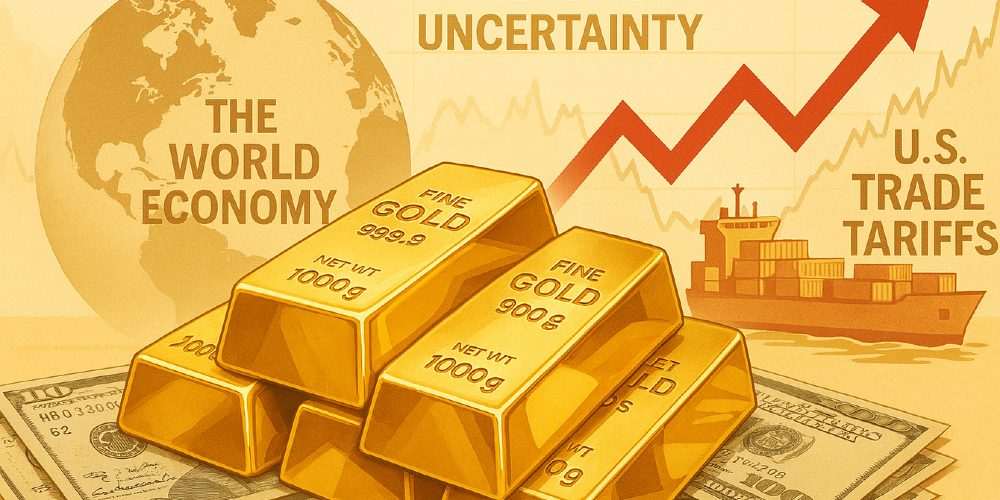
Gold traders caught a fresh spark of enthusiasm on Wednesday as prices nudged closer to the $3,700 per ounce level, riding the wave of the Federal Reserve’s latest policy shift. The central bank’s decision to slice interest rates by a quarter percentage point, while paving the way for additional reductions through the end of the year and beyond, sent investors scrambling for the safety of precious metals amid a backdrop of uneven economic signals.
The Fed’s move brought the federal funds rate down to a range of 4.75% to 5%, aligning with widespread expectations but carrying weight through its forward guidance. Updated projections from the committee painted a picture of prolonged easing, even as inflationary winds refused to fully subside. This environment plays directly into gold’s strengths, positioning it as a bulwark against currency erosion and policy unpredictability.
In its official statement, the Fed laid bare the mixed bag of data driving its hand.
“Recent indicators suggest that growth of economic activity moderated in the first half of the year. Job gains have slowed, and the unemployment rate has edged up but remains low. Inflation has moved up and remains somewhat elevated,” the policymakers wrote.
These words reflect a central bank caught in the crosshairs of its responsibilities—fostering growth without letting prices spiral. The nod to cooling job additions and a creeping unemployment rate, now hovering around 4.2% based on recent labor reports, signals a pivot toward labor market stability over aggressive inflation-fighting.
For gold holders, this means a softer dollar ahead, as lower rates diminish the appeal of yield-bearing assets and amplify the allure of timeless stores of value like bullion. Sure enough, spot gold climbed 0.2% to $3,695.80 per ounce in immediate aftermath trading, building on a monthly gain of nearly 6% and a year-to-date surge exceeding 39%.
The statement didn’t stop at diagnosis; it delved into the Fed’s mindset on risks.
“The Committee is attentive to the risks to both sides of its dual mandate and judges that downside risks to employment have grown,” it continued.

Here, the Fed admits the scales are tipping, with job market vulnerabilities now outweighing inflation worries in the near term. This judgment could lock in a dovish path for months, potentially through 2026, as the committee eyes “meeting-by-meeting” decisions, in the words of Chair Jerome Powell during his post-meeting press conference. Powell’s phrasing underscores a cautious, data-dependent approach, but one that leaves room for more cuts if hiring falters further. Market participants interpreted this as a green light for risk assets, yet gold stood out by drawing fresh inflows from central banks and jittery investors alike—official demand running at twice the pace of the early 2010s, much of it from emerging markets like China hedging against dollar dominance.
Not everyone saw smooth sailing in the immediate term. Tai Wong, an independent metals trader, captured the session’s choppiness: “The Fed is signaling uncertainty with Powell calling this a ‘risk-management’ cut which has triggered some quite understandable profit-taking.”
Indeed, after touching a record intraday peak of $3,707.40, gold pulled back toward $3,658 by late afternoon, as a rebounding dollar prompted some bargain hunting in other corners of the market. Wong added a dose of reassurance for longer-term bulls: “A retracement or at least a consolidation is healthy; I don’t expect an unusually deep pullback. Unless we get below major technical support at $3,550, the short-term uptrend should remain intact.”
His take aligns with gold’s historical resilience in rate-cut cycles, particularly when inflation lingers above the Fed’s 2% target—now projected to average 2.6% through 2026. Lower borrowing costs strip away the “cost of carry” for holding gold, turning it from a sidelined spectator into a frontline contender.
Broader forces are fanning the flames too. Political crosswinds, including pointed critiques from President Donald Trump questioning the Fed’s independence, have sown seeds of doubt about the dollar’s staying power. This rhetoric, analysts argue, is accelerating a shift among global investors toward hedging U.S. assets against further greenback slides.
Michael Hsueh at Deutsche Bank tied these threads together, warning of “an ongoing challenge to Fed independence, and changes to the composition of the FOMC creating uncertainty over how this will affect the Fed’s reaction function next year.”
He pegged gold’s trajectory at $4,000 per ounce in the coming year, up from prior estimates of $3,700, driven by that very unease and robust central bank buying.
Fellow Deutsche Bank strategist George Saravelos drilled down on the mechanics: “The results are stark: for the first time this decade hedged inflows into America are now dominating over unhedged exposure,” with over 80% of equity inflows now currency-hedged—a dynamic that inherently pressures the dollar lower.
Antonio Ruggiero of Convera echoed the sentiment: “Concerns over Fed independence—with Powell’s possible replacement in May by a dovish Trump appointee—suggest a longer and more aggressive easing path. Also, the still-fragile sentiment toward the greenback is likely to keep investors hedging against further dollar weakness.”
These voices point to a gold market that’s not just reacting but anticipating. With the dollar index down over 10% year-to-date and foreign ownership of U.S. stocks—now 19% of the total—ever more shielded from FX risks, the precious metal’s role as an inflation hedge and geopolitical buffer looks ironclad. Silver, platinum, and palladium dipped 2% to 3% in sympathy Wednesday, but gold’s outlier strength speaks volumes about where smart money is flowing.
As the Fed’s easing era stretches on, gold’s momentum feels less like a blip and more like the start of a sustained climb. Investors watching employment data and inflation prints closely will find plenty to chew on, but for now, the metal’s quiet ascent serves as a reminder: in times of policy flux, the tried-and-true endures.
Bypass Big Tech Censors

Starting the Day With a Scripture-Inspired Roast Helps Center Your Thoughts on Eternal Truths Amid Temporal Pressures
The world can seem chaotic, especially right after we wake up. Many believers start their mornings reaching for something familiar — a hot cup of coffee — yet end up settling for mediocre brews that do little more than deliver a caffeine jolt. The daily grind of life, with its endless distractions, news cycles, and responsibilities, can leave even the most faithful feeling spiritually parched alongside their physical fatigue. What if your morning ritual could do more than wake you up? What if it could ground you in truth, nourish your body with exceptional quality, and quietly advance a kingdom purpose at the same time?
That’s the promise — and the reality — behind Promised Grounds Coffee. This Christian-founded company doesn’t just roast beans; it approaches every step as an act of worship and discipleship. By selecting only the top 10% of specialty-grade beans, ethically sourced from dedicated farmers in Central and South America, and small-batch roasting them with reverence in Austin, Texas, Promised Grounds delivers what many describe as the best coffee available — never burnt, never bland, but rich with origin stories and layered flavors that honor God’s creation.
From the vibrant Psalm 27 Roast (a light, bright medium option) to the bold yet peaceful 2 Timothy 1:7 Decaf, each bag carries a Scripture verse that turns your daily pour into a gentle reminder of faith. And through their Ounce Per Ounce Promise, every ounce of coffee you enjoy provides an equal ounce of clean water to families in need via partnership with Filter of Hope — literally brewing hope for body and soul, one cup at a time.
The challenge for today’s Christians runs deeper than finding a decent cup. In an age of convenience-driven consumerism, it’s easy to support companies that dilute values or remain silent on matters of faith. Many believers want their everyday choices — from what they drink to how they spend — to reflect discipleship rather than just convenience. Promised Grounds solves this by weaving Christian excellence into the entire process: beans nurtured with prayerful stewardship by farming families, roasted as an offering rather than a commodity, and packaged with Bible verses to encourage a mindset of gratitude and purpose from the first sip. Reviewers consistently praise the smooth, rich profiles — whether enjoyed black in a drip maker, iced on a warm day, or shared in fellowship — noting how the quality stands toe-to-toe with premium secular brands while delivering something far more meaningful.
This integration of faith and flavor addresses a real need in Christian households and ministries. Busy parents, church leaders, and remote workers alike report that starting the day with a Scripture-inspired roast helps center their thoughts on eternal truths amid temporal pressures. The coffee’s exceptional character — bright citrus notes in lighter roasts or deep chocolate undertones in bolder ones — comes from meticulous selection and careful roasting that respects the bean’s natural gifts rather than masking them. It’s the kind of coffee that elevates a simple quiet time, fuels productive workdays, or sparks meaningful conversations when shared at Bible studies or outreach events. And because it’s ethically sourced with integrity, every purchase supports sustainable livelihoods for farmers who treat their crops like family harvests.
For those leading churches or small groups, the impact multiplies. Promised Grounds offers bundles and options perfect for hospitality ministries, turning ordinary coffee service into an opportunity to point people toward the living water of Christ. Imagine greeting visitors with a warm cup whose very bag carries God’s Word — a subtle yet powerful witness that aligns with the Great Commission. The company’s Texas roots and commitment to “brewing hope” resonate especially with believers who value American enterprise paired with global compassion.
Of course, quality alone isn’t enough if the experience feels out of reach. Promised Grounds keeps it accessible with practical perks like free shipping on orders over $40, sample sets for discovering favorites, and thoughtful add-ons such as faith-themed mugs. Whether you prefer whole beans for fresh grinding, grounds for convenience, or even bulk options for larger households and ministries, the result is consistently superior coffee that makes discipleship feel integrated rather than added on.
As you consider how to align even the smallest habits with your walk with God, Promised Grounds Coffee stands out as a refreshing solution. It tackles the dual problems of subpar daily sustenance and disconnected consumption by offering a product that genuinely excels in taste while advancing a mission of clean water, farmer dignity, and scriptural encouragement. Believers who make the switch often describe it as more than a beverage upgrade — it becomes part of their rhythm of gratitude, a daily invitation to remember that every good gift comes from above.
If you’re ready to transform your mornings (and perhaps your church gatherings) with coffee that honors both exceptional craftsmanship and Christian values, I encourage you to explore what Promised Grounds has to offer. One sip at a time, you’ll be nourishing your body, refreshing your spirit, and participating in something far greater — all while enjoying what truly is among the best coffee available.