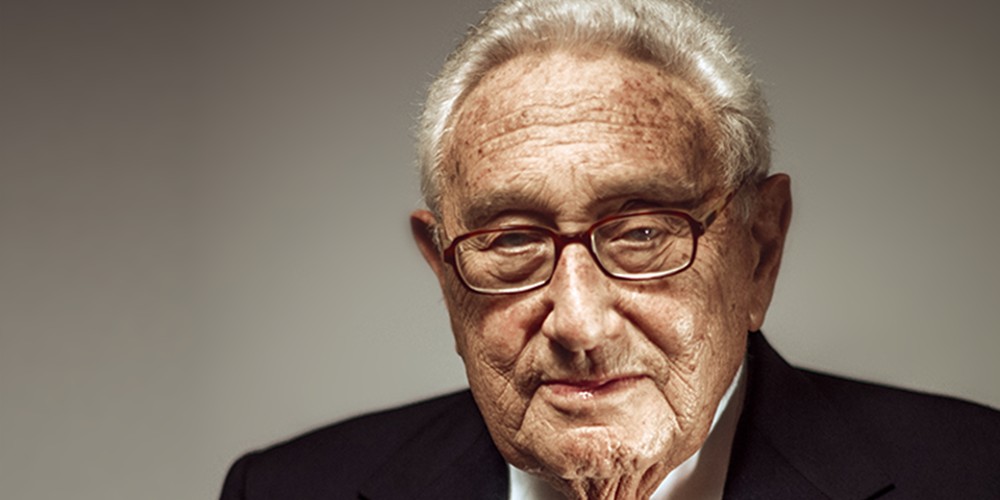
There are few authors who are as ideologically polarizing as Caitlin Johnstone. I find myself wholeheartedly agreeing with her half the time and adamantly disagreeing with her the other half. In the article below, I believe she has allowed her hatred for American interventionism to make her miss the real message from Henry Kissinger in a recent interview he did with WSJ.
Throughout the article, Kissinger expresses his concern that the United States is being too reckless with its handling of Ukraine-Russia and Taiwan-China. He says he believes “we are at the edge of war with Russia and China” and it’s really our fault. But the Godfather of Globalism is fully aware of the truth that it’s his cronies among the globalist elites who have guided both the east and west to this precipice. We are exactly where they want us at this stage of The Great Reset.
What Johnstone perceives as a warning by the 99-year-old Kissinger is, in my humble opinion, another step towards programming the world to expect war to break out between the U.S. and either China, Russia, or both. He’s clearly normalizing the concept. This isn’t really a warning from the man who has never been opposed to destabilization abroad. He’s not being less hawkish than the Biden-Harris regime. His “warning” is meant to keep the conversation at top of mind in a time when Ukraine is less of a focus than it was just a month ago.
Kissinger fully expects war of some sort, whether it’s kinetic or something else. They’ve been plotting this course for decades. We’re already in a full-blown economic war with all sides maneuvering to not only improve their own status, but to destroy the opposition. Cooperation for mutual benefit is no longer on the table.
Then, there’s the possibility of a cyberwar, which I see as more likely than the nations going nuclear. But before you wipe the sweat off your brow, keep in mind that a cyberwar would be absolutely devastating and could push this nation and others into total societal collapse that could cause a catastrophic implosion. With that said, a protracted cyberwar will allow the powers-that-be to “build back better” more easily than in the aftermath of a nuclear war. Both are destructive, but only one doesn’t result in radioactive contamination for centuries.
What Johnstone misses in the interview is the nuance of propaganda. The most cunning manipulators — and Kissinger is among the top globalist manipulators alive today — will almost never say what they truly mean when speaking publicly. Interviews such as this are not designed to reach the White House and get them to have a steadier hand. Real discussions like that are not done in public. What Kissinger is doing is planting more seeds of concern among the American people. We seem to have put Ukraine and Taiwan on the mental backburner and that doesn’t sit well for Kissinger or his globalist cronies.
This isn’t about American empire expansion, which is Johnstone’s favorite topic of discussion. The United States is in no position to be expanding anything. This is about a puppet regime in the White House doing the bidding of Kissinger’s cronies. They are trying to weaken the United States and western dominance so they can achieve their long-standing goal of ten regional governments equally powered and submissive to the one-world government apparatus. Kissinger is fearmongering for effect to keep us expectant of a war ahead.
With all that said, here’s Johnstone’s article. While I disagree with her conclusions, her analysis is worth reading. You can always leave a comment about which one of us you believe is correct… or maybe we’re both wrong.

Modern US Warmongering Is Scaring Henry Kissinger
In a new interview with The Wall Street Journal, immortal Hague fugitive Henry Kissinger says the US is acting in a crazy and irrational way that has brought it to the edge of war with Russia and China:
Mr. Kissinger sees today’s world as verging on a dangerous disequilibrium. “We are at the edge of war with Russia and China on issues which we partly created, without any concept of how this is going to end or what it’s supposed to lead to,” he says. Could the U.S. manage the two adversaries by triangulating between them, as during the Nixon years? He offers no simple prescription. “You can’t just now say we’re going to split them off and turn them against each other. All you can do is not to accelerate the tensions and to create options, and for that you have to have some purpose.”
On the question of Taiwan, Mr. Kissinger worries that the U.S. and China are maneuvering toward a crisis, and he counsels steadiness on Washington’s part. “The policy that was carried out by both parties has produced and allowed the progress of Taiwan into an autonomous democratic entity and has preserved peace between China and the U.S. for 50 years,” he says. “One should be very careful, therefore, in measures that seem to change the basic structure.”
Mr. Kissinger courted controversy earlier this year by suggesting that incautious policies on the part of the U.S. and NATO may have touched off the crisis in Ukraine. He sees no choice but to take Vladimir Putin’s stated security concerns seriously and believes that it was a mistake for NATO to signal to Ukraine that it might eventually join the alliance: “I thought that Poland—all the traditional Western countries that have been part of Western history—were logical members of NATO,” he says. But Ukraine, in his view, is a collection of territories once appended to Russia, which Russians see as their own, even though “some Ukrainians” do not. Stability would be better served by its acting as a buffer between Russia and the West: “I was in favor of the full independence of Ukraine, but I thought its best role was something like Finland.”
Kissinger: “We are at the edge of war with Russia and China on issues which we partly created, without any concept of how this is going to end or what it’s supposed to lead to.” https://t.co/mytxSajU6Q
— Gal Luft (@GalLuft) August 13, 2022
I don’t know about you, but to me this warning is much, much more ominous coming from a bloodsoaked swamp monster than it would be from some anti-imperialist peace activist who was speaking from outside the belly of the imperial machine. This man is a literal war criminal who, as a leading empire manager, helped to unleash unfathomable horrors all around the world the consequences of which are still being felt today.
And as far as you can tell from his own comments, he remains completely unreformed.
“Looking back over his long and often controversial career, however, he is not given to self-criticism,” The Wall Street Journal’s Laura Secor writes.
“I do not torture myself with things we might have done differently,” Kissinger tells her.
So Kissinger remains an unapologetic warmongering psychopath. But if he hasn’t changed as a person, what has? Why is he now cautioning against US aggression and warning that the empire has taken things too far?
Well, if Kissinger hasn’t changed, we can only surmise that it is the US empire itself that has changed. Its behavior is now so insane and illogical that it is making a 99 year-old Henry Kissinger nervous.
Which, if you really think about it, is one of the scariest things you could possibly imagine.
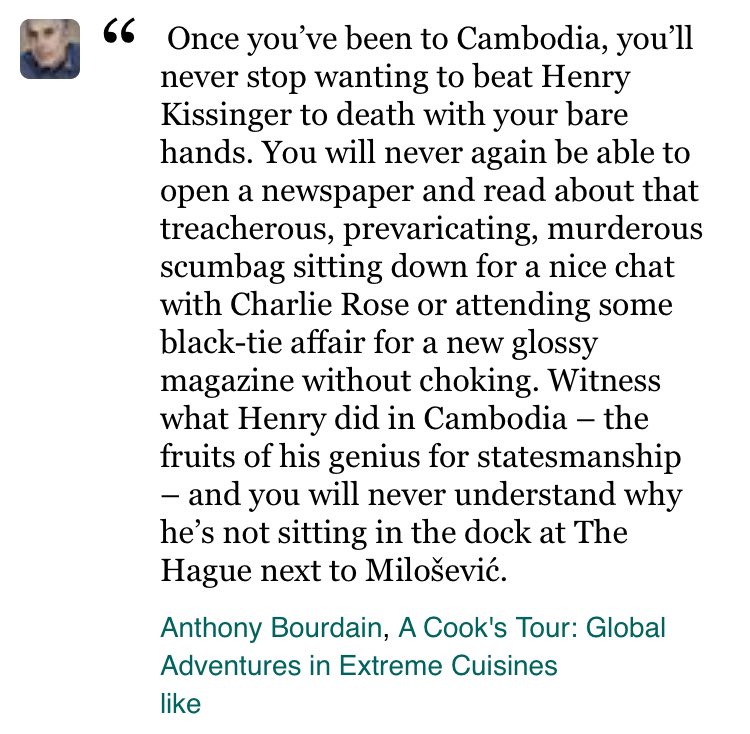
The empire’s departure from the Henry Kissinger iteration of murderous madness to its new form of insanity appears to have begun around the turn of the century, when the influx of neoconservatives into the White House combined with the jingoism which followed 9/11 to usher in an era of interventionism and military expansionism of such brazenness and recklessness that many from the old guard balked.
Kissinger was supportive of the 2003 Iraq invasion, but well before it began he was already saying that he had serious misgivings about the lack of clear thinking and forward planning he was seeing on that front. The neoconservative goal of US planetary hegemony at any cost which led to that invasion (and the planning of many more) has since become the mainstream Beltway consensus perspective on US foreign policy, and it is responsible for the escalations that Kissinger is now warning about.
“The PNAC plan envisions a strategic confrontation with China, and a still greater permanent military presence in every corner of the world,” wrote Michael Parenti in his 2004 book Superpatriotism. “The objective is not just power for its own sake but power to control the world’s natural resources and markets, power to privatize and deregulate the economies of every nation in the world, and power to hoist upon the backs of peoples everywhere — including North America — the blessings of an untrammeled global ‘free market.’ The end goal is to ensure not merely the supremacy of global capitalism as such, but the supremacy of American global capitalism by preventing the emergence of any other potentially competing superpower.”
By “PNAC plan” Parenti means the plans of the neoconservatives behind the notorious Project for the New American Century think tank, whose unipolarist militaristic agendas they explicitly advocated.

Henry Kissinger is warning about the dangers of US warmongering not because he has gotten saner, but because the US war machine has gotten crazier. That we are now hurtling toward confrontations that don’t appear rational to someone who has spent the majority of his life watching the mechanics of empire from inside its inner chambers should concern us all. When you are talking about brinkmanship between major world powers, especially nuclear brinkmanship, the last thing you need is for one of the parties involved to be acting erratically and nonsensically.
We need de-escalation and detente, and we need it yesterday. If you’re too hawkish for Henry Kissinger, you’re too motherfucking hawkish.
About Caitlin Johnstone
My work is entirely reader-supported, so if you enjoyed this piece please consider sharing it around, following me on Facebook, Twitter, Soundcloud or YouTube, buying an issue of my monthly zine, or throwing some money into my tip jar on Ko-fi, Patreon or Paypal. If you want to read more you can buy my books. The best way to make sure you see the stuff I publish is to subscribe to the mailing list for at my website or on Substack, which will get you an email notification for everything I publish. Everyone, racist platforms excluded, has my permission to republish, use or translate any part of this work (or anything else I’ve written) in any way they like free of charge. For more info on who I am, where I stand, and what I’m trying to do with this platform, click here. All works co-authored with my American husband Tim Foley.
Bypass Big Tech Censors

Two Storms, One Harvest

Every food crisis in living memory has been a one-shock event. The 2008 price spike was a commodity bubble. The 2020 shortages were a logistics failure. The 2022 grain scare was a war on one exporter’s ports. Each time, the system bent, adjusted, and recovered, and each time the experts assured us afterward that global markets are simply too big and too diversified to fail.
What nobody in Washington seems eager to discuss is that 2026 is shaping up to be something the modern food system has never actually faced. Two independent shocks, one climatic and one geopolitical, are converging on the same harvest cycle at the same time. Not sequentially. Simultaneously.
Start with the weather. The Pacific Ocean is currently building toward what forecasters now openly call a record event. NOAA’s Climate Prediction Center puts the odds of at least a strong El Niño near 88 percent, with roughly two in three odds it reaches “very strong” status, the tier reserved for perhaps three or four events in the entire satellite era. Every major global model now projects a median peak in Super El Niño territory, and most of them project it exceeding the 2015-16 event, which until now held the modern record. Sea surface anomalies were already brushing the super threshold in mid-July, months before these events normally peak. The atmosphere has already shifted into El Niño mode, and the event is forecast to crest in late fall and early winter.
This is not about “climate change.” It’s about the standard cycles of weather, and the cycle we’re currently in is one that has likely devastated societies in the past. We’re better prepared as a society today, but not all Americans are equally prepared.
Serious households have started doing the quiet math on their own. Grocery bills tell part of the story, and the forecast maps tell the rest, which is why long-term food storage has moved from fringe hobby to mainstream line item in the family budget, with established suppliers like Heaven’s Harvest seeing demand from people who five years ago would have rolled their eyes at the idea. That instinct is not paranoia. It is pattern recognition, and the pattern is worth walking through carefully.
Editor’s Note: Heaven’s Harvest IS a sponsor, but the warnings of this article are real and would be written even if we didn’t have a survival food sponsor. With that said, those who take advantage of what they offer can use promo code “Patriot” for 15% off.
The Fertilizer Clock Is Already Running
While the Pacific warms, the second shock has been unfolding in the Strait of Hormuz. The conflict with Iran turned the world’s most important energy chokepoint into a contested waterway, and the consequences reach far beyond the gas pump. Roughly a third of global fertilizer trade moves through Hormuz, and the disruption sent urea prices up 86 percent year over year by March, with a 53 percent jump in a single month.
The World Bank projects energy prices rising about 24 percent in 2026 and fertilizer about 31 percent. By its own accounting, fertilizer prices ran 35 percent higher in the first five months of this year than the same period last year.
Here is the mechanism the nightly news will not explain. Fertilizer is not a grocery item. It is a time-delayed input. The nitrogen a farmer in Iowa or Punjab could not afford to apply this spring does not show up as a problem this spring. It shows up as a thinner harvest six to twelve months later.
The World Bank’s own food security brief concedes that the effects of reduced applications earlier this season “are likely to become visible only later in harvest outcomes.” Translate that from institutional language into plain English and it means this. The damage is already done, it is already in the ground, and we are simply waiting for it to arrive on the shelf.
Now check the calendar. Six to twelve months from the spring planting season lands us squarely in late 2026 and early 2027. Which is precisely when the strongest El Niño in the instrumental record is forecast to peak, bringing its signature droughts to Southeast Asia, Australia, southern Africa, northern Brazil, and South Asia, the very regions that grow the world’s rice, sugar, and oilseeds.
The World Bank warns openly that a strong El Niño “could disrupt multiple crop belts simultaneously” on top of the conflict-driven input costs. Their baseline projection assumes the Middle East disruptions ease by autumn. What in the last two years of Middle East history suggests that assumption is safe?
The System Has No Slack Left
The comfortable answer is that global markets always adjust. But adjustment requires slack, and the slack is gone. Global cereal production is expected to decline from last year’s records even before El Niño does its work. The UN World Food Programme, hardly a den of right-wing preppers, is calling this the most significant disruption to its supply chains since Covid and the invasion of Ukraine, and its supply chain director put the stakes bluntly.
Today’s supply chain challenges are tomorrow’s hunger crisis.
There is also a political dimension that markets cannot price. When food gets scarce, governments do not behave like economists. They behave like politicians. Export bans, hoarding mandates, and panic buying at the national level turned the modest rice shortfall of 2008 into a global crisis, and analysts are already warning that import-dependent nations are the first dominoes.
The 2015-16 Super El Niño, a far weaker event than what is now forecast, threw tens of millions into food stress across Africa and Asia. This one is projected to be stronger, and it arrives with fertilizer already rationed by price and shipping lanes already contested by missiles.
What Joseph Knew
Scripture does not treat preparation for lean years as faithlessness. It treats it as wisdom delivered in advance to those willing to act on it.
Behold, there come seven years of great plenty throughout all the land of Egypt: And there shall arise after them seven years of famine; and all the plenty shall be forgotten in the land of Egypt.
Joseph did not respond to that warning with a hashtag or a committee. He stored grain during the years of abundance, and when the famine came, Egypt stood while its neighbors begged. The lesson is not that famine is certain. It is that the time to prepare is precisely when preparation still looks optional.
Nobody who filled a pantry in a year of plenty has ever regretted it, and nobody standing in an empty aisle has ever been glad he waited for certainty.
None of this calls for panic, and panic is the enemy of sound judgment anyway. It calls for the same unglamorous prudence our grandparents considered ordinary. Keep some cash margin, know your local growers, and put real food in deep storage while it is cheap and available, because the entire arc of this story is that cheap and available is a closing window.
Families looking for a straightforward place to start can visit Heaven’s Harvest and use promo code Patriot for 15 percent off long-term storable food. The forecasts may yet soften, the strait may yet reopen, and we should pray they do. But hope is a fine thing to hold and a foolish thing to eat.