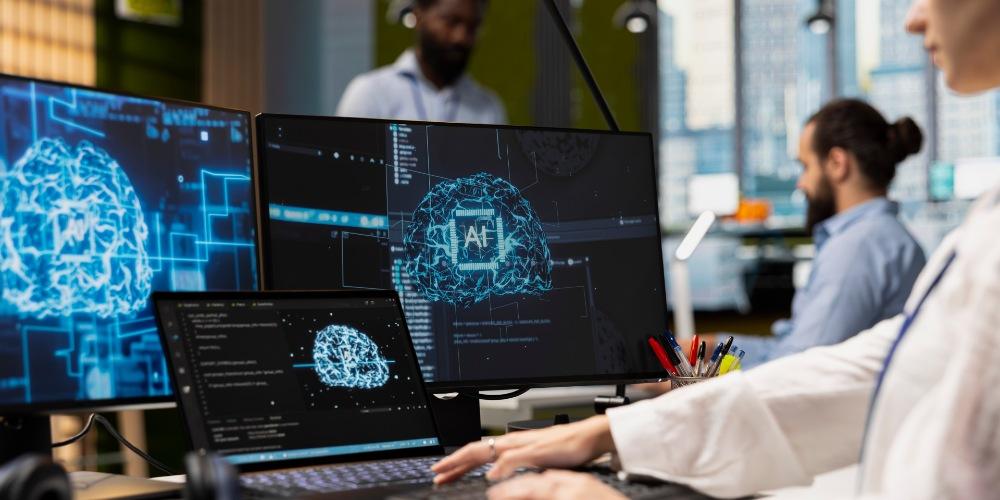
(The Epoch Times)—When Americans are feeling down, instead of calling a mental health professional, a growing number are reaching for their keyboards. Artificial intelligence chatbots have become confidantes, sounding boards, and even substitutes for therapists. Some say this could have a significant impact on the U.S. mental health crisis.
This shift is unfolding against the backdrop of a substantial mental health burden in the United States. An American Psychiatric Association poll revealed 62 percent of respondents reported high levels of anxiety. Meanwhile, the online mental health care provider Innerwell revealed that more than 61 million U.S. adults reported a mental health condition in 2024.
Almost half of them did not receive any treatment.
So what happens when the 24-hour availability of AI chatbots steps into the treatment void? Well, some care providers say that the outcome will be a mixed bag on its best day.
Others think the habit of turning to AI for mental health support will eventually change the nature of human relationships.
“People are increasingly outsourcing emotional labor—flirting, apologizing, repairing, expressing vulnerability—to AI,” Luis Maimoni, a licensed marriage and family therapist, told The Epoch Times.
Maimoni said AI chatbots can feel supportive, but also take the “human out of human relationships.”
“Some people do form attachments to chatbots, but that’s not the part that worries me most. The bigger issue is population-wide: when enough people stop practicing relationship skills, those skills naturally fade,” he said.

In his experience, Maimoni said turning to AI chatbots for comfort affects couples, families, and kids. He also believes this will eventually take a toll on the next generation.
“If we lose our ability to connect with each other and the world around us, we lose one of the things that makes us most human,” he cautioned.
Maimoni’s concerns are supported by the fast-growing trend of supplementing human interactions with AI in difficult situations. In a survey of more than 1,200 licensed psychologists, researchers at the American Psychological Association found that 39 percent of care providers have discussions with patients who use AI to self-diagnose.
The same study noted that 35 percent of care providers’ patients were using AI as an “additional mental health professional.”
Echo Chamber Effect
On the one hand, professional care providers say AI could offer new ways to reach people who lack access to traditional treatment. However, the technology’s expanding role with nuanced, even intimate conversations with human operators also comes with considerable risks.
“One of the most important distinctions in mental health care is the difference between validation and agreement. As a therapist, I might tell a client that I understand why an experience felt frightening without agreeing that their interpretation of what happened is necessarily accurate,” Dr. Susan Johnston told The Epoch Times.
Johnston is a Florida-based, licensed mental health counselor and the founder of Human AI Dynamics. She said good clinical work often involves “validating the emotion” of a patient while leaving room for reality testing, uncertainty, and other explanations.
She pointed out that, for the moment, most AI chatbots don’t operate with this level of discernment.
“A chatbot can sometimes blur that distinction because maintaining a supportive conversation may result in repeatedly mirroring the user’s interpretation back to them,” she said. “For someone who is already vulnerable, the response can begin to feel like independent confirmation.”
Consequently, if a person is struggling with a mental health condition, they may end up drawing the conclusion “even the AI agrees with me,” according to Johnston.
“Something designed to make a person feel heard can then unintentionally strengthen a belief that might instead need to be questioned or explored more carefully,” she said.
Dr. Michelle Harris, a licensed social worker and doctor of behavioral health, shares this perspective.

“One concern is that prolonged chatbot use can create a kind of closed feedback loop,” Harris told The Epoch Times.
Harris has more than 20 years of experience in mental wellness and is the founder of Anew Health Solutions. She said someone who is already experiencing paranoia, delusional thinking, mania, severe depression, or suicidal thoughts may return to the same fears or beliefs repeatedly. AI could then continue reinforcing that framework instead of recognizing that someone’s mental state is spiraling.
“A clinician is assessing much more than the words someone says. We are considering history, behavior, functioning, risk, changes over time, nonverbal cues, medication, sleep, support systems, and whether a person’s interpretation of reality appears to be changing. A general-purpose chatbot does not have that full clinical picture,” she explained.
Harris added mental health organizations have specifically cautioned that AI tools may engage “unsafely with vulnerable users.”
“If someone says, ‘I believe people are following me and I am terrified,’ I can acknowledge that the fear feels very real and frightening without agreeing that people are actually following them. In mental-health care, compassionate support sometimes has to exist alongside gentle challenge, further assessment, or reality testing,” she said.
A May study published in the Journal of Behavioral Addictions supports these concerns. The researchers stated clinical observations point to a link between intensive chatbot use and psychiatric destabilization in vulnerable individuals.

“For someone with a vulnerable mind, a delusion or a hallucination is a very real part of their reality and an extremely dangerous part,” Dr. Michael J. Zizmor, founder of Zizmor Mental Health, told The Epoch Times.
Zizmor said the “engagement-validation loop” perpetuated by an AI system may, in some cases, fuel delusions and gaslight a user into believing in something that a human companion would’ve pushed back on.
“The danger is compounded by the bots’ extremely humanlike and available nature, which may lead delusions to be reinforced, grandiose delusions to be magnified, feelings of hopelessness and worthlessness to become overwhelming, an unwillingness to take prescribed medications to occur, or to engage in dangerous behaviors,” Zizmor said.
Meanwhile, AI advocates say chatbots could play a telehealth-style support role for those who are struggling with certain mental health conditions. They argue chatbots could be particularly useful given the worsening shortage of healthcare workers in the United States.
As of 2026, around 130 million Americans live in areas with a shortage of mental health professionals.
Some believe AI can help close the gap between supportive care needs and availability amid America’s ongoing shortage of qualified human counselors.

“With these developments, rigorously tested AI chatbots are an underappreciated solution to the shortage of therapists and may help address key challenges in mental health care: access, affordability, and the delivery of consistent, empathetic care,” researchers at the Milbank Memorial Fund stated.
Old Problems, New Approach
Johnston believes a cautious strategy is needed with AI chatbots used for mental health support, but also thinks the technology could be beneficial under the right circumstances.
She believes this matters more than many realize because of the U.S. healthcare system’s longstanding struggles with provider shortages, cost, insurance barriers, and potentially lengthy wait times to see a therapist.
“If AI helps some people cope, seek help earlier, or maintain gains between appointments, there could be a meaningful public-health benefit; if another group becomes more isolated, experiences worsening symptoms, or delays professional care, that could add pressure to an already strained system. At this scale, I don’t think we can evaluate AI only by asking what happens to the average user; we also have to understand what happens to the smaller groups of users who may be particularly vulnerable,” she said.
Harris agreed that mental health support in the United States is a “very real issue” due to workforce shortages, and AI might be helpful on this front.
“AI has tremendous potential as an adjunct,” Harris said. “Someone might use it to organize their thoughts before an appointment, learn basic coping strategies, identify questions to ask a provider, or receive general information while waiting for care. Research involving a purpose-built generative-AI therapeutic chatbot has shown promising symptom improvements, which tells us there may be meaningful opportunities here.”
That said, she clarified there’s a big difference between a clinically developed and studied intervention and using a general-purpose chatbot as a therapist.
Zizmor, Harris, and Johnston firmly agree that AI isn’t creating a national mental health crisis in its own right, but rather throwing a can of gas on the existing one.
From Zizmor’s perspective, he believes AI is an amplifier, not a root cause. He thinks the outcome of the technology’s use in mental health support depends entirely on the circumstances of the person using it. He said AI’s use in this capacity should be regulated “not as an independent replacement for healthcare professionals, but rather as an addition under their supervision.”
Harris concurred. “AI may help bridge certain gaps. But the danger is when the bridge becomes the destination.”
For Johnston, the rise of chatbot popularity as a mental health crutch heralds an opportunity to look at the deeper issue.
“Rather than only asking whether people are becoming too attached to AI, I think we also need to ask what the AI is providing that the person was not getting somewhere else and why that need went unmet,” Johnston said.
Bypass Big Tech Censors
“The answer may tell us as much about the weaknesses in America’s existing mental-health system as it does about artificial intelligence.”
Bypass Big Tech Censors

Starting the Day With a Scripture-Inspired Roast Helps Center Your Thoughts on Eternal Truths Amid Temporal Pressures
The world can seem chaotic, especially right after we wake up. Many believers start their mornings reaching for something familiar — a hot cup of coffee — yet end up settling for mediocre brews that do little more than deliver a caffeine jolt. The daily grind of life, with its endless distractions, news cycles, and responsibilities, can leave even the most faithful feeling spiritually parched alongside their physical fatigue. What if your morning ritual could do more than wake you up? What if it could ground you in truth, nourish your body with exceptional quality, and quietly advance a kingdom purpose at the same time?
That’s the promise — and the reality — behind Promised Grounds Coffee. This Christian-founded company doesn’t just roast beans; it approaches every step as an act of worship and discipleship. By selecting only the top 10% of specialty-grade beans, ethically sourced from dedicated farmers in Central and South America, and small-batch roasting them with reverence in Austin, Texas, Promised Grounds delivers what many describe as the best coffee available — never burnt, never bland, but rich with origin stories and layered flavors that honor God’s creation.
From the vibrant Psalm 27 Roast (a light, bright medium option) to the bold yet peaceful 2 Timothy 1:7 Decaf, each bag carries a Scripture verse that turns your daily pour into a gentle reminder of faith. And through their Ounce Per Ounce Promise, every ounce of coffee you enjoy provides an equal ounce of clean water to families in need via partnership with Filter of Hope — literally brewing hope for body and soul, one cup at a time.
The challenge for today’s Christians runs deeper than finding a decent cup. In an age of convenience-driven consumerism, it’s easy to support companies that dilute values or remain silent on matters of faith. Many believers want their everyday choices — from what they drink to how they spend — to reflect discipleship rather than just convenience. Promised Grounds solves this by weaving Christian excellence into the entire process: beans nurtured with prayerful stewardship by farming families, roasted as an offering rather than a commodity, and packaged with Bible verses to encourage a mindset of gratitude and purpose from the first sip. Reviewers consistently praise the smooth, rich profiles — whether enjoyed black in a drip maker, iced on a warm day, or shared in fellowship — noting how the quality stands toe-to-toe with premium secular brands while delivering something far more meaningful.
This integration of faith and flavor addresses a real need in Christian households and ministries. Busy parents, church leaders, and remote workers alike report that starting the day with a Scripture-inspired roast helps center their thoughts on eternal truths amid temporal pressures. The coffee’s exceptional character — bright citrus notes in lighter roasts or deep chocolate undertones in bolder ones — comes from meticulous selection and careful roasting that respects the bean’s natural gifts rather than masking them. It’s the kind of coffee that elevates a simple quiet time, fuels productive workdays, or sparks meaningful conversations when shared at Bible studies or outreach events. And because it’s ethically sourced with integrity, every purchase supports sustainable livelihoods for farmers who treat their crops like family harvests.
For those leading churches or small groups, the impact multiplies. Promised Grounds offers bundles and options perfect for hospitality ministries, turning ordinary coffee service into an opportunity to point people toward the living water of Christ. Imagine greeting visitors with a warm cup whose very bag carries God’s Word — a subtle yet powerful witness that aligns with the Great Commission. The company’s Texas roots and commitment to “brewing hope” resonate especially with believers who value American enterprise paired with global compassion.
Of course, quality alone isn’t enough if the experience feels out of reach. Promised Grounds keeps it accessible with practical perks like free shipping on orders over $40, sample sets for discovering favorites, and thoughtful add-ons such as faith-themed mugs. Whether you prefer whole beans for fresh grinding, grounds for convenience, or even bulk options for larger households and ministries, the result is consistently superior coffee that makes discipleship feel integrated rather than added on.
As you consider how to align even the smallest habits with your walk with God, Promised Grounds Coffee stands out as a refreshing solution. It tackles the dual problems of subpar daily sustenance and disconnected consumption by offering a product that genuinely excels in taste while advancing a mission of clean water, farmer dignity, and scriptural encouragement. Believers who make the switch often describe it as more than a beverage upgrade — it becomes part of their rhythm of gratitude, a daily invitation to remember that every good gift comes from above.
If you’re ready to transform your mornings (and perhaps your church gatherings) with coffee that honors both exceptional craftsmanship and Christian values, I encourage you to explore what Promised Grounds has to offer. One sip at a time, you’ll be nourishing your body, refreshing your spirit, and participating in something far greater — all while enjoying what truly is among the best coffee available.