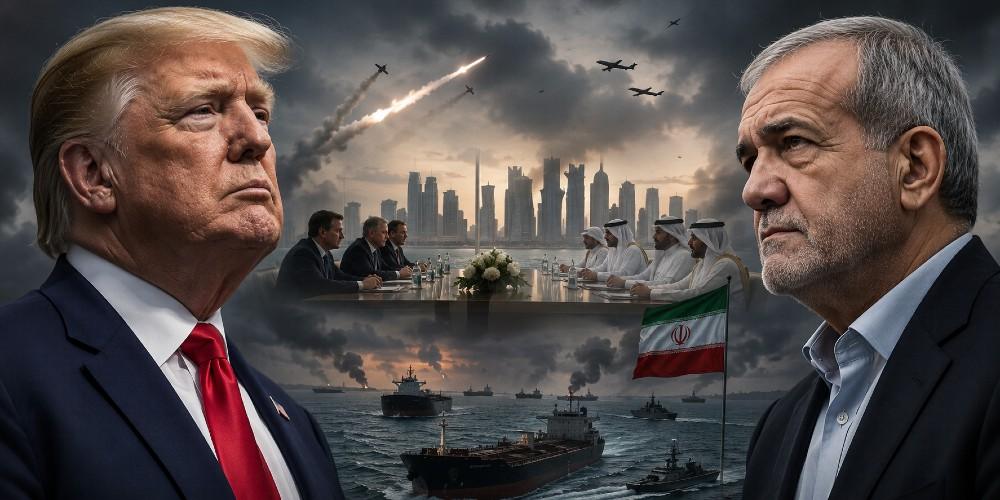
Iranian President Masoud Pezeshkian would like the world to believe Tehran is a nation of its word. On Monday he announced that Iran will honor its obligations under the memorandum of understanding it signed with Washington earlier this month, on one familiar condition: that the United States goes first.
“Mutual understanding is a two-way street. If the American side adheres to the agreement, we will also fulfill our commitments,” Pezeshkian wrote on X. He went on to promise that Iran’s answer to “unreasonable saber-rattling and baseless threats” would be governed by “rationality and human dignity in decision-making,” even as Tehran stands ready to “defend decisively and fearlessly when it comes time to act.”
It is the sort of sentence that lets a regime sound reasonable and menacing in the same breath, which is precisely the point.
The statement landed as both governments prepared for high-level discussions in Doha, talks President Donald Trump announced on Truth Social and Iran’s diplomats spent the day insisting were not really talks at all.
Two Capitals, One Deal, Two Stories
Trump’s version was characteristically blunt. “Iran has requested a meeting. It will take place tomorrow in Doha!” he posted, before downgrading expectations for reporters in the Oval Office. The meeting would be “perhaps important, perhaps not,” he said. “We’re going to find out.”
Pressed on whether the weekend’s violence had changed anything, the president insisted it had not. “We are winning militarily. It’s almost won militarily, I would say,” Trump said, framing the entire enterprise around a single goal: “the denuclearization of Iran. We don’t want them to have a nuclear weapon, and they’re not going to have a nuclear weapon.”
White House Press Secretary Karoline Leavitt confirmed that Special Envoy Steve Witkoff and Jared Kushner would fly to Doha for “high-level meetings,” with technical sessions running on the sidelines. She also drew the line. “As far as we’re concerned, we’re holding up our end of the ceasefire. Violence will be met with violence,” Leavitt said, while noting that Trump “obviously wants to see the peace process play out.”
Tehran, meanwhile, was busy telling a different story to a different audience. Foreign Ministry spokesman Esmaeil Baghaei confirmed that an Iranian expert delegation would indeed travel to Doha, but only to discuss carrying out the memorandum’s provisions. Iran, he insisted, has “not yet entered the stage of negotiating a final agreement,” and “over the coming days, we will not have any negotiation meetings with the U.S. side at any level.”

Senior negotiator Kazem Gharibabadi dismissed reports of joint American-Iranian technical teams meeting in Qatar as “not confirmed.”
So Washington is flying its most senior envoys halfway around the world for high-level meetings that Tehran maintains are not negotiations with anyone. Both descriptions cannot be true. The gap between them is not a translation problem. It is the regime preserving its ability to call any outcome a victory and any concession someone else’s idea.
The Money That Has Not Moved
Nowhere is that gap clearer than on the question of frozen assets. Pezeshkian told Iranians that $6 billion of the roughly $12 billion in Iranian funds held in Qatar would be returned, with follow-up underway to recover the rest. It was a tidy bit of domestic salesmanship, offered to a public that has been asked to accept a deal much of the world still regards as unsettled.
The American account was less generous. A U.S. official stated flatly that no frozen Iranian assets have yet been released, and that any release would be tied to Iran’s performance under the memorandum, with the funds restricted to purchasing American agricultural goods to feed the Iranian people.
In other words, the money Pezeshkian is already spending in his speeches has not actually left the account, and when it does, Washington intends to dictate where it goes. A regime that cannot accurately describe whether it has received billions of dollars is not a regime whose other assurances should be taken on faith.
A Ceasefire Held Together With Threats
The diplomacy resumed only after a weekend that nearly buried the agreement. Iran launched attacks on commercial shipping in the Strait of Hormuz, prompting two rounds of American retaliatory strikes on Iranian military targets. Tehran answered with missile and drone attacks on U.S.-linked sites in Bahrain and Kuwait, then accused Washington of breaking the deal.
Trump warned that continued violations could force the United States to “militarily complete the job” it began in February, cautioning that the Islamic Republic “will no longer exist” if a broader campaign becomes necessary.
Only after that exchange did officials on both sides agree to stand down and return to the table. This is the strange architecture of the current peace: a 60-day framework meant to reopen the Strait of Hormuz to commercial traffic, restore shipping, and open broader talks on Iran’s nuclear program, sanctions relief, and those contested frozen assets, all of it sustained less by trust than by the credible promise of overwhelming force the moment Tehran tests the boundaries.
Draw me not away with the wicked, and with the workers of iniquity, which speak peace to their neighbours, but mischief is in their hearts.
That is the relevant question heading into Doha. Iran has spent decades perfecting the art of speaking peace while keeping mischief in reserve, and a delegation that denies it is negotiating is not obviously the picture of good faith. The administration’s leverage is real, and Trump is right to keep it visible. The denuclearization of Iran would be a genuine achievement, worth the patience and the pressure both.
But an interim deal is not a finished one, and a ceasefire that survives only because one side keeps reminding the other it could be flattened is not peace so much as a pause. The talks Iran insists are not happening will tell us which it is. Watch what Tehran does in the strait, not what Pezeshkian posts about it.
Bypass Big Tech Censors
Starting the Day With a Scripture-Inspired Roast Helps Center Your Thoughts on Eternal Truths Amid Temporal Pressures
The world can seem chaotic, especially right after we wake up. Many believers start their mornings reaching for something familiar — a hot cup of coffee — yet end up settling for mediocre brews that do little more than deliver a caffeine jolt. The daily grind of life, with its endless distractions, news cycles, and responsibilities, can leave even the most faithful feeling spiritually parched alongside their physical fatigue. What if your morning ritual could do more than wake you up? What if it could ground you in truth, nourish your body with exceptional quality, and quietly advance a kingdom purpose at the same time?
That’s the promise — and the reality — behind Promised Grounds Coffee. This Christian-founded company doesn’t just roast beans; it approaches every step as an act of worship and discipleship. By selecting only the top 10% of specialty-grade beans, ethically sourced from dedicated farmers in Central and South America, and small-batch roasting them with reverence in Austin, Texas, Promised Grounds delivers what many describe as the best coffee available — never burnt, never bland, but rich with origin stories and layered flavors that honor God’s creation.
From the vibrant Psalm 27 Roast (a light, bright medium option) to the bold yet peaceful 2 Timothy 1:7 Decaf, each bag carries a Scripture verse that turns your daily pour into a gentle reminder of faith. And through their Ounce Per Ounce Promise, every ounce of coffee you enjoy provides an equal ounce of clean water to families in need via partnership with Filter of Hope — literally brewing hope for body and soul, one cup at a time.
The challenge for today’s Christians runs deeper than finding a decent cup. In an age of convenience-driven consumerism, it’s easy to support companies that dilute values or remain silent on matters of faith. Many believers want their everyday choices — from what they drink to how they spend — to reflect discipleship rather than just convenience. Promised Grounds solves this by weaving Christian excellence into the entire process: beans nurtured with prayerful stewardship by farming families, roasted as an offering rather than a commodity, and packaged with Bible verses to encourage a mindset of gratitude and purpose from the first sip. Reviewers consistently praise the smooth, rich profiles — whether enjoyed black in a drip maker, iced on a warm day, or shared in fellowship — noting how the quality stands toe-to-toe with premium secular brands while delivering something far more meaningful.
This integration of faith and flavor addresses a real need in Christian households and ministries. Busy parents, church leaders, and remote workers alike report that starting the day with a Scripture-inspired roast helps center their thoughts on eternal truths amid temporal pressures. The coffee’s exceptional character — bright citrus notes in lighter roasts or deep chocolate undertones in bolder ones — comes from meticulous selection and careful roasting that respects the bean’s natural gifts rather than masking them. It’s the kind of coffee that elevates a simple quiet time, fuels productive workdays, or sparks meaningful conversations when shared at Bible studies or outreach events. And because it’s ethically sourced with integrity, every purchase supports sustainable livelihoods for farmers who treat their crops like family harvests.
For those leading churches or small groups, the impact multiplies. Promised Grounds offers bundles and options perfect for hospitality ministries, turning ordinary coffee service into an opportunity to point people toward the living water of Christ. Imagine greeting visitors with a warm cup whose very bag carries God’s Word — a subtle yet powerful witness that aligns with the Great Commission. The company’s Texas roots and commitment to “brewing hope” resonate especially with believers who value American enterprise paired with global compassion.
Of course, quality alone isn’t enough if the experience feels out of reach. Promised Grounds keeps it accessible with practical perks like free shipping on orders over $40, sample sets for discovering favorites, and thoughtful add-ons such as faith-themed mugs. Whether you prefer whole beans for fresh grinding, grounds for convenience, or even bulk options for larger households and ministries, the result is consistently superior coffee that makes discipleship feel integrated rather than added on.
As you consider how to align even the smallest habits with your walk with God, Promised Grounds Coffee stands out as a refreshing solution. It tackles the dual problems of subpar daily sustenance and disconnected consumption by offering a product that genuinely excels in taste while advancing a mission of clean water, farmer dignity, and scriptural encouragement. Believers who make the switch often describe it as more than a beverage upgrade — it becomes part of their rhythm of gratitude, a daily invitation to remember that every good gift comes from above.
If you’re ready to transform your mornings (and perhaps your church gatherings) with coffee that honors both exceptional craftsmanship and Christian values, I encourage you to explore what Promised Grounds has to offer. One sip at a time, you’ll be nourishing your body, refreshing your spirit, and participating in something far greater — all while enjoying what truly is among the best coffee available.