
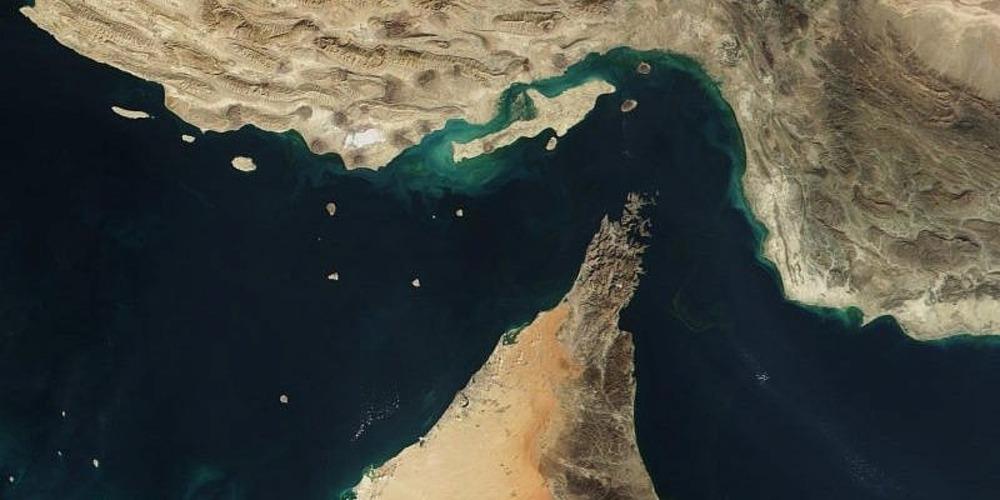
(Zero Hedge)—Iranian state-owned outlet Press TV has released a new report quoting Major General Kowsari, a senior member of the Iranian Parliament’s National Security Commission, who stated:
“The Parliament has reached the conclusion that the Strait of Hormuz should be closed, but the final decision in this regard lies with the Supreme National Security Council.”
‼️ Major General Kowsari, member of the National Security Commission of the Parliament: The Parliament has reached the conclusion that the Strait of Hormuz should be closed, but the final decision in this regard lies with the Supreme National Security Council. pic.twitter.com/sWd0rsOBsA
— Press TV Breaking (@PTVBreaking1) June 22, 2025
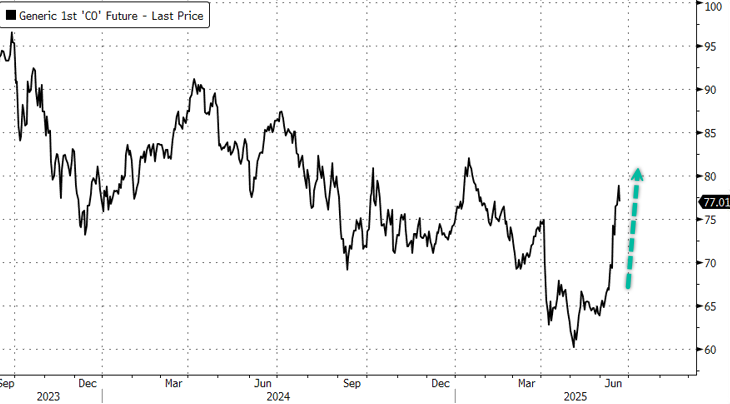
If Ayatollah Ali Khamenei approves the proposed closure of the critical maritime chokepoint—through which approximately 30% of global seaborne oil and 20% of LNG transit—Brent crude and natural gas futures will surge sharply this evening.
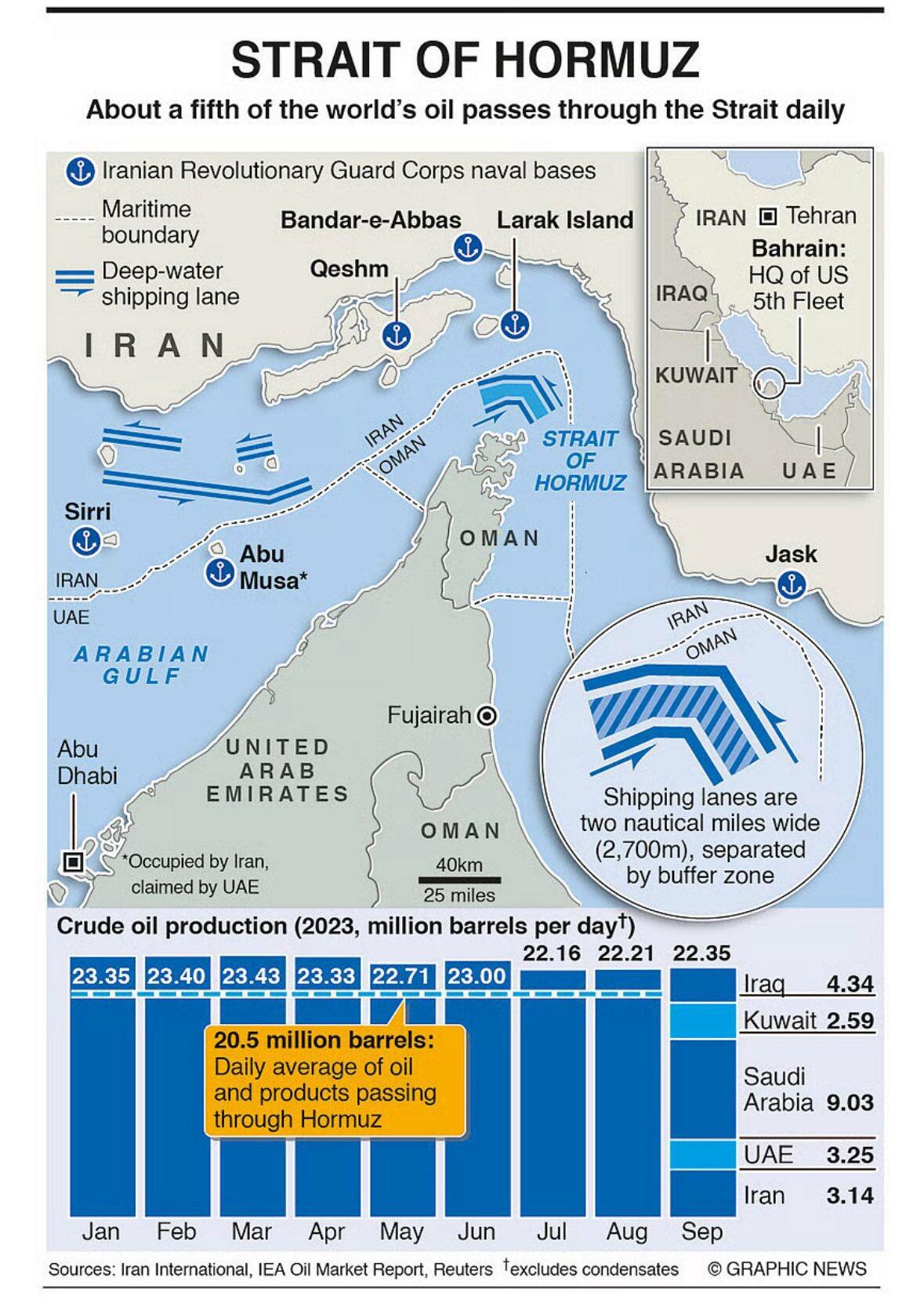
Reuters earlier cited lawmaker and Revolutionary Guards Commander Esmail Kosari, who told Young Journalist Club that closing the critical maritime checkpoint is on the agenda and “will be done whenever necessary.”
And this.
‘We can close the strait of Hormuz and shut their mouths. This will ruin their economy’
Young Iranians dismiss Trump attacks, sharing thoughts on bombings to Fars News
‘We should hit Dimona 10 times harder’ pic.twitter.com/fZRyaVm1wG
— RT (@RT_com) June 22, 2025
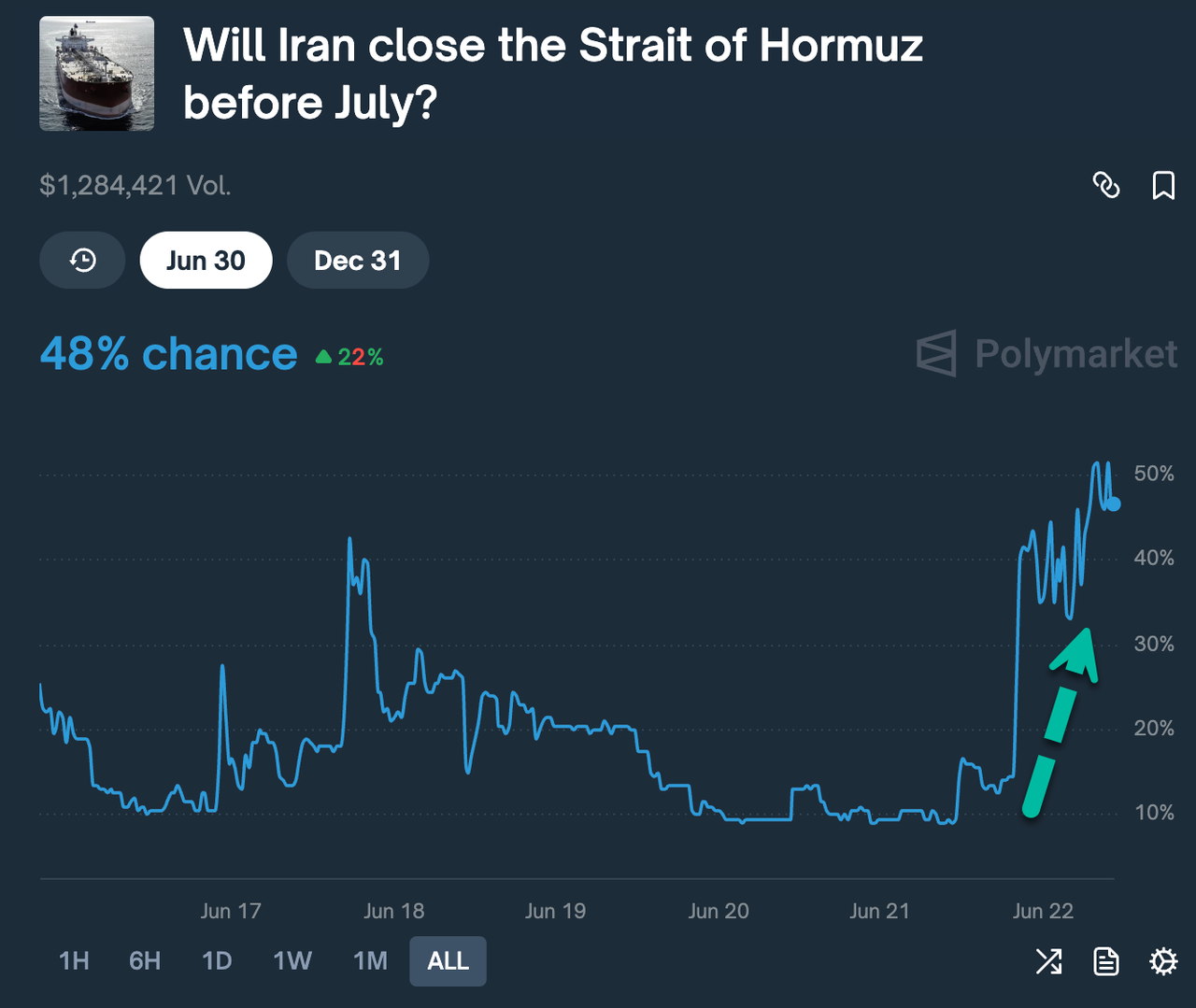
Crypto-based prediction market Polymarket shows that odds for a “Strait of Hormuz closure by July” surged from roughly 15% before the U.S. B-2 stealth bomber strikes on Iran’s key nuclear sites—Fordow, Natanz, and Esfahan—to as high as 60% earlier today, reflecting a sharp repricing of geopolitical risk.
The potential closure of the strait was recently outlined in a “worst-case scenario” by JPMorgan’s chief commodity strategist, Natasha Kaneva (available to pro subscribers in the usual place). The note cautioned that a severe outcome could send oil prices into the $120-$130 per barrel range.
London-based oil strategist at Bloomberg, Julian Lee, penned several important questions about what would happen if Iran tried to close the critical maritime chokepoint:
Could Iran really block the Strait of Hormuz?
Iran would have no legal authority to order a halt to traffic through Hormuz, so would need to achieve this by force or the threat of force.
If its navy tried to bar entry to the strait, it would likely be met with a strong response from the U.S. Fifth Fleet and other Western navies patrolling the area.
But it could cause severe disruption without a single Iranian warship leaving port. One option would be to harry shipping with small, fast patrol boats. Or it could launch drones and fire missiles toward ships from coastal or inland sites. That could make it too risky for commercial ships to venture through.
Similar tactics have been employed successfully by the Houthi militia in Yemen to disrupt traffic through the Bab el-Mandeb strait leading into the Red Sea on the other side of the Arabian peninsula. The Houthis have mostly fired missiles and drones at ships after warning owners of vessels linked to the U.S., the UK and Israel that they will be attacked if they approach the area.
A US-led force in the Red Sea is seeking to protect shipping there. But the number of ships sailing through the Red Sea and Gulf of Aden was still down about 70% in June compared with the average level of 2022 and 2023, according to Clarkson Research Services Ltd, a unit of the world’s largest shipbroker. This has forced vessel operators to reroute their traffic around the southern tip of Africa instead of going through the Suez Canal — a lengthier and more expensive journey for ships traveling between Asia and Europe.
Closing the Strait of Hormuz would quickly hit Iran’s own economy as it would prevent it from exporting its petroleum. And it would antagonize China, the biggest buyer of Iranian oil and a critical partner that’s used its veto power at the UN Security Council to shield Iran from Western-led sanctions or resolutions.
When has Iran disrupted shipping?
Iran has used harassment of ships in the Gulf for decades to register its dissatisfaction with sanctions against it, or as leverage in disputes.
- In April 2024, hours before launching a drone and missile attack on Israel, Iran’s Islamic Revolutionary Guard Corps seized an Israel-linked container ship near the Strait of Hormuz. Iran released the ship’s crew the following month, according to trade publication Lloyd’s List. Tehran claimed that the MSC Aries had violated maritime regulations, but analysts pointed to its Israeli ownership connection as a motive.
- When it seized a US-bound tanker in April 2023, Iran said the ship had struck another vessel. But the move appeared to be retaliation for the seizure off Malaysia’s coast of a ship loaded with Iranian crude by U.S. authorities on the grounds of sanctions violations.
- In May 2022, Iran seized two Greek tankers and held them for six months, presumably a response to the confiscation by Greek and U.S. authorities of Iranian oil on a different ship. The cargo was eventually released and the Greek tankers freed. So, too, was the oil on a tanker that Iran said it impounded in January “in retaliation for the theft of oil by the US.”
Has Iran ever closed the Strait of Hormuz?
Not so far. During the 1980-88 war between Iraq and Iran, Iraqi forces attacked an oil export terminal at Kharg Island, northwest of the strait, in part to provoke an Iranian retaliation that would draw the U.S. into the conflict. Afterward, in what was called the Tanker War, the two sides attacked 451 vessels between them. That significantly raised the cost of insuring tankers and helped push up oil prices. When sanctions were imposed on Iran in 2011, it threatened to close the strait, but ultimately backed off.
Commodore Alireza Tangsiri, head of Iran’s Islamic Revolutionary Guard Corps naval forces, said shortly before the MSC Aries seizure that Iran has the option of disrupting traffic through the Strait of Hormuz, but chooses not to.
How did the U.S. and allies respond to threats to Hormuz shipping in the past?
During the Tanker War, the U.S. Navy resorted to escorting vessels through the Gulf. In 2019, it dispatched an aircraft carrier and B-52 bombers to the region. The same year, the U.S. started Operation Sentinel in response to Iran’s disruption of shipping. Ten other nations — including the UK, Saudi Arabia, the United Arab Emirates, and Bahrain — later joined the operation, known now as the International Maritime Security Construct. Since late 2023, much of the focus on protecting shipping has switched away from the Strait of Hormuz and onto the southern Red Sea, the region’s other vital waterway, and the Bab el-Mandeb Strait that connects it to the Gulf of Aden and the Indian Ocean. Attacks by the Iran-backed Houthis on shipping entering or exiting the Red Sea became a greater concern than the Strait of Hormuz.
UK-flagged tanker Kohzan Maru reversed course in the Strait of Hormuz overnight after the strikes became public.

At least one tanker in the Strait of Hormuz appears to have paused its transit after the US struck Iran overnight.
Seen here, the UK-flagged tanker Kohzan Maru reversed course after the strikes became public and is now racing south at top speed. pic.twitter.com/xugD83AoEZ
— OSINTtechnical (@Osinttechnical) June 22, 2025
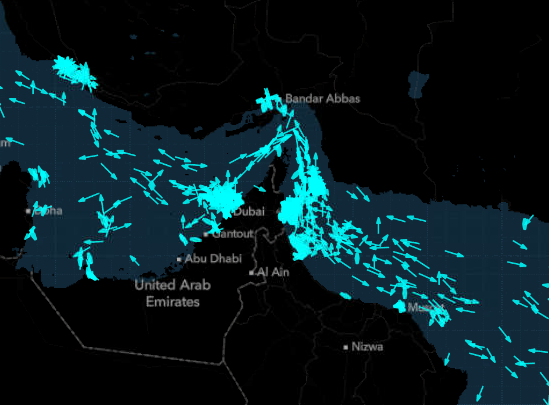
Latest ship tracking data via Bloomberg shows tankers are still flowing through the maritime chokepoint.
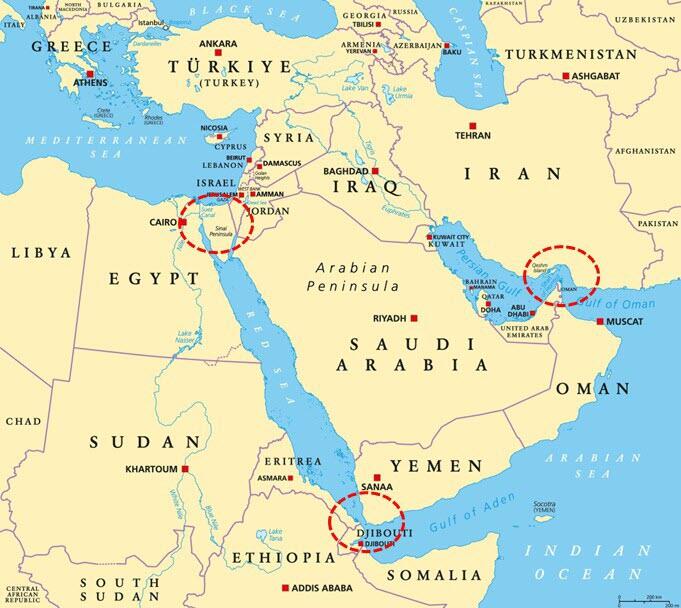
Other critical maritime chokepoints to keep an eye on in the region.
U.S. Secretary of State Marco Rubio issued this warning to Iran on Fox News: “If Iran closes the Strait of Hormuz, it will be another terrible mistake. It’s economic suicide for them if they do it and we retain options to deal with that.”
Rubio:
“If Iran closes the Strait of Hormuz, it will be another terrible mistake. It’s economic suicide for them if they do it and we retain options to deal with that” pic.twitter.com/6mXeYXJ6Te
— Visegrád 24 (@visegrad24) June 22, 2025
Now the West waits for Iran’s retaliatory attack.
Bypass Big Tech Censors

Two Storms, One Harvest

Every food crisis in living memory has been a one-shock event. The 2008 price spike was a commodity bubble. The 2020 shortages were a logistics failure. The 2022 grain scare was a war on one exporter’s ports. Each time, the system bent, adjusted, and recovered, and each time the experts assured us afterward that global markets are simply too big and too diversified to fail.
What nobody in Washington seems eager to discuss is that 2026 is shaping up to be something the modern food system has never actually faced. Two independent shocks, one climatic and one geopolitical, are converging on the same harvest cycle at the same time. Not sequentially. Simultaneously.
Start with the weather. The Pacific Ocean is currently building toward what forecasters now openly call a record event. NOAA’s Climate Prediction Center puts the odds of at least a strong El Niño near 88 percent, with roughly two in three odds it reaches “very strong” status, the tier reserved for perhaps three or four events in the entire satellite era. Every major global model now projects a median peak in Super El Niño territory, and most of them project it exceeding the 2015-16 event, which until now held the modern record. Sea surface anomalies were already brushing the super threshold in mid-July, months before these events normally peak. The atmosphere has already shifted into El Niño mode, and the event is forecast to crest in late fall and early winter.
This is not about “climate change.” It’s about the standard cycles of weather, and the cycle we’re currently in is one that has likely devastated societies in the past. We’re better prepared as a society today, but not all Americans are equally prepared.
Serious households have started doing the quiet math on their own. Grocery bills tell part of the story, and the forecast maps tell the rest, which is why long-term food storage has moved from fringe hobby to mainstream line item in the family budget, with established suppliers like Heaven’s Harvest seeing demand from people who five years ago would have rolled their eyes at the idea. That instinct is not paranoia. It is pattern recognition, and the pattern is worth walking through carefully.
Editor’s Note: Heaven’s Harvest IS a sponsor, but the warnings of this article are real and would be written even if we didn’t have a survival food sponsor. With that said, those who take advantage of what they offer can use promo code “Patriot” for 15% off.
The Fertilizer Clock Is Already Running
While the Pacific warms, the second shock has been unfolding in the Strait of Hormuz. The conflict with Iran turned the world’s most important energy chokepoint into a contested waterway, and the consequences reach far beyond the gas pump. Roughly a third of global fertilizer trade moves through Hormuz, and the disruption sent urea prices up 86 percent year over year by March, with a 53 percent jump in a single month.
The World Bank projects energy prices rising about 24 percent in 2026 and fertilizer about 31 percent. By its own accounting, fertilizer prices ran 35 percent higher in the first five months of this year than the same period last year.
Here is the mechanism the nightly news will not explain. Fertilizer is not a grocery item. It is a time-delayed input. The nitrogen a farmer in Iowa or Punjab could not afford to apply this spring does not show up as a problem this spring. It shows up as a thinner harvest six to twelve months later.
The World Bank’s own food security brief concedes that the effects of reduced applications earlier this season “are likely to become visible only later in harvest outcomes.” Translate that from institutional language into plain English and it means this. The damage is already done, it is already in the ground, and we are simply waiting for it to arrive on the shelf.
Now check the calendar. Six to twelve months from the spring planting season lands us squarely in late 2026 and early 2027. Which is precisely when the strongest El Niño in the instrumental record is forecast to peak, bringing its signature droughts to Southeast Asia, Australia, southern Africa, northern Brazil, and South Asia, the very regions that grow the world’s rice, sugar, and oilseeds.
The World Bank warns openly that a strong El Niño “could disrupt multiple crop belts simultaneously” on top of the conflict-driven input costs. Their baseline projection assumes the Middle East disruptions ease by autumn. What in the last two years of Middle East history suggests that assumption is safe?
The System Has No Slack Left
The comfortable answer is that global markets always adjust. But adjustment requires slack, and the slack is gone. Global cereal production is expected to decline from last year’s records even before El Niño does its work. The UN World Food Programme, hardly a den of right-wing preppers, is calling this the most significant disruption to its supply chains since Covid and the invasion of Ukraine, and its supply chain director put the stakes bluntly.
Today’s supply chain challenges are tomorrow’s hunger crisis.
There is also a political dimension that markets cannot price. When food gets scarce, governments do not behave like economists. They behave like politicians. Export bans, hoarding mandates, and panic buying at the national level turned the modest rice shortfall of 2008 into a global crisis, and analysts are already warning that import-dependent nations are the first dominoes.
The 2015-16 Super El Niño, a far weaker event than what is now forecast, threw tens of millions into food stress across Africa and Asia. This one is projected to be stronger, and it arrives with fertilizer already rationed by price and shipping lanes already contested by missiles.
What Joseph Knew
Scripture does not treat preparation for lean years as faithlessness. It treats it as wisdom delivered in advance to those willing to act on it.
Behold, there come seven years of great plenty throughout all the land of Egypt: And there shall arise after them seven years of famine; and all the plenty shall be forgotten in the land of Egypt.
Joseph did not respond to that warning with a hashtag or a committee. He stored grain during the years of abundance, and when the famine came, Egypt stood while its neighbors begged. The lesson is not that famine is certain. It is that the time to prepare is precisely when preparation still looks optional.
Nobody who filled a pantry in a year of plenty has ever regretted it, and nobody standing in an empty aisle has ever been glad he waited for certainty.
None of this calls for panic, and panic is the enemy of sound judgment anyway. It calls for the same unglamorous prudence our grandparents considered ordinary. Keep some cash margin, know your local growers, and put real food in deep storage while it is cheap and available, because the entire arc of this story is that cheap and available is a closing window.
Families looking for a straightforward place to start can visit Heaven’s Harvest and use promo code Patriot for 15 percent off long-term storable food. The forecasts may yet soften, the strait may yet reopen, and we should pray they do. But hope is a fine thing to hold and a foolish thing to eat.


