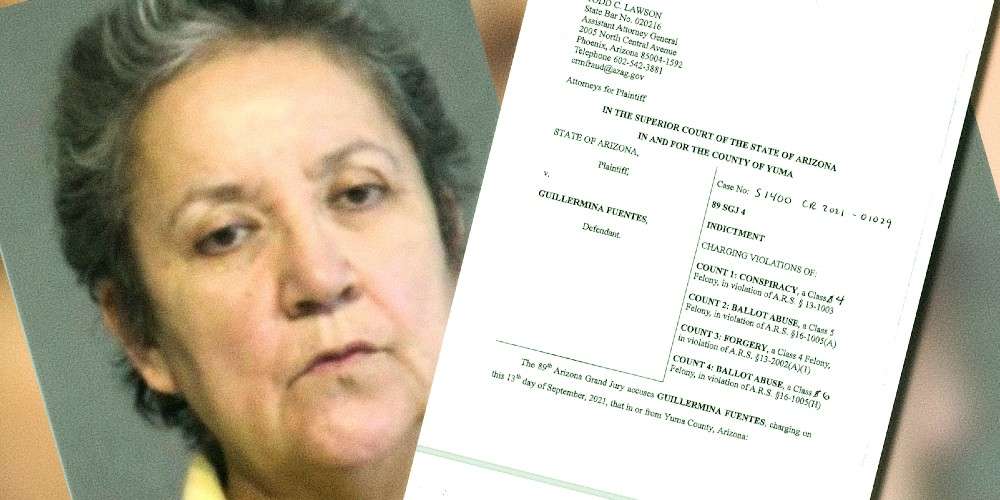
“An Arizona woman indicted in 2020 on accusations of illegally collecting ballots apparently ran a sophisticated operation using her status as a well-known Democratic operative in the border city of San Luis to persuade voters to let her gather and in some cases fill out their ballots, according to records obtained…”
That was not the opening paragraph to an article on The Gateway Pundit or Valiant News. It wasn’t written by people who work for Steve Bannon, Mike Lindell, or Dinesh D’Souza. The first paragraph of this article was part of a bombshell news report from The Associated Press.
Of course, very, very few corporate news outlets who subscribe to their services picked up this particular story, even with its innocuous title, “Records show coordinated Arizona ballot collection scheme.” Leftist media has been saying for a year and a half that the 2020 election was the most accurate and secure election of all time. They have backed the installation of the Biden-Harris regime and have proclaimed without evidence that Donald Trump’s claims of massive, widespread voter fraud are unfounded.
Even as the story details how Guillermina Fuentes, 66, and another woman engaged in open-air ballot harvesting, which is illegal in Arizona, the writer does his best to downplay what this means. If one person on video on a single day can be seen collecting and filling out dozens of ballots for people, what would that look like at scale? How many days did she do it? How many other Democrat operatives did the same thing in different areas of the city? In how many other cities was this practice taking place?
According to the article:
Fuentes, a former San Luis mayor who serves as an elected board member of the Gadsden Elementary School District in San Luis, has a Thursday court date where she may change her not guilty plea. Her co-defendant awaits sentencing after pleading guilty to a reduced charge several months ago.
Fuentes is accused of collecting ballots during the 2020 primary election in violation of the law that only allows a caregiver or family member to return someone else’s early ballot, and in some cases filling them out.
It is almost certain based on the boldness of the allegations that Fuentes did this on multiple occasions, and she wasn’t alone. If we assume very conservative estimates that there were 100 people engaged in ballot harvesting (there were likely thousands), they each collected 50 ballots per day, and engaged in this activity an average of 10 days each, that would be 50,000 fraudulent votes. Joe Biden allegedly “won” the state by 10,457 votes.

Of course the AP story does its level best to cast doubt on the potential that this was massive and widespread with the standard operating procedure of claiming “no sign” [emphasis added]:
Republicans have rallied around the possibility of widespread voting fraud in the 2020 election where former President Donald Trump was defeated. They’ve pointed to the charges against Fuentes as part of a broader pattern in battleground states.
There is no sign of that in the investigation records, though. They were obtained through a public records request from the Arizona attorney general’s office that was first made in February 2021, but was denied. The AP sent a new request last October after more charges were filed against Fuentes. The attorney general finally provided more than 20 documents laying out the investigation late last week.
As leftist journalists are wont to do, this AP reporter made sure to invoke the standard denial technique. It’s not that there are no signs this type of activity was widespread in Arizona and across the nation. The AP reported snuck in the there were no signs in the investigation records. Because the investigation records are focused on the single case, of course there were no signs that this was part of a broader plan. It’s like saying, “When looking through a microscope to see a fungus on a slide, there were no signs the fungus exists anywhere else in the world.”
The investigation record is narrow. Both common sense and tons of indicators outside of this particular investigation’s records tell us this was widespread, coordinated, and likely accounted for tens if not hundreds of thousands of illegally acquired votes in the 2020 election in Arizona alone.
Again, Joe Biden allegedly “won” the state by 10,457 votes.
The AP reporter buried the lede. After going through as many official-sounding statements reflecting the Associated Press’s perspective that the elections wasn’t stolen, they admitted in paragraphs 12 and 13 the two most important facts. We emphasized these two facts from the article:
Investigators said it appears she used her position as a powerful figure in the heavily Mexican American community to get people to give her or others their ballots to return to the polls.
The alleged illegal ballot collection by Fuentes and her co-defendant happened in plain sight outside a cultural center in San Luis on the day of the primary election, the reports show. Fuentes was at a card table set up by supporters of a slate of city council candidates and was spotted with several mail-ballot envelopes, pulling out the ballots and in some cases marking them.
The ballots were then taken inside the cultural center and deposited in a ballot box.
It was videotaped by a write-in candidate who called the Yuma County sheriff. An investigation was launched that day, and about 50 ballots checked for fingerprints, which were inconclusive. The investigation was taken over by the attorney general’s office within days, with investigators collaborating with the sheriff’s deputies to interview voters and others, including Fuentes.
Although Fuentes is charged only with actions that appear on the videotape and involve just a handful of ballots, investigators believe the effort went much farther.

Attorney general’s office investigator William Kluth wrote in one report that there was some evidence suggesting Fuentes actively canvassed San Luis neighborhoods and collected ballots, in some cases paying for them.
The Associated Press and the story’s author made a big deal earlier in the article that the investigation records do not point to a wider conspiracy while barely mentioning the opinion of actual investigators in the case who believe the efforts went much farther. Oh, and Fuentes was paying for ballots, which the AP felt was finally worth a mention in paragraph 13.
Before anyone gives kudos to the AP for at least posting the story, let’s remember that this is an attempt to bury the bombshells. From this one case alone we can extrapolate the extreme likelihood of voter fraud on a scale that could easily have stolen the state for Biden. We know that Democrat operatives were paying people to hand over blank ballots. We can combine this with mountains of evidence from audits and other sources that point to the near certainty Arizona was actually won by President Trump by a wide margin.
The Associated Press did everything in their power to make this seem like a nothingburger. It’s a bombshell they’ve hidden in plain sight, adding to the long list of mounting evidence that the 2020 election was, indeed, stolen.
Bypass Big Tech Censors

Starting the Day With a Scripture-Inspired Roast Helps Center Your Thoughts on Eternal Truths Amid Temporal Pressures
The world can seem chaotic, especially right after we wake up. Many believers start their mornings reaching for something familiar — a hot cup of coffee — yet end up settling for mediocre brews that do little more than deliver a caffeine jolt. The daily grind of life, with its endless distractions, news cycles, and responsibilities, can leave even the most faithful feeling spiritually parched alongside their physical fatigue. What if your morning ritual could do more than wake you up? What if it could ground you in truth, nourish your body with exceptional quality, and quietly advance a kingdom purpose at the same time?
That’s the promise — and the reality — behind Promised Grounds Coffee. This Christian-founded company doesn’t just roast beans; it approaches every step as an act of worship and discipleship. By selecting only the top 10% of specialty-grade beans, ethically sourced from dedicated farmers in Central and South America, and small-batch roasting them with reverence in Austin, Texas, Promised Grounds delivers what many describe as the best coffee available — never burnt, never bland, but rich with origin stories and layered flavors that honor God’s creation.
From the vibrant Psalm 27 Roast (a light, bright medium option) to the bold yet peaceful 2 Timothy 1:7 Decaf, each bag carries a Scripture verse that turns your daily pour into a gentle reminder of faith. And through their Ounce Per Ounce Promise, every ounce of coffee you enjoy provides an equal ounce of clean water to families in need via partnership with Filter of Hope — literally brewing hope for body and soul, one cup at a time.
The challenge for today’s Christians runs deeper than finding a decent cup. In an age of convenience-driven consumerism, it’s easy to support companies that dilute values or remain silent on matters of faith. Many believers want their everyday choices — from what they drink to how they spend — to reflect discipleship rather than just convenience. Promised Grounds solves this by weaving Christian excellence into the entire process: beans nurtured with prayerful stewardship by farming families, roasted as an offering rather than a commodity, and packaged with Bible verses to encourage a mindset of gratitude and purpose from the first sip. Reviewers consistently praise the smooth, rich profiles — whether enjoyed black in a drip maker, iced on a warm day, or shared in fellowship — noting how the quality stands toe-to-toe with premium secular brands while delivering something far more meaningful.
This integration of faith and flavor addresses a real need in Christian households and ministries. Busy parents, church leaders, and remote workers alike report that starting the day with a Scripture-inspired roast helps center their thoughts on eternal truths amid temporal pressures. The coffee’s exceptional character — bright citrus notes in lighter roasts or deep chocolate undertones in bolder ones — comes from meticulous selection and careful roasting that respects the bean’s natural gifts rather than masking them. It’s the kind of coffee that elevates a simple quiet time, fuels productive workdays, or sparks meaningful conversations when shared at Bible studies or outreach events. And because it’s ethically sourced with integrity, every purchase supports sustainable livelihoods for farmers who treat their crops like family harvests.
For those leading churches or small groups, the impact multiplies. Promised Grounds offers bundles and options perfect for hospitality ministries, turning ordinary coffee service into an opportunity to point people toward the living water of Christ. Imagine greeting visitors with a warm cup whose very bag carries God’s Word — a subtle yet powerful witness that aligns with the Great Commission. The company’s Texas roots and commitment to “brewing hope” resonate especially with believers who value American enterprise paired with global compassion.
Of course, quality alone isn’t enough if the experience feels out of reach. Promised Grounds keeps it accessible with practical perks like free shipping on orders over $40, sample sets for discovering favorites, and thoughtful add-ons such as faith-themed mugs. Whether you prefer whole beans for fresh grinding, grounds for convenience, or even bulk options for larger households and ministries, the result is consistently superior coffee that makes discipleship feel integrated rather than added on.
As you consider how to align even the smallest habits with your walk with God, Promised Grounds Coffee stands out as a refreshing solution. It tackles the dual problems of subpar daily sustenance and disconnected consumption by offering a product that genuinely excels in taste while advancing a mission of clean water, farmer dignity, and scriptural encouragement. Believers who make the switch often describe it as more than a beverage upgrade — it becomes part of their rhythm of gratitude, a daily invitation to remember that every good gift comes from above.
If you’re ready to transform your mornings (and perhaps your church gatherings) with coffee that honors both exceptional craftsmanship and Christian values, I encourage you to explore what Promised Grounds has to offer. One sip at a time, you’ll be nourishing your body, refreshing your spirit, and participating in something far greater — all while enjoying what truly is among the best coffee available.