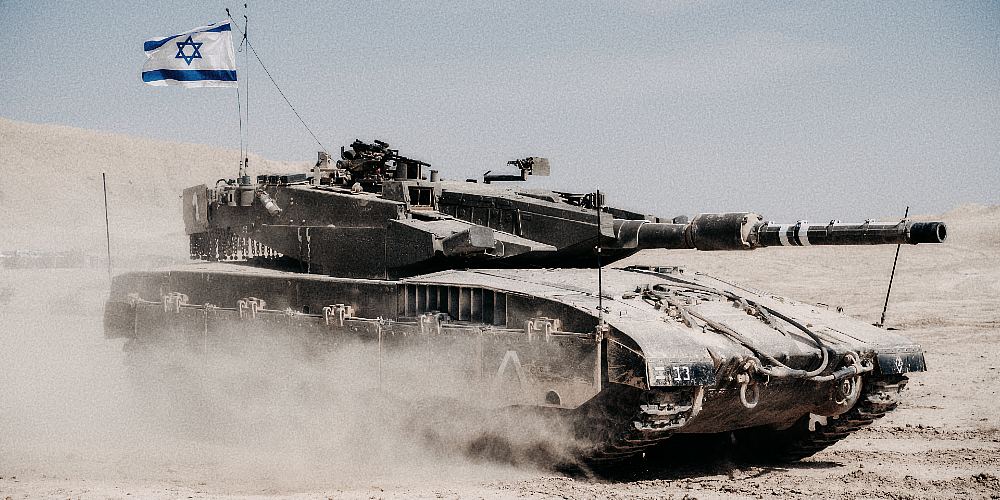
(End of the American Dream)—I have no idea why this isn’t getting more attention. Israeli tanks are literally rolling into southern Lebanon right now. When you send tanks in, you aren’t just conducting “localized raids”. A lot of people don’t seem to understand that this is it. The IDF has initiated a ground operation in southern Lebanon, and according to Hezbollah this means that there will be all-out war. In other words, we just crossed the point of no return. Interestingly, Donald Trump just told a crowd at a campaign rally in California that he was concerned that we could “end up in a world war” in the next few months…
U.S. Republican presidential candidate Donald Trump is worried that World War III could break out in the next four months due to the policies of the Democrats leading the US government.
“I actually worry about the next three months. I really do. I worry about the next three and a half four months will end up in a world war because of this, the people that we have [in government],” he said at a rally in the state of California.
The Biden administration has been making colossal mistake after colossal mistake in the Middle East.
Now the time for talk is over and Israeli tanks have entered southern Lebanon…
Israeli tanks have burst through the gates of a United Nations peacekeeper base in southern Lebanon, the UN confirmed today.
It comes after Israel’s Prime Minister Benjamin Netanyahu demanded the UNIFL withdraw from combat zones and Hezbollah strongholds — and accused the UN of inadvertently ‘providing terrorists with human shields’.
In a statement addressed to U.N. Secretary General Antonio Guterres, Netanyahu said: ‘The time has come for you to withdraw UNIFIL from Hezbollah strongholds and from the combat zones.
Of course Hezbollah has been quite busy as well. On Saturday, Hezbollah fired missiles at four different Israeli military bases…
Hezbollah claimed it had destroyed four military bases in Israel today as it launched a blistering rocket attack across the southern border.
The Iranian-proxy group said it had hit bases in Al-Jarrah, Za’rit and bases in the Golan Heights after claiming to have pushed back advancing forces late Friday.
Its fighters were ‘targeting the explosives factory there with a salvo of… missiles’, the group said in a statement this morning.
Then on Sunday, a massive Hezbollah drone attack injured more than 60 people in northern Israel…
More than 60 people have been injured, several of them critically, in a drone attack in northern Israel, according to first responders.
There were no immediate official reports of deaths from the attack, but the high number of injuries reported makes the attack one of the bloodiest since the war started last October.
The news comes after Hezbollah said Sunday it had fired a swarm of attack drones on an Israeli “Golani” infantry training camp in Binyamina, south of Haifa. The Lebanon-based militant group said the attack was in response to Israeli strikes in Lebanon on Thursday that killed 22 people and injured 117, according to the Lebanese Ministry of Health.
Most Americans are not really paying much attention to this war yet.
And most Americans don’t seem to realize that we will be directly involved.
In fact, it is being reported that approximately 100 U.S. troops will be operating the THAAD air defense systems that are about to be sent to Israel…

On Saturday we were among the first outlets to report that the United States is preparing to deploy THAAD anti-ballistic missile systems in Israel, a major development which will put American troops directly in harm’s way (or… boots on the ground) amid the tense showdown with Iran.
The Pentagon in follow-up statements to the NY Times has confirmed the THAAD (Terminal High Altitude Area Defense) systems will be sent to Israel, and that about 100 American troops will operate them.
If Iran and Israel start lobbing thousands of missiles at one another, those troops will be very heavily involved in what is happening.
Israel has promised to respond to Iran’s recent missile attack, and that could unleash a chain of events that nobody will be able to control.
According to the Daily Mail, the Iranians are making some very alarming threats…
Iran has threatened to recalculate its nuclear weapons programme if Israel launches a revenge strike as Biden has insisted Tehran is not building nukes. Since Hamas’s October 7 attack last year on Israel triggered a wave of regional hostilities between Israeli forces and Hezbollah militants, officials in Tehran have warned the Islamic republic could change its nuclear doctrine if it faced an existential threat. But they have been deliberately vague about what that might entail.
Pretty soon, both sides will be forced to reveal all of their cards. And once that happens, everything will change.
Meanwhile, the Russians continue to gobble up more territory in eastern Ukraine…
Russian forces have seized control of another eastern Ukrainian settlement, Moscow said on Sunday, in what would be the latest in a string of gains in the Donetsk region if confirmed.
The Kremlin said on Sunday that its Center group of forces had captured the Donetsk village of Mykhailivka.
Several settlements in Ukraine bear the same name, and Russia’s Defense Ministry statement is likely referring to the village immediately east of Selydove, southeast of the strategic Ukrainian-held hub of Pokrovsk where Moscow has been concentrating its efforts.
The Russians clearly have the upper hand at this stage.
Ukraine’s President Volodymyr Zelensky desperately wants NATO to give him permission to use western missiles to strike targets deep inside Russia, and he is also accusing the Russians of using North Korean troops against him…
Zelensky’s comments came days after visiting several European capitals to press his case for more military and financial help in the war against invading Russian forces.
“We see an increasing alliance between Russia and regimes like in North Korea,” Zelensky said in his evening address.
“It is no longer just about transferring weapons. It is actually about the transfer of people from North Korea to the occupier’s military forces.
“Obviously, in such circumstances, our relations with our partners need to be developed. The frontline needs more support,” he said.
Both sides just continue to escalate matters, and I am entirely convinced that it is just a matter of time before the U.S. and Russia are directly fighting one another.
If our leaders had any sense, they would sit down at the negotiating table before things ever have a chance to reach that point.
Before I end this article, there is one more thing that I wanted to mention.
According to the Wall Street Journal, fleets of unidentified drones have been flying over U.S. military bases on the east coast…
U.S. Air Force Gen. Mark Kelly wasn’t sure what to make of reports that a suspicious fleet of unidentified aircraft had been flying over Langley Air Force Base on Virginia’s shoreline.
Kelly, a decorated senior commander at the base, got on a squadron rooftop to see for himself. He joined a handful of other officers responsible for a clutch of the nation’s most advanced jet fighters, including F-22 Raptors.
For several nights, military personnel had reported a mysterious breach of restricted airspace over a stretch of land that has one of the largest concentrations of national-security facilities in the U.S. The show usually starts 45 minutes to an hour after sunset, another senior leader told Kelly.
The first drone arrived shortly. Kelly, a career fighter pilot, estimated it was roughly 20 feet long and flying at more than 100 miles an hour, at an altitude of roughly 3,000 to 4,000 feet. Other drones followed, one by one, sounding in the distance like a parade of lawn mowers.
I would very much encourage you to read that entire article, because it is absolutely stunning.

Our military has no idea where the drones are coming from, and they are not being allowed to shoot them down…
Officials didn’t know if the drone fleet, which numbered as many as a dozen or more over the following nights, belonged to clever hobbyists or hostile forces. Some suspected that Russia or China deployed them to test the response of American forces.
Federal law prohibits the military from shooting down drones near military bases in the U.S. unless they pose an imminent threat. Aerial snooping doesn’t qualify, though some lawmakers hope to give the military greater leeway.
If a fleet of unidentified aircraft is flying over highly sensitive military bases, you shoot them down.
I don’t even understand why there would be any debate.
My guess is that the drones are probably from either Russia or China. But if they are not from either Russia or China, that is probably an even more troubling scenario.
In any event, it has become clear that we are living at a time of wars and rumors of wars.
This war in the Middle East has escalated to an extremely dangerous level, the war in Ukraine is reaching a critical stage, and I believe that it won’t be too long before a conflict between the U.S. and China erupts.

World War I and World World War II both killed millions of people. World War III will kill billions of people, and it is right at the door.
Michael’s new book entitled “Why” is available in paperback and for the Kindle on Amazon.com, and you can subscribe to his Substack newsletter at michaeltsnyder.substack.com.
Bypass Big Tech Censors

Two Storms, One Harvest

Every food crisis in living memory has been a one-shock event. The 2008 price spike was a commodity bubble. The 2020 shortages were a logistics failure. The 2022 grain scare was a war on one exporter’s ports. Each time, the system bent, adjusted, and recovered, and each time the experts assured us afterward that global markets are simply too big and too diversified to fail.
What nobody in Washington seems eager to discuss is that 2026 is shaping up to be something the modern food system has never actually faced. Two independent shocks, one climatic and one geopolitical, are converging on the same harvest cycle at the same time. Not sequentially. Simultaneously.
Start with the weather. The Pacific Ocean is currently building toward what forecasters now openly call a record event. NOAA’s Climate Prediction Center puts the odds of at least a strong El Niño near 88 percent, with roughly two in three odds it reaches “very strong” status, the tier reserved for perhaps three or four events in the entire satellite era. Every major global model now projects a median peak in Super El Niño territory, and most of them project it exceeding the 2015-16 event, which until now held the modern record. Sea surface anomalies were already brushing the super threshold in mid-July, months before these events normally peak. The atmosphere has already shifted into El Niño mode, and the event is forecast to crest in late fall and early winter.
This is not about “climate change.” It’s about the standard cycles of weather, and the cycle we’re currently in is one that has likely devastated societies in the past. We’re better prepared as a society today, but not all Americans are equally prepared.
Serious households have started doing the quiet math on their own. Grocery bills tell part of the story, and the forecast maps tell the rest, which is why long-term food storage has moved from fringe hobby to mainstream line item in the family budget, with established suppliers like Heaven’s Harvest seeing demand from people who five years ago would have rolled their eyes at the idea. That instinct is not paranoia. It is pattern recognition, and the pattern is worth walking through carefully.
Editor’s Note: Heaven’s Harvest IS a sponsor, but the warnings of this article are real and would be written even if we didn’t have a survival food sponsor. With that said, those who take advantage of what they offer can use promo code “Patriot” for 15% off.
The Fertilizer Clock Is Already Running
While the Pacific warms, the second shock has been unfolding in the Strait of Hormuz. The conflict with Iran turned the world’s most important energy chokepoint into a contested waterway, and the consequences reach far beyond the gas pump. Roughly a third of global fertilizer trade moves through Hormuz, and the disruption sent urea prices up 86 percent year over year by March, with a 53 percent jump in a single month.
The World Bank projects energy prices rising about 24 percent in 2026 and fertilizer about 31 percent. By its own accounting, fertilizer prices ran 35 percent higher in the first five months of this year than the same period last year.
Here is the mechanism the nightly news will not explain. Fertilizer is not a grocery item. It is a time-delayed input. The nitrogen a farmer in Iowa or Punjab could not afford to apply this spring does not show up as a problem this spring. It shows up as a thinner harvest six to twelve months later.
The World Bank’s own food security brief concedes that the effects of reduced applications earlier this season “are likely to become visible only later in harvest outcomes.” Translate that from institutional language into plain English and it means this. The damage is already done, it is already in the ground, and we are simply waiting for it to arrive on the shelf.
Now check the calendar. Six to twelve months from the spring planting season lands us squarely in late 2026 and early 2027. Which is precisely when the strongest El Niño in the instrumental record is forecast to peak, bringing its signature droughts to Southeast Asia, Australia, southern Africa, northern Brazil, and South Asia, the very regions that grow the world’s rice, sugar, and oilseeds.
The World Bank warns openly that a strong El Niño “could disrupt multiple crop belts simultaneously” on top of the conflict-driven input costs. Their baseline projection assumes the Middle East disruptions ease by autumn. What in the last two years of Middle East history suggests that assumption is safe?
The System Has No Slack Left
The comfortable answer is that global markets always adjust. But adjustment requires slack, and the slack is gone. Global cereal production is expected to decline from last year’s records even before El Niño does its work. The UN World Food Programme, hardly a den of right-wing preppers, is calling this the most significant disruption to its supply chains since Covid and the invasion of Ukraine, and its supply chain director put the stakes bluntly.
Today’s supply chain challenges are tomorrow’s hunger crisis.
There is also a political dimension that markets cannot price. When food gets scarce, governments do not behave like economists. They behave like politicians. Export bans, hoarding mandates, and panic buying at the national level turned the modest rice shortfall of 2008 into a global crisis, and analysts are already warning that import-dependent nations are the first dominoes.
The 2015-16 Super El Niño, a far weaker event than what is now forecast, threw tens of millions into food stress across Africa and Asia. This one is projected to be stronger, and it arrives with fertilizer already rationed by price and shipping lanes already contested by missiles.
What Joseph Knew
Scripture does not treat preparation for lean years as faithlessness. It treats it as wisdom delivered in advance to those willing to act on it.
Behold, there come seven years of great plenty throughout all the land of Egypt: And there shall arise after them seven years of famine; and all the plenty shall be forgotten in the land of Egypt.
Joseph did not respond to that warning with a hashtag or a committee. He stored grain during the years of abundance, and when the famine came, Egypt stood while its neighbors begged. The lesson is not that famine is certain. It is that the time to prepare is precisely when preparation still looks optional.
Nobody who filled a pantry in a year of plenty has ever regretted it, and nobody standing in an empty aisle has ever been glad he waited for certainty.
None of this calls for panic, and panic is the enemy of sound judgment anyway. It calls for the same unglamorous prudence our grandparents considered ordinary. Keep some cash margin, know your local growers, and put real food in deep storage while it is cheap and available, because the entire arc of this story is that cheap and available is a closing window.
Families looking for a straightforward place to start can visit Heaven’s Harvest and use promo code Patriot for 15 percent off long-term storable food. The forecasts may yet soften, the strait may yet reopen, and we should pray they do. But hope is a fine thing to hold and a foolish thing to eat.