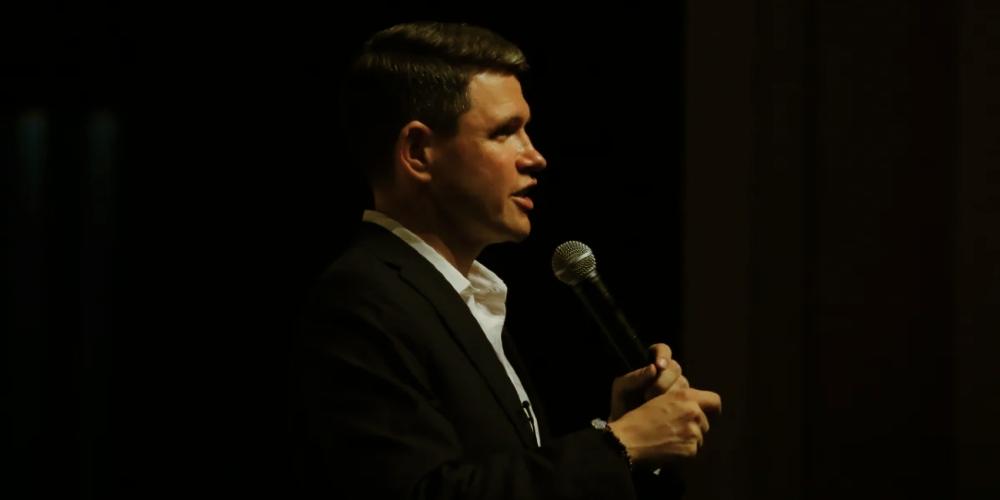
James Talarico wants Texas to believe he is a Christian seminarian with a Bible in one hand and a workingman’s lunch pail in the other. What keeps falling out of both hands is the actual gospel, and what keeps landing on the table is a stew of class warfare and religious mush that would have made the old mainline liberals blush.
Breitbart pulled the latest clip. In a resurfaced video, the Democrat running against Ken Paxton for U.S. Senate does not merely soften the edges of the faith. He denies the center of it. Christianity and Islam, he says, are “equal pathways to truth.”
Then he draws his little circle.
I find that they’re all kind of equal pathways to truth. You know, that’s how I think, you know, I always think of all of the world’s faith traditions as like a circle with that divine mystery of the universe in the middle. And we all have different names for that mystery.
He lists the names like a man reading off a campus interfaith brochure.
Whether it’s God or Yahweh or Allah or Nirvana, the Great Spirit, whatever you call it, this is all, you know, different pathways to the same kind of fundamental truth of reality.
That is not a slip. That is the pitch. Jesus is one flavor. Allah is another. Nirvana gets a seat. The Great Spirit gets a seat. The Cross becomes décor. The empty tomb becomes optional. And a man who still calls himself a Christian asks Texas to send him to Washington to lecture the rest of us about “Christian nationalism.”
Jesus Did Not Leave Room for Talarico’s Circle
Scripture is not confused on this point. “For there is one God, and one mediator between God and men, the man Christ Jesus.”
That sentence does not survive Talarico’s geometry. If Allah and Nirvana lead to the same “fundamental truth,” then the Incarnation was a branding exercise and Calvary was theater. The apostles did not die for a brand. They died because they preached a Name.
Talarico has been running this line for years. On The Weekend Show in 2024, he insisted Christians, Muslims, and Jews “all worship the same God,” added that “Muslims love Jesus,” and described the Abrahamic faiths as “branches on the same tree.”
On Ezra Klein’s show he said Christianity “points to the truth” while other “religions of love point to the same truth.” He talks about cups and languages. English, Spanish, French. Same cup. Different words. Cute. Except Christ did not say He was one vocabulary among many. He said He is the way, the truth, and the life, and that no man comes to the Father but by Him.

Islam does not “love Jesus” the way the New Testament loves Him. The Quran denies the Son. It denies the Cross as Christians confess it. It denies the Trinity. You can be polite about your Muslim neighbor and still tell the truth about that. Talarico will not, because the truth ruins the circle.
This is the same candidate who, in a 2021 Texas House invocation, opened with “Holy Mystery, you have so many names,” then cited the Torah, the Koran, the Gita, the Dharma, and the First Epistle of John before closing “in all your many names.”
Love as cosmic glue. The Big Bang as liturgy. Jesus reduced to a “barefoot rabbi” who left two commandments and, apparently, no exclusive claim on salvation. He asked the chamber to honor “not just the name of Jesus, but the way of Jesus,” which in Talarico-speak means policies. Always policies. The gospel becomes a floor speech.
The Seminarian Who Keeps Insulting the Church
Give the man this much. He is consistent. Breitbart reported that Talarico called Christianity the “most violent” religion and said it had done “more damage” to Islam than the other way around. He framed Judaism, Christianity, and Islam as seasons of the same show and put his own faith in the bloodiest slot. That is a hell of a thing to say in Texas while asking for Christian votes.
He has called himself a “Christian who hates Christianity.” He has said God is “beyond gender” and, on the House floor, that “God is non-binary.” He has claimed the Bible is “silent on abortion.” He has preached that “God is not a Christian.”
He has said Islamic mystics and Rumi shaped his faith “as much” as Christian writers. He has quoted the Gnostic Gospel of Thomas to blur male and female on the way into the kingdom. He has suggested atheists in the Texas Legislature can be “more Christ-like” than the Christians sitting next to them.
None of that is “taking the Bible seriously.” It is taking the Bible hostage. You keep the words that flatter a progressive platform. You sand off the words that judge it. You baptize the result and call the people who notice “Christian nationalists.”
A faith that cannot say Jesus is Lord in a way that excludes rival lords is not courage. It is marketing. And marketing is what you do when you need the pews on Sunday and the DSA donor list on Monday.
Then He Reaches for the Hammer and Sickle
The heresy would be bad enough if it stayed in the pulpit. It does not. Talarico’s economics are the other half of the concoction, and they are not a secret.
In a September 2020 Zoom forum with the Austin Sierra Club, obtained later and blasted across the race this month, the then-state representative thanked “young activists” for connecting three things he called oppressive systems. Climate change. White supremacy. Capitalism. Then he said the quiet part.
I think only ending the ways that all three of those oppressive systems work together are we gonna be able to begin the process of dismantling them.
The New York Post, Fox News, and RedState all ran the tape. On the same call he compared Texas oil and gas to “being the leader in cassette tapes in the 1980s” and promised that industry “is not gonna last.” This is the man now asking energy-state voters to trust him with a Senate seat while his campaign blurts that he is a “proud capitalist.”
Proud capitalist. Dismantle capitalism. Pick one. The 2020 version is the honest one. It is the language of campus Marxism dressed up as climate pastoral care. Link the engine of American prosperity to racial original sin, declare the whole machine oppressive, and then preach “political love” as the solvent. That is not the Book of Acts. That is a reading list.

Jonathan Turley called it a touch of Trotsky in the Texas Senate race, and he was not reaching. The Democratic Socialists have been chanting “dismantle” for years. Talarico did not invent the slogan. He just put a clerical collar near it and hoped Texas would confuse the costume for conviction.
Why the Mixture Matters
Heresy and Marxism are not random hobbies that happen to share a candidate. They serve the same appetite. Both need a world without a final Judge and without a created order that refuses to be redesigned. If every religion is a path to the same mist, then no commandment binds.
If capitalism is just another “oppressive system” welded to white supremacy, then Texas oil, private property, and the ordinary family that lives off both become moral problems to be managed by the state.
That is why Talarico talks constantly about love and almost never about repentance. Love, in his usage, is a mood that ratifies the platform. It blesses abortion because “Jesus never talks about” it. It blesses the gender revolution because God is “non-binary.”
It blesses Islam as a sister path because interfaith dialogue “brings out new flavors.” It blesses the dismantling of the economy that built the state he wants to represent. The one thing it will not bless is the exclusive Christ who divides sheep from goats.
Texas is not required to play along. A senator does not have to pass a systematic theology exam. He does have to tell the truth about what he worships. Talarico worships a mystery in the middle of a circle. Christians worship a risen Lord who walked out of a grave and left every rival claim on the floor.

Ken Paxton is a flawed man. Voters already know that. What they are being offered on the other side is not a humble Sunday school teacher with better health care ideas. It is a seminary-trained politician who will use the language of Jesus to empty Jesus of His uniqueness, then use the language of justice to treat prosperity as a sin. That concoction does not produce revival. It produces a softer state and a thinner church.
The apostles were offered syncretism too. They did not draw a circle. They named a Name. Texas can still do the same.
Bypass Big Tech Censors
Starting the Day With a Scripture-Inspired Roast Helps Center Your Thoughts on Eternal Truths Amid Temporal Pressures
The world can seem chaotic, especially right after we wake up. Many believers start their mornings reaching for something familiar — a hot cup of coffee — yet end up settling for mediocre brews that do little more than deliver a caffeine jolt. The daily grind of life, with its endless distractions, news cycles, and responsibilities, can leave even the most faithful feeling spiritually parched alongside their physical fatigue. What if your morning ritual could do more than wake you up? What if it could ground you in truth, nourish your body with exceptional quality, and quietly advance a kingdom purpose at the same time?
That’s the promise — and the reality — behind Promised Grounds Coffee. This Christian-founded company doesn’t just roast beans; it approaches every step as an act of worship and discipleship. By selecting only the top 10% of specialty-grade beans, ethically sourced from dedicated farmers in Central and South America, and small-batch roasting them with reverence in Austin, Texas, Promised Grounds delivers what many describe as the best coffee available — never burnt, never bland, but rich with origin stories and layered flavors that honor God’s creation.
From the vibrant Psalm 27 Roast (a light, bright medium option) to the bold yet peaceful 2 Timothy 1:7 Decaf, each bag carries a Scripture verse that turns your daily pour into a gentle reminder of faith. And through their Ounce Per Ounce Promise, every ounce of coffee you enjoy provides an equal ounce of clean water to families in need via partnership with Filter of Hope — literally brewing hope for body and soul, one cup at a time.
The challenge for today’s Christians runs deeper than finding a decent cup. In an age of convenience-driven consumerism, it’s easy to support companies that dilute values or remain silent on matters of faith. Many believers want their everyday choices — from what they drink to how they spend — to reflect discipleship rather than just convenience. Promised Grounds solves this by weaving Christian excellence into the entire process: beans nurtured with prayerful stewardship by farming families, roasted as an offering rather than a commodity, and packaged with Bible verses to encourage a mindset of gratitude and purpose from the first sip. Reviewers consistently praise the smooth, rich profiles — whether enjoyed black in a drip maker, iced on a warm day, or shared in fellowship — noting how the quality stands toe-to-toe with premium secular brands while delivering something far more meaningful.
This integration of faith and flavor addresses a real need in Christian households and ministries. Busy parents, church leaders, and remote workers alike report that starting the day with a Scripture-inspired roast helps center their thoughts on eternal truths amid temporal pressures. The coffee’s exceptional character — bright citrus notes in lighter roasts or deep chocolate undertones in bolder ones — comes from meticulous selection and careful roasting that respects the bean’s natural gifts rather than masking them. It’s the kind of coffee that elevates a simple quiet time, fuels productive workdays, or sparks meaningful conversations when shared at Bible studies or outreach events. And because it’s ethically sourced with integrity, every purchase supports sustainable livelihoods for farmers who treat their crops like family harvests.
For those leading churches or small groups, the impact multiplies. Promised Grounds offers bundles and options perfect for hospitality ministries, turning ordinary coffee service into an opportunity to point people toward the living water of Christ. Imagine greeting visitors with a warm cup whose very bag carries God’s Word — a subtle yet powerful witness that aligns with the Great Commission. The company’s Texas roots and commitment to “brewing hope” resonate especially with believers who value American enterprise paired with global compassion.
Of course, quality alone isn’t enough if the experience feels out of reach. Promised Grounds keeps it accessible with practical perks like free shipping on orders over $40, sample sets for discovering favorites, and thoughtful add-ons such as faith-themed mugs. Whether you prefer whole beans for fresh grinding, grounds for convenience, or even bulk options for larger households and ministries, the result is consistently superior coffee that makes discipleship feel integrated rather than added on.
As you consider how to align even the smallest habits with your walk with God, Promised Grounds Coffee stands out as a refreshing solution. It tackles the dual problems of subpar daily sustenance and disconnected consumption by offering a product that genuinely excels in taste while advancing a mission of clean water, farmer dignity, and scriptural encouragement. Believers who make the switch often describe it as more than a beverage upgrade — it becomes part of their rhythm of gratitude, a daily invitation to remember that every good gift comes from above.
If you’re ready to transform your mornings (and perhaps your church gatherings) with coffee that honors both exceptional craftsmanship and Christian values, I encourage you to explore what Promised Grounds has to offer. One sip at a time, you’ll be nourishing your body, refreshing your spirit, and participating in something far greater — all while enjoying what truly is among the best coffee available.