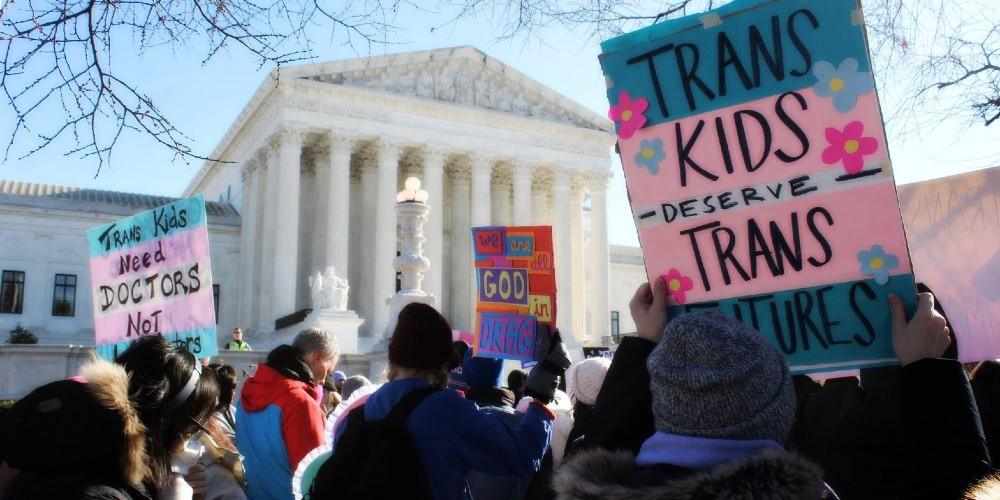
(WND News Center)—The U.S. Supreme Court on Tuesday heard arguments in a pair of cases challenging state laws that provide for boys to be in boys sports, and girls to be in girls.
The fight is over claims by transgender community advocates that males who pretend to be female must be allowed in girls’ sports.
That ideology in recent years has put adolescent boys in the shower rooms with adolescent girls, adult males in community center showers with young girls, and much worse.
Alito pinpointed the failing of the entirety of the agenda by asking a lawyer advocate for the deviant lifestyle choices how are boys and girls, men and woman, defined.
The lawyer was unable to answer.
But she did obfuscate with comments about not being a biologist, not having a definition for that and more.
An analyst for lawyers representing the plaintiffs pointed out the ACLU lawyer would not offer an answer.
Most people, he confirmed, would assign “no credibility” to someone who cannot answer that question.

In fact, transgender promoters insist that it’s all changeable, and a 5-year-old can be a boy, but that boy can be a girl at 10 years old, and vice versa.
Attorney General Pam Bondi said the government, in the cases, is arguing for common sense that has prevailed for millennia: That sports for women and girls must be protected from the overwhelming physical advantage of men.
“We are fighting to protect girls and women in the locker room…” she said.
Actor James Woods was unable to withhold sarcasm over the entire argument:
“Listening now to the Supreme Court arguing about how many angels can dance on the head of a pin. Oh wait, they’re arguing about whether a 240 lb. guy can knock out a 90 lb. high school girl on the soccer field and then shower with her later.”
The two cases heard are Little v. Hecox and West Virginia v. B.P.J. involving an Idaho student who insisted that, as a male, he had the right to participate on college teams for females, and a similar fight brought by a West Virginia student, a male.
Lower courts struck state laws that barred boys and men from teams for girls and women.
Leftist justice Elena Kagan complained during the arguments that most chess grandmasters are male, and West Virginia Solicitor General Michael Williams pointed out there’s a lack of any evidence of a physiological difference that would come to light in a chess match.
According to a report at Fox, ACLU lawyer Josh Block insisted that the Supreme Court should recognized only the studies that support his organization’s pro-transgender claims.
He said, “I don’t think the best way to get it right is to rely on cherry-picked studies or assertions in amicus briefs. I think the way to get it right is to let all the facts they’re trying to put in the record actually be put in the record, and then we’ll have the facts in front of us, and maybe they’ll make the issue go away. But I think that’s unnecessary to intervene at this instance with a sweeping legal conclusion to something that might actually be a narrow factual dispute.”
Justice Neil Gorsuch raised the issue of discrimination based on academic performance and how that should be handled.
“The statute says no discrimination on the basis of sex. And you’re saying, ‘Yeah, it’s okay when they’re not similarly situated.’ And you’re worried about locker rooms. Great. I appreciate that, but I’m worried about that math remedial class or the chess club or whatever.”
Alito’s concerns were addressed to Kathleen Hartnett, arguing for the pro-transgender policies mostly adopted under the administration of activist Joe Biden.
“We do not have a definition for the court, and we don’t take issue with the – we’re not disputing the definition here. What we’re saying is that the way it applies in practice is to exclude birth sex males categorically from women’s teams, and that there’s a subset of those birth sex males where it doesn’t make sense to do so, according to the state’s own interest,” Hartnett claimed.
Alito cited the obvious: “How can a court determine whether there’s discrimination on the basis of sex without knowing what sex means for equal protection purposes?”

Idaho Governor Brad Little posted a statement to X, explaining his state always has “led with common sense.”
“It’s why we were the first state in the nation to ban men from competing in women’s sports,” Little posted to X. “I’m confident that same common sense will prevail as the Supreme Court reviews our law that set the precedent in defending girls and women.”
Justice Sonia Sotomayor claimed there are “nearly 3 million trans-identifying” people in the U.S., and that’s “an awfully big figure.”
Justice Ketanji Jackson complained Idaho’s law discriminates on the basis of sex.
The ACLU, in a statement promoting its arguments to the court, insisted that the focal point was that discrimination is “harmful to a student’s self-esteem.”
The organization insisted that participation in “team sports” is good for students, and that denying a boy the right to be on a girls’ team is just wrong.

The organization referenced Becky, the boy it is representing.
“As the lower court recognized, forcing Becky to either give up sports or play on the boys’ team–in contradiction of who she is at school, at home, and across her life–is really no choice at all.”
The student, Becky Pepper-Jackson, complained in the statement that he was banned from “playing as who I really am. This is unfair to me….”
* * *
Content created by the WND News Center is available for re-publication without charge to any eligible news publisher that can provide a large audience. For licensing opportunities of our original content, please contact [email protected].
This article was originally published by the WND News Center.

Bypass Big Tech Censors

Starting the Day With a Scripture-Inspired Roast Helps Center Your Thoughts on Eternal Truths Amid Temporal Pressures
The world can seem chaotic, especially right after we wake up. Many believers start their mornings reaching for something familiar — a hot cup of coffee — yet end up settling for mediocre brews that do little more than deliver a caffeine jolt. The daily grind of life, with its endless distractions, news cycles, and responsibilities, can leave even the most faithful feeling spiritually parched alongside their physical fatigue. What if your morning ritual could do more than wake you up? What if it could ground you in truth, nourish your body with exceptional quality, and quietly advance a kingdom purpose at the same time?
That’s the promise — and the reality — behind Promised Grounds Coffee. This Christian-founded company doesn’t just roast beans; it approaches every step as an act of worship and discipleship. By selecting only the top 10% of specialty-grade beans, ethically sourced from dedicated farmers in Central and South America, and small-batch roasting them with reverence in Austin, Texas, Promised Grounds delivers what many describe as the best coffee available — never burnt, never bland, but rich with origin stories and layered flavors that honor God’s creation.
From the vibrant Psalm 27 Roast (a light, bright medium option) to the bold yet peaceful 2 Timothy 1:7 Decaf, each bag carries a Scripture verse that turns your daily pour into a gentle reminder of faith. And through their Ounce Per Ounce Promise, every ounce of coffee you enjoy provides an equal ounce of clean water to families in need via partnership with Filter of Hope — literally brewing hope for body and soul, one cup at a time.
The challenge for today’s Christians runs deeper than finding a decent cup. In an age of convenience-driven consumerism, it’s easy to support companies that dilute values or remain silent on matters of faith. Many believers want their everyday choices — from what they drink to how they spend — to reflect discipleship rather than just convenience. Promised Grounds solves this by weaving Christian excellence into the entire process: beans nurtured with prayerful stewardship by farming families, roasted as an offering rather than a commodity, and packaged with Bible verses to encourage a mindset of gratitude and purpose from the first sip. Reviewers consistently praise the smooth, rich profiles — whether enjoyed black in a drip maker, iced on a warm day, or shared in fellowship — noting how the quality stands toe-to-toe with premium secular brands while delivering something far more meaningful.
This integration of faith and flavor addresses a real need in Christian households and ministries. Busy parents, church leaders, and remote workers alike report that starting the day with a Scripture-inspired roast helps center their thoughts on eternal truths amid temporal pressures. The coffee’s exceptional character — bright citrus notes in lighter roasts or deep chocolate undertones in bolder ones — comes from meticulous selection and careful roasting that respects the bean’s natural gifts rather than masking them. It’s the kind of coffee that elevates a simple quiet time, fuels productive workdays, or sparks meaningful conversations when shared at Bible studies or outreach events. And because it’s ethically sourced with integrity, every purchase supports sustainable livelihoods for farmers who treat their crops like family harvests.
For those leading churches or small groups, the impact multiplies. Promised Grounds offers bundles and options perfect for hospitality ministries, turning ordinary coffee service into an opportunity to point people toward the living water of Christ. Imagine greeting visitors with a warm cup whose very bag carries God’s Word — a subtle yet powerful witness that aligns with the Great Commission. The company’s Texas roots and commitment to “brewing hope” resonate especially with believers who value American enterprise paired with global compassion.
Of course, quality alone isn’t enough if the experience feels out of reach. Promised Grounds keeps it accessible with practical perks like free shipping on orders over $40, sample sets for discovering favorites, and thoughtful add-ons such as faith-themed mugs. Whether you prefer whole beans for fresh grinding, grounds for convenience, or even bulk options for larger households and ministries, the result is consistently superior coffee that makes discipleship feel integrated rather than added on.
As you consider how to align even the smallest habits with your walk with God, Promised Grounds Coffee stands out as a refreshing solution. It tackles the dual problems of subpar daily sustenance and disconnected consumption by offering a product that genuinely excels in taste while advancing a mission of clean water, farmer dignity, and scriptural encouragement. Believers who make the switch often describe it as more than a beverage upgrade — it becomes part of their rhythm of gratitude, a daily invitation to remember that every good gift comes from above.
If you’re ready to transform your mornings (and perhaps your church gatherings) with coffee that honors both exceptional craftsmanship and Christian values, I encourage you to explore what Promised Grounds has to offer. One sip at a time, you’ll be nourishing your body, refreshing your spirit, and participating in something far greater — all while enjoying what truly is among the best coffee available.