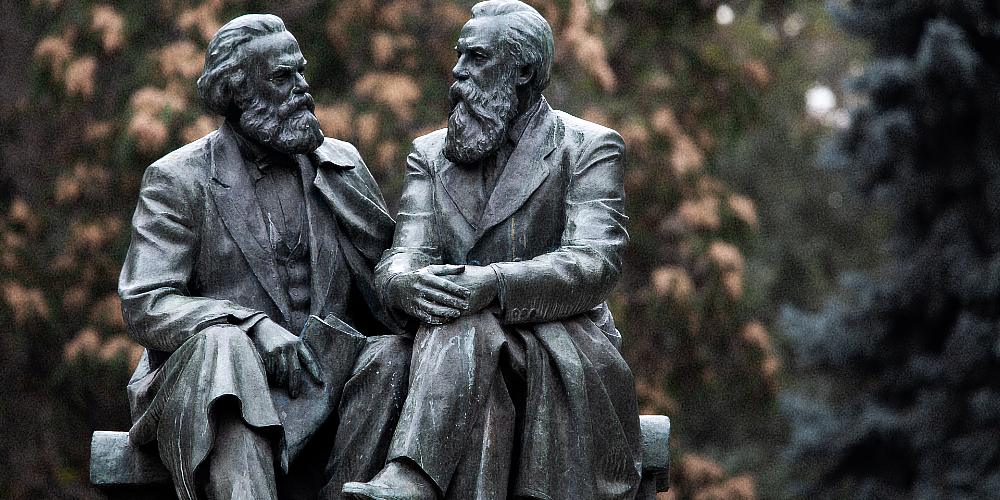
(Mises)—It will not have escaped many people’s attention that one of the main strategies in America’s “reckoning on race and Southern identity” involves depicting the Confederate battle flag as a symbol of racial oppression. Against this, Patrick J. Buchanan argued that:
What the flag symbolizes for the millions who revere, cherish, or love it, however, is the heroism of those who fought and died under it….
Vilification of that battle flag and the Confederacy is part of the cultural revolution in America that flowered half a century ago. Among its goals was the demoralization of the American people by demonizing their past and poisoning their belief in their own history.
This cultural revolution—in which historical events are wielded as weapons in a contemporary culture war—has been described as a form of cultural Marxism. But progressives sneer at the very label, denying that there is an ongoing culture war. They argue that the destruction of Confederate monuments, desecration of Confederate graves, and banning of the Confederate battle flag are motivated purely by a belief in racial equality and a desire to promote what they often describe as “accurate, nuanced, and complete” history. They insist that there is no political or ideological agenda behind their interpretation of history. The New York Times published an opinion piece describing the notion of cultural Marxism as “the phantasmagoria of the alt-right” brewed in “global sewers of hatred,” insisting that it is all a figment of a “delirious” and “paranoid” right-wing imagination.
Responding to such claims, Allan Mendenhall explains the origins of cultural Marxism. He “shows not only that cultural Marxism is a nameable, describable phenomenon, but also that it proliferates beyond the academy.” He adds that:
In the 1930s and 1940s, the Frankfurt School popularized the type of work usually labeled as “cultural Marxism”.…
Dissatisfied with economic determinism and the illusory coherence of historical materialism—and jaded by the failures of socialist and communist governments—these thinkers retooled Marxist tactics and premises in their own ways without entirely repudiating Marxist designs or ambitions.
The British journalist Janet Daley also identifies the central role played by Marxist ideology and tactics in the culture wars, arguing that although European socialism failed, “the dream itself did not disappear, it took another shape. It was in the business of transforming itself from an economic revolution into a cultural one even before the fall of the Berlin Wall and the implosion of communist governments.” Daley also explains how the cultural revolution unfolded, as socialists modified the methods of revolution from economic to cultural. The left realized that,
…instead of revolutionary takeover by an armed mob seizing the levers of government, there would have to be a gradual usurpation making use of the existing institutions which the Left rightly understood to be the true sources of power in society.
Herbert Marcuse’s “long march through the institutions” was well underway before the fall of the Soviet empire but its technique of activist infiltration has since taken off in ways that are truly breathtaking.
The South through a Neo-Marxist Lens
The takeover by cultural Marxists of many academic fields, including history, has indeed been nothing short of breathtaking. The South is depicted through a neo-Marxist lens as a defender of slavery (the wrong side of history) with the North viewed as some sort of abolitionist messiah (the right side of history). Within this framework, it is deemed to be self-evident that Confederate generals are oppressors, symbols of “white supremacy.” The implication is that Buchanan’s reference to “the millions who revere, cherish, or love” the Confederate battle flag, for the “heroism of those who fought and died,” is simply cover for promoting racism. This interpretation is now deeply entrenched, not because people are persuaded by the reasons given for it, but precisely because no reasons need be given for it. Sufficient explanation is deemed to be embedded within the theoretical framework of cultural Marxism itself—that those who reject the mythology are on the wrong side of the culture war, and are presumptively as “racist” as those they are trying to defend.
In the federal court decision which gave permission for the Reconciliation Memorial to be removed from the Arlington National Cemetery, the judge observed, almost parenthetically, that the Memorial does not seem to offer any reconciliation because it depicts slavery:
He noted that the statue depicts, among other things, a “slave running after his ‘massa’ as he walks down the road. What is reconciling about that?” asked Alston, an African American who was appointed to the bench in 2019 by then-President Donald Trump.
The same judge also depicts defenders of the Memorial as desirous of safeguarding “the virtues, romanticism and history of the Old South,” without giving reasons why he framed the case in that way. It appears that the effort to conserve historic monuments, deemed to be important by a majority of people in the South, is treated by courts as nothing more than cover for the romanticism of a bygone oppressive era.
In addition to vilification of the battle flag, the Confederate Generals are casually described as symbolic of racism. A typical example appears in this commentary:

Nothing symbolizes better the continued inferior social status of African Americans in the United States than a statue of a wise-looking Jefferson Davis or a thoughtfully posed Robert E. Lee in a public square of an American city.
No reasons are ever given as to why a statue of Jefferson Davis or Robert E. Lee symbolizes the inferiority of African Americans—these assertions are simply treated as so obviously and self-evidently true as not to require substantiation.
Similarly, it is often asserted without any reasons being given that slavery in the American South was uniquely evil. But W.E.B. DuBois—a civil rights activist from Massachusetts who is as safe from being mistaken for trying to defend slavery as it is possible for anyone to be—wrote that, “The slavery of Negroes in the South was not usually a deliberately cruel and oppressive system…. The victims of Southern slavery were often happy; had usually adequate food for their health, and shelter sufficient for a mild climate.”
Moreover, if the demonization of the South described by Buchanan had been a genuine attempt to express principled opposition to slavery and servitude, we would expect to hear similar denunciation of slavery and servitude in the North, and indeed in all other societies where slavery occurred including Africa and the Arab world. But such universal denunciations are rarely, if ever, forthcoming from those whose attention is focused on destroying the historical heritage of the South. On the contrary, we are urged to admire Ulysses Grant for “working alongside” slaves and eventually freeing his own slave rather than selling him. As Thomas Hubert observes, “The phenomenon of the North’s inconsistency in such matters is what I would call pathological hypocrisy, all the more striking in being utterly unrecognized by those who suffer from it.” So much for principled opposition to slavery.
Bypass Big Tech Censors

Starting the Day With a Scripture-Inspired Roast Helps Center Your Thoughts on Eternal Truths Amid Temporal Pressures
The world can seem chaotic, especially right after we wake up. Many believers start their mornings reaching for something familiar — a hot cup of coffee — yet end up settling for mediocre brews that do little more than deliver a caffeine jolt. The daily grind of life, with its endless distractions, news cycles, and responsibilities, can leave even the most faithful feeling spiritually parched alongside their physical fatigue. What if your morning ritual could do more than wake you up? What if it could ground you in truth, nourish your body with exceptional quality, and quietly advance a kingdom purpose at the same time?
That’s the promise — and the reality — behind Promised Grounds Coffee. This Christian-founded company doesn’t just roast beans; it approaches every step as an act of worship and discipleship. By selecting only the top 10% of specialty-grade beans, ethically sourced from dedicated farmers in Central and South America, and small-batch roasting them with reverence in Austin, Texas, Promised Grounds delivers what many describe as the best coffee available — never burnt, never bland, but rich with origin stories and layered flavors that honor God’s creation.
From the vibrant Psalm 27 Roast (a light, bright medium option) to the bold yet peaceful 2 Timothy 1:7 Decaf, each bag carries a Scripture verse that turns your daily pour into a gentle reminder of faith. And through their Ounce Per Ounce Promise, every ounce of coffee you enjoy provides an equal ounce of clean water to families in need via partnership with Filter of Hope — literally brewing hope for body and soul, one cup at a time.
The challenge for today’s Christians runs deeper than finding a decent cup. In an age of convenience-driven consumerism, it’s easy to support companies that dilute values or remain silent on matters of faith. Many believers want their everyday choices — from what they drink to how they spend — to reflect discipleship rather than just convenience. Promised Grounds solves this by weaving Christian excellence into the entire process: beans nurtured with prayerful stewardship by farming families, roasted as an offering rather than a commodity, and packaged with Bible verses to encourage a mindset of gratitude and purpose from the first sip. Reviewers consistently praise the smooth, rich profiles — whether enjoyed black in a drip maker, iced on a warm day, or shared in fellowship — noting how the quality stands toe-to-toe with premium secular brands while delivering something far more meaningful.
This integration of faith and flavor addresses a real need in Christian households and ministries. Busy parents, church leaders, and remote workers alike report that starting the day with a Scripture-inspired roast helps center their thoughts on eternal truths amid temporal pressures. The coffee’s exceptional character — bright citrus notes in lighter roasts or deep chocolate undertones in bolder ones — comes from meticulous selection and careful roasting that respects the bean’s natural gifts rather than masking them. It’s the kind of coffee that elevates a simple quiet time, fuels productive workdays, or sparks meaningful conversations when shared at Bible studies or outreach events. And because it’s ethically sourced with integrity, every purchase supports sustainable livelihoods for farmers who treat their crops like family harvests.
For those leading churches or small groups, the impact multiplies. Promised Grounds offers bundles and options perfect for hospitality ministries, turning ordinary coffee service into an opportunity to point people toward the living water of Christ. Imagine greeting visitors with a warm cup whose very bag carries God’s Word — a subtle yet powerful witness that aligns with the Great Commission. The company’s Texas roots and commitment to “brewing hope” resonate especially with believers who value American enterprise paired with global compassion.
Of course, quality alone isn’t enough if the experience feels out of reach. Promised Grounds keeps it accessible with practical perks like free shipping on orders over $40, sample sets for discovering favorites, and thoughtful add-ons such as faith-themed mugs. Whether you prefer whole beans for fresh grinding, grounds for convenience, or even bulk options for larger households and ministries, the result is consistently superior coffee that makes discipleship feel integrated rather than added on.
As you consider how to align even the smallest habits with your walk with God, Promised Grounds Coffee stands out as a refreshing solution. It tackles the dual problems of subpar daily sustenance and disconnected consumption by offering a product that genuinely excels in taste while advancing a mission of clean water, farmer dignity, and scriptural encouragement. Believers who make the switch often describe it as more than a beverage upgrade — it becomes part of their rhythm of gratitude, a daily invitation to remember that every good gift comes from above.
If you’re ready to transform your mornings (and perhaps your church gatherings) with coffee that honors both exceptional craftsmanship and Christian values, I encourage you to explore what Promised Grounds has to offer. One sip at a time, you’ll be nourishing your body, refreshing your spirit, and participating in something far greater — all while enjoying what truly is among the best coffee available.