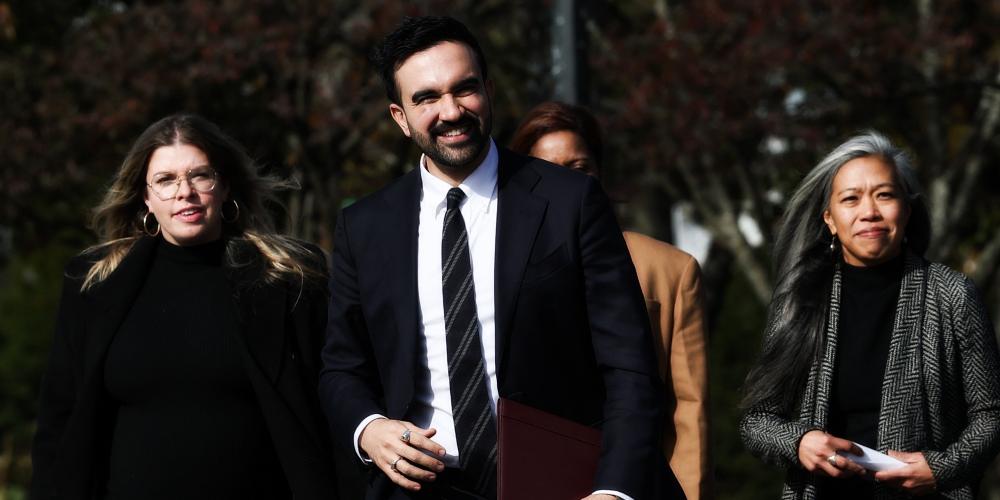
(Daily Signal)—Speculation swirls over New York City’s incoming socialist Mayor Zohran Mamdani and whether he will be “rational” or a radical once he’s in office.
While that matter is yet to be settled, a review of Mamdani’s transition team indicates that, at the moment, it may be best to bet on radical or maybe just wildly irresponsible and incompetent.
On Tuesday, Fox New Digital reported that Mamdani had “appointed a convicted armed robber” to advise him on the criminal justice system. Mysonne Linen had been in prison for seven years after he committed a string of violent robberies in the 1990s.
Mamdani defended the appointment.
“We put together a team of more than 400 New Yorkers who are on 17 different committees, and these are New Yorkers who bring with them both a fluency of the policies and politics of the city, the places that they’ve succeeded, the places that they’ve failed, and we will take all of their experiences and their analysis into account as we build a city for each and every person,” he said to Fox News.
It should be no surprise then that that team of 400 is filled with mostly a combination of staffers from the disastrous administration of former New York Mayor Bill de Blasio, another far-left figure, and a whole lot of extreme folks.
It’s worth pointing out the backgrounds of just a few of the people on Mamdani’s list.
Alex Vitale
Despite the fact that Mamdani called for defunding the NYPD in 2020, saying on X that they are “racist, anti-queer & a major threat to public safety,” he changed his tune on the campaign trail. Mamdani insisted that he no longer wanted to defund the police, quite convenient given the idea’s now radioactive poll numbers, but instead wanted to fund more social workers who would respond to 911 calls.

Keeping the competent NYPD commissioner Jessica Tisch at her post is a good thing as long as that lasts, but Mamdani was likely showing his true colors with the appointment of Alex Vitale to his Committee on Public Safety.
Vitale literally wrote the book on police abolition. He wrote “The End of Policing” in 2017. Here’s a snippet of what it’s about, from Fox News: “The book, which opens by explaining that police don’t exist to help citizens, argues for an end to traditional policing for certain criminal activity, including narcotics use, prostitution, patrolling borders and ‘misbehaving adolescents.’ The book also argues that police shouldn’t combat street gangs.”
In addition, Vitale argued that policing the border is racist. In fact, he wrote that basically all policing is racist in America.
“Racism in policing is structural, not simply a product of bad attitudes,” the book notes. “Training officers to recognize implicit bias without changing what they are tasked with enforcing is like teaching a soldier to be sensitive while sending him to occupy a foreign country.”
Tamika Mallory
Remember the “Women’s March” of pink hat-wearing women that was sort of like the “No Kings” protests of President Donald Trump’s first term?
I’ll forgive you if you’ve forgotten. The movement collapsed and was seemingly memory holed by the legacy media after it was revealed that several founding members of the protest group had been accused of antisemitism.
Well, one of the accused is back and on Mamdani’s transition team: Tamika Mallory.
Mamdani also appointed Mallory to the Committee on Public Safety, despite or perhaps because she had called for defunding and perhaps, on that beautiful day when human nature wholly changes, outright abolishing the police.
Mallory has been a longtime admirer of the Nation of Islam’s Louis Farrakhan, and once called him the “GOAT,” or “greatest of all time.’” She did somewhat qualify her admiration for Farrakhan, however, saying in a 2019 interview with “The View,” “I didn’t call him the greatest of all time because of his rhetoric. I called him the greatest of all time because of what he’s done in black communities.”
Kassandra Frederique
It’s hard to stop pointing out members of the now oxymoronic “Committee on Public Safety,” but it really is stuffed with some fringy folks.
Kassandra Frederique is the head of the Drug Policy Alliance and is now a member of this esteemed body. Like that old, and not quite accurate joke about the Opium War, her organization isn’t for curtailing drug use, it’s fighting on the side of the drugs. Frederique and her organization are against “prohibition” of basically any drug, no matter how destructive.
When asked in an interview how she felt when she heard of celebrities dying of drug overdoses she said, “As someone who is an abolitionist and also works to be a drug policy reformer, every day I have to fight the prohibitionists inside of me.”

She continued: “When I heard that Whitney Houston passed, when I heard that Prince passed, you know, yesterday when I heard Michael K. Williams passed, it was a blow. And I go through my own existential crisis about like what am I doing? Is this, am I on the right side? I always come back to the point that the work that I do, the things that I believe in are right.”
? Mamdani “Community Safety” Pick Says Some Revolutionaries “Need To Be High” To “Take Over The State”
Meet Kassandra Frederique, head of the Drug Policy Alliance and now a member of Zohran Mamdani’s Committee on Community Safety.
In this interview about overdose deaths like… pic.twitter.com/UubI49FZkL
— Stu Smith (@thestustustudio) November 26, 2025
I hate to keep citing memes here, but she seems to be saying, “Am I out of touch? No, it is the children who are wrong.”
Her organization was reportedly “integral” to the decriminalization of hard drugs in Oregon in 2020, a policy so immediately catastrophic that even Democrats in the state backed repealing the law.
Those who don’t learn from history may be doomed to repeat it, but it appears that some who made those mistakes in history are also liable to learn nothing and repeat them.
Good luck, New York.
Demetre Daskalakis
Dr. Demetre Daskalakis already drove one brief news cycle as of late when he resigned from the Centers for Disease Control and Prevention in late August due to conflicts over vaccinations with Health and Human Services Secretary Robert F. Kennedy Jr. He was President Joe Biden’s monkeypox czar.

Here’s how The Washington Free Beacon’s Jon Levine recently described Daskalakis: “New York City mayor-elect Zohran Mamdani’s public health brain trust includes an accused Satanist who advised former president Joe Biden on the 2022-2023 monkeypox outbreak, the architect of the Empire State’s race-based COVID-19 policies, and a former city official who denied the NYPD’s request for masks during the pandemic.”
Daskalakis essentially refused to recommend a cessation of the behavior that would allow the transition of monkeypox that in most cases happened between gay men. He said in 2023 that the administration would make, “sure [they] got the word out in a way that supports people’s joy, as opposed to calling them ‘risky.’”
Biden monkeypox advisor Demetre Daskalakis says the Biden administration aims to “support peoples’ joy as opposed to calling them ‘risky'”:
“One person’s idea of risk is another person’s idea of a great festival or Friday night.” pic.twitter.com/nKsRQNmOwY
— RNC Research (@RNCResearch) June 18, 2023
I’d post more about Daskalakis here, but this is a family-friendly website.
Rabbi Abby Stein
Mamdani’s transition team features a far-Left, anti-Israel transgender rabbi, who has been placed the Committee on Public Health.
Abby Stein was a prominent supporter of Mamdani’s campaign. He appeared in an ad with female rabbis making the case that Mamdani would help New York.
WATCH:
The Free Beacon tracked down the “rabbis” from Zohran Mamdani’s new “Jews for Zohran” ad campaign.
You won’t believe it, but one of them, “Rabbi” Abby Stein, is a transgender rabbi who was booted from a Biden White House shindig for disrupting the event with demands to… pic.twitter.com/TLV0h0KvMA
— Washington Free Beacon (@FreeBeacon) October 28, 2025
“We know Zohran will fight to make our city affordable and safe for our families,” Stein said in the ad. “As Jews, as rabbis, as New Yorkers, we believe that all people deserve to thrive. Zohran agrees.”

Stein has been controversial even among Democrats. He said that he had been kicked out of the White House in 2024 after hectoring first lady Jill Biden about creating a ceasefire in Gaza.
Bypass Big Tech Censors
Two Storms, One Harvest

Every food crisis in living memory has been a one-shock event. The 2008 price spike was a commodity bubble. The 2020 shortages were a logistics failure. The 2022 grain scare was a war on one exporter’s ports. Each time, the system bent, adjusted, and recovered, and each time the experts assured us afterward that global markets are simply too big and too diversified to fail.
What nobody in Washington seems eager to discuss is that 2026 is shaping up to be something the modern food system has never actually faced. Two independent shocks, one climatic and one geopolitical, are converging on the same harvest cycle at the same time. Not sequentially. Simultaneously.
Start with the weather. The Pacific Ocean is currently building toward what forecasters now openly call a record event. NOAA’s Climate Prediction Center puts the odds of at least a strong El Niño near 88 percent, with roughly two in three odds it reaches “very strong” status, the tier reserved for perhaps three or four events in the entire satellite era. Every major global model now projects a median peak in Super El Niño territory, and most of them project it exceeding the 2015-16 event, which until now held the modern record. Sea surface anomalies were already brushing the super threshold in mid-July, months before these events normally peak. The atmosphere has already shifted into El Niño mode, and the event is forecast to crest in late fall and early winter.
This is not about “climate change.” It’s about the standard cycles of weather, and the cycle we’re currently in is one that has likely devastated societies in the past. We’re better prepared as a society today, but not all Americans are equally prepared.
Serious households have started doing the quiet math on their own. Grocery bills tell part of the story, and the forecast maps tell the rest, which is why long-term food storage has moved from fringe hobby to mainstream line item in the family budget, with established suppliers like Heaven’s Harvest seeing demand from people who five years ago would have rolled their eyes at the idea. That instinct is not paranoia. It is pattern recognition, and the pattern is worth walking through carefully.
Editor’s Note: Heaven’s Harvest IS a sponsor, but the warnings of this article are real and would be written even if we didn’t have a survival food sponsor. With that said, those who take advantage of what they offer can use promo code “Patriot” for 15% off.
The Fertilizer Clock Is Already Running
While the Pacific warms, the second shock has been unfolding in the Strait of Hormuz. The conflict with Iran turned the world’s most important energy chokepoint into a contested waterway, and the consequences reach far beyond the gas pump. Roughly a third of global fertilizer trade moves through Hormuz, and the disruption sent urea prices up 86 percent year over year by March, with a 53 percent jump in a single month.
The World Bank projects energy prices rising about 24 percent in 2026 and fertilizer about 31 percent. By its own accounting, fertilizer prices ran 35 percent higher in the first five months of this year than the same period last year.
Here is the mechanism the nightly news will not explain. Fertilizer is not a grocery item. It is a time-delayed input. The nitrogen a farmer in Iowa or Punjab could not afford to apply this spring does not show up as a problem this spring. It shows up as a thinner harvest six to twelve months later.
The World Bank’s own food security brief concedes that the effects of reduced applications earlier this season “are likely to become visible only later in harvest outcomes.” Translate that from institutional language into plain English and it means this. The damage is already done, it is already in the ground, and we are simply waiting for it to arrive on the shelf.
Now check the calendar. Six to twelve months from the spring planting season lands us squarely in late 2026 and early 2027. Which is precisely when the strongest El Niño in the instrumental record is forecast to peak, bringing its signature droughts to Southeast Asia, Australia, southern Africa, northern Brazil, and South Asia, the very regions that grow the world’s rice, sugar, and oilseeds.
The World Bank warns openly that a strong El Niño “could disrupt multiple crop belts simultaneously” on top of the conflict-driven input costs. Their baseline projection assumes the Middle East disruptions ease by autumn. What in the last two years of Middle East history suggests that assumption is safe?
The System Has No Slack Left
The comfortable answer is that global markets always adjust. But adjustment requires slack, and the slack is gone. Global cereal production is expected to decline from last year’s records even before El Niño does its work. The UN World Food Programme, hardly a den of right-wing preppers, is calling this the most significant disruption to its supply chains since Covid and the invasion of Ukraine, and its supply chain director put the stakes bluntly.
Today’s supply chain challenges are tomorrow’s hunger crisis.
There is also a political dimension that markets cannot price. When food gets scarce, governments do not behave like economists. They behave like politicians. Export bans, hoarding mandates, and panic buying at the national level turned the modest rice shortfall of 2008 into a global crisis, and analysts are already warning that import-dependent nations are the first dominoes.
The 2015-16 Super El Niño, a far weaker event than what is now forecast, threw tens of millions into food stress across Africa and Asia. This one is projected to be stronger, and it arrives with fertilizer already rationed by price and shipping lanes already contested by missiles.
What Joseph Knew
Scripture does not treat preparation for lean years as faithlessness. It treats it as wisdom delivered in advance to those willing to act on it.
Behold, there come seven years of great plenty throughout all the land of Egypt: And there shall arise after them seven years of famine; and all the plenty shall be forgotten in the land of Egypt.
Joseph did not respond to that warning with a hashtag or a committee. He stored grain during the years of abundance, and when the famine came, Egypt stood while its neighbors begged. The lesson is not that famine is certain. It is that the time to prepare is precisely when preparation still looks optional.
Nobody who filled a pantry in a year of plenty has ever regretted it, and nobody standing in an empty aisle has ever been glad he waited for certainty.
None of this calls for panic, and panic is the enemy of sound judgment anyway. It calls for the same unglamorous prudence our grandparents considered ordinary. Keep some cash margin, know your local growers, and put real food in deep storage while it is cheap and available, because the entire arc of this story is that cheap and available is a closing window.
Families looking for a straightforward place to start can visit Heaven’s Harvest and use promo code Patriot for 15 percent off long-term storable food. The forecasts may yet soften, the strait may yet reopen, and we should pray they do. But hope is a fine thing to hold and a foolish thing to eat.