(The Economic Collapse Blog)—Why does the U.S. just continue to get pummeled by historic storm after historic storm? We keep being told that what we are witnessing is “normal”, but there is definitely nothing “normal” about any of this. A couple of decades ago, it was extremely rare for the U.S. to be hit by a “billion dollar disaster”, but over the past couple of years we have been averaging a “billion dollar disaster” about every two weeks. The American people deserve the truth, because people are dying.
Most of the people that just died in Texas were caught totally by surprise by the floods.
The National Weather Service had warned that rain was coming, but a top Texas official is admitting that the actual amount of rain that ultimately fell “was never in any of those forecasts”…
“The original forecast that we received Wednesday from the National Weather Service predicted 3-6 inches of rain in the Concho Valley and 4-8 inches in the Hill Country,” said Texas Emergency Management Chief W. Nim Kidd at a press conference Friday. “The amount of rain that fell at this specific location was never in any of those forecasts.”
Sudden thunderstorms dumped more than 10 inches of rain on the area, causing heavy flooding from the Guadalupe River.
Dalton Rice, the city manager for Kerrville, Texas—who also spoke at the press conference—said that the catastrophic flash flooding happened because the skies “dumped more rain than what was forecasted” on two of the river’s forks.
At one point, 7 inches of rain fell in a three hour period.
As USA Today has noted, 7 inches of rain is “nearly 122 million gallons of water per square mile”…
On July 4, rain was falling at 3-4 inches per hour, with some locations recording a deluge of up to 7 inches of rain in just three hours, the National Weather Service said. Seven inches of rain is nearly 122 million gallons of water per square mile. Over 7 square miles that’s enough water to fill the AT&T Stadium, home of the Dallas Cowboys.
I have a hard time even imagining that much water.
As water relentlessly poured from the sky, the Guadalupe River “rose from about one foot to more than 36 feet” in just 3 hours…
Reports from the U.S. Geological Survey show the waters of the Guadalupe rose from about one foot to more than 36 feet between 2 a.m. and 5 a.m. Friday morning. The wall of water sharply increased at 5:15 a.m. when it spiked from 1.82 feet to 36 feet an hour and a half later.
In my entire lifetime, I have never seen anything like this.

In the middle of the night, rushing waters suddenly arrived without any warning, and many victims never even had a chance.
According to the Daily Mail, the final death toll is expected to be above 100…
Texas’s Division of Emergency Management predicted the number of dead as a result of catastrophic flooding in Kerrville on July 4 would top 100, Daily Mail can exclusively reveal.
In an email sent out Saturday, the state disaster office told partners the number of dead would surpass 100, two different sources confirmed to Daily Mail.
The estimate of the dead is vastly different than the message state officials are projecting publicly, insisting that they are still searching for people who are alive, and refusing to say rescue efforts have shifted to recovery of remains.
In the midst of this great tragedy, there were heroes that were willing to give everything in order to save others.
27-year-old Julian Ryan and his family were sleeping when the floodwaters hit their trailer.
As the waters rose to waist height, Ryan’s two young children were put on a mattress that was floating, but the waters just continued to rise.
That was when Julian decided that the only way that he could save his family would be to break the window…
With no escape route, Julian looked to the only option: the window.
He punched through the glass, but the broken edges almost cut his arm clean off, Christinia told KHOU, and severed an artery.
As blood poured from Julian’s limb, the other two adults tried calling 911 – but nobody came.
Julian knew that he wasn’t going to make it, and with his dying words he expressed his love for his family.
Thankfully, Julian’s sacrifice was not in vain because his family was able to miraculously escape…
Julian was losing consciousness from blood loss and the water had risen up to their chins.
With his dying words, Julian told his family: “I’m sorry, I’m not going to make it. I love y’all.”
Christinia said the trailer was eventually broken in half by the force of the currents – allowing the rest of the family to escape.
70-year-old Richard Eastland is another hero that gave his life during this great tragedy.
His family has been running Camp Mystic since 1974, and he did all that he could to save campers from the floodwaters…
The director of Camp Mystic was killed while trying to save girls from the horrific flooding that swept through the Texas summer camp.
Richard ‘Dick’ Eastland, 70, died while trying to rescue campers from the biblical rushing waters that struck the state on July 4.
At least 11 girls and one counselor are missing from Camp Mystic in Hunt, Texas, and five of their fellow campers have died after the rushing waters destroyed the all-girls private Christian summer camp.
Richard Eastland will be remembered as a hero.
According to one former camper, it wasn’t a surprise “that his last act of kindness and sacrifice was working to save the lives of campers”…

The Eastlands have owned and operated Camp Mystic since 1974, and many viewed him as a father figure at the camp.
‘It doesn’t surprise me at all that his last act of kindness and sacrifice was working to save the lives of campers,’ The Kerrville Daily Times guest columnist Paige Sumner said in a tribute to Eastland.
‘Dick was the father figure to all of us while we were away from home at Camp Mystic for six weeks.
‘He was the father of four amazing boys, but he had hundreds of girls each term who looked up to him like a dad. I would never have taken a fishing class if it wasn’t taught by my new friend Dick.’
There is no greater love than laying down your life for others.
But could this great tragedy have been avoided in the first place?
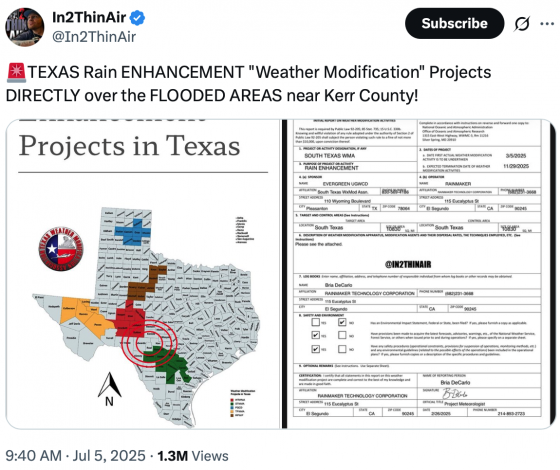
Many on social media are pointing out that “rain enhancement projects” have recently been conducted in Texas. Needless to say, we need answers from those that were involved in those projects.
Humanity should never mess with the weather.
Hopefully some new laws will get passed as a result of everything that we just witnessed.
Unfortunately, the disasters aren’t going to stop any time soon.

In fact, a tropical storm could soon bring “severe weather” to Washington D.C., New York City and Boston…
With deadly Texas flooding dominating headlines this weekend, we now shift focus to Tropical Storm Chantal, which made landfall near Myrtle Beach, South Carolina, early Sunday. This marks the first tropical storm to make landfall in the 2025 Atlantic hurricane season—and the earliest to do so since 2022.
Chantal is the third tropical storm of this year’s hurricane season, following Andrea and Barry, both of which formed in June. The new storm appeared on our radar Friday, with spaghetti models showing a potential path up the U.S. East Coast, through parts of the Mid-Atlantic, and possibly over southern New Jersey and New York City.
Updated spaghetti models posted by meteorologist Ben Noll on X show a strong level of confidence in Chantal’s track into the Mid-Atlantic and Northeast, where severe weather could be seen next from D.C. to New York and Boston.
We just keep getting hit by one major disaster after another.
You would think that most of the population would have figured out that something has gone terribly wrong after everything that we have been through over the past few years.
What we are experiencing is not even close to “normal”, and it is time to start demanding some answers.
Michael’s new book entitled “10 Prophetic Events That Are Coming Next” is available in paperback and for the Kindle on Amazon.com, and you can subscribe to his Substack newsletter at michaeltsnyder.substack.com.
Bypass Big Tech Censors

Starting the Day With a Scripture-Inspired Roast Helps Center Your Thoughts on Eternal Truths Amid Temporal Pressures
The world can seem chaotic, especially right after we wake up. Many believers start their mornings reaching for something familiar — a hot cup of coffee — yet end up settling for mediocre brews that do little more than deliver a caffeine jolt. The daily grind of life, with its endless distractions, news cycles, and responsibilities, can leave even the most faithful feeling spiritually parched alongside their physical fatigue. What if your morning ritual could do more than wake you up? What if it could ground you in truth, nourish your body with exceptional quality, and quietly advance a kingdom purpose at the same time?
That’s the promise — and the reality — behind Promised Grounds Coffee. This Christian-founded company doesn’t just roast beans; it approaches every step as an act of worship and discipleship. By selecting only the top 10% of specialty-grade beans, ethically sourced from dedicated farmers in Central and South America, and small-batch roasting them with reverence in Austin, Texas, Promised Grounds delivers what many describe as the best coffee available — never burnt, never bland, but rich with origin stories and layered flavors that honor God’s creation.
From the vibrant Psalm 27 Roast (a light, bright medium option) to the bold yet peaceful 2 Timothy 1:7 Decaf, each bag carries a Scripture verse that turns your daily pour into a gentle reminder of faith. And through their Ounce Per Ounce Promise, every ounce of coffee you enjoy provides an equal ounce of clean water to families in need via partnership with Filter of Hope — literally brewing hope for body and soul, one cup at a time.
The challenge for today’s Christians runs deeper than finding a decent cup. In an age of convenience-driven consumerism, it’s easy to support companies that dilute values or remain silent on matters of faith. Many believers want their everyday choices — from what they drink to how they spend — to reflect discipleship rather than just convenience. Promised Grounds solves this by weaving Christian excellence into the entire process: beans nurtured with prayerful stewardship by farming families, roasted as an offering rather than a commodity, and packaged with Bible verses to encourage a mindset of gratitude and purpose from the first sip. Reviewers consistently praise the smooth, rich profiles — whether enjoyed black in a drip maker, iced on a warm day, or shared in fellowship — noting how the quality stands toe-to-toe with premium secular brands while delivering something far more meaningful.
This integration of faith and flavor addresses a real need in Christian households and ministries. Busy parents, church leaders, and remote workers alike report that starting the day with a Scripture-inspired roast helps center their thoughts on eternal truths amid temporal pressures. The coffee’s exceptional character — bright citrus notes in lighter roasts or deep chocolate undertones in bolder ones — comes from meticulous selection and careful roasting that respects the bean’s natural gifts rather than masking them. It’s the kind of coffee that elevates a simple quiet time, fuels productive workdays, or sparks meaningful conversations when shared at Bible studies or outreach events. And because it’s ethically sourced with integrity, every purchase supports sustainable livelihoods for farmers who treat their crops like family harvests.
For those leading churches or small groups, the impact multiplies. Promised Grounds offers bundles and options perfect for hospitality ministries, turning ordinary coffee service into an opportunity to point people toward the living water of Christ. Imagine greeting visitors with a warm cup whose very bag carries God’s Word — a subtle yet powerful witness that aligns with the Great Commission. The company’s Texas roots and commitment to “brewing hope” resonate especially with believers who value American enterprise paired with global compassion.
Of course, quality alone isn’t enough if the experience feels out of reach. Promised Grounds keeps it accessible with practical perks like free shipping on orders over $40, sample sets for discovering favorites, and thoughtful add-ons such as faith-themed mugs. Whether you prefer whole beans for fresh grinding, grounds for convenience, or even bulk options for larger households and ministries, the result is consistently superior coffee that makes discipleship feel integrated rather than added on.
As you consider how to align even the smallest habits with your walk with God, Promised Grounds Coffee stands out as a refreshing solution. It tackles the dual problems of subpar daily sustenance and disconnected consumption by offering a product that genuinely excels in taste while advancing a mission of clean water, farmer dignity, and scriptural encouragement. Believers who make the switch often describe it as more than a beverage upgrade — it becomes part of their rhythm of gratitude, a daily invitation to remember that every good gift comes from above.
If you’re ready to transform your mornings (and perhaps your church gatherings) with coffee that honors both exceptional craftsmanship and Christian values, I encourage you to explore what Promised Grounds has to offer. One sip at a time, you’ll be nourishing your body, refreshing your spirit, and participating in something far greater — all while enjoying what truly is among the best coffee available.