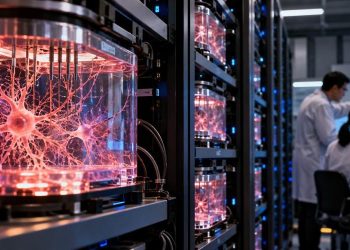
(End of the American Dream)—We live at a time when technology is increasing at a faster pace than we have ever seen before in all of human history. But is humanity equipped to handle the extremely bizarre technology that we are now developing? Earlier this month, I discussed some of the frightening ways that AI is changing our society. Today, I want to focus on nanotechnology. This is a field where extraordinary advances are being made on a regular basis, and we are being told that nanotechnology is already “revolutionizing myriad industries”…
Nanotechnology, a cutting-edge discipline at the intersection of science, engineering, and technology, is revolutionizing myriad industries with its focus on manipulating matter at the nanoscale. At this minuscule level, materials exhibit unique properties and behaviours, paving the way for unprecedented advancements in fields as diverse as medicine, electronics, energy, and materials science.
A “nanoparticle” is a particle of matter that is less than 100 nanometers in diameter. Highly specialized equipment is necessary to work with nanoparticles, because they are way too small to be seen with the naked eye…
One of the hallmarks of nanotechnology is the utilization of nanoparticles, minute entities often ranging from 1 to 100 nanometers. These particles, when engineered with precision, bring forth distinctive characteristics that can redefine the functionality of materials. In medicine, for instance, nanoparticles serve as drug carriers, enabling targeted delivery and enhancing therapeutic efficacy while minimizing side effects. Nano-engineered materials have found their niche in the realm of electronics.
Scientists are promising us that nanotechnology has the potential to make all of our lives much better.
But are there any dangers?
Many are concerned that the healthcare industry is one area where nanoparticles are already being used on a widespread basis…
The healthcare sector is witnessing a transformative impact through nanotechnology. Nanomedicine, an interdisciplinary field, employs nanoscale tools for the diagnosis, imaging, and treatment of diseases. Nanoparticles, with their ability to navigate biological barriers, offer a novel approach to targeted drug delivery, ensuring precise and efficient treatment with reduced side effects.
“Precise and efficient treatment with reduced side effects” certainly sounds good.
But there have been other developments in this field that are rather ominous.
For example, a team of researchers in South Korea has discovered a way to use nanoparticles to “control the minds of mice”…

Scientists at the Institute for Basic Science (IBS) in South Korea have developed a new way to control the minds of mice by manipulating nanoparticle-activated “switches” inside their brains with an external magnetic field.
The system, dubbed Nano-MIND (Magnetogenetic Interface for NeuroDynamics), works by controlling targeted regions of the brain by activating neural circuits.
Using an external magnetic field, these scientists were able to make mice eat more or eat less. And in another experiment, they were able to manipulate the maternal behavior of female mice…
In experiments, the researchers activated inhibitory neurons within specific areas of the brain to increase appetite and feeding behaviors by 100 percent. By exciting these neurons, the team could conversely reduce the food the mice ate by 50 percent.
They also used the system to selectively activate receptors responsible for maternal behaviors in the brains of female mice that hadn’t reproduced. By activating these pathways, the mice “significantly increased nurturing behaviors, such as bringing pups to their nest, similar to maternal mice,” according to a press release.
Of course this is just the tip of the iceberg.
If they can control the minds of mice, it is inevitable that research will be done into how to control human minds.
So what would happen if scientists develop “nanoparticles” that have the ability to search out and attach themselves to key areas of the human brain?
Such “nanoparticles” would be far too small to be seen by the human eye, and people could become “infected” with these “nanoparticles” without even knowing it.
In fact, if a tyrannical government could find an effective way to use nanoparticles to remotely control the minds of the general population, a mass mind control program could be implemented without the general public even realizing what is going on.
If that sounds very frightening to you, that is because it is very frightening.
Sadly, most of us don’t even realize that there are nanoparticles in many common foods that we eat on a regular basis…
Among the foods most likely to have nano-tech: Foods with caramelized sugar, nutritional supplements, toothpastes, gums, M&Ms, Jello Banana Cream Pudding, Pop Tarts, Mentos, Nestle Original Coffee Creamer, and even… purified water!
One of the scariest elements of the article isn’t that these pieces of nanotechnology are harmful to the human bodies. It’s that no one knows if they’re harmful. Testing has been nearly nonexistent. The FDA, the governing body we’ve put in charge to keep bad things from entering our bodies, doesn’t even have a list of foods that contain nanotechnology.
And most people don’t even realize that there are nanoparticles in many of the shots that we are encouraged to get.
In fact, this is an area that is being heavily researched. The following comes from an MIT article entitled “MIT scientists use a new type of nanoparticle to make vaccines more powerful”…
Many vaccines, including vaccines for hepatitis B and whooping cough, consist of fragments of viral or bacterial proteins. These vaccines often include other molecules called adjuvants, which help to boost the immune system’s response to the protein.
Most of these adjuvants consist of aluminum salts or other molecules that provoke a nonspecific immune response. A team of MIT researchers has now shown that a type of nanoparticle called a metal organic framework (MOF) can also provoke a strong immune response, by activating the innate immune system — the body’s first line of defense against any pathogen — through cell proteins called toll-like receptors.
In a study of mice, the researchers showed that this MOF could successfully encapsulate and deliver part of the SARS-CoV-2 spike protein, while also acting as an adjuvant once the MOF is broken down inside cells.
It doesn’t take much imagination to come up with a scenario in which the use of nanotechnology goes horribly wrong.
For example, have you seen a movie or a television show where self-replicating “nanobots” threaten to destroy everyone and everything in their path?

If we are not careful, such a scenario could someday become a reality.
Just like AI, nanotechnology is potentially an existential threat to the human race.
Our scientists should be proceeding with extreme caution, but unfortunately that simply isn’t happening.
Michael’s new book entitled “Why” is available in paperback and for the Kindle on Amazon.com, and you can subscribe to his Substack newsletter at michaeltsnyder.substack.com.
Bypass Big Tech Censors

Starting the Day With a Scripture-Inspired Roast Helps Center Your Thoughts on Eternal Truths Amid Temporal Pressures
The world can seem chaotic, especially right after we wake up. Many believers start their mornings reaching for something familiar — a hot cup of coffee — yet end up settling for mediocre brews that do little more than deliver a caffeine jolt. The daily grind of life, with its endless distractions, news cycles, and responsibilities, can leave even the most faithful feeling spiritually parched alongside their physical fatigue. What if your morning ritual could do more than wake you up? What if it could ground you in truth, nourish your body with exceptional quality, and quietly advance a kingdom purpose at the same time?
That’s the promise — and the reality — behind Promised Grounds Coffee. This Christian-founded company doesn’t just roast beans; it approaches every step as an act of worship and discipleship. By selecting only the top 10% of specialty-grade beans, ethically sourced from dedicated farmers in Central and South America, and small-batch roasting them with reverence in Austin, Texas, Promised Grounds delivers what many describe as the best coffee available — never burnt, never bland, but rich with origin stories and layered flavors that honor God’s creation.
From the vibrant Psalm 27 Roast (a light, bright medium option) to the bold yet peaceful 2 Timothy 1:7 Decaf, each bag carries a Scripture verse that turns your daily pour into a gentle reminder of faith. And through their Ounce Per Ounce Promise, every ounce of coffee you enjoy provides an equal ounce of clean water to families in need via partnership with Filter of Hope — literally brewing hope for body and soul, one cup at a time.
The challenge for today’s Christians runs deeper than finding a decent cup. In an age of convenience-driven consumerism, it’s easy to support companies that dilute values or remain silent on matters of faith. Many believers want their everyday choices — from what they drink to how they spend — to reflect discipleship rather than just convenience. Promised Grounds solves this by weaving Christian excellence into the entire process: beans nurtured with prayerful stewardship by farming families, roasted as an offering rather than a commodity, and packaged with Bible verses to encourage a mindset of gratitude and purpose from the first sip. Reviewers consistently praise the smooth, rich profiles — whether enjoyed black in a drip maker, iced on a warm day, or shared in fellowship — noting how the quality stands toe-to-toe with premium secular brands while delivering something far more meaningful.
This integration of faith and flavor addresses a real need in Christian households and ministries. Busy parents, church leaders, and remote workers alike report that starting the day with a Scripture-inspired roast helps center their thoughts on eternal truths amid temporal pressures. The coffee’s exceptional character — bright citrus notes in lighter roasts or deep chocolate undertones in bolder ones — comes from meticulous selection and careful roasting that respects the bean’s natural gifts rather than masking them. It’s the kind of coffee that elevates a simple quiet time, fuels productive workdays, or sparks meaningful conversations when shared at Bible studies or outreach events. And because it’s ethically sourced with integrity, every purchase supports sustainable livelihoods for farmers who treat their crops like family harvests.
For those leading churches or small groups, the impact multiplies. Promised Grounds offers bundles and options perfect for hospitality ministries, turning ordinary coffee service into an opportunity to point people toward the living water of Christ. Imagine greeting visitors with a warm cup whose very bag carries God’s Word — a subtle yet powerful witness that aligns with the Great Commission. The company’s Texas roots and commitment to “brewing hope” resonate especially with believers who value American enterprise paired with global compassion.
Of course, quality alone isn’t enough if the experience feels out of reach. Promised Grounds keeps it accessible with practical perks like free shipping on orders over $40, sample sets for discovering favorites, and thoughtful add-ons such as faith-themed mugs. Whether you prefer whole beans for fresh grinding, grounds for convenience, or even bulk options for larger households and ministries, the result is consistently superior coffee that makes discipleship feel integrated rather than added on.
As you consider how to align even the smallest habits with your walk with God, Promised Grounds Coffee stands out as a refreshing solution. It tackles the dual problems of subpar daily sustenance and disconnected consumption by offering a product that genuinely excels in taste while advancing a mission of clean water, farmer dignity, and scriptural encouragement. Believers who make the switch often describe it as more than a beverage upgrade — it becomes part of their rhythm of gratitude, a daily invitation to remember that every good gift comes from above.
If you’re ready to transform your mornings (and perhaps your church gatherings) with coffee that honors both exceptional craftsmanship and Christian values, I encourage you to explore what Promised Grounds has to offer. One sip at a time, you’ll be nourishing your body, refreshing your spirit, and participating in something far greater — all while enjoying what truly is among the best coffee available.