
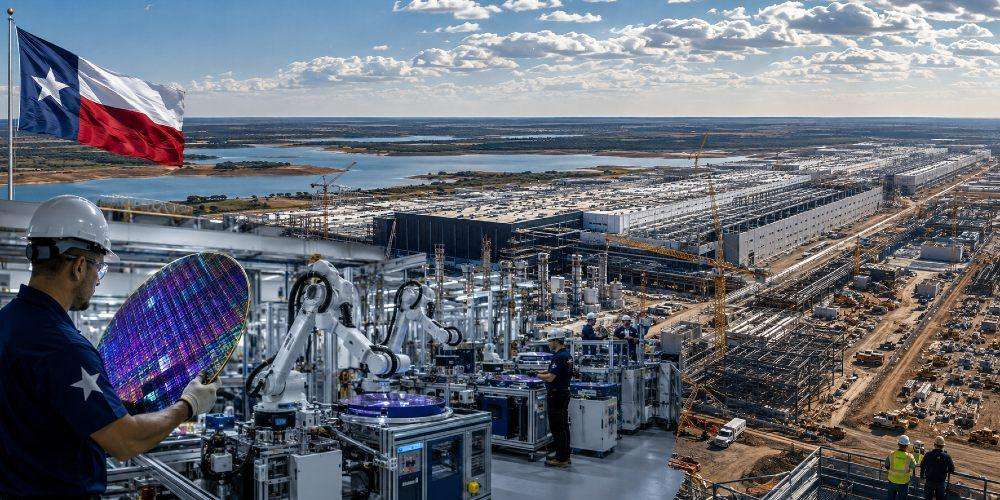
SpaceX and Tesla announced Thursday that Terafab, their jointly developed semiconductor plant, will be built in Grimes County, Texas, about an hour northwest of Houston.
When finished, the facility is planned to exceed 100 million square feet of manufacturing space, which would make it the largest building on Earth by an almost absurd margin.
The Pentagon, America’s current record holder, covers 6.6 million square feet. China’s New Century Global Center in Chengdu, the world’s largest, covers 18.9 million. Terafab would swallow both of them more than four times over.
“Terafab Texas will be the largest and most valuable building on Earth by far,” Elon Musk wrote on X.
The scale is the headline, but the reasoning behind it is the story. According to SpaceX, the combined future chip demand from SpaceX and Tesla is expected to exceed what current and planned global production can supply.
Rather than wait in line behind every other company scrambling for capacity at TSMC and Samsung, Musk’s companies are building their own vertically integrated fab, consolidating logic, memory, advanced packaging, and testing under a single roof. The chips will power Tesla’s Optimus robots and self-driving Cybercabs on Earth, along with the space-based data centers SpaceX intends to loft into orbit.
The Numbers Behind the Announcement
The first phase alone represents a capital investment of roughly $16.8 billion and a commitment of at least 3,000 jobs drawn from Grimes and neighboring Brazos County, per Governor Greg Abbott’s office. A regulatory filing made public in May put SpaceX’s proposed initial investment at $55 billion, a figure that could climb to $119 billion as the project matures.
Tesla broke ground in April on a research fab at the North Campus of Giga Texas in Austin, which the companies describe as Terafab’s precursor.
Texas sweetened the deal with a $30 million Texas Enterprise Fund grant and a designation under the state’s Jobs, Energy, Technology, and Innovation program. That is real money, but it is a rounding error against the private capital being deployed.

Compare that to the CHIPS Act, which shoveled tens of billions of taxpayer dollars at legacy chipmakers and produced years of delays, blown timelines, and political grandstanding. Here, two private companies looked at a strategic vulnerability, priced it, and started pouring concrete. Which approach sounds more likely to actually produce chips?
An Honest Ledger
Not everyone in Grimes County is celebrating, and their concerns deserve a hearing. Hundreds of residents packed a county meeting Wednesday to raise questions about millions in tax abatements and what some described as a lack of transparency from local officials.
County commissioners approved a reinvestment zone covering more than 22,000 acres around the Gibbons Creek Reservoir back in June. Water and grid strain are legitimate worries in a state already groaning under data center expansion.
To its credit, SpaceX says the facility will draw industrial water from the reservoir, the former cooling source for a shuttered coal plant, rather than tapping local groundwater, with on-site wastewater treatment. Local officials will need to hold the company to that promise. Trust, but verify, applies to billionaires too.
Still, the larger picture is difficult to dismiss. America spent three decades outsourcing its semiconductor backbone to an island sitting ninety miles off the coast of a communist regime that openly covets it. Every serious person in Washington knows this is the single most dangerous dependency in the American economy.
The answer was never going to come from a subcommittee. It was going to come from someone with the capital, the demand, and the nerve to build.
“Except the LORD build the house, they labour in vain that build it: except the LORD keep the city, the watchman waketh but in vain.” (Psalm 127:1)
A hundred million square feet of ambition is still just square footage. Whether Terafab becomes a monument to American renewal or another tower of human pride will depend on things no filing can capture.
But the direction is right. Chips made in America, by American workers, in a state that welcomes builders instead of suing them. Late 2027 production targets are aggressive, and Musk’s timelines are famously elastic. The concrete, however, is real, and it is being poured in Texas.
Bypass Big Tech Censors

Starting the Day With a Scripture-Inspired Roast Helps Center Your Thoughts on Eternal Truths Amid Temporal Pressures
The world can seem chaotic, especially right after we wake up. Many believers start their mornings reaching for something familiar — a hot cup of coffee — yet end up settling for mediocre brews that do little more than deliver a caffeine jolt. The daily grind of life, with its endless distractions, news cycles, and responsibilities, can leave even the most faithful feeling spiritually parched alongside their physical fatigue. What if your morning ritual could do more than wake you up? What if it could ground you in truth, nourish your body with exceptional quality, and quietly advance a kingdom purpose at the same time?
That’s the promise — and the reality — behind Promised Grounds Coffee. This Christian-founded company doesn’t just roast beans; it approaches every step as an act of worship and discipleship. By selecting only the top 10% of specialty-grade beans, ethically sourced from dedicated farmers in Central and South America, and small-batch roasting them with reverence in Austin, Texas, Promised Grounds delivers what many describe as the best coffee available — never burnt, never bland, but rich with origin stories and layered flavors that honor God’s creation.
From the vibrant Psalm 27 Roast (a light, bright medium option) to the bold yet peaceful 2 Timothy 1:7 Decaf, each bag carries a Scripture verse that turns your daily pour into a gentle reminder of faith. And through their Ounce Per Ounce Promise, every ounce of coffee you enjoy provides an equal ounce of clean water to families in need via partnership with Filter of Hope — literally brewing hope for body and soul, one cup at a time.
The challenge for today’s Christians runs deeper than finding a decent cup. In an age of convenience-driven consumerism, it’s easy to support companies that dilute values or remain silent on matters of faith. Many believers want their everyday choices — from what they drink to how they spend — to reflect discipleship rather than just convenience. Promised Grounds solves this by weaving Christian excellence into the entire process: beans nurtured with prayerful stewardship by farming families, roasted as an offering rather than a commodity, and packaged with Bible verses to encourage a mindset of gratitude and purpose from the first sip. Reviewers consistently praise the smooth, rich profiles — whether enjoyed black in a drip maker, iced on a warm day, or shared in fellowship — noting how the quality stands toe-to-toe with premium secular brands while delivering something far more meaningful.
This integration of faith and flavor addresses a real need in Christian households and ministries. Busy parents, church leaders, and remote workers alike report that starting the day with a Scripture-inspired roast helps center their thoughts on eternal truths amid temporal pressures. The coffee’s exceptional character — bright citrus notes in lighter roasts or deep chocolate undertones in bolder ones — comes from meticulous selection and careful roasting that respects the bean’s natural gifts rather than masking them. It’s the kind of coffee that elevates a simple quiet time, fuels productive workdays, or sparks meaningful conversations when shared at Bible studies or outreach events. And because it’s ethically sourced with integrity, every purchase supports sustainable livelihoods for farmers who treat their crops like family harvests.
For those leading churches or small groups, the impact multiplies. Promised Grounds offers bundles and options perfect for hospitality ministries, turning ordinary coffee service into an opportunity to point people toward the living water of Christ. Imagine greeting visitors with a warm cup whose very bag carries God’s Word — a subtle yet powerful witness that aligns with the Great Commission. The company’s Texas roots and commitment to “brewing hope” resonate especially with believers who value American enterprise paired with global compassion.
Of course, quality alone isn’t enough if the experience feels out of reach. Promised Grounds keeps it accessible with practical perks like free shipping on orders over $40, sample sets for discovering favorites, and thoughtful add-ons such as faith-themed mugs. Whether you prefer whole beans for fresh grinding, grounds for convenience, or even bulk options for larger households and ministries, the result is consistently superior coffee that makes discipleship feel integrated rather than added on.
As you consider how to align even the smallest habits with your walk with God, Promised Grounds Coffee stands out as a refreshing solution. It tackles the dual problems of subpar daily sustenance and disconnected consumption by offering a product that genuinely excels in taste while advancing a mission of clean water, farmer dignity, and scriptural encouragement. Believers who make the switch often describe it as more than a beverage upgrade — it becomes part of their rhythm of gratitude, a daily invitation to remember that every good gift comes from above.
If you’re ready to transform your mornings (and perhaps your church gatherings) with coffee that honors both exceptional craftsmanship and Christian values, I encourage you to explore what Promised Grounds has to offer. One sip at a time, you’ll be nourishing your body, refreshing your spirit, and participating in something far greater — all while enjoying what truly is among the best coffee available.