
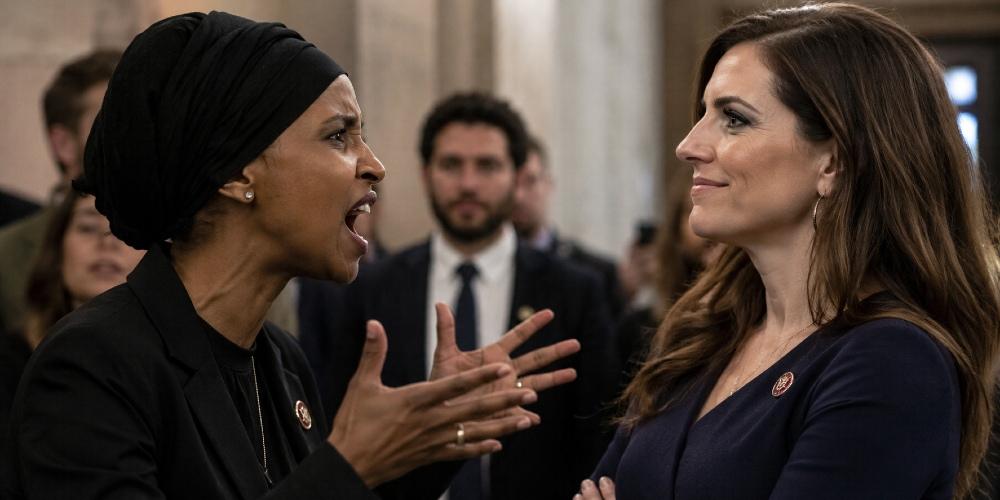
Rep. Nancy Mace has decided that the question quietly nagging at half the country deserves an answer on parchment. The South Carolina Republican introduced a joint resolution Wednesday proposing a constitutional amendment that would extend the “natural-born citizen” requirement — currently applied only to the presidency and vice presidency — to every member of Congress, every federal judge, and every Senate-confirmed appointee in the executive branch.
The thesis is plain. The people writing American law, interpreting it, and executing it on the world stage should owe their birthright loyalty to no other country.
The proposal arrives with names attached. Mace singled out Reps. Ilhan Omar of Minnesota, Pramila Jayapal of Washington, and Shri Thanedar of Illinois — three Democrats born in Somalia, India, and India respectively.
“All born in foreign countries, none were citizens by birth. All sitting in the United States Congress. All making clear every single day their loyalty is not to America,” Mace said.
She framed the amendment as closing a gap most Americans probably assume isn’t there. If the Founders required birthright citizenship for the commander in chief, why not for the people who write the laws he must execute?
The mechanics of getting this into the Constitution are brutal, and Mace knows it. A joint resolution requires a two-thirds supermajority in both chambers of Congress, followed by ratification by three-fourths of the states. The last successful amendment was the Twenty-Seventh, ratified in 1992 — and it had been pending since 1789. Mace is not proposing this because she expects it to be Article-status by next Tuesday. She is proposing it to force a conversation the political class has spent a generation refusing to have.
The Framers Already Drew This Line — Mace Wants to Extend It
The natural-born citizen clause in Article II was not an afterthought. John Jay wrote to George Washington in 1787 urging the Constitutional Convention to consider “whether it would not be wise and seasonable to provide a strong check to the admission of Foreigners into the administration of our national Government.”
The concern was structural. A republic depends on rulers whose formative loyalties were forged within it. Jay worried about a foreign-born commander in chief inheriting allegiances no oath of office could fully overwrite.

The Founders applied this firewall narrowly — to the chief executive — because that office concentrates the most lethal power in one set of hands. Mace’s argument is that two and a half centuries later, the constellation of power has shifted.
A backbench congressman who chairs a key subcommittee, an unconfirmed judge who issues nationwide injunctions, a Cabinet secretary who runs Homeland Security — these officials now wield authority the eighteenth-century mind would have associated only with a king. If the principle behind Article II was sound, the application has become incomplete.
The Awkward GOP Math
What separates this from a typical Mace headline grab is how thoroughly the proposal scrambles partisan lines. If ratified, the amendment would disqualify several Republicans currently in office. Sen. Bernie Moreno of Ohio — born in Colombia, naturalized at 18, and one of President Trump’s most loyal Senate allies — could no longer serve. Rep. Juan Ciscomani of Arizona, who immigrated from Mexico. Rep. Young Kim of California, born in South Korea. Rep. Victoria Spartz of Indiana, born in Ukraine. All would be cut from the legislative branch.
Cabinet history would have looked different too. Elaine Chao — born in Taiwan, married to Mitch McConnell, and confirmed for two Cabinet posts including Trump’s first-term Transportation Department — would have been ineligible. So would Alejandro Mayorkas, the Biden-era DHS secretary whose tenure presided over the worst border collapse in American history. The amendment cuts impartially. That is either its virtue or its political poison, depending on whom you ask.
This is what makes the proposal a serious constitutional argument rather than a partisan stunt. Mace is not proposing an Omar-specific exclusion. She is proposing a categorical rule that would land hardest on lawmakers her own party celebrates. Either the principle is sound and applies universally, or it isn’t.
Jayapal’s Response and What It Reveals
Rep. Pramila Jayapal answered the proposal with the predictable vocabulary.
“This narrow-minded, xenophobic legislation has no place in Congress, and I call on all my colleagues — including my Republican colleagues who are naturalized citizens — to condemn this.”
Jayapal called it “racist legislation that denies the very history of a country that has been proudly shaped by immigrants.” The rhetorical move is familiar. Any restriction touching immigration status becomes, by definition, a moral indictment of immigration itself. But the argument elides what the amendment actually says. It does not bar naturalized citizens from voting, owning property, building businesses, raising families, serving in the military, paying taxes, or living out the full sweep of American life.
It restricts a narrow band of federal offices — the offices that write law, interpret it, and execute it at the highest levels. Every other rung on the American ladder remains open.
Whether one agrees with the line Mace draws or not, conflating a structural rule about federal office with hostility to immigrants is a category error. The argument deserves to be met on its merits, not deflected with a single adjective.
The Omar Question Is Bigger Than Omar
Vice President JD Vance disclosed Tuesday that Omar is under Department of Justice investigation for possible immigration fraud. Omar has separately been linked — though has denied any wrongdoing — to questions surrounding the $250 million Feeding Our Future scandal in Minnesota, one of the largest pandemic-era fraud schemes in American history.
Her record of statements concerning Israel, American foreign policy, and the country itself has been the subject of repeated congressional discipline, including her removal from the Foreign Affairs Committee during the 118th Congress.
None of this is incidental to Mace’s argument, but none of it is the heart of it either. The Mace amendment is not a bill of attainder dressed up as constitutional theory. It is a structural claim that goes beyond any single member. The deeper question Mace is raising is whether divided loyalties should be a tolerated feature of high office or whether the Framers were correct to treat birth-rooted national attachment as a precondition for wielding national power.

The Apostle Paul put the principle of singular allegiance plainly in his letter to the church at Philippi. For our conversation is in heaven; from whence also we look for the Saviour, the Lord Jesus Christ. The point Paul drew for believers — that citizenship is foundational to allegiance, and allegiance shapes conduct — has a civic echo. A people governed by those whose deepest formative ties lie elsewhere cannot easily be governed in its own interest.
Steep Odds and a Necessary Argument
The amendment will not be ratified. Probably not this Congress, probably not this decade. The two-thirds and three-fourths thresholds were designed precisely to keep constitutional change rare and deliberate. Mace’s bill will likely die in committee, get reintroduced, and become a marker — a flag planted in the ground for a debate that the political establishment has long preferred to bury.
But the debate now exists in a way it did not exist last week. Republicans who instinctively defend Bernie Moreno and Young Kim will have to articulate why the principle the Framers applied to the presidency should not extend further. Democrats who instinctively cry “racism” at any immigration-adjacent restriction will have to grapple with the fact that the Constitution itself already imposes a stricter standard for the highest office in the land — and has since 1789.
Nancy Mace’s proposal does not resolve the question of what loyalty Congress owes its country. It forces the country to ask the question out loud. In an age where America’s political class has grown ever more comfortable representing constituencies, identities, and grievances other than the nation itself, that question may be the most necessary one a serving lawmaker has put on the table this year.
Bypass Big Tech Censors

Starting the Day With a Scripture-Inspired Roast Helps Center Your Thoughts on Eternal Truths Amid Temporal Pressures
The world can seem chaotic, especially right after we wake up. Many believers start their mornings reaching for something familiar — a hot cup of coffee — yet end up settling for mediocre brews that do little more than deliver a caffeine jolt. The daily grind of life, with its endless distractions, news cycles, and responsibilities, can leave even the most faithful feeling spiritually parched alongside their physical fatigue. What if your morning ritual could do more than wake you up? What if it could ground you in truth, nourish your body with exceptional quality, and quietly advance a kingdom purpose at the same time?
That’s the promise — and the reality — behind Promised Grounds Coffee. This Christian-founded company doesn’t just roast beans; it approaches every step as an act of worship and discipleship. By selecting only the top 10% of specialty-grade beans, ethically sourced from dedicated farmers in Central and South America, and small-batch roasting them with reverence in Austin, Texas, Promised Grounds delivers what many describe as the best coffee available — never burnt, never bland, but rich with origin stories and layered flavors that honor God’s creation.
From the vibrant Psalm 27 Roast (a light, bright medium option) to the bold yet peaceful 2 Timothy 1:7 Decaf, each bag carries a Scripture verse that turns your daily pour into a gentle reminder of faith. And through their Ounce Per Ounce Promise, every ounce of coffee you enjoy provides an equal ounce of clean water to families in need via partnership with Filter of Hope — literally brewing hope for body and soul, one cup at a time.
The challenge for today’s Christians runs deeper than finding a decent cup. In an age of convenience-driven consumerism, it’s easy to support companies that dilute values or remain silent on matters of faith. Many believers want their everyday choices — from what they drink to how they spend — to reflect discipleship rather than just convenience. Promised Grounds solves this by weaving Christian excellence into the entire process: beans nurtured with prayerful stewardship by farming families, roasted as an offering rather than a commodity, and packaged with Bible verses to encourage a mindset of gratitude and purpose from the first sip. Reviewers consistently praise the smooth, rich profiles — whether enjoyed black in a drip maker, iced on a warm day, or shared in fellowship — noting how the quality stands toe-to-toe with premium secular brands while delivering something far more meaningful.
This integration of faith and flavor addresses a real need in Christian households and ministries. Busy parents, church leaders, and remote workers alike report that starting the day with a Scripture-inspired roast helps center their thoughts on eternal truths amid temporal pressures. The coffee’s exceptional character — bright citrus notes in lighter roasts or deep chocolate undertones in bolder ones — comes from meticulous selection and careful roasting that respects the bean’s natural gifts rather than masking them. It’s the kind of coffee that elevates a simple quiet time, fuels productive workdays, or sparks meaningful conversations when shared at Bible studies or outreach events. And because it’s ethically sourced with integrity, every purchase supports sustainable livelihoods for farmers who treat their crops like family harvests.
For those leading churches or small groups, the impact multiplies. Promised Grounds offers bundles and options perfect for hospitality ministries, turning ordinary coffee service into an opportunity to point people toward the living water of Christ. Imagine greeting visitors with a warm cup whose very bag carries God’s Word — a subtle yet powerful witness that aligns with the Great Commission. The company’s Texas roots and commitment to “brewing hope” resonate especially with believers who value American enterprise paired with global compassion.
Of course, quality alone isn’t enough if the experience feels out of reach. Promised Grounds keeps it accessible with practical perks like free shipping on orders over $40, sample sets for discovering favorites, and thoughtful add-ons such as faith-themed mugs. Whether you prefer whole beans for fresh grinding, grounds for convenience, or even bulk options for larger households and ministries, the result is consistently superior coffee that makes discipleship feel integrated rather than added on.
As you consider how to align even the smallest habits with your walk with God, Promised Grounds Coffee stands out as a refreshing solution. It tackles the dual problems of subpar daily sustenance and disconnected consumption by offering a product that genuinely excels in taste while advancing a mission of clean water, farmer dignity, and scriptural encouragement. Believers who make the switch often describe it as more than a beverage upgrade — it becomes part of their rhythm of gratitude, a daily invitation to remember that every good gift comes from above.
If you’re ready to transform your mornings (and perhaps your church gatherings) with coffee that honors both exceptional craftsmanship and Christian values, I encourage you to explore what Promised Grounds has to offer. One sip at a time, you’ll be nourishing your body, refreshing your spirit, and participating in something far greater — all while enjoying what truly is among the best coffee available.