
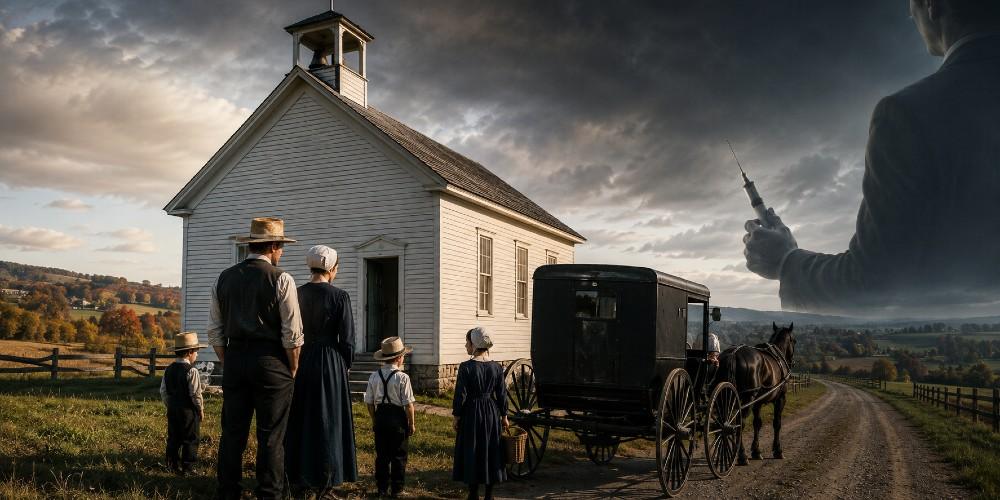
New York’s Amish do not want a fight. They want a one-room schoolhouse on their own land, a horse, a Bible, and the right to raise their children without Albany’s syringe in the door. The state answered with $2,000 fines, a Cuomo-era decree, and a health department that treats a peaceable church like a public nuisance. So the plain people are saying the quiet part out loud. If the Supreme Court will not protect them, they will leave.
That is not a metaphor. Attorneys for the families in Miller v. McDonald told the New York Post the community of roughly 25,000 — the fifth-largest Amish population in the country — will pack up for Pennsylvania if they lose.
Pennsylvania already holds about 95,000 of them. New York can keep the bureaucrats.
“Have we gotten to a place where we aren’t going to make room for the Amish anymore?” asked Hiram Sasser, one of the lawyers. “When you think of Americana — apple pie, fireworks — the Amish are on that list. They’re part of the American fabric. They’re a good litmus test of our religious liberty and our tolerance.”
The test is not going well.
Cuomo Took the Exemption. The Fines Did the Rest.
In 2019, after a measles outbreak in an Orthodox Jewish community, then-Gov. Andrew Cuomo signed away New York’s religious exemption to school immunization rules. California had already done it. Maine and Connecticut later joined the club. West Virginia never offered one. Medical exemptions stayed. Faith did not.
The law does not stop at public school. It hits private and parochial classrooms too, including Amish schools that take no tax money, sit on private land, and teach only Amish children. New York still demands 24 to 27 shots for K-12 attendance. The Amish generally refuse injectables. Their religion treats trust in the shot as a rival to trust in God.
Ezra Wengerd of Canajoharie, 55, an Old Order father and an elected representative of the state’s Amish schools, put it in a handwritten letter.
“We, as a peace loving religious group, are sincerely sorry that we are causing the state a prob. We are indeed grateful to the state of NY for the many privileges freedoms and protections they have blessed us with, for many years. Our Almighty God wants us to fully put our faith and trust in Him. Which is in conflict to put our trust in vaccines. We are also commanded to not be conformed to this world.”
The state was not interested in the apology. It started slapping $2,000 penalties on noncompliant schools around 2022. Three named in the suit — Shady Lane in Clymer, Pleasant View in Heuvelton, and Dygert Road near Canajoharie — have already been hit for $118,000 combined. Lawyers say every Amish school in New York sits in the same trap. The Health Department would not tell the Post how many others have been fined. Aaron Siri, who also represents the families, noted the only realistic way to collect that kind of money is to take the land.

Then Peter and the other apostles answered and said, We ought to obey God rather than men.
The Second Circuit Doubled Down After the High Court Said Look Again
The Amish have been in federal court since 2024. They lost at the district level. The New York-based Second Circuit — majority Democrat-appointed — sided with the state. Last year the Supreme Court vacated that ruling and sent it back for another look in light of Mahmoud v. Taylor, the 2025 decision that backed parents who objected on religious grounds to a school district’s LGBT curriculum, as The Christian Post reported when the remand landed.
The Second Circuit “reconsidered.” On June 30, 2026, it issued the same answer. Neutral law. Generally applicable. Rational basis. The vaccine rule, the panel said, does not tell children what to believe, so Mahmoud does not save the Amish. The court treated a needle in a child’s arm as less serious than a storybook in a classroom.
That is the legal magic trick. Keep a medical exemption. Kill the religious one. Call the statute neutral. Pretend Wisconsin v. Yoder — the 1972 case that stopped Wisconsin from forcing Amish teenagers into high school — has nothing to say when the same people ask to keep their own little schools free of a mandate that violates their creed.
Siri has said the families will petition the Supreme Court again next month. They do not want to be there. Amish culture generally forbids both lawsuits and injectables. “They’ve been left with no choice,” he told the Post.
The Children Albany Wants to “Protect”
Here is the part the Department of Health would rather not put on a press release. Sworn filings in the case describe 168 unvaccinated children across 26 families at the three targeted schools. None had a health problem that arose after birth.
Expert evidence compared that group with expected rates in a random sample of 168 American children and found the usual load of chronic illness missing — the allergies, ADHD, asthma, and autism that now pass for normal in vaccinated cohorts.
Daniel Horowitz at The Blaze asked the obvious question. Why treat a living, unvaccinated population as a problem to be fined out of existence instead of evidence worth studying? New York’s answer is a slogan. A spokeswoman told the Post the department’s job is to “protect public health,” “enforce the law fairly and equitably,” and follow requirements “based in science.”
Fairly. Equitably. Against people who build their own schools and ask nothing from the treasury except to be left alone.
Wayne State law professor Christopher Lund told the Post the Amish are sympathetic plaintiffs, but the state is “thinking more widely.” That is the whole philosophy in one phrase. The individual conscience is always the rounding error.
The herd is the point. The Second Circuit has spent years batting down religious objectors to COVID shots. Vaccine cases make the justices nervous. Medical authorities still get the benefit of the doubt they squandered during the last panic.
The Trump administration is at least saying the quiet counterpoint. An HHS spokesman told the Post that the president’s executive order reaffirmed parental choice and religious freedom on childhood vaccination, and that under Secretary Robert F. Kennedy Jr. the department will keep working to protect parents who make health decisions “in accordance with their deeply held beliefs.”
A Litmus Test New York Is Failing
Other states have found workarounds when Amish life collided with modern rules — photo IDs, reflective tape on buggies, building codes. New York chose confiscatory fines on churches that look like Little House on the Prairie.
If the high court shrugs, the buggies roll west. Pennsylvania will take them. New York will keep its schedule of 27 shots, its empty desks, and the proud claim that no child’s faith is allowed to interfere with the state’s idea of safety. The Amish will still be the Amish. Albany will still be Albany. Only one of those two has ever been good at leaving people alone.
Bypass Big Tech Censors
Starting the Day With a Scripture-Inspired Roast Helps Center Your Thoughts on Eternal Truths Amid Temporal Pressures
The world can seem chaotic, especially right after we wake up. Many believers start their mornings reaching for something familiar — a hot cup of coffee — yet end up settling for mediocre brews that do little more than deliver a caffeine jolt. The daily grind of life, with its endless distractions, news cycles, and responsibilities, can leave even the most faithful feeling spiritually parched alongside their physical fatigue. What if your morning ritual could do more than wake you up? What if it could ground you in truth, nourish your body with exceptional quality, and quietly advance a kingdom purpose at the same time?
That’s the promise — and the reality — behind Promised Grounds Coffee. This Christian-founded company doesn’t just roast beans; it approaches every step as an act of worship and discipleship. By selecting only the top 10% of specialty-grade beans, ethically sourced from dedicated farmers in Central and South America, and small-batch roasting them with reverence in Austin, Texas, Promised Grounds delivers what many describe as the best coffee available — never burnt, never bland, but rich with origin stories and layered flavors that honor God’s creation.
From the vibrant Psalm 27 Roast (a light, bright medium option) to the bold yet peaceful 2 Timothy 1:7 Decaf, each bag carries a Scripture verse that turns your daily pour into a gentle reminder of faith. And through their Ounce Per Ounce Promise, every ounce of coffee you enjoy provides an equal ounce of clean water to families in need via partnership with Filter of Hope — literally brewing hope for body and soul, one cup at a time.
The challenge for today’s Christians runs deeper than finding a decent cup. In an age of convenience-driven consumerism, it’s easy to support companies that dilute values or remain silent on matters of faith. Many believers want their everyday choices — from what they drink to how they spend — to reflect discipleship rather than just convenience. Promised Grounds solves this by weaving Christian excellence into the entire process: beans nurtured with prayerful stewardship by farming families, roasted as an offering rather than a commodity, and packaged with Bible verses to encourage a mindset of gratitude and purpose from the first sip. Reviewers consistently praise the smooth, rich profiles — whether enjoyed black in a drip maker, iced on a warm day, or shared in fellowship — noting how the quality stands toe-to-toe with premium secular brands while delivering something far more meaningful.
This integration of faith and flavor addresses a real need in Christian households and ministries. Busy parents, church leaders, and remote workers alike report that starting the day with a Scripture-inspired roast helps center their thoughts on eternal truths amid temporal pressures. The coffee’s exceptional character — bright citrus notes in lighter roasts or deep chocolate undertones in bolder ones — comes from meticulous selection and careful roasting that respects the bean’s natural gifts rather than masking them. It’s the kind of coffee that elevates a simple quiet time, fuels productive workdays, or sparks meaningful conversations when shared at Bible studies or outreach events. And because it’s ethically sourced with integrity, every purchase supports sustainable livelihoods for farmers who treat their crops like family harvests.
For those leading churches or small groups, the impact multiplies. Promised Grounds offers bundles and options perfect for hospitality ministries, turning ordinary coffee service into an opportunity to point people toward the living water of Christ. Imagine greeting visitors with a warm cup whose very bag carries God’s Word — a subtle yet powerful witness that aligns with the Great Commission. The company’s Texas roots and commitment to “brewing hope” resonate especially with believers who value American enterprise paired with global compassion.
Of course, quality alone isn’t enough if the experience feels out of reach. Promised Grounds keeps it accessible with practical perks like free shipping on orders over $40, sample sets for discovering favorites, and thoughtful add-ons such as faith-themed mugs. Whether you prefer whole beans for fresh grinding, grounds for convenience, or even bulk options for larger households and ministries, the result is consistently superior coffee that makes discipleship feel integrated rather than added on.
As you consider how to align even the smallest habits with your walk with God, Promised Grounds Coffee stands out as a refreshing solution. It tackles the dual problems of subpar daily sustenance and disconnected consumption by offering a product that genuinely excels in taste while advancing a mission of clean water, farmer dignity, and scriptural encouragement. Believers who make the switch often describe it as more than a beverage upgrade — it becomes part of their rhythm of gratitude, a daily invitation to remember that every good gift comes from above.
If you’re ready to transform your mornings (and perhaps your church gatherings) with coffee that honors both exceptional craftsmanship and Christian values, I encourage you to explore what Promised Grounds has to offer. One sip at a time, you’ll be nourishing your body, refreshing your spirit, and participating in something far greater — all while enjoying what truly is among the best coffee available.