
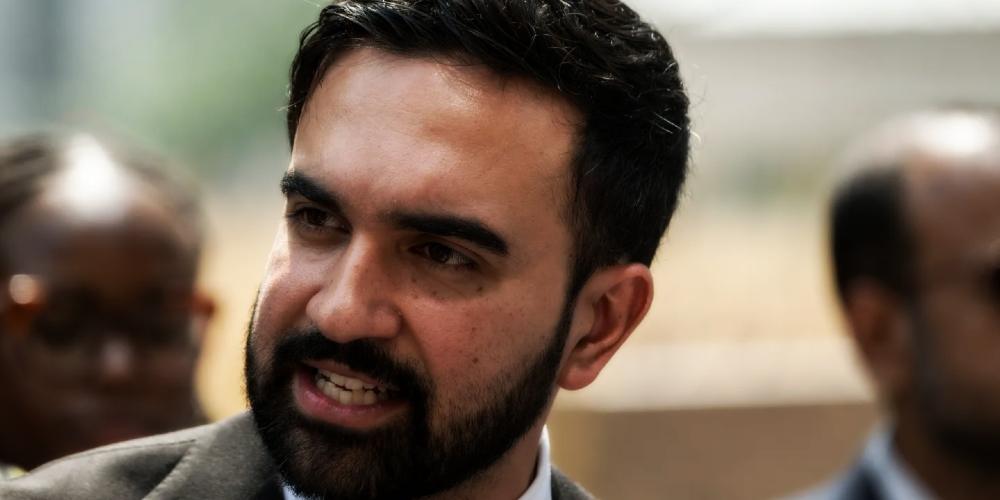
(The Epoch Times)—New York City Mayor Zohran Mamdani quickly advanced his democratic socialist agenda on Jan. 1, passing a series of executive orders and using his inauguration speech to promote collectivism.
“We will replace the frigidity of rugged individualism with the warmth of collectivism,” he said after a swearing-in ceremony in front of City Hall.
After speeches from fellow democratic socialists Sen. Bernie Sanders (I-Vt.) and Rep. Alexandria Ocasio-Cortez (D-N.Y.), Mamdani advocated universal childcare, freezing rents, and making “buses fast and free.”
Hours into his new administration, Mamdani launched a series of changes, such as establishing a deputy mayor for economic justice, a new Office to Combat Antisemitism, and an advisory Commission on Universal After-School.
Other developments included a new Office of Community Hiring and Workforce Development, designed to help prepare New Yorkers for “career success and economic security,” and multiple task forces aimed at catalyzing housing development.
Mamdani, 34, beat out former Democratic Gov. Andrew Cuomo, who ran as an independent, in the mayoral election last year amid intense scrutiny of his socialist ideology. He’s replacing another Democrat, Eric Adams, who has criticized socialism and stood in the crowd as Mamdani suggested the city had left residents behind.
“I stand alongside countless more New Yorkers watching from cramped kitchens in Flushing and barbershops in East New York, from cell phones propped against the dashboards of parked taxi cabs at LaGuardia, from hospitals in Mott Haven and libraries in El Barrio that have too long known only neglect,” he said.
Boos could be heard from the audience after Mamdani mentioned Adams, who ended his 4-year tenure. Adams was indicted in 2024 for alleged bribery, which he has denied, and federal prosecutors later dropped the case under the Trump administration. Despite calls for his resignation, Adams stayed in office and sought reelection before dropping out of the race in late September.

One of Mamdani’s first executive orders rescinded executive orders Adams issued on or after Sept. 26, 2024, the date of his indictment. During his speech on Jan. 1, Mamdani positioned his administration as following in the footsteps of former Mayor Bill de Blasio and his goal of ending inequality.
“I was elected as a democratic socialist, and I will govern as a democratic socialist,” he said. “I will not abandon my principles for fear of being deemed radical.”
Mamdani has called for city-owned grocery stores, taxing the city’s most wealthy, and “Trump-proofing NYC” by keeping U.S. Immigration and Customs Enforcement officers out of city facilities and increasing legal support for illegal immigrants.
Mamdani and Trump, a native New Yorker, have traded jabs over the past year, with Trump criticizing the then-candidate as a “communist.” More recently, the two met in the Oval Office, where they highlighted their shared interest in New York, home to Trump Tower and Trump’s family business.
“We have one thing in common. We want this city of ours that we love to do very well. And I wanted to congratulate the mayor,” Trump told reporters as Mamdani stood next to him.
When asked about the communist label, Trump said Mamdani had “views that are a little out there” but that he was confident Mamdani could do a “good job.”
When reporters pressed Mamdani about his previously labeling Trump a “despot” and a “fascist,” he said he appreciated how the meeting was focused on “the shared purpose that we had in serving New Yorkers” instead of disagreements.
Trump later interjected, saying, “I have been called much more than a despot.
“It’s not that insulting,” the president joked. “I think he will change his mind after we get to working together.”
Immigration could be a sticking point for cooperation between the two leaders as they’ve offered sharply different visions on the issue. Under Trump’s second term, the city and the Trump administration, which has been prioritizing immigration enforcement and deportation of illegal immigrants, have sued each other over various immigration-related issues.
One of Mamdani’s executive orders on Jan. 1 established the Office to Facilitate Pro Bono Legal Assistance, which was tasked with compiling and providing “information on the availability of providers that offer pro bono legal services to City residents and entities that serve them.”
He also directed the new office to “coordinate with the Mayor’s Office of Immigrant Affairs and the New York City Department of Social Services on the distribution of funds for immigrant legal services.”

His deputy mayor for economic justice has also been tasked with “supporting, uplifting, and protecting immigrant communities.”
Emel Akan contributed to this report.
Bypass Big Tech Censors

Starting the Day With a Scripture-Inspired Roast Helps Center Your Thoughts on Eternal Truths Amid Temporal Pressures
The world can seem chaotic, especially right after we wake up. Many believers start their mornings reaching for something familiar — a hot cup of coffee — yet end up settling for mediocre brews that do little more than deliver a caffeine jolt. The daily grind of life, with its endless distractions, news cycles, and responsibilities, can leave even the most faithful feeling spiritually parched alongside their physical fatigue. What if your morning ritual could do more than wake you up? What if it could ground you in truth, nourish your body with exceptional quality, and quietly advance a kingdom purpose at the same time?
That’s the promise — and the reality — behind Promised Grounds Coffee. This Christian-founded company doesn’t just roast beans; it approaches every step as an act of worship and discipleship. By selecting only the top 10% of specialty-grade beans, ethically sourced from dedicated farmers in Central and South America, and small-batch roasting them with reverence in Austin, Texas, Promised Grounds delivers what many describe as the best coffee available — never burnt, never bland, but rich with origin stories and layered flavors that honor God’s creation.
From the vibrant Psalm 27 Roast (a light, bright medium option) to the bold yet peaceful 2 Timothy 1:7 Decaf, each bag carries a Scripture verse that turns your daily pour into a gentle reminder of faith. And through their Ounce Per Ounce Promise, every ounce of coffee you enjoy provides an equal ounce of clean water to families in need via partnership with Filter of Hope — literally brewing hope for body and soul, one cup at a time.
The challenge for today’s Christians runs deeper than finding a decent cup. In an age of convenience-driven consumerism, it’s easy to support companies that dilute values or remain silent on matters of faith. Many believers want their everyday choices — from what they drink to how they spend — to reflect discipleship rather than just convenience. Promised Grounds solves this by weaving Christian excellence into the entire process: beans nurtured with prayerful stewardship by farming families, roasted as an offering rather than a commodity, and packaged with Bible verses to encourage a mindset of gratitude and purpose from the first sip. Reviewers consistently praise the smooth, rich profiles — whether enjoyed black in a drip maker, iced on a warm day, or shared in fellowship — noting how the quality stands toe-to-toe with premium secular brands while delivering something far more meaningful.
This integration of faith and flavor addresses a real need in Christian households and ministries. Busy parents, church leaders, and remote workers alike report that starting the day with a Scripture-inspired roast helps center their thoughts on eternal truths amid temporal pressures. The coffee’s exceptional character — bright citrus notes in lighter roasts or deep chocolate undertones in bolder ones — comes from meticulous selection and careful roasting that respects the bean’s natural gifts rather than masking them. It’s the kind of coffee that elevates a simple quiet time, fuels productive workdays, or sparks meaningful conversations when shared at Bible studies or outreach events. And because it’s ethically sourced with integrity, every purchase supports sustainable livelihoods for farmers who treat their crops like family harvests.
For those leading churches or small groups, the impact multiplies. Promised Grounds offers bundles and options perfect for hospitality ministries, turning ordinary coffee service into an opportunity to point people toward the living water of Christ. Imagine greeting visitors with a warm cup whose very bag carries God’s Word — a subtle yet powerful witness that aligns with the Great Commission. The company’s Texas roots and commitment to “brewing hope” resonate especially with believers who value American enterprise paired with global compassion.
Of course, quality alone isn’t enough if the experience feels out of reach. Promised Grounds keeps it accessible with practical perks like free shipping on orders over $40, sample sets for discovering favorites, and thoughtful add-ons such as faith-themed mugs. Whether you prefer whole beans for fresh grinding, grounds for convenience, or even bulk options for larger households and ministries, the result is consistently superior coffee that makes discipleship feel integrated rather than added on.
As you consider how to align even the smallest habits with your walk with God, Promised Grounds Coffee stands out as a refreshing solution. It tackles the dual problems of subpar daily sustenance and disconnected consumption by offering a product that genuinely excels in taste while advancing a mission of clean water, farmer dignity, and scriptural encouragement. Believers who make the switch often describe it as more than a beverage upgrade — it becomes part of their rhythm of gratitude, a daily invitation to remember that every good gift comes from above.
If you’re ready to transform your mornings (and perhaps your church gatherings) with coffee that honors both exceptional craftsmanship and Christian values, I encourage you to explore what Promised Grounds has to offer. One sip at a time, you’ll be nourishing your body, refreshing your spirit, and participating in something far greater — all while enjoying what truly is among the best coffee available.


