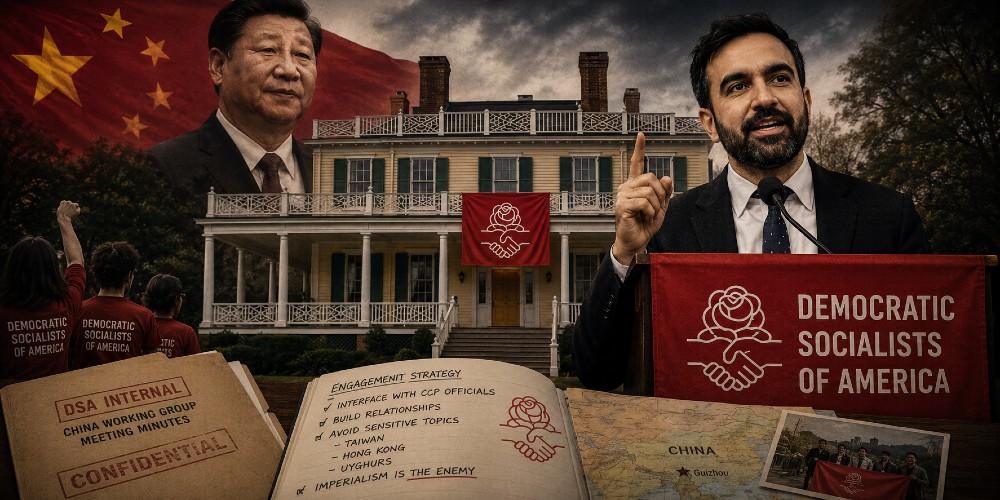
New York City’s Democratic Socialists of America, the political home of Mayor Zohran Mamdani, have been actively courting favor with the Chinese Communist Party. Internal meeting minutes reveal members eager to “interface” with CCP officials, self-censoring on Beijing’s atrocities to maintain the relationship—all under the banner of fighting “imperialism.”
In other words, they know where their allegiance will end up if they’re able to take control of America. It is the logical endpoint of a movement that now holds significant power in America’s largest city, and that power is spreading.
The revelations, drawn from extensive DSA documents obtained by Newsweek, expose a sustained effort to align with the world’s most powerful totalitarian regime.
Participants in the DSA’s International Committee China Working Group discussed developing itineraries for engagement, hiring locals to deepen ties with the Communist Party of China, and avoiding any criticism of sensitive issues like the threatened invasion of Taiwan, the crackdown in Hong Kong, or the Uyghur genocide. One activist enthused that if they played their cards right, “we’re golden.”
Zohran Mamdani, the democratic socialist who now occupies Gracie Mansion, has long been tied to this organization. While he has publicly distanced himself from certain national DSA positions at times, the group powered his rise and shares his ideological roots. Socialism, whether wrapped in democratic rhetoric or not, inevitably drifts toward authoritarianism. History has shown this repeatedly—from the Soviet Union to Venezuela to Mao’s China itself.
The DSA’s deference to the CCP confirms what many have warned: these are not mere reformers but radicals comfortable with bending the knee to actual communists.
The Mechanics of Influence
The minutes paint a picture of ideological capture. DSA members agreed to sidestep topics that might offend their Chinese counterparts, dismissing reports of Uyghur oppression as American propaganda in some cases. They explored partnerships with pro-CCP media outlets and celebrated direct meetings facilitated by Chinese officials during trips to places like Guizhou. Chinese authorities encouraged formal exchanges, and the DSA appeared all too willing to oblige.
This is not harmless internationalism. The CCP is engaged in a long-term strategy of influence operations across the West—subverting institutions, stealing technology, and advancing its vision of global dominance. An American political organization with real sway in a major city volunteering to filter its discourse to appease Beijing represents a profound security and ideological vulnerability.
When socialists prioritize solidarity with a regime that runs concentration camps, crushes dissent, and spies on its own citizens over the defense of liberty, the mask slips entirely.

Connections extend beyond the DSA’s internal circles. Bernie Sanders, the elder statesman of American democratic socialism, has drawn scrutiny for his own engagements, including efforts that critics argue would hamstring U.S. AI development while China surges ahead.
The pattern is consistent: a reflexive opposition to American strength paired with strange indulgence for regimes that embody the very authoritarianism they claim to oppose.
A Threat to Constitutional Order
America’s Founders designed a republic to guard against concentrated power and foreign entanglements that compromise sovereignty. They understood that alliances with tyrannical governments erode the moral and political foundations of self-government.
Today’s DSA-aligned leaders in New York appear to view the Constitution not as a safeguard but as an obstacle to their transformative agenda. By cozying up to the CCP, they signal whose side they ultimately favor in the global contest between freedom and control.
The irony abounds. These are the same voices who lecture endlessly about threats to democracy while partnering with a party that has never won a free election, bans opposition parties, and maintains total surveillance over its people. They decry “fascism” at home yet make excuses for a communist superpower that exports repression through economic coercion and influence networks. The American people, particularly in New York, deserve leaders who prioritize their security and prosperity—not those auditioning for approval from Beijing.
Mamdani’s mayoralty places this ideology in a position of governance. Policies that weaken law enforcement, burden taxpayers, and prioritize ideological purity over practical governance will compound the damage if informed by a worldview sympathetic to the CCP model. New Yorkers who voted for affordability and change may soon discover the steeper price of socialist governance: diminished freedom, economic stagnation, and compromised national loyalty.
As the prophet Isaiah warned of those who seek alliances that defy God’s order, “Woe to them that go down to Egypt for help, and stay on horses, and trust in chariots… but they look not unto the Holy One of Israel, neither seek the LORD!” (Isaiah 31:1).
In our age, the modern equivalent of misplaced trust is exchanging American principles for solidarity with a godless regime that persecutes believers and exalts the state above all. Christians and conservatives must discern these influences clearly and stand firm for truth, liberty, and the defense of the innocent against tyranny in all its forms.
The DSA’s outreach to the CCP is a warning. Socialism does not moderate in power; it seeks fellow travelers abroad who share its contempt for individual rights and limited government. Americans committed to the constitutional republic cannot afford complacency. The battle for the soul of the nation—and its great cities—requires vigilance, moral clarity, and an unyielding defense of the freedoms that distinguish us from the authoritarian darkness now being courted in plain sight.
Bypass Big Tech Censors

Starting the Day With a Scripture-Inspired Roast Helps Center Your Thoughts on Eternal Truths Amid Temporal Pressures
The world can seem chaotic, especially right after we wake up. Many believers start their mornings reaching for something familiar — a hot cup of coffee — yet end up settling for mediocre brews that do little more than deliver a caffeine jolt. The daily grind of life, with its endless distractions, news cycles, and responsibilities, can leave even the most faithful feeling spiritually parched alongside their physical fatigue. What if your morning ritual could do more than wake you up? What if it could ground you in truth, nourish your body with exceptional quality, and quietly advance a kingdom purpose at the same time?
That’s the promise — and the reality — behind Promised Grounds Coffee. This Christian-founded company doesn’t just roast beans; it approaches every step as an act of worship and discipleship. By selecting only the top 10% of specialty-grade beans, ethically sourced from dedicated farmers in Central and South America, and small-batch roasting them with reverence in Austin, Texas, Promised Grounds delivers what many describe as the best coffee available — never burnt, never bland, but rich with origin stories and layered flavors that honor God’s creation.
From the vibrant Psalm 27 Roast (a light, bright medium option) to the bold yet peaceful 2 Timothy 1:7 Decaf, each bag carries a Scripture verse that turns your daily pour into a gentle reminder of faith. And through their Ounce Per Ounce Promise, every ounce of coffee you enjoy provides an equal ounce of clean water to families in need via partnership with Filter of Hope — literally brewing hope for body and soul, one cup at a time.
The challenge for today’s Christians runs deeper than finding a decent cup. In an age of convenience-driven consumerism, it’s easy to support companies that dilute values or remain silent on matters of faith. Many believers want their everyday choices — from what they drink to how they spend — to reflect discipleship rather than just convenience. Promised Grounds solves this by weaving Christian excellence into the entire process: beans nurtured with prayerful stewardship by farming families, roasted as an offering rather than a commodity, and packaged with Bible verses to encourage a mindset of gratitude and purpose from the first sip. Reviewers consistently praise the smooth, rich profiles — whether enjoyed black in a drip maker, iced on a warm day, or shared in fellowship — noting how the quality stands toe-to-toe with premium secular brands while delivering something far more meaningful.
This integration of faith and flavor addresses a real need in Christian households and ministries. Busy parents, church leaders, and remote workers alike report that starting the day with a Scripture-inspired roast helps center their thoughts on eternal truths amid temporal pressures. The coffee’s exceptional character — bright citrus notes in lighter roasts or deep chocolate undertones in bolder ones — comes from meticulous selection and careful roasting that respects the bean’s natural gifts rather than masking them. It’s the kind of coffee that elevates a simple quiet time, fuels productive workdays, or sparks meaningful conversations when shared at Bible studies or outreach events. And because it’s ethically sourced with integrity, every purchase supports sustainable livelihoods for farmers who treat their crops like family harvests.
For those leading churches or small groups, the impact multiplies. Promised Grounds offers bundles and options perfect for hospitality ministries, turning ordinary coffee service into an opportunity to point people toward the living water of Christ. Imagine greeting visitors with a warm cup whose very bag carries God’s Word — a subtle yet powerful witness that aligns with the Great Commission. The company’s Texas roots and commitment to “brewing hope” resonate especially with believers who value American enterprise paired with global compassion.
Of course, quality alone isn’t enough if the experience feels out of reach. Promised Grounds keeps it accessible with practical perks like free shipping on orders over $40, sample sets for discovering favorites, and thoughtful add-ons such as faith-themed mugs. Whether you prefer whole beans for fresh grinding, grounds for convenience, or even bulk options for larger households and ministries, the result is consistently superior coffee that makes discipleship feel integrated rather than added on.
As you consider how to align even the smallest habits with your walk with God, Promised Grounds Coffee stands out as a refreshing solution. It tackles the dual problems of subpar daily sustenance and disconnected consumption by offering a product that genuinely excels in taste while advancing a mission of clean water, farmer dignity, and scriptural encouragement. Believers who make the switch often describe it as more than a beverage upgrade — it becomes part of their rhythm of gratitude, a daily invitation to remember that every good gift comes from above.
If you’re ready to transform your mornings (and perhaps your church gatherings) with coffee that honors both exceptional craftsmanship and Christian values, I encourage you to explore what Promised Grounds has to offer. One sip at a time, you’ll be nourishing your body, refreshing your spirit, and participating in something far greater — all while enjoying what truly is among the best coffee available.