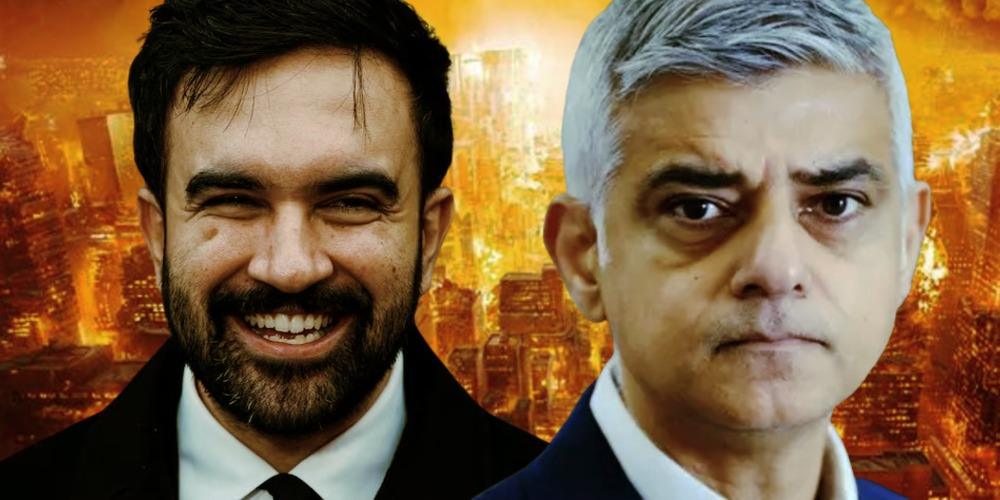
New York City stands on the brink of a pivotal mayoral election tomorrow, with democratic socialist Zohran Mamdani surging ahead in the polls against former Governor Andrew Cuomo and Republican Curtis Sliwa. President Trump threw his weight behind Cuomo, warning that federal funds for the city could dry up if Mamdani takes office.
Trump’s endorsement came with a stark message about the risks of handing the keys to America’s largest city to someone whose policies echo the troubling path London has taken under Mayor Sadiq Khan. For years, Khan has overseen a transformation in the British capital that many see as a surrender to radical influences, and Mamdani’s vision for New York promises an even more aggressive shift.
Look at London today. Knife crime has plagued the streets for years, with stabbings reaching record levels during Khan’s tenure. Official stats from the UK government show over 14,000 knife offenses in London alone last year, a sharp rise since he took office in 2016.
Critics point to lax policing and a focus on “community relations” that often prioritizes appeasing certain groups over enforcing the law. Pro-Palestinian protests have turned chaotic, with reports of antisemitic chants and violence going unchecked, leaving residents feeling unsafe.
Khan’s response? He downplays the issues, calling out “Islamophobia” while his city grapples with what some describe as creeping Sharia influences—claims Trump amplified at the UN General Assembly in September, accusing Khan of allowing religious laws to seep into governance. There’s no outright adoption of Sharia, of course, but the mayor’s decisions—like renaming streets to honor Muslim figures or pushing for more halal options in schools—signal a broader cultural overhaul that erodes traditional British identity.
Khan, the son of Pakistani immigrants and the first Muslim mayor of a major Western city, has faced relentless criticism. Yet, the substance of the complaints holds water. His handling of the 2023-2024 Gaza protests allowed mobs to dominate public spaces, with police standing by as Hamas sympathizers waved flags and shouted slogans that would get anyone else arrested for hate speech.
A UK Conservative MP was even suspended for suggesting “Islamists” had Khan under their thumb, a comment that sparked outrage but resonated with those watching London’s decline.
Economic stagnation follows suit: Businesses flee high taxes and regulations, tourism dips amid safety fears, and the once-vibrant city now ranks among Europe’s most dangerous for violent crime. Khan’s third term, secured in 2024, only cements this trajectory, with policies like ultra-low emission zones crippling working-class drivers while he jets to climate summits like COP30 in Rio this week.

Now, turn to Zohran Mamdani, the 33-year-old New York State Assembly member vying to become New York City’s first Muslim mayor. Born to Ugandan-Indian parents who fled Idi Amin’s regime, Mamdani shares Khan’s immigrant roots and faith, but his politics veer sharper left. He’s a proud member of the Democratic Socialists of America, advocating for defunding the police, rent controls that could bankrupt landlords, and a foreign policy that blasts Israel at every turn. In debates, he’s promised to open the door to radical curricula influenced by his allies in progressive circles.
What makes Mamdani potentially worse than Khan? A recent report from the International Legal Forum on Antisemitism flagged his rhetoric as an “alarm bell,” citing ties to groups that downplay October 7 atrocities and push narratives that fuel hate against Jews. In New York, home to the world’s largest Jewish population outside Israel, this could ignite tensions far beyond London’s protest scenes.
Imagine Times Square overrun by unchecked demonstrations, with NYPD budgets slashed under Mamdani’s watch—echoing Khan’s soft-on-crime approach but amplified by socialist economics that prioritize redistribution over public safety.
Mamdani’s campaign has drawn fire from billionaires and business leaders pouring millions into ads against him, including viral videos where CEOs mock his policies by “applying” for jobs under a socialist regime. They fear a New York mirroring London’s economic woes: Sky-high taxes driving out the wealthy, vacant office spaces from remote work mandates, and a housing crisis worsened by his anti-development stance.
Khan’s London has seen GDP growth lag behind the UK average, with youth unemployment spiking in immigrant-heavy boroughs. Mamdani’s plans for “affordable housing” through aggressive rent caps could do the same here, stifling investment and turning Manhattan into a ghost town for entrepreneurs.
There’s a deeper thread connecting these two figures, one that whispers of a coordinated push by global progressives to reshape Western cities. Khan and Mamdani have reportedly swapped advice, with the London mayor offering tips on handling Trump-style attacks. At COP30, Khan dismissed criticisms of Mamdani as baseless, urging New Yorkers to ignore religion in the race—just as he deflects scrutiny of his own policies. But when Trump calls out the “Sharia creep” in London, he’s tapping into real anxieties about leaders who prioritize international alliances over local needs.
Mamdani’s foreign policy leanings, including his vocal support for Hamas, align with a network of activists who view America and its allies as oppressors. If he wins, expect New York to become a hub for anti-Western sentiment, with city funds diverted to “solidarity” programs that echo Khan’s multicultural initiatives but go further into defunding law enforcement and embracing open borders.
Voters tomorrow face a choice: Preserve the city’s grit and opportunity, or risk a transformation that could make Khan’s London look tame by comparison.
In the end, cities like London and New York thrive on diversity, but not at the expense of security and prosperity. Khan’s record serves as a cautionary tale, and Mamdani’s promises threaten to write an even darker chapter for the Big Apple.
Bypass Big Tech Censors
Two Storms, One Harvest

Every food crisis in living memory has been a one-shock event. The 2008 price spike was a commodity bubble. The 2020 shortages were a logistics failure. The 2022 grain scare was a war on one exporter’s ports. Each time, the system bent, adjusted, and recovered, and each time the experts assured us afterward that global markets are simply too big and too diversified to fail.
What nobody in Washington seems eager to discuss is that 2026 is shaping up to be something the modern food system has never actually faced. Two independent shocks, one climatic and one geopolitical, are converging on the same harvest cycle at the same time. Not sequentially. Simultaneously.
Start with the weather. The Pacific Ocean is currently building toward what forecasters now openly call a record event. NOAA’s Climate Prediction Center puts the odds of at least a strong El Niño near 88 percent, with roughly two in three odds it reaches “very strong” status, the tier reserved for perhaps three or four events in the entire satellite era. Every major global model now projects a median peak in Super El Niño territory, and most of them project it exceeding the 2015-16 event, which until now held the modern record. Sea surface anomalies were already brushing the super threshold in mid-July, months before these events normally peak. The atmosphere has already shifted into El Niño mode, and the event is forecast to crest in late fall and early winter.
This is not about “climate change.” It’s about the standard cycles of weather, and the cycle we’re currently in is one that has likely devastated societies in the past. We’re better prepared as a society today, but not all Americans are equally prepared.
Serious households have started doing the quiet math on their own. Grocery bills tell part of the story, and the forecast maps tell the rest, which is why long-term food storage has moved from fringe hobby to mainstream line item in the family budget, with established suppliers like Heaven’s Harvest seeing demand from people who five years ago would have rolled their eyes at the idea. That instinct is not paranoia. It is pattern recognition, and the pattern is worth walking through carefully.
Editor’s Note: Heaven’s Harvest IS a sponsor, but the warnings of this article are real and would be written even if we didn’t have a survival food sponsor. With that said, those who take advantage of what they offer can use promo code “Patriot” for 15% off.
The Fertilizer Clock Is Already Running
While the Pacific warms, the second shock has been unfolding in the Strait of Hormuz. The conflict with Iran turned the world’s most important energy chokepoint into a contested waterway, and the consequences reach far beyond the gas pump. Roughly a third of global fertilizer trade moves through Hormuz, and the disruption sent urea prices up 86 percent year over year by March, with a 53 percent jump in a single month.
The World Bank projects energy prices rising about 24 percent in 2026 and fertilizer about 31 percent. By its own accounting, fertilizer prices ran 35 percent higher in the first five months of this year than the same period last year.
Here is the mechanism the nightly news will not explain. Fertilizer is not a grocery item. It is a time-delayed input. The nitrogen a farmer in Iowa or Punjab could not afford to apply this spring does not show up as a problem this spring. It shows up as a thinner harvest six to twelve months later.
The World Bank’s own food security brief concedes that the effects of reduced applications earlier this season “are likely to become visible only later in harvest outcomes.” Translate that from institutional language into plain English and it means this. The damage is already done, it is already in the ground, and we are simply waiting for it to arrive on the shelf.
Now check the calendar. Six to twelve months from the spring planting season lands us squarely in late 2026 and early 2027. Which is precisely when the strongest El Niño in the instrumental record is forecast to peak, bringing its signature droughts to Southeast Asia, Australia, southern Africa, northern Brazil, and South Asia, the very regions that grow the world’s rice, sugar, and oilseeds.
The World Bank warns openly that a strong El Niño “could disrupt multiple crop belts simultaneously” on top of the conflict-driven input costs. Their baseline projection assumes the Middle East disruptions ease by autumn. What in the last two years of Middle East history suggests that assumption is safe?
The System Has No Slack Left
The comfortable answer is that global markets always adjust. But adjustment requires slack, and the slack is gone. Global cereal production is expected to decline from last year’s records even before El Niño does its work. The UN World Food Programme, hardly a den of right-wing preppers, is calling this the most significant disruption to its supply chains since Covid and the invasion of Ukraine, and its supply chain director put the stakes bluntly.
Today’s supply chain challenges are tomorrow’s hunger crisis.
There is also a political dimension that markets cannot price. When food gets scarce, governments do not behave like economists. They behave like politicians. Export bans, hoarding mandates, and panic buying at the national level turned the modest rice shortfall of 2008 into a global crisis, and analysts are already warning that import-dependent nations are the first dominoes.
The 2015-16 Super El Niño, a far weaker event than what is now forecast, threw tens of millions into food stress across Africa and Asia. This one is projected to be stronger, and it arrives with fertilizer already rationed by price and shipping lanes already contested by missiles.
What Joseph Knew
Scripture does not treat preparation for lean years as faithlessness. It treats it as wisdom delivered in advance to those willing to act on it.
Behold, there come seven years of great plenty throughout all the land of Egypt: And there shall arise after them seven years of famine; and all the plenty shall be forgotten in the land of Egypt.
Joseph did not respond to that warning with a hashtag or a committee. He stored grain during the years of abundance, and when the famine came, Egypt stood while its neighbors begged. The lesson is not that famine is certain. It is that the time to prepare is precisely when preparation still looks optional.
Nobody who filled a pantry in a year of plenty has ever regretted it, and nobody standing in an empty aisle has ever been glad he waited for certainty.
None of this calls for panic, and panic is the enemy of sound judgment anyway. It calls for the same unglamorous prudence our grandparents considered ordinary. Keep some cash margin, know your local growers, and put real food in deep storage while it is cheap and available, because the entire arc of this story is that cheap and available is a closing window.
Families looking for a straightforward place to start can visit Heaven’s Harvest and use promo code Patriot for 15 percent off long-term storable food. The forecasts may yet soften, the strait may yet reopen, and we should pray they do. But hope is a fine thing to hold and a foolish thing to eat.