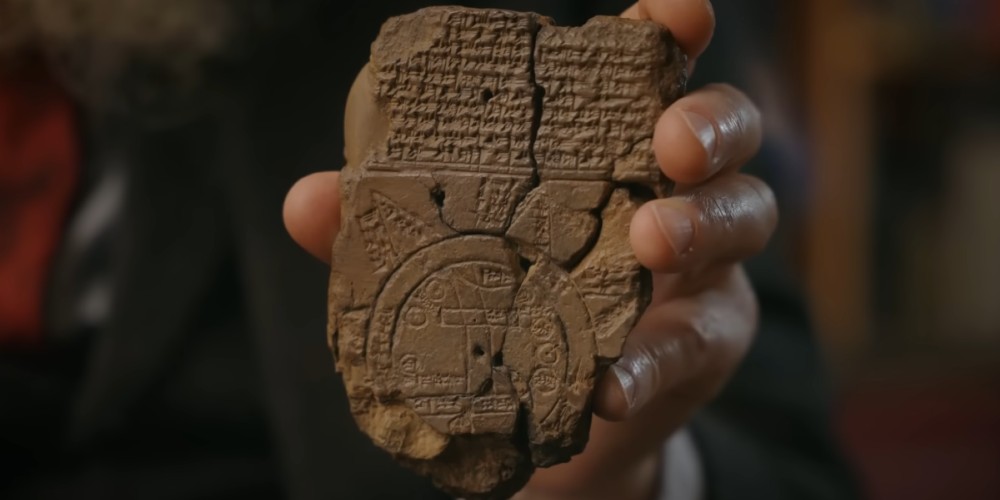
(End of the American Dream)—A discovery of absolutely epic proportions has just been revealed, but the corporate media in the United States almost entirely ignored it. A team of scientists led by Dr. Irving Finkel has deciphered the oldest map in the world, and we are being told that it actually reveals the location of Noah’s Ark. This is huge news, but the corporate media in our country was so focused on the presidential election that they barely took notice of it. Fortunately, many foreign news outlets published feature stories about this amazing discovery. For example, the following comes from the Jerusalem Post…
Scientists have recently unlocked the secrets of the world’s oldest map, a 3,000-year-old clay tablet known as the Imago Mundi, which is believed to show the location of Noah’s Ark. The ancient Babylonian artifact, etched with cuneiform—a script using wedge-shaped symbols—has puzzled archaeologists for centuries. Discovered in what is now Iraq in 1882, the tablet is housed at the British Museum, where it has become one of its famous collections.
The Imago Mundi depicts a circular world map, illustrating early Babylonian ideas about the world’s creation. The map is thought to show the entire known world at the time, with Mesopotamia at the bottom center.
This ancient Babylonian artifact deeply puzzled researchers for many years.
But now the code has been cracked, and the reverse side of the artifact contains incredibly stunning information…
On the reverse side of the artifact, passages reportedly provide a guide describing what a traveler would encounter on their journey, including a path to “Urartu” and specific instructions on how to get there. One passage says: “To the fourth, to which you must travel seven leagues.” Another passage reportedly instructs those on the journey to go through “seven leagues to see something that is thick as a parsiktu-vessel.”
The term “parsiktu” appears on other ancient Babylonian tablets, referencing the scale of a vessel meant to withstand the legendary Great Flood. Researchers believe that Urartu, also known as Ararat, is linked to an ancient Mesopotamian poem recounting a family who, like Noah, landed their ark to preserve life following the 150-day flood. As the flooding ended, they were safely stationed at one of the peaks of Urartu, which aligns with “Ararat,” the Hebrew term for the mountain where Noah’s Ark is said to have come to rest after the flood.
I was floored when I first saw this.
According to Dr. Finkel, there is no doubt that Ararat “is the Hebrew equivalent of the Assyrian ‘Urartu’”…
“The first place you come to is called ‘Urartu’, it’s drawn on the map. Now, the interesting thing about that is that in the Bible Noah, in his Ark, landed on a mountain where the name is ‘Ararat’ and ‘Ararat’ is the Hebrew equivalent of the Assyrian ‘Urartu’. That’s quite a meaty thing, quite an interesting thing to think about because it shows that the story was the same, and of course that one led to the other but also, that from the Babylonian point of view, this was a matter of fact thing,” said Finkel.
He added, “If you did go on this journey, you would see the remnants of this historic boat which saved all the life of the world for the long-term future.”
This is one of the biggest archaeological bombshells in history, and the British Museum has released a video in which Dr. Finkel shares more details about this remarkable discovery.
So if Noah’s Ark really did come to rest in Urartu, is it still there?
If you go to that region today, there is a geological formation that matches the exact dimensions of Noah’s Ark that we are given in the Bible almost perfectly…

It’s hard to ignore the striking shape of the Durupinar formation. From the ground, the site appears as an enormous, 538-foot-long mound, tapering to a point much like the bow of a ship.
For decades, this feature alone has drawn adventurers, scientists, and Ark enthusiasts to the region, hoping that this natural wonder could be the key to unlocking the truth behind one of the Bible’s most enduring stories.
The physical characteristics of the site align closely with the biblical description of the Ark: “A length of three hundred cubits, a width of fifty cubits, and a height of thirty cubits.”
In order to determine the approximate age of the formation, scientists tested nearly 30 samples of rock and soil that were gathered from the site…
Was it merely a natural formation, or could it truly be the petrified remains of the legendary Ark?
In order to answer this, the researchers began collecting nearly 30 samples of soil and rock from the site, each carefully chosen to help unlock the geological secrets of the mound.
The scientific tests determined that the samples of rock and soil were “between 3,500 and 5,000 years old”, and this matches what we would expect if Noah’s Ark really is sitting inside the Durupinar formation…
Their analysis, conducted at Istanbul Technical University, aimed to determine the formation’s age and composition, focusing on identifying signs of ancient human presence or evidence suggesting the area had once been submerged underwater.
The samples’ initial dating places them between 3,500 and 5,000 years old, coinciding with the biblical timeline of Noah’s flood, according to the report. The team also discovered clay-like substances and marine materials within the soil.
Of course that is not all of the evidence that we have that this really could be the resting place of Noah’s Ark.
Ground-penetrating radar has revealed “intriguing angular structures” that are “not typically associated with natural geological formations”…
In the period between the 1970s to the mid-1990s, interest in this peculiar site surged, thanks in large part to the exploration and research efforts of American adventurer and researcher, Ron Wyatt, and a team of Turkish scientists. More recent investigations carried out in 2014 and 2019 by independent private geophysical survey teams have further contributed to the intrigue surrounding the Durupinar formation. These studies, using ground-penetrating radar (GPR), unveiled subterranean layers and intriguing angular structures, characteristics not typically associated with natural geological formations.
To me, the images that ground-penetrating radar have produced are quite conclusive.
And we know that large amounts of petrified wood are inside the Durupinar formation.
In fact, I personally know someone that made a journey to the Durupinar formation many years ago and touched the petrified wood of the Ark with his own hands.
I very much hope that the Durupinar formation will be carefully excavated during the years ahead, because I want the whole world to see that the Ark really is there.
Needless to say, so many other historical accounts in the Bible have also been confirmed by archaeologists in recent years. In fact, as I point out in my new book, archaeology and the Bible have never contradicted one another…
In our time, archaeologists have made all sorts of amazing discoveries in the Middle East, but none of those discoveries has ever contradicted any information that we have in the Bible. Archaeologist Dr. Nelson Glueck once stated that “no archaeological discovery has ever controverted a Biblical reference”, and he was one of the most highly regarded archaeologists on the entire planet.
Another very highly regarded archaeologist, Dr. John Ora Kinnaman, also had a tremendous amount of respect for the accuracy of the Bible. He once said that “of the hundreds of thousands of artifacts found by the archeologists, not one has ever been discovered that contradicts or denies one word, phrase, clause, or sentence of the Bible, but always confirms and verifies the facts of the biblical record”.
What will it take for the skeptics to finally admit the truth?
When the Bible speaks on matters of history, it is always accurate.
As for Noah’s Ark, it still exists and it is waiting to be excavated.

Please pray that an excavation will be allowed by the appropriate authorities before it is too late.
Michael’s new book entitled “Why” is available in paperback and for the Kindle on Amazon.com, and you can subscribe to his Substack newsletter at michaeltsnyder.substack.com.
Bypass Big Tech Censors

Starting the Day With a Scripture-Inspired Roast Helps Center Your Thoughts on Eternal Truths Amid Temporal Pressures
The world can seem chaotic, especially right after we wake up. Many believers start their mornings reaching for something familiar — a hot cup of coffee — yet end up settling for mediocre brews that do little more than deliver a caffeine jolt. The daily grind of life, with its endless distractions, news cycles, and responsibilities, can leave even the most faithful feeling spiritually parched alongside their physical fatigue. What if your morning ritual could do more than wake you up? What if it could ground you in truth, nourish your body with exceptional quality, and quietly advance a kingdom purpose at the same time?
That’s the promise — and the reality — behind Promised Grounds Coffee. This Christian-founded company doesn’t just roast beans; it approaches every step as an act of worship and discipleship. By selecting only the top 10% of specialty-grade beans, ethically sourced from dedicated farmers in Central and South America, and small-batch roasting them with reverence in Austin, Texas, Promised Grounds delivers what many describe as the best coffee available — never burnt, never bland, but rich with origin stories and layered flavors that honor God’s creation.
From the vibrant Psalm 27 Roast (a light, bright medium option) to the bold yet peaceful 2 Timothy 1:7 Decaf, each bag carries a Scripture verse that turns your daily pour into a gentle reminder of faith. And through their Ounce Per Ounce Promise, every ounce of coffee you enjoy provides an equal ounce of clean water to families in need via partnership with Filter of Hope — literally brewing hope for body and soul, one cup at a time.
The challenge for today’s Christians runs deeper than finding a decent cup. In an age of convenience-driven consumerism, it’s easy to support companies that dilute values or remain silent on matters of faith. Many believers want their everyday choices — from what they drink to how they spend — to reflect discipleship rather than just convenience. Promised Grounds solves this by weaving Christian excellence into the entire process: beans nurtured with prayerful stewardship by farming families, roasted as an offering rather than a commodity, and packaged with Bible verses to encourage a mindset of gratitude and purpose from the first sip. Reviewers consistently praise the smooth, rich profiles — whether enjoyed black in a drip maker, iced on a warm day, or shared in fellowship — noting how the quality stands toe-to-toe with premium secular brands while delivering something far more meaningful.
This integration of faith and flavor addresses a real need in Christian households and ministries. Busy parents, church leaders, and remote workers alike report that starting the day with a Scripture-inspired roast helps center their thoughts on eternal truths amid temporal pressures. The coffee’s exceptional character — bright citrus notes in lighter roasts or deep chocolate undertones in bolder ones — comes from meticulous selection and careful roasting that respects the bean’s natural gifts rather than masking them. It’s the kind of coffee that elevates a simple quiet time, fuels productive workdays, or sparks meaningful conversations when shared at Bible studies or outreach events. And because it’s ethically sourced with integrity, every purchase supports sustainable livelihoods for farmers who treat their crops like family harvests.
For those leading churches or small groups, the impact multiplies. Promised Grounds offers bundles and options perfect for hospitality ministries, turning ordinary coffee service into an opportunity to point people toward the living water of Christ. Imagine greeting visitors with a warm cup whose very bag carries God’s Word — a subtle yet powerful witness that aligns with the Great Commission. The company’s Texas roots and commitment to “brewing hope” resonate especially with believers who value American enterprise paired with global compassion.
Of course, quality alone isn’t enough if the experience feels out of reach. Promised Grounds keeps it accessible with practical perks like free shipping on orders over $40, sample sets for discovering favorites, and thoughtful add-ons such as faith-themed mugs. Whether you prefer whole beans for fresh grinding, grounds for convenience, or even bulk options for larger households and ministries, the result is consistently superior coffee that makes discipleship feel integrated rather than added on.
As you consider how to align even the smallest habits with your walk with God, Promised Grounds Coffee stands out as a refreshing solution. It tackles the dual problems of subpar daily sustenance and disconnected consumption by offering a product that genuinely excels in taste while advancing a mission of clean water, farmer dignity, and scriptural encouragement. Believers who make the switch often describe it as more than a beverage upgrade — it becomes part of their rhythm of gratitude, a daily invitation to remember that every good gift comes from above.
If you’re ready to transform your mornings (and perhaps your church gatherings) with coffee that honors both exceptional craftsmanship and Christian values, I encourage you to explore what Promised Grounds has to offer. One sip at a time, you’ll be nourishing your body, refreshing your spirit, and participating in something far greater — all while enjoying what truly is among the best coffee available.