
(The Epoch Times)—Sheriffs will likely play a key role in helping federal agents secure the border and deport illegal immigrants under President-elect Donald Trump.
Trump made mass deportation of illegal immigrants a key part of his campaign to win a second term as almost 11 million people flooded into the country illegally since 2021.
The president-elect’s incoming border czar, Tom Homan, has signaled a new era of federal, state, and local cooperation when it comes to deporting illegal immigrants.
Homan, the former acting head of U.S. Immigration and Customs Enforcement (ICE), indicated he will first target those who have criminal convictions or are wanted for crimes.
“The nation wants a safe country. We’ve had enough crime in this country,” Homan said during a stop at the Texas border in November.
Sheriffs in the nation’s 3,100 counties could play an essential role in helping ICE to identify and detain illegal immigrants, said Sam Bushman, CEO of the Constitutional Sheriffs and Peace Officers Association (CSPOA), a conservative organization that opposes “unconstitutional” government overreach.
As chief law enforcement officers in their counties, elected sheriffs have more latitude than appointed police chiefs. They have authority over criminal investigations, serving warrants, managing county jails, and providing court security within the county.
Bushman foresees cooperation between willing county, state, and federal authorities to deport illegal immigrants, possibly through the creation of a new coordination agency or command center.

“I think that we could create an organization that communicates with this trifecta, and that would be very effective,” he said.
Richard Mack, a former Arizona sheriff and founder of CSPOA, has been in contact with Homan and believes sheriffs will be an integral part of border security and deportation efforts because of their unique understanding of their jurisdictions.
“Who in this country knows their counties better than the sheriff?” he asked.
Because of their local knowledge, sheriffs are in a unique position to help make deportation safer and easier, Mack told The Epoch Times.
Regardless of politics, sheriffs must protect their constituents from crime and criminals, both tied to illegal immigration in terms of drug and human smuggling along with violent gang activity, he said.
Policy experts have suggested that the federal government could deputize local law enforcement under its 287(g) program to aid ICE because the agency likely doesn’t have the manpower to do so alone.
The 287(g) program currently provides a framework of cooperation wherein local jails work with ICE to identify illegal immigrants as they are booked for a crime. ICE and designated local law enforcement can then hold that inmate for up to an additional 48 hours so that ICE can take custody of the inmate.
Homan has touted the program as a safe deportation pipeline, as ICE officers can pick up deportees within the safety of a jail setting, rather than having to organize an operation out in the community.
ICE has about 20,000 employees, including support personnel. ICE’s Enforcement and Removal Operations (ERO) has 6,100 deportation officers and more than 750 enforcement removal assistants who are assigned to 24 field offices, according to an agency website.
Former Chief of the U.S. Border Patrol Rodney Scott, who served under both Trump and Biden, said in a previous interview with The Epoch Times that Trump could expand the 287(g) program to help with deportations, as he did during his first term.
Scott was recently nominated by Trump to serve as the incoming Customs and Border Protection commissioner.
He said the 287(g) program also allows the creation of a task force and hybrid model that would enable local and state law enforcement to arrest illegal immigrants.

In the blue state of Maryland, Frederick County Sheriff Chuck Jenkins, a longtime Republican, recalls when the task force model was operational in 2008.
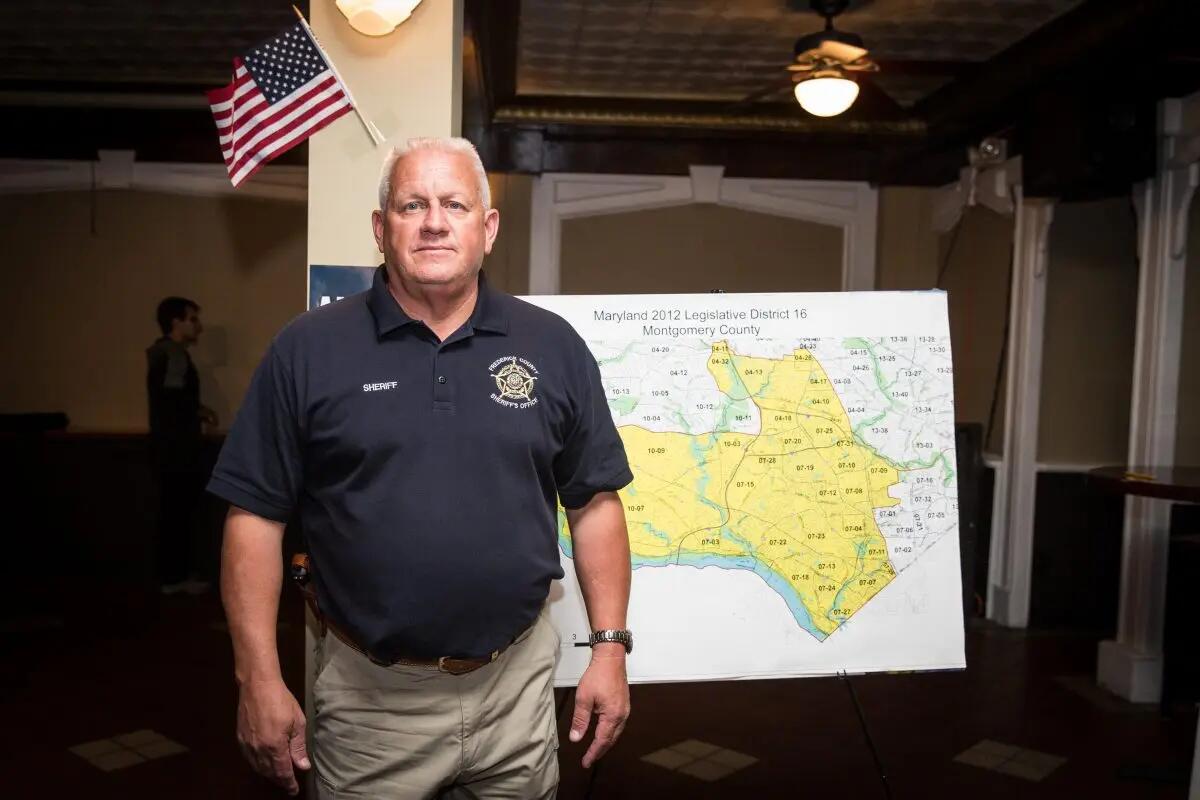
“We had deputies on the street that could work at the direction of ICE and with ICE to take into custody people who had deportation warrants and so forth,” Jenkins told The Epoch Times.
Reinstating the task force model would help expedite the deportation of criminals in the country illegally, he said.
The Trump administration could also send representatives to local sheriff departments to recruit them to join the program, he said.
“ICE can’t do it alone, or certainly not enough,” Jenkins said. “We need to be a force multiplier for them.”
Tying federal grant money to sheriff department cooperation with ICE would likely convince many to come on board, he said.

Even if sheriffs don’t participate in arresting illegal immigrants, they could help in other ways, such as providing transportation and logistical support and workspace for ICE, he said.
Jenkins said Frederick County’s jail-based detainer program has been successful, resulting in the removal of about 2,000 illegal immigrant criminals in the county.
Under the 287(g) program, sheriff’s office employees are trained to file a detainer and prepare the paperwork under the supervision of ICE in an effort to streamline the process, he said.
San Diego County Sheriff Kelly Martinez, who serves in the nation’s fifth most populous county, has vowed to defy a new county policy to limit cooperation with federal deportation efforts.
Earlier this month, San Diego County supervisors voted to ban its sheriff department from working with ICE on the federal agency’s enforcement of civil immigration laws, including those that allow for deportations.
California law generally prohibits cooperation but makes exceptions for those convicted of certain violent crimes.

Martinez, whose office is nonpartisan but considers herself a Democrat, said she wouldn’t honor the new policy and that the county government doesn’t oversee her office.
“Current state law strikes the right balance between limiting local law enforcement’s cooperation with immigration authorities, ensuring public safety, and building community trust,” Martinez said.
In the blue state of Michigan, Barry County Sheriff Dar Lief said it is important to remove violent criminals from the streets.
“I’m on board with that,” he told The Epoch Times.
Lief echoed the belief of Trump and his surrogates during the presidential campaign that many of the illegal immigrants coming into the country were from prison systems or asylums.
“Nonetheless, our governor here asked residents to take in illegal immigrants,” he said. “Who are you opening up your house to?”
Lief said he warned the citizens of Barry County against taking in illegal immigrants, which Gov. Gretchen Whitmer called “new Americans,” because there was no guarantee they were properly vetted.
Not all blue states or city leaders are against Trump’s deportation plan to remove criminal illegal immigrants.
New York City Mayor Eric Adams met with Homan recently to discuss deporting illegal immigrants who commit violent crimes in the Democrat-run city.
“We will not be a safe haven for those who commit violent acts. We don’t do it for those who are citizens, and we’re not going to do it for those who are undocumented,” Adams said during a press conference.

Adams said law-abiding illegal immigrants are welcome in the city. Still, it was a “terrible mistake” to allow those in the country unlawfully to commit violent crimes repeatedly, especially those associated with gangs.
New York Gov. Kathy Hochul said in November during a press conference that she supports “legal” immigrants, including asylum-seekers, but not criminals here illegally or those committing crimes.
Bypass Big Tech Censors
“Someone breaks the law—I‘ll be the first one to call up ICE and say, ’Get them out of here,’” she said.
Homan said blue city officials don’t have to cooperate, but he has repeatedly warned them not to stand in his way.
Homan recently announced he would begin deportations in Chicago, criticizing Chicago Mayor Brandon Johnson and Illinois Gov. J.B. Pritzker for resisting the removal of criminal immigrants.
“If he impedes us, if he knowingly harbors and conceals an illegal alien, I will prosecute him,” Homan said of the Chicago mayor.

Texas Model
Homan said during a visit to the Texas border town of Eagle Pass before Thanksgiving that the state’s operation to stop illegal immigration could become a national model.
He praised Texas Gov. Greg Abbott’s Operation Lone Star, a $10-billion border mission to string razor wire along the border, place buoy barriers in the Rio Grande, help build a border wall, and bus illegal immigrants to sanctuary cities.

The operation consists of Department of Public Safety law enforcement and Texas National Guard members.
The program also focuses on arresting illegal immigrants for trespassing on private ranchland along the border—offering a unique roadmap for how counties could help deport illegal immigrants.
Brent Smith, the county attorney for Kinney County, has plenty of experience dealing with illegal immigrants in his county, which sits along the Texas–Mexico border.
Kinney County has prosecuted the largest number of illegal immigrants for trespass and related misdemeanors under Operation Lone Star.
In 2019 and 2020, the small, rural county dealt with just 254 and 132 misdemeanor cases, respectively, mostly involving U.S. citizens.
The U.S. citizen caseload has remained somewhat constant, but because of illegal immigration, the total number of misdemeanor cases shot up to 6,799 in 2022 and 5,826 in 2023, according to numbers obtained from the county attorney’s office.
Smith told The Epoch Times that trespassing arrests in Kinney County under Operation Lone Star offered valuable lessons on how to run a border security initiative.
At first, funding went to provide law enforcement, but Smith said it became clear that there needed to be more funding for the entire county justice system for prosecutors, public defenders, clerks, and judges to process illegal immigrants charged with trespassing.

“What I foresee is some very strong 287(g) agreements being entered into, and state and local law enforcement actually becoming an arm of the Department of Homeland Security (DHS) immigration enforcement,” he said.

He said that after undergoing a DHS training program, local officers are considered immigration officers under the supervision of an ICE agent.
He pointed to former Maricopa County Sheriff Joe Arpaio, who was known for implementing the 287(g) task force successfully to arrest illegal immigrants in Arizona but came under fire during the Obama administration.
Maricopa County’s 287(g) program was canceled in 2011 after a Department of Justice investigation accused the sheriff of racial profiling.
In 2012, the Obama administration discontinued the task force and hybrid models of the program altogether.
Trump expanded the program in his first term to 150 agreements with local law enforcement and broadened the removal criteria to include misdemeanors.
Under the Biden administration, new 287(g) agreements were paused.
Smith said that once Trump ends the Biden administration’s catch-and-release policy, there will be more “gotaways,” which will require a shift in resources to focus on apprehension instead of processing those claiming asylum.
Money—or the lack of it—will be an essential tool in deportation and border security, he said.
On the state level, he has been discussing a bill with Texas lawmakers that would require sheriffs to apply for 287(g) agreements before receiving state grant funding.
The same principle could be applied to federal grant money for cities such as Chicago, he said.
“How much is your political leanings worth to you? Is it worth $1,000, or $100,000, or $2 million?” he said. “We’re going to find out.”
Bypass Big Tech Censors
Starting the Day With a Scripture-Inspired Roast Helps Center Your Thoughts on Eternal Truths Amid Temporal Pressures
The world can seem chaotic, especially right after we wake up. Many believers start their mornings reaching for something familiar — a hot cup of coffee — yet end up settling for mediocre brews that do little more than deliver a caffeine jolt. The daily grind of life, with its endless distractions, news cycles, and responsibilities, can leave even the most faithful feeling spiritually parched alongside their physical fatigue. What if your morning ritual could do more than wake you up? What if it could ground you in truth, nourish your body with exceptional quality, and quietly advance a kingdom purpose at the same time?
That’s the promise — and the reality — behind Promised Grounds Coffee. This Christian-founded company doesn’t just roast beans; it approaches every step as an act of worship and discipleship. By selecting only the top 10% of specialty-grade beans, ethically sourced from dedicated farmers in Central and South America, and small-batch roasting them with reverence in Austin, Texas, Promised Grounds delivers what many describe as the best coffee available — never burnt, never bland, but rich with origin stories and layered flavors that honor God’s creation.
From the vibrant Psalm 27 Roast (a light, bright medium option) to the bold yet peaceful 2 Timothy 1:7 Decaf, each bag carries a Scripture verse that turns your daily pour into a gentle reminder of faith. And through their Ounce Per Ounce Promise, every ounce of coffee you enjoy provides an equal ounce of clean water to families in need via partnership with Filter of Hope — literally brewing hope for body and soul, one cup at a time.
The challenge for today’s Christians runs deeper than finding a decent cup. In an age of convenience-driven consumerism, it’s easy to support companies that dilute values or remain silent on matters of faith. Many believers want their everyday choices — from what they drink to how they spend — to reflect discipleship rather than just convenience. Promised Grounds solves this by weaving Christian excellence into the entire process: beans nurtured with prayerful stewardship by farming families, roasted as an offering rather than a commodity, and packaged with Bible verses to encourage a mindset of gratitude and purpose from the first sip. Reviewers consistently praise the smooth, rich profiles — whether enjoyed black in a drip maker, iced on a warm day, or shared in fellowship — noting how the quality stands toe-to-toe with premium secular brands while delivering something far more meaningful.
This integration of faith and flavor addresses a real need in Christian households and ministries. Busy parents, church leaders, and remote workers alike report that starting the day with a Scripture-inspired roast helps center their thoughts on eternal truths amid temporal pressures. The coffee’s exceptional character — bright citrus notes in lighter roasts or deep chocolate undertones in bolder ones — comes from meticulous selection and careful roasting that respects the bean’s natural gifts rather than masking them. It’s the kind of coffee that elevates a simple quiet time, fuels productive workdays, or sparks meaningful conversations when shared at Bible studies or outreach events. And because it’s ethically sourced with integrity, every purchase supports sustainable livelihoods for farmers who treat their crops like family harvests.
For those leading churches or small groups, the impact multiplies. Promised Grounds offers bundles and options perfect for hospitality ministries, turning ordinary coffee service into an opportunity to point people toward the living water of Christ. Imagine greeting visitors with a warm cup whose very bag carries God’s Word — a subtle yet powerful witness that aligns with the Great Commission. The company’s Texas roots and commitment to “brewing hope” resonate especially with believers who value American enterprise paired with global compassion.
Of course, quality alone isn’t enough if the experience feels out of reach. Promised Grounds keeps it accessible with practical perks like free shipping on orders over $40, sample sets for discovering favorites, and thoughtful add-ons such as faith-themed mugs. Whether you prefer whole beans for fresh grinding, grounds for convenience, or even bulk options for larger households and ministries, the result is consistently superior coffee that makes discipleship feel integrated rather than added on.
As you consider how to align even the smallest habits with your walk with God, Promised Grounds Coffee stands out as a refreshing solution. It tackles the dual problems of subpar daily sustenance and disconnected consumption by offering a product that genuinely excels in taste while advancing a mission of clean water, farmer dignity, and scriptural encouragement. Believers who make the switch often describe it as more than a beverage upgrade — it becomes part of their rhythm of gratitude, a daily invitation to remember that every good gift comes from above.
If you’re ready to transform your mornings (and perhaps your church gatherings) with coffee that honors both exceptional craftsmanship and Christian values, I encourage you to explore what Promised Grounds has to offer. One sip at a time, you’ll be nourishing your body, refreshing your spirit, and participating in something far greater — all while enjoying what truly is among the best coffee available.