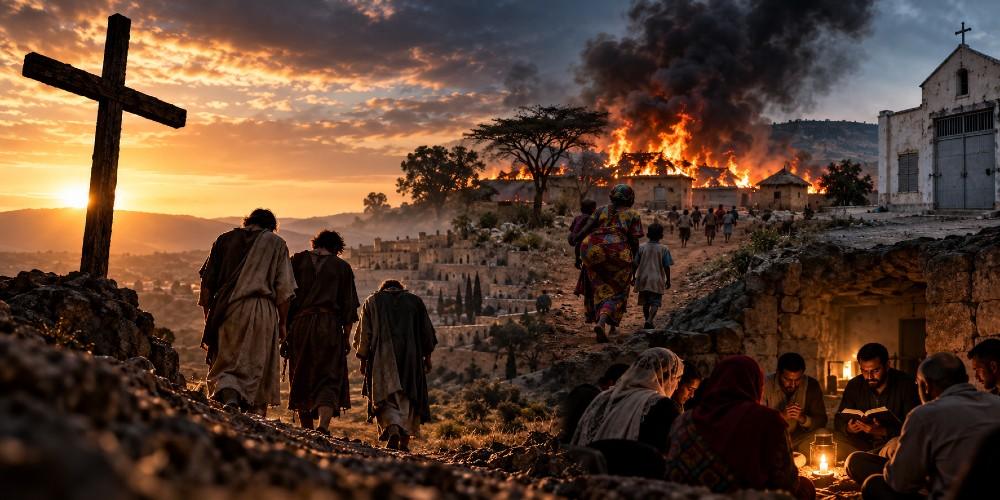
Everyone who ever signed on to the winning side signed a contract that runs through Friday before it reaches Sunday. That was the arrangement for the men who watched their rabbi die between two thieves and walked home convinced they had wasted three years of their lives, and it has been the arrangement ever since. The losses piling up around the global church right now are not evidence that we backed the wrong horse.
They are the receipt.
The numbers are worse than most American Christians realize. An estimated 388 million believers now live under high levels of persecution, up eight million in a single year, with 4,849 killed during the reporting period, 224,129 driven from their homes, and fifteen countries now registered at the most extreme level of hostility, up from thirteen.
Nigeria alone accounted for roughly 3,490 of those deaths, about seventy percent of the global total. The director of Open Doors put the irony plainly when the list came out, noting that the center of gravity of Christianity has shifted to Africa — and that Africa is precisely where it is being hunted.
So how should the church read a season like this? Two wrong answers are on offer, and both are selling well. The first says the scoreboard proves God has left the field, so retreat into private faith and wait it out. The second says the scoreboard proves we have been too nice, so pick up the enemy’s methods, swap the gospel for a power strategy, and win at any cost.
Neither one survives contact with Scripture, and the second is far more dangerous than the first.
The Floor of the Argument Is in Nigeria
Any honest conversation about Christian suffering has to start where the bodies are. In Plateau State this August, armed Fulani militants attacked predominantly Christian villages and killed at least thirty-one people, among them an infant three months old, burning homes as families fled. Algeria has now sealed nearly every evangelical congregation connected to its Protestant Church association, leaving believers to gather quietly in living rooms, garages, and under olive trees. In Pakistan last month, a young Christian woman was shot dead inside her own home by a neighbor, a teenage Christian was beaten by a mob, and another Christian man was jailed on a blasphemy accusation that will follow him for the rest of his life whether or not a court ever convicts him.
These are not statistics from a fundraising brochure. They are the ordinary weekly output of a world in which roughly one of every seven Christians pays a price for the name.

A Win That Lasted About Ninety Days
Here is the part that proves the thesis better than any casualty figure. Late last year, after an extended lobbying campaign by religious freedom advocates, Trump designated Nigeria a Country of Particular Concern, threatened to cut off aid, and ordered the Pentagon to prepare for action. On Christmas Day, American forces struck Islamic State positions in Sokoto state in coordination with Nigerian authorities.
Trump followed it with a warning that left nothing to interpretation.
If they continue to kill Christians, it will be a many-time strike.
That was a genuine win. We’ll take it because a church that cannot recognize a win has no business complaining about losses. Then came the sequel. Abuja hired a lobbying firm to persuade Washington that the picture it had been given was inaccurate, and by late January the two governments were inaugurating a joint counterterrorism working group in the Nigerian capital. Threat became partnership. Pressure became process. And the villages kept burning.
Real, partial, immediately eroded. That is what victory looks like on this side of eternity, and anyone who expected otherwise was reading a different book than the one we claim to believe.
Two Pincers and Only One of Them Can Kill Us
The external pressure is easy enough to see. A coalition has formed between people who believe religion is a tool of oppression and people who believe their religion should oppress, and it holds together beautifully, because shared enemies bond far more reliably than shared beliefs. Whatever else it is, it is effective, and it is not going to be argued out of existence at a conference.
The internal threat is the one that should keep pastors awake. A movement has grown up in the last few years that has learned to quote chapter and verse fluently while emptying the words of their content, reducing Christ to a tribal mascot and dressing very old hatreds in freshly pressed theological clothing.
It speaks constantly of winning. It measures everything by whether it advances a faction. It treats anyone who objects as a traitor rather than a brother with an argument, which is precisely the move it claims to despise in the left.
Paul warned the Ephesian elders about exactly this order of danger, and he did not put the wolves outside the walls.
For I know this, that after my departing shall grievous wolves enter in among you, not sparing the flock. Also of your own selves shall men arise, speaking perverse things, to draw away disciples after them.
Diocletian never did to the church what Arius did. Persecution has produced martyrs for two thousand years. Heresy produces something worse, a counterfeit that still uses the name.
Our Losses Are Real and They Are Not That
American Christians are losing things. The Family Research Council has documented well over a thousand hostile acts against churches since 2018. A gunman opened fire on children at a school Mass in Minneapolis. A man drove a truck into a chapel in Grand Blanc, shot the congregants, and set the building on fire. Three houses of worship in Far Rockaway were tagged with anti-Christian graffiti. A Baptist church in Oklahoma City was vandalized and burned in January. None of that is imaginary, and pretending otherwise to seem humble helps nobody.
But a believer who loses a client over a social media post and a mother in Plateau State burying a three-month-old are not serving the same sentence, and the difference matters. Much of what American Christians file under persecution is more accurately filed under inconvenience.
We are mocked. We are passed over. We lose arguments, followers, and the occasional friendship. That is the cost of standing somewhere in a culture that has decided our standing place is disqualifying, and it is a cost, but it is not a machete.

The honest question is not whether the annoyances are real. It is what they reveal. A man who cannot endure being unpopular at the office has no reason to assume he would endure anything heavier. Small pressure exposes what large pressure would finish.
Nothing in the Script Promised Us a Winning Record
When the disciples asked for signs of the end, Jesus did not describe an expanding Christian civilization. He described the opposite.
Then shall they deliver you up to be afflicted, and shall kill you, and ye shall be hated of all nations for my name’s sake. And then shall many be offended, and shall betray one another, and shall hate one another. And many false prophets shall rise, and shall deceive many. And because iniquity shall abound, the love of many shall wax cold. But he that shall endure unto the end, the same shall be saved.
Betrayal from within. Deception dressed as prophecy. Love going cold. And exactly one instruction, which is not to win but to endure. Nobody here is setting dates or reading headlines as a countdown clock, and nobody should trust anyone who does. But the pattern described in that passage is not difficult to recognize from where we are standing, and a church that finds recent years bewildering has not been paying attention to its own text.
Sealed Buildings, Unsealed Church
The writer of Hebrews catalogued a long list of believers who were tortured, mocked, scourged, imprisoned, stoned, and sawn asunder, and then closed the ledger with a line that should be read slowly by anyone keeping score. These all, having obtained a good report through faith, received not the promise. They lost, by every measurement available to them, and they are listed among the commended.
Algeria sealed the church buildings and did not touch the church. It relocated to garages and olive groves, where it is doing precisely what it did in the first century, which is grow. That is the pattern nobody in any ministry of religious affairs has ever managed to break. The scoreboard we can see is not the one being kept, and the final score was settled outside a tomb before any of us drew a breath.
Suffering a whole lot of losses along the way is not the price of being wrong. It is the evidence of being on a side whose victory was never scheduled for a date we get to choose.

Bypass Big Tech Censors
Two Storms, One Harvest

Every food crisis in living memory has been a one-shock event. The 2008 price spike was a commodity bubble. The 2020 shortages were a logistics failure. The 2022 grain scare was a war on one exporter’s ports. Each time, the system bent, adjusted, and recovered, and each time the experts assured us afterward that global markets are simply too big and too diversified to fail.
What nobody in Washington seems eager to discuss is that 2026 is shaping up to be something the modern food system has never actually faced. Two independent shocks, one climatic and one geopolitical, are converging on the same harvest cycle at the same time. Not sequentially. Simultaneously.
Start with the weather. The Pacific Ocean is currently building toward what forecasters now openly call a record event. NOAA’s Climate Prediction Center puts the odds of at least a strong El Niño near 88 percent, with roughly two in three odds it reaches “very strong” status, the tier reserved for perhaps three or four events in the entire satellite era. Every major global model now projects a median peak in Super El Niño territory, and most of them project it exceeding the 2015-16 event, which until now held the modern record. Sea surface anomalies were already brushing the super threshold in mid-July, months before these events normally peak. The atmosphere has already shifted into El Niño mode, and the event is forecast to crest in late fall and early winter.
This is not about “climate change.” It’s about the standard cycles of weather, and the cycle we’re currently in is one that has likely devastated societies in the past. We’re better prepared as a society today, but not all Americans are equally prepared.
Serious households have started doing the quiet math on their own. Grocery bills tell part of the story, and the forecast maps tell the rest, which is why long-term food storage has moved from fringe hobby to mainstream line item in the family budget, with established suppliers like Heaven’s Harvest seeing demand from people who five years ago would have rolled their eyes at the idea. That instinct is not paranoia. It is pattern recognition, and the pattern is worth walking through carefully.
Editor’s Note: Heaven’s Harvest IS a sponsor, but the warnings of this article are real and would be written even if we didn’t have a survival food sponsor. With that said, those who take advantage of what they offer can use promo code “Patriot” for 15% off.
The Fertilizer Clock Is Already Running
While the Pacific warms, the second shock has been unfolding in the Strait of Hormuz. The conflict with Iran turned the world’s most important energy chokepoint into a contested waterway, and the consequences reach far beyond the gas pump. Roughly a third of global fertilizer trade moves through Hormuz, and the disruption sent urea prices up 86 percent year over year by March, with a 53 percent jump in a single month.
The World Bank projects energy prices rising about 24 percent in 2026 and fertilizer about 31 percent. By its own accounting, fertilizer prices ran 35 percent higher in the first five months of this year than the same period last year.
Here is the mechanism the nightly news will not explain. Fertilizer is not a grocery item. It is a time-delayed input. The nitrogen a farmer in Iowa or Punjab could not afford to apply this spring does not show up as a problem this spring. It shows up as a thinner harvest six to twelve months later.
The World Bank’s own food security brief concedes that the effects of reduced applications earlier this season “are likely to become visible only later in harvest outcomes.” Translate that from institutional language into plain English and it means this. The damage is already done, it is already in the ground, and we are simply waiting for it to arrive on the shelf.
Now check the calendar. Six to twelve months from the spring planting season lands us squarely in late 2026 and early 2027. Which is precisely when the strongest El Niño in the instrumental record is forecast to peak, bringing its signature droughts to Southeast Asia, Australia, southern Africa, northern Brazil, and South Asia, the very regions that grow the world’s rice, sugar, and oilseeds.
The World Bank warns openly that a strong El Niño “could disrupt multiple crop belts simultaneously” on top of the conflict-driven input costs. Their baseline projection assumes the Middle East disruptions ease by autumn. What in the last two years of Middle East history suggests that assumption is safe?
The System Has No Slack Left
The comfortable answer is that global markets always adjust. But adjustment requires slack, and the slack is gone. Global cereal production is expected to decline from last year’s records even before El Niño does its work. The UN World Food Programme, hardly a den of right-wing preppers, is calling this the most significant disruption to its supply chains since Covid and the invasion of Ukraine, and its supply chain director put the stakes bluntly.
Today’s supply chain challenges are tomorrow’s hunger crisis.
There is also a political dimension that markets cannot price. When food gets scarce, governments do not behave like economists. They behave like politicians. Export bans, hoarding mandates, and panic buying at the national level turned the modest rice shortfall of 2008 into a global crisis, and analysts are already warning that import-dependent nations are the first dominoes.
The 2015-16 Super El Niño, a far weaker event than what is now forecast, threw tens of millions into food stress across Africa and Asia. This one is projected to be stronger, and it arrives with fertilizer already rationed by price and shipping lanes already contested by missiles.
What Joseph Knew
Scripture does not treat preparation for lean years as faithlessness. It treats it as wisdom delivered in advance to those willing to act on it.
Behold, there come seven years of great plenty throughout all the land of Egypt: And there shall arise after them seven years of famine; and all the plenty shall be forgotten in the land of Egypt.
Joseph did not respond to that warning with a hashtag or a committee. He stored grain during the years of abundance, and when the famine came, Egypt stood while its neighbors begged. The lesson is not that famine is certain. It is that the time to prepare is precisely when preparation still looks optional.
Nobody who filled a pantry in a year of plenty has ever regretted it, and nobody standing in an empty aisle has ever been glad he waited for certainty.
None of this calls for panic, and panic is the enemy of sound judgment anyway. It calls for the same unglamorous prudence our grandparents considered ordinary. Keep some cash margin, know your local growers, and put real food in deep storage while it is cheap and available, because the entire arc of this story is that cheap and available is a closing window.
Families looking for a straightforward place to start can visit Heaven’s Harvest and use promo code Patriot for 15 percent off long-term storable food. The forecasts may yet soften, the strait may yet reopen, and we should pray they do. But hope is a fine thing to hold and a foolish thing to eat.