
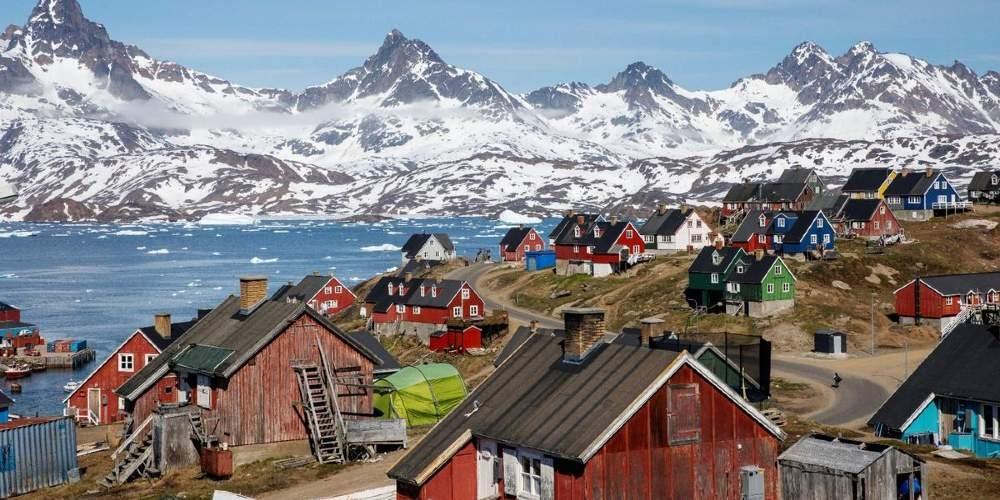
(ZeroHedge)—Stephen Miller, one of President Trump’s top aides who serves as his deputy chief of staff for policy, just poured more fuel on the fire in terms of the ongoing spat with Denmark over the future of Greenland and sovereignty.
He said in fresh remarks that there won’t be any military intervention to take the Arctic territory as simply “nobody is going to fight the United States militarily over the future of Greenland.” More importantly he spelled out the US administration’s view that Denmark fundamentally does not have a right to the resource-rich Arctic territory.
Miller was asked by reporters on whether Trump might ‘invade’ Greenland next, after this weekend’s ‘shock’ Venezuela action. “What do you mean military action against Greenland? Greenland has a population of 30,000 people,” he began his response.
“The real question is what right does Denmark have to assert control over Greenland? What is the basis of their territorial claim? What is their basis of having Greenland as a colony of Denmark?” Miller then questioned.
And he added: “The US is the power of Nato. For the US to secure the Arctic region to protect and defend Nato and Nato interests, obviously Greenland should be part of the US. And so that’s a conversation that we’re going to have as a country. That’s a process we’re going to have as a community of nations.”
Despite the somewhat absurd diplomatic circus surrounding the Greenland question, which has of course remained highly entertaining, Miller has an indisputable point on his NATO comment. If Washington were to ever pull out of NATO, the military alliance would simply become one only on paper – akin to a mere ‘EU Army’.
Denmark’s foreign policy committee is meanwhile Tuesday evening having an emergency session to try and figure out how to handle the growing diplomatic showdown with the Trump administration. According to more background and context related to the latest:
The Danish prime minister, Mette Frederiksen, responded on Monday by saying that an attack by the US on a Nato ally would mean the end of the military alliance and “post-second world war security”. It would, she warned, mark the end of “everything”.
Greenland’s prime minister, Jens-Frederik Nielsen, also made a strong statement in which he urged Trump to give up his “fantasies about annexation” and accused the US of “completely and utterly unacceptable” rhetoric. “Enough is enough,” he said.
Miller’s comments about Greenland came after his wife, the rightwing podcaster Katie Miller, posted a map on X of Greenland draped in a US flag with the caption “SOON” hours after the military operation in Venezuela.
Stephen Miller was later asked about this, to which he explained: “It has been the formal position of the US government since the beginning of this administration, frankly going back into the previous Trump administration, that Greenland should be part of the US. The president has been very clear about that.”

Trump’s Greenland rhetoric currently does appear more than just about bombastic social media claims, memes or mocking Europe – as there’s currently said to be real, high level admin discussions:
According to two people familiar with private high-level discussions and granted anonymity to share their details, the White House has shown little interest in an overture last year from Denmark’s prime minister offering the U.S. the option to increase its military presence in Greenland, where it already operates a base and has long deployed troops at liberty.
“The option of more U.S. military presence has been on the table,” said one of the people, a European defense official. “The White House is not interested.”
The second person, an American in frequent contact with the administration and European officials, said that most of what Trump says he wants out of Greenland — access to investment resources like critical minerals, more troops and military bases, better intelligence sharing — could be easily accomplished by negotiating directly with Denmark, a steadfast ally.
Europe is (as expected) immediately coming to Denmark’s defense:
Six European allies have rallied to support Denmark following renewed insistence by the US that it must have control over Greenland.
“Greenland belongs to its people, and only Denmark and Greenland can decide on matters concerning their relations,” the leaders of the UK, France, Germany, Italy, Poland, Spain, and Denmark said in a joint statement.
On Sunday, Donald Trump said the US “needed” Greenland – a semi-autonomous region of fellow Nato member Denmark – for security reasons.
Meanwhile fresh commentary by Rabobank has some creative ideas that the administration might want to take up, such as providing every Greenlander $1 million in exchange for their country, which they would likely find very attractive.
That fresh Rabobank commentary and thought experiment is re-presented in the below:
* * *
Historically, the Monroe Doctrine applied to Central and South America, but its geographic boundaries were never explicitly defined. The Trump Administration, however, may be getting creative with borders, suggesting the Doctrine could soon extend to Greenland (which is still technically in the Western Hemisphere).
Greenland first surfaced as a talking point during Trump’s campaign. This has re-emerged over the weekend with Trump announcing that the U.S. “need[s] Greenland from a national security situation,” and that “we will deal with Greenland in about two months. Let’s talk about Greenland in 20 days.” What exactly we’ll be talking about when it comes to Greenland is not yet clear, but Denmark—and the EU—is taking this as a threat.
Danish Prime Minister Mette Frederiksen has said that “if the U.S. chooses to attack another NATO country militarily, then everything stops, including NATO and thus the security that has been established since the end of the Second World War.”
Greenland’s Prime Minister had some strong words for the Trump Administration, but seemed open to negotiations. “No more pressure,” he said, “No more fantasies of annexation. We are open to dialogue. We are open to discussions. But this must happen through the proper channels and with respect for international law.”
While an outright U.S. military takeover seems unlikely, diplomatic maneuvering is another matter. Trump’s approach to Statecraft has often been described as “too much stick, not enough carrot.” In the case of Greenland, we may see a bit more carrot. Still, with a population of only around 50,000, one might imagine a thought experiment where, for the low, low price of $50 billion, the U.S. offers every Greenlander $1 million in exchange for their country. That might prove more attractive.
Bypass Big Tech Censors

Starting the Day With a Scripture-Inspired Roast Helps Center Your Thoughts on Eternal Truths Amid Temporal Pressures
The world can seem chaotic, especially right after we wake up. Many believers start their mornings reaching for something familiar — a hot cup of coffee — yet end up settling for mediocre brews that do little more than deliver a caffeine jolt. The daily grind of life, with its endless distractions, news cycles, and responsibilities, can leave even the most faithful feeling spiritually parched alongside their physical fatigue. What if your morning ritual could do more than wake you up? What if it could ground you in truth, nourish your body with exceptional quality, and quietly advance a kingdom purpose at the same time?
That’s the promise — and the reality — behind Promised Grounds Coffee. This Christian-founded company doesn’t just roast beans; it approaches every step as an act of worship and discipleship. By selecting only the top 10% of specialty-grade beans, ethically sourced from dedicated farmers in Central and South America, and small-batch roasting them with reverence in Austin, Texas, Promised Grounds delivers what many describe as the best coffee available — never burnt, never bland, but rich with origin stories and layered flavors that honor God’s creation.
From the vibrant Psalm 27 Roast (a light, bright medium option) to the bold yet peaceful 2 Timothy 1:7 Decaf, each bag carries a Scripture verse that turns your daily pour into a gentle reminder of faith. And through their Ounce Per Ounce Promise, every ounce of coffee you enjoy provides an equal ounce of clean water to families in need via partnership with Filter of Hope — literally brewing hope for body and soul, one cup at a time.
The challenge for today’s Christians runs deeper than finding a decent cup. In an age of convenience-driven consumerism, it’s easy to support companies that dilute values or remain silent on matters of faith. Many believers want their everyday choices — from what they drink to how they spend — to reflect discipleship rather than just convenience. Promised Grounds solves this by weaving Christian excellence into the entire process: beans nurtured with prayerful stewardship by farming families, roasted as an offering rather than a commodity, and packaged with Bible verses to encourage a mindset of gratitude and purpose from the first sip. Reviewers consistently praise the smooth, rich profiles — whether enjoyed black in a drip maker, iced on a warm day, or shared in fellowship — noting how the quality stands toe-to-toe with premium secular brands while delivering something far more meaningful.
This integration of faith and flavor addresses a real need in Christian households and ministries. Busy parents, church leaders, and remote workers alike report that starting the day with a Scripture-inspired roast helps center their thoughts on eternal truths amid temporal pressures. The coffee’s exceptional character — bright citrus notes in lighter roasts or deep chocolate undertones in bolder ones — comes from meticulous selection and careful roasting that respects the bean’s natural gifts rather than masking them. It’s the kind of coffee that elevates a simple quiet time, fuels productive workdays, or sparks meaningful conversations when shared at Bible studies or outreach events. And because it’s ethically sourced with integrity, every purchase supports sustainable livelihoods for farmers who treat their crops like family harvests.
For those leading churches or small groups, the impact multiplies. Promised Grounds offers bundles and options perfect for hospitality ministries, turning ordinary coffee service into an opportunity to point people toward the living water of Christ. Imagine greeting visitors with a warm cup whose very bag carries God’s Word — a subtle yet powerful witness that aligns with the Great Commission. The company’s Texas roots and commitment to “brewing hope” resonate especially with believers who value American enterprise paired with global compassion.
Of course, quality alone isn’t enough if the experience feels out of reach. Promised Grounds keeps it accessible with practical perks like free shipping on orders over $40, sample sets for discovering favorites, and thoughtful add-ons such as faith-themed mugs. Whether you prefer whole beans for fresh grinding, grounds for convenience, or even bulk options for larger households and ministries, the result is consistently superior coffee that makes discipleship feel integrated rather than added on.
As you consider how to align even the smallest habits with your walk with God, Promised Grounds Coffee stands out as a refreshing solution. It tackles the dual problems of subpar daily sustenance and disconnected consumption by offering a product that genuinely excels in taste while advancing a mission of clean water, farmer dignity, and scriptural encouragement. Believers who make the switch often describe it as more than a beverage upgrade — it becomes part of their rhythm of gratitude, a daily invitation to remember that every good gift comes from above.
If you’re ready to transform your mornings (and perhaps your church gatherings) with coffee that honors both exceptional craftsmanship and Christian values, I encourage you to explore what Promised Grounds has to offer. One sip at a time, you’ll be nourishing your body, refreshing your spirit, and participating in something far greater — all while enjoying what truly is among the best coffee available.


